
The Slow Library
The books that keep coming back, ordered by question, not by place; each one linked to the piece it stands behind.
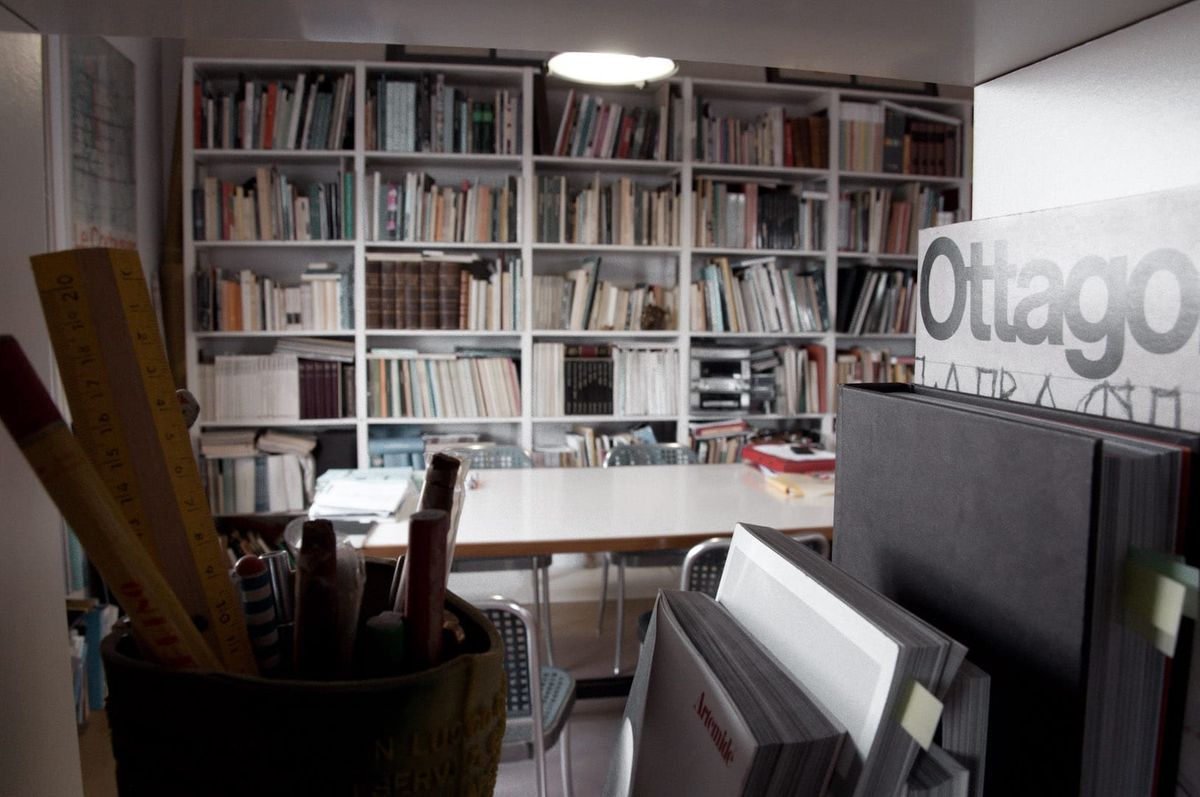
There's a strange moment in architecture school when you realise that books on architectural history are not picture books. They're textbooks. The photographs are there — few, black and white in the serious ones — but they're not the point. The point is the words, the concepts, the categories. You buy them to understand what proportion means, what system means, what language means. Not to see the buildings.
Then you go to see the buildings, and you discover the books gave you eyes.
This page is my library — not all of it: the part that matters. The books that keep coming back, the ones I still think about standing in front of a facade, the ones that built the way this blog looks at things. It isn't a shopping list: several of these live in any university library, and at the bottom of the page I tell you how to find them near you, wherever you are. Some are in English, some only in Italian — I've flagged it where it matters. Where a book stands behind a piece on this blog, the piece is linked: the book is the long version, the piece is what I did with it.
I've ordered them not by place but by question. Because that's how books work: one at a time, when the question arrives.
The handbook (how to read a building)
One book before the questions, because it's the one that taught me to ask them.
Peter Murray — L'architettura del Rinascimento italiano (Laterza; the English original, The Architecture of the Italian Renaissance, is from 1963) My copy is the Laterza paperback of 2007, bought for the modern architecture exam at university, and the one chapter that never left me is the one on Brunelleschi: the dome of Florence built without centring, the bricks laid in a herringbone that climbs in a double spiral, so that every ring holds itself up while the next one is being laid. I still use it as an example, to anyone who will listen. Murray is sixty years old, and some of his dates and attributions have been revised since; read him for the way he explains why a building is made as it is, and check the numbers against the monographs below. In English and Italian. His chapter on Caprarola is behind the palace essay, his pages on Giulio Romano behind Palazzo Te.
Why some cities live and others don't
The heart of the blog. If you've ever wondered why certain cities live for centuries while others, beautiful, stay empty, these are the books that ask the question better than anyone.
James C. Scott — Seeing Like a State (Yale University Press, 1998) A confession, before the recommendation: I've never read it cover to cover. Read in fragments, skipping, doubling back — the disordered way you read the books that really matter. And it's still the first title I'd recommend. Scott explains why grand top-down schemes to "improve" society — from Brasília to the collectivisation campaigns — almost always produce the opposite of what they promise: the planner has to simplify reality in order to read it, and in simplifying erases the fine fabric that keeps a place alive. It isn't a book about architecture: it's political science written by an anthropologist. And that's exactly why architects need it more than many architecture books — because no one inside the discipline would have the nerve to tell us these things. Some books aren't finished: they're kept company. The question it asks is the one in Sabbioneta and in Gibellina.
Jean Gottmann — La città invincibile (Franco Angeli, 1983) I have a history with this book. It was the set text for my urban geography exam, first year of university. I studied it badly, didn't understand it, got a 24 out of 30 — the mark of someone who has memorised without seeing. Then, years later, I reopened it by chance, and found inside everything I'd meanwhile learned by walking: cities live on crossroads, on flows meeting at a node. Design can welcome those flows or ignore them; it cannot create them. Gottmann — the geographer who took "megalopolis", a word the pessimists used for the swollen, dying city, and turned it into the neutral name for a new urban form — was already saying it there, in a book I wasn't ready to read at nineteen. If you find in my pieces an obsession with the where against the how, this is where it comes from. Little known, hard to find in a bookshop, easy in a library. In Italian only; in English, start from Megalopolis (1961), then The Coming of the Transactional City (1983) and Since Megalopolis (Johns Hopkins, 1990). Read the essay.
Lewis Mumford — The City in History (1961) The great overarching account, from the ancient city to the metropolis. More than six hundred pages nobody reads in full and everybody should cross at least once, even skipping. The chapter not to skip is the one on the Baroque city: the moment streets stop following life — the market, the water, the slope — and begin following the prince's gaze. When I walk Sabbioneta, or the Via Diritta at Caprarola, it's Mumford walking beside me.
Spiro Kostof — The City Shaped (Thames & Hudson, 1991) The atlas of urban patterns: the grid, the organic city, the "Grand Manner" of power. It's the most visually generous book in this section — you can just leaf through it and already learn. Kostof's central lesson could be this blog's motto: we read a form correctly only to the extent that we know the cultural conditions that generated it. Which is to say: stones don't speak on their own; you have to know who put them there, and why. In English.
Kevin Lynch — Good City Form (MIT Press, 1981) The most theoretical in the section, and the most useful to anyone who designs. Lynch tries to answer the question everyone dodges: what really makes an urban form good — net of taste and fashion? Not couch reading; it's the toolbox. In English.
James Holston — The Modernist City (University of Chicago Press, 1989) The anatomy of Brasília's failure, written by an anthropologist who lived there. His is the thought experiment I use often: take the plan of Venice and black out the buildings — you'll see the solid dominate, the squares carved out like open-air rooms. Do it with Brasília: you'll see the void dominate, the buildings floating like sculptures in an endless park. The whole problem of the modern city, in two ink blots. In English.
The dream of the perfect city
For five centuries someone has been trying to design the ideal city. For five centuries ideal cities have come out beautifully on paper and badly in life. These books tell the dream — and its stubbornness.
Hanno-Walter Kruft — Le città utopiche. La città ideale dal XV al XVIII secolo fra utopia e realtà (Laterza, 1990) The most rigorous study of the ideal city from the fifteenth to the eighteenth century, with Italy at the centre: Sforzinda, Palmanova, Sabbioneta. Here Sabbioneta is read as an attempt to translate the humanist conception of the world into architecture — which sounds like a compliment and, once you walk inside it, turns out to be a diagnosis. In Italian. Read the essay.
Helen Rosenau — The Ideal City (Routledge, 1983) The long history of the concept, from the biblical sources to the social reformers of the nineteenth century. Useful for grasping that the ideal city isn't a Renaissance invention: it's a permanent temptation of the human spirit. Every age disguises it as a new solution. In English.
The craft of saving things
Restoration is also my profession, and this is the section I care about most. People outside the field think restoring means "making new again." It's almost the opposite — and the first book here is why.
Cesare Brandi — Teoria del restauro (1963) The founding text of modern restoration, and one of the densest books you can read in under two hundred pages. I studied it hard at university, for the restoration exams, and at the time the professors seemed obsessive to me — that almost theological rigour on every word, every distinction, every principle. Then I began to work, and to deal with those whose job is to conserve: and I understood that the professors weren't obsessive. They were training us. Preparing us for the hardest part of the profession — sitting at the table with those charged with conserving, and finding the point where protecting and designing stop being adversaries. Brandi is the shared language of that table: if you don't speak it, you don't even enter the conversation. The thesis, radical and still uncomfortable: you restore the matter of the work, not its ideal image; you don't invent, you don't reconstruct a false past, and every intervention must remain recognisable and reversible. It's the reason the steel tendons in Civita's rock must stay visible. Years after university I reread it on a beach — under two hundred pages, it fits in a beach bag — and it's as an adult, with a few building sites behind you, that you truly understand it. To read slowly, underlining. Even under a beach umbrella. In Italian (an English edition, Theory of Restoration, exists). It is the book behind the three pieces on "as it was, where it was": Notre-Dame and Chartres, St Mark's Campanile and Gibellina.
Giovanni Carbonara — La reintegrazione dell'immagine (Bulzoni, 1976) and Trattato di restauro architettonico (UTET, eleven volumes, from 1996) The man who turned Brandi into a practice: the first is the short book on what you may add back to a damaged building and what you may not; the second is the shelf behind every Italian restoration site. In Italian. Behind the piece on St Mark's Campanile, together with the opposite view, Viollet-le-Duc's entry "Restauration" in the Dictionnaire raisonné (1866), where restoring means completing a building as it ought to have been.
Giovanni Attili — Civita. Senza aggettivi e senza altre specificazioni (Quodlibet, 2020) The most honest book on Civita di Bagnoregio — and on what it means to preserve a place without managing to preserve its inhabitants. Not a guidebook: an essay that holds together history, urbanism and personal memory. The chapter on Astra Zarina — the architect who devoted her life to Civita — is worth the price on its own. In Italian. Read the essay.
Power turned to stone
Renaissance architecture is rarely only beautiful. Almost always it's also an argument about power — who has it, who wants it, who has lost it. These books teach you to hear that argument beneath the decoration.
Clare Robertson — Il Gran Cardinale: Alessandro Farnese, Patron of the Arts (Yale University Press, 1992) The book on the Farnese as a political project. Before reading it, Caprarola seemed to me an extraordinary palace; afterwards, it seemed what it is — a machine of power with frescoes. Rigorous, documented, never gossipy. In English. Read the essay, and the frescoes, room by room.
Horst Bredekamp — Vicino Orsini und der heilige Wald von Bomarzo (1985; Italian edition Vicino Orsini e il Sacro Bosco di Bomarzo, Edizioni dell'Elefante, 1989) Everything has been written about Bomarzo — alchemy, esotericism, secret messages. Bredekamp is what remains once the fanciful interpretations fall away: iconography, sources, political context, and a broken man who builds the only sixteenth-century garden without an axis. Not an easy read. It's the one that holds. In German and Italian. Read the essay.
Maurizio Calvesi — Gli incantesimi di Bomarzo (Bompiani, 2000) The most accessible entry to Bomarzo among serious scholars. If Mannerism is new territory, start here and climb to Bredekamp afterwards. In Italian.
Enrico Guidoni — Il Sacro Bosco di Bomarzo nella cultura europea (Davide Ghaleb Editore, 2006) and Sabine Frommel with Andrea Alessi (eds) — Bomarzo. Il Sacro Bosco (Electa, 2009) The two volumes for going further: who actually carved the giants, and what the wood meant to the Europe of its time. In Italian.
Luke Morgan — The Monster in the Garden: The Grotesque and the Gigantic in Renaissance Landscape Design (University of Pennsylvania Press, 2016) The sixteenth-century taste for artifice, giants and monsters in gardens, from Bomarzo to the automata of Tivoli: the book that puts the two gardens of the Tuscia in the same sentence, where they belong. In English.
"Ligorio, Pirro" — Dizionario Biografico degli Italiani (Treccani, online, free) The balanced account of the antiquary who designed Villa d'Este, succeeded Michelangelo at St Peter's for a year, and invented inscriptions nobody has ever seen on a stone; next to it, the entry "Este, Ippolito d'", for the man who paid. In Italian. Read the piece on the palace.
The masters' books (read with a pencil)
Treatises and lives: the texts Renaissance architects wrote for future architects. They still read — not out of nostalgia, but because the problem they discuss (the rules: when to follow them, when to bend them) has never gone out of fashion.
Rudolf Wittkower — Architectural Principles in the Age of Humanism (1949) The book that explains the Renaissance proportional system — the invisible grid within which Alberti and Palladio moved. I bought it as a student, for the words and not the pictures (which are few and black and white), and it's the book that took me to Mantua to see Palazzo Te for myself. Without Wittkower, Mannerism can be seen but not understood.
Sebastiano Serlio — The Seven Books of Architecture The treatise that gave words to the most beautiful problem in classical architecture: rule and licence. Book IV, on the orders, is the way in — and you'll discover that seemingly pedantic questions, like the corner triglyph, were heated intellectual disputes. Giulio Romano built a whole facade on it, at Palazzo Te. Read the essay.
Giorgio Vasari — The Lives of the Artists Not to be read cover to cover: to be consulted the way you phone a cultured, gossipy friend. The right rule is to read the biography after the visit — Giulio Romano after Mantua, say — and discover that Vasari had been struck by exactly the same things that struck you, four hundred and fifty years earlier.
Manfredo Tafuri and others (eds) — Giulio Romano (Electa, 1989) The catalogue of the great Mantua exhibition: everything known about the man whose name I borrowed, drawing by drawing. In Italian. Read the essay.
Side reading (for pleasure, and for doubt)
Books that aren't architectural non-fiction and teach more about cities than many manuals.
Manuel Mujica Láinez — Bomarzo (1962) The Argentine novel that turns the life of Vicino Orsini into an epic of immortal souls and alchemy. Historically unreliable and entirely worth reading. It doesn't explain Bomarzo: it amplifies it. Read it after the visit, never before — or the wood will seem less strange than it is. In Spanish and Italian.
Jun'ichirō Tanizaki — In Praise of Shadows (1933) Forty pages on why a room needs darkness, written about Japanese houses and true of every cathedral. It is the book behind the piece on Notre-Dame, where the shadows haven't gone: they've been moved up, out of reach. In English and Italian.
The monographs (for one place, in depth)
For when, after a post, you want to go deep on a single place.
Orvieto — Luigi Fumi, Il Duomo di Orvieto e i suoi restauri (Rome, 1891): the documents of the façade, pier by pier, from the man who ran the archive. And the proceedings Il Duomo di Orvieto e le grandi cattedrali del Duecento (Turin, 1995), for the cathedral among its contemporaries. In Italian. Read the essay.
Siena — Enrico Guidoni, Il Campo di Siena (Multigrafica, Rome, 1971; first published in the Quaderni dell'Istituto di storia dell'architettura in 1966): short, dense, still unsurpassed on the political reading of the piazza. Guglielmo Villa, Siena medievale. La costruzione della città nell'età ghibellina (1200–1270) (Bonsignori, Rome, 2004), for how the city was built in its seventy great years, and the Siena volume of the Atlante storico delle città italiane (vol. 8, Bonsignori, 1986), for the plans. And D. Balestracci et al., I Bottini. Acquedotti medievali senesi (Siena, 1984): the systematic study of the underground water system almost no one knows exists — technical, and if you've walked over those tunnels, worth every page. In Italian. Read the essay.
Todi — David M. Gillerman, The Gothic Church of San Fortunato in Todi (PhD thesis, New York University, 1987): the study of one of the most beautiful questions in Umbrian architecture — why Todi chose the hall church. Not a bookshop item: it circulates as a dissertation copy, but some art-history libraries hold it; his article in the Journal of the Society of Architectural Historians (1989) is the short version. In English. Read the essay.
Caprarola — Alessandro Ricci and Carlotta Bilardi, Cartografia, arte e potere tra Riforma e Controriforma. Il Palazzo Farnese a Caprarola (Franco Cosimo Panini, 2020): the most current work on the Room of the Cosmography. Casa Farnese. Caprarola, Roma, Piacenza, Parma (Franco Maria Ricci, 1994; the history of the family by Ingeborg Walter and Roberto Zapperi), for the family in its four cities and the two palaces that mirror each other. And Umberto Liguori and Raimondo Pinna in Storia dell'Urbanistica n. 14 (2022), on the street. In Italian. Read the frescoes.
Mantua — Ugo Bazzotti, Palazzo Te a Mantova (Franco Cosimo Panini, 2012; in English, Palazzo Te: Giulio Romano's Masterwork in Mantua, Thames & Hudson, 2013): the monograph on the palace that fails on cue, with the plans and all the frescoes. Read the essay.
Villa d'Este — David R. Coffin, The Villa d'Este at Tivoli (Princeton University Press, 1960): the book that shows the frescoes and the fountains carry out one programme. Read the essays. Carmelo Occhipinti, Giardino delle Esperidi. Le tradizioni del mito e la storia di Villa d'Este a Tivoli (Rome, 2009), in Italian, for the documents. Isabella Barisi, Guida di Villa d'Este (De Luca, Rome, 2003), the one to carry. Vincenzo Pacifici, Ippolito II d'Este cardinale di Ferrara (Tivoli, 1920; reprinted 1984), the old biography, and Mary Hollingsworth, The Cardinal's Hat (Profile Books, 2004), the new one: how a Borgia prince's court actually spent its money. In English.
The Appian Way — Annarena Ambrogi and Rita Paris (eds), Il Museo della Via Appia Antica nel Mausoleo di Cecilia Metella – Castrum Caetani (L'Erma di Bretschneider, Rome, 2020): the monograph on the complex, geology, tomb, castle, the excavations of 1997–2000. Carla De Stefanis, La Via Appia sotto le mura di Roma. Esperimenti di musealizzazione nell'Ottocento e oltre (Radboud University Press, 2025), free to read online, for who made the road we see today. Fabrizio Vistoli, Saggio bibliografico sull'antica via Appia (Società Magna Grecia, Rome, 2013), the annotated bibliography. Antonio Cederna, I vandali in casa (Laterza, 1956), the book that saved the Appia from being built over, and still angry. And Piranesi, Le Antichità Romane (1756), the third volume, the tombs and the road plate by plate. The archaeology behind the two pieces of Strata. In Italian, Piranesi in Latin and images.
Where to find them
Many of these books live in a library before a bookshop — and rightly so: several are academic works you don't need to own to read once, well.
To find them anywhere in the world there's WorldCat (worldcat.org): enter the title and your postcode, and it shows you the nearest library that holds them — it works in any country, from the United States to Germany. For Italy, OPAC SBN (opac.sbn.it) does the same across the national library catalogue.
Buy a book when you find you keep coming back to it. But begin at the library: it's how these books were meant to be read — slowly, on loan, with a due date that forces you to actually read them.
This page will grow. Like real libraries do.