
Start Here
Where to begin: the first step to the side, the questions that run through the blog, the essays and letters in the order that makes sense, and the practical guides, from Rome and beyond.
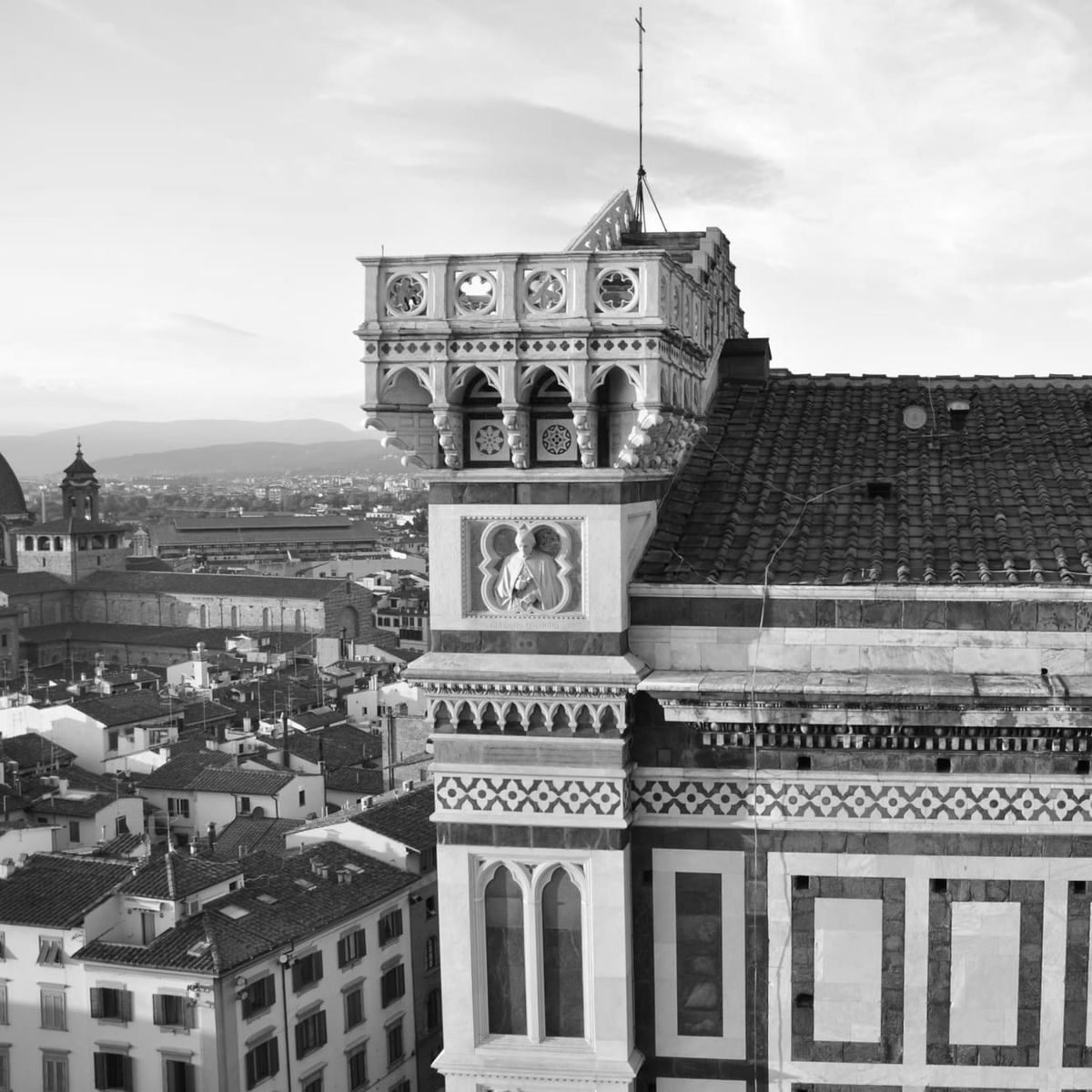
I had seen the Duomo of Orvieto four times before I ever really saw it. The fifth time, I took a step to the side, and the building changed. This blog begins there: with the idea that the places we think we know have a profile that hurry hides. All it takes is to stop one second longer.
You'll find three ways of writing here. The essays read a place slowly: how it's made, why it's made that way, what it hides. The Slow Letters are letters, and there is always a memory or an observation inside them: the part of the journey that doesn't fit in the plans. The guides are the practical side, for when you decide to go: how to get there, what to see in what order, what to skip. They often come from the same place. Not always.
The first step
If you don't know where to begin, begin where I did. Everyone photographs Orvieto's golden façade; almost nobody asks why it shines like that, or what holds it up: ORVIETO — THE CATHEDRAL THAT BECAME A LIGHTHOUSE. And then the step that made me see it: One step to the side. If you want to go, there is the guide to Orvieto.
Why some cities live and others don't
It's the question that runs through the whole blog. Civita di Bagnoregio is dying, and we keep building it bridges: CIVITA DI BAGNOREGIO — THE CITY THAT IS DYING, and the letter from when I went back with my daughter, The question of the bridge. Siena lost the wars and kept its shape: SIENA — THE CITY THAT NEVER REALLY LOST, and the day I spent checking a book against the city, The steak I can't remember. Sabbioneta is the opposite case: a perfect city, designed by one man, that life never came to fill: SABBIONETA — THE CITY TOO BIG FOR ITS LIFE, and the letter that sets it beside Brasília and Le Havre, The empty stage. And if you want to know where this obsession comes from, there's the book I studied badly at nineteen: THE INVINCIBLE CITY — THE BOOK I STUDIED BADLY. Then there is Matera, which the state emptied in 1952 as a national disgrace and which is now a World Heritage Site. In between came Pasolini, who went looking for his Jerusalem in the very place the state had emptied: MATERA — THE CAVE CITY THAT WAS A DISGRACE, THEN A WONDER. And back to Civita, this time on the side of those who kept it standing: CIVITA DI BAGNOREGIO — THE INVISIBLE ARCHITECTURE, on Astra Zarina’s restoration and the question every restoration carries with it: how far can you touch?
Thresholds
Some architecture is built to make you stop. In Todi, the portal of San Fortunato asks you for one second more: TODI — THE THRESHOLD AND THE CITY. Then there's the night when, after writing about thresholds as invitations, we locked every door: The doors we locked in Todi.
Power turned to stone
At Caprarola the Farnese turned a fortress into a palace and a whole town into a stage set: CAPRAROLA — THE PALACE THAT TURNED A WHOLE TOWN INTO A STAGE SET, and inside it the frescoes make the argument room by room: CAPRAROLA — THE FRESCOES AS A POLITICAL MANIFESTO. Vignola built a road to make the climb compulsory; I took the easy door: The climb I didn't do again. In Mantua, Giulio Romano spent ten years building an order that fails on cue: PALAZZO TE — RULE AND LICENCE. And since I sign with his name, sooner or later I had to go and settle up: The name I didn't steal.
Utopian Cities
Every so often someone has had the power to draw a whole city alone, on a blank sheet of paper. It has not always gone well. It starts with a pope who rebuilt his home village to enjoy the view: PIENZA — THE POPE WHO BUILT A CITY TO ENJOY THE VIEW. Then the kings, who ran their avenues straight to the palace, from Versailles to St Petersburg and Haussmann’s Paris: ALL ROADS LEAD TO THE KING. Then the boss, who built the houses along with the factory, from Crespi d’Adda to Pullman and Fordlândia, in the middle of the Amazon: THE COMPANY TOWN. And finally the state, from Sabaudia to Brasília and Chandigarh: THE PLAN.
Water, and a wood without an axis
A cardinal who lost six conclaves built at Tivoli a garden that is a hydraulic machine and a map of the road to Rome: VILLA D'ESTE — WATER AS A BUILDING MATERIAL. Inside the palace, the frescoes lie, the fountains play and the man who designed it all invented inscriptions: VILLA D'ESTE, THE OTHER SIDE: FRESCOES, AUTOMATA, MYSTERIES. Thirty kilometres from Caprarola, a grieving prince built the only sixteenth-century garden that refuses to explain itself: BOMARZO — THE GARDEN THAT DOESN'T EXPLAIN ITSELF, and the letter from the wood, Out of plumb.
Strata
A series on a very Italian habit: not demolishing, but building on top, inside, beside. The Appian Way runs on a lava flow, and the road we picture is younger than it looks: THE APPIAN WAY — THE ROAD ON TOP OF A VOLCANO and WHO MADE THE APPIAN WAY.
Exactly
Some questions deserve a precise answer, with measurements, dates and a drawing. How the Roman roads were made, layer by layer, and how much of it is legend: HOW WERE ROMAN ROADS BUILT?. Roman concrete, which was not stronger than ours but lasts longer: how it was made, in HOW WAS ROMAN CONCRETE MADE?, and why it is still there, in WHY DOES ROMAN CONCRETE LAST?. The Colosseum, missing more than half of its outer ring: who took it apart, stone by stone, in WHAT HAPPENED TO THE COLOSSEUM?, and who stopped the fall, with two opposite ideas of restoration, in WHO RESTORED THE COLOSSEUM?. And Venice, standing on ground nobody ever sees: HOW IS VENICE BUILT ON WATER?.
As it was, where it was
Three pieces on what we rebuild, and when. Notre-Dame after the fire, with its shadows moved out of reach, against Chartres, where daylight still works: THE CATHEDRAL WITHOUT SHADOWS. St Mark's Campanile, rebuilt in 1912, and why "as it was" is never a return to the origin: AS IT WAS — BUT WHEN?. And the one place in Italy where "as it was, where it was" was refused on both counts: WHERE IT WASN'T, AS IT WASN'T.
The guides
The practical guides, free for everyone, with hours, tickets, the order of the day and what to skip: when reading turns into going. From Rome: Orvieto, Civita di Bagnoregio, Villa Farnese at Caprarola, the Monster Park of Bomarzo, Tivoli, Villa d'Este and Hadrian's Villa. Without even leaving Rome, the Appian Way, on foot and by bike. Further out, towards the sea, the Etruscans of Tarquinia, Cerveteri and Tuscania. With a night away, Umbria, halfway between Rome and Florence: Assisi; Perugia, which you climb from below, through the pope’s fortress; Todi; Montefalco and Bevagna. Or Tuscany: the Val d’Orcia by car; Siena, a city you understand with your feet, along its three ridges; and Florence on foot, twice: after the Medici, and along the façades of its churches. Further north, Mantua and Sabbioneta, the Gonzaga court and Vespasiano Gonzaga’s ideal city. And for Venice there is the Biennale, twice: the essay, which asks whether it is worth going in, and the guide, for when the answer is yes.
The first five, as a PDF to carry on the day, are in the free guide. All the day trips from Rome, nearest first, with the map and the times by train and by car, are on one page.
The books
Behind every piece there are books. The Slow Library is the library behind the blog, ordered by question, not by place.
The Slow Letter
If this is your kind of slow, the letters also come by email, every other Friday: one place, one detail, one question. Subscribe here. And if you want to know who's behind all this, it's in the About page.