CAPRAROLA — THE FRESCOES AS A POLITICAL MANIFESTO
Read in order, the rooms of Caprarola stop being decoration and become an argument: from the Farnese lands to the map of the world, from the cardinal's family history to a room where a whisper crosses the corners.
In the main post I didn't show the frescoes of Caprarola. Not by oversight.
I left them out because they deserve a space of their own — and because the strategy of Alessandro Farnese, the Gran Cardinale, which is the most interesting thing about the entire palace, can only be understood by reading the rooms one by one, as rooms of an argument rather than of a palace.
What follows is that argument — or at least the way I read it.
Who Designed the Rooms
Before the painters, before the frescoes, before any brushstroke, there were the humanists.
The iconographic programme of Caprarola was devised by some of the most distinguished intellectuals of the period in the cardinal's service. Annibal Caro — poet, translator of the Aeneid, trusted man of the Farnese for decades. Fulvio Orsini — the cardinal's librarian, one of the greatest antiquarians of the sixteenth century, collector of coins, gems, manuscripts. Onofrio Panvinio — ecclesiastical historian, author of fundamental works on the history of the popes. After Panvinio's death in 1568, Cardinal Guglielmo Sirleto took over the programme of the winter rooms.
These were not decorators. They were among the finest minds in Italy, and their task was to construct an argument. Room by room, ceiling by ceiling, the palace of Caprarola had to demonstrate something: that Alessandro Farnese was the legitimate heir to a tradition of greatness — religious, political, cultural, cosmic.
The painters were the instrument — first Taddeo Zuccari, then his brother Federico, then Jacopo Bertoja. The humanists were the thought.
Entering the Argument
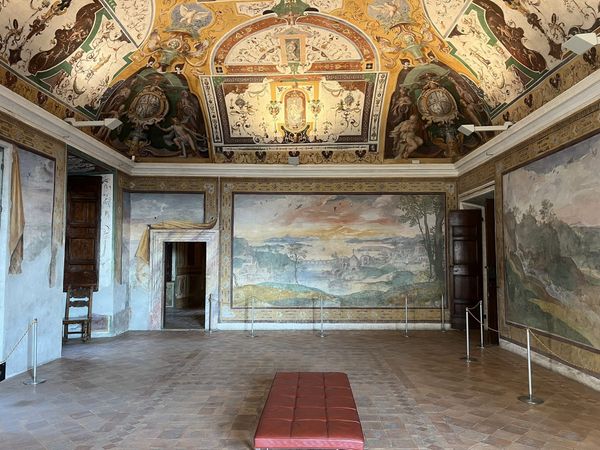
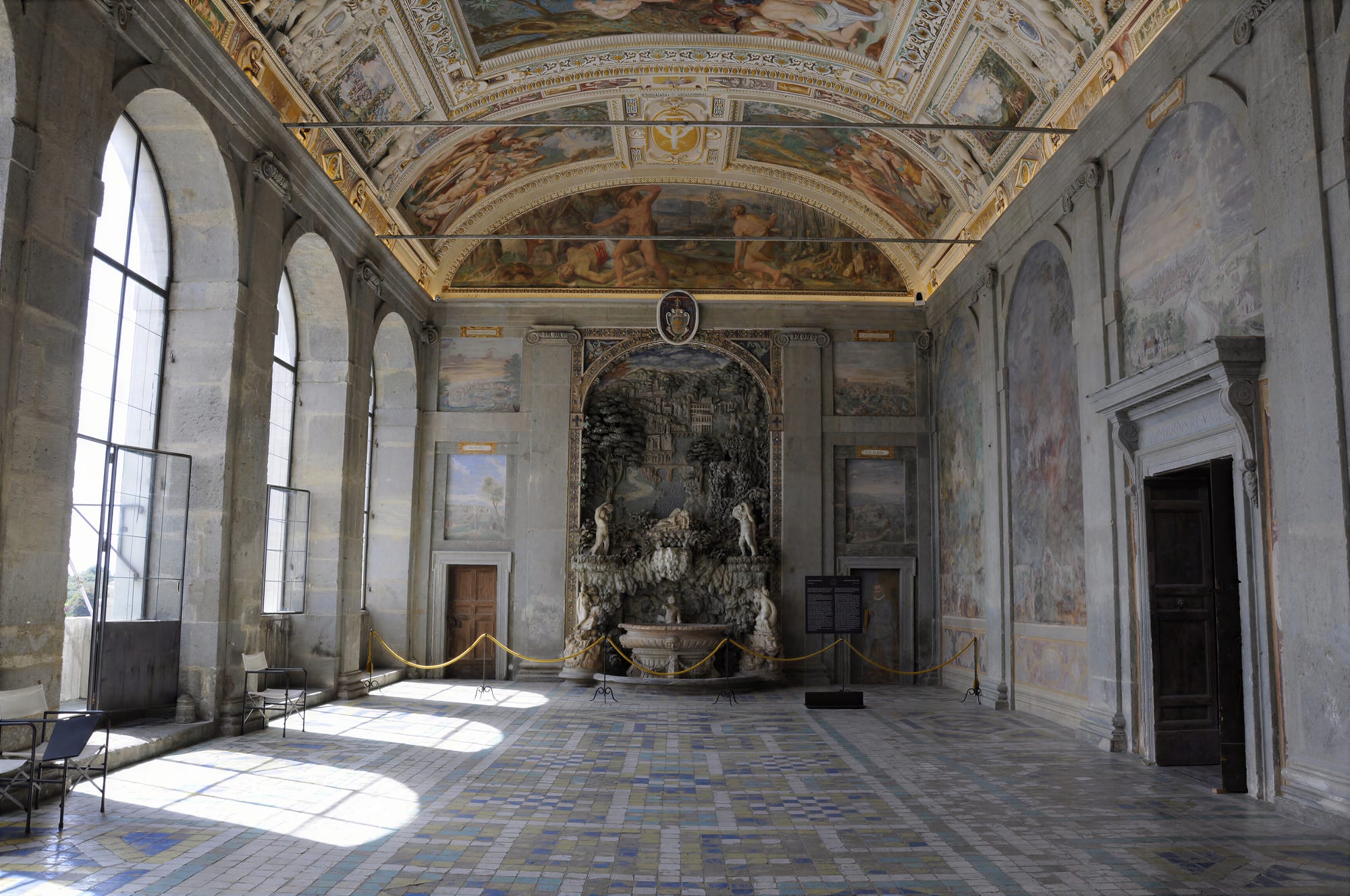
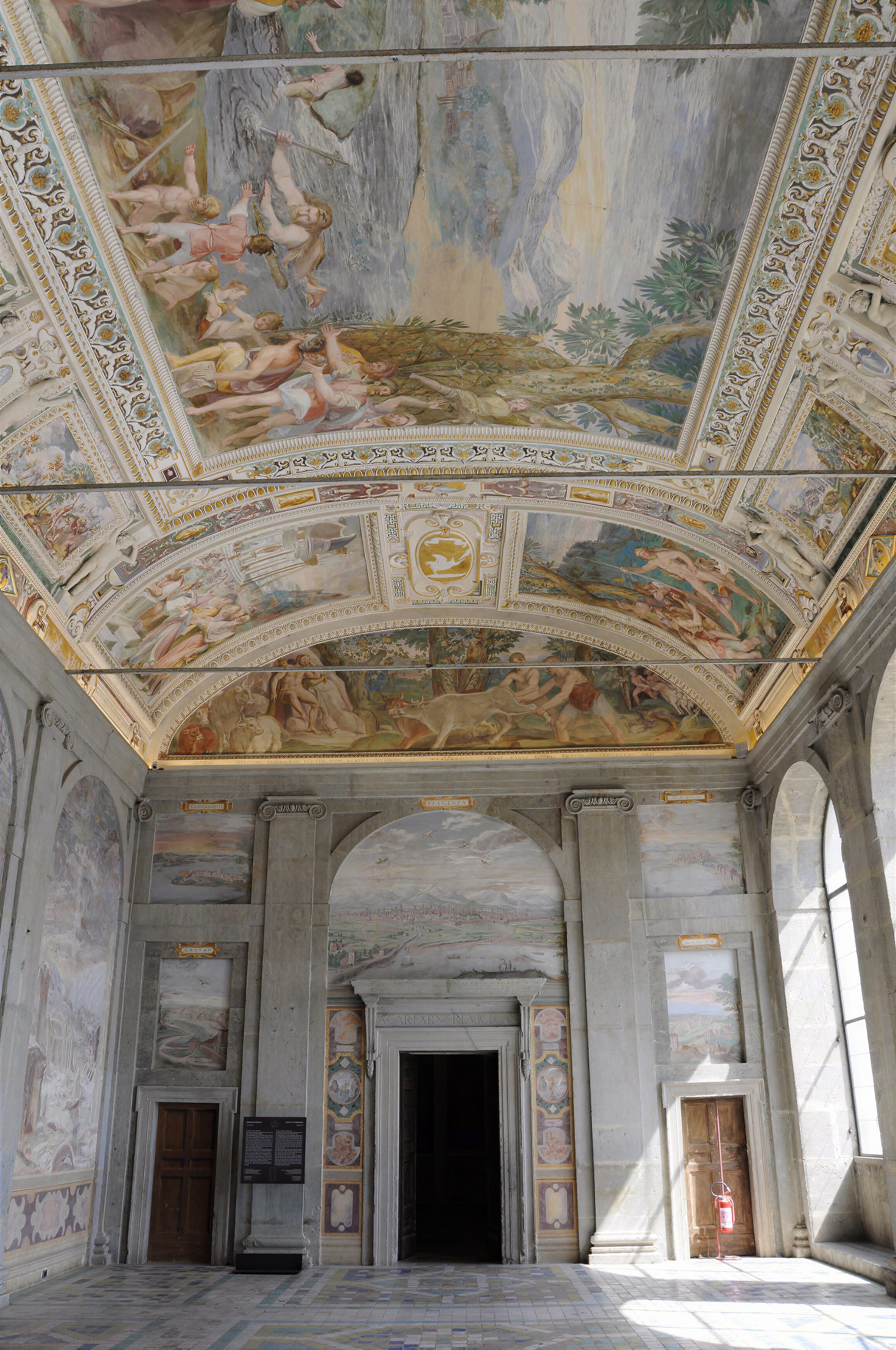
The first thing you notice climbing the Scala Regia is that the palace doesn't wait for you. There is no neutral room to prepare you. The Sala di Ercole, a great loggia open to the light, receives you already inside the programme. On the walls, in ten views, the territorial holdings of the Farnese: the Duchies of Parma and Piacenza, the fiefs of the Tuscia. Real cities, real places — begun under Federico Zuccari and finished by Bertoja after Zuccari had left the building site. These are not poetic visions. They are property maps. And on the vault Hercules founds the lake of Vico, a few kilometres from here — Hercules, the founder of lineages, the protector of borders, the force that turns territory into dominion, and in this room a transparent mask for the cardinal himself. Before you have understood where you are, you have been shown what he owns. It is not arrogance — it is communicative strategy. Anyone entering that palace was already a political interlocutor. The calling card comes before the drawing room.
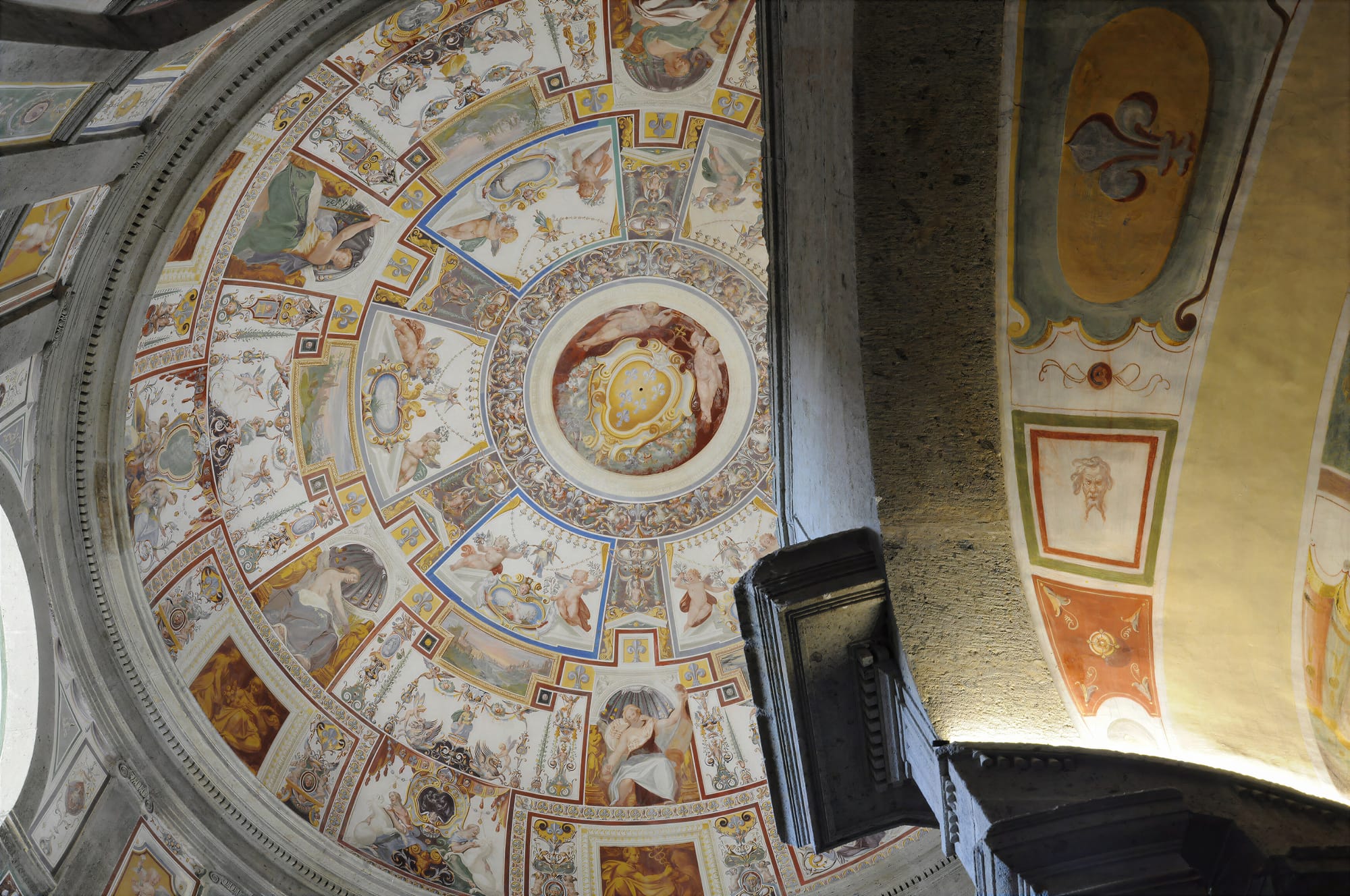
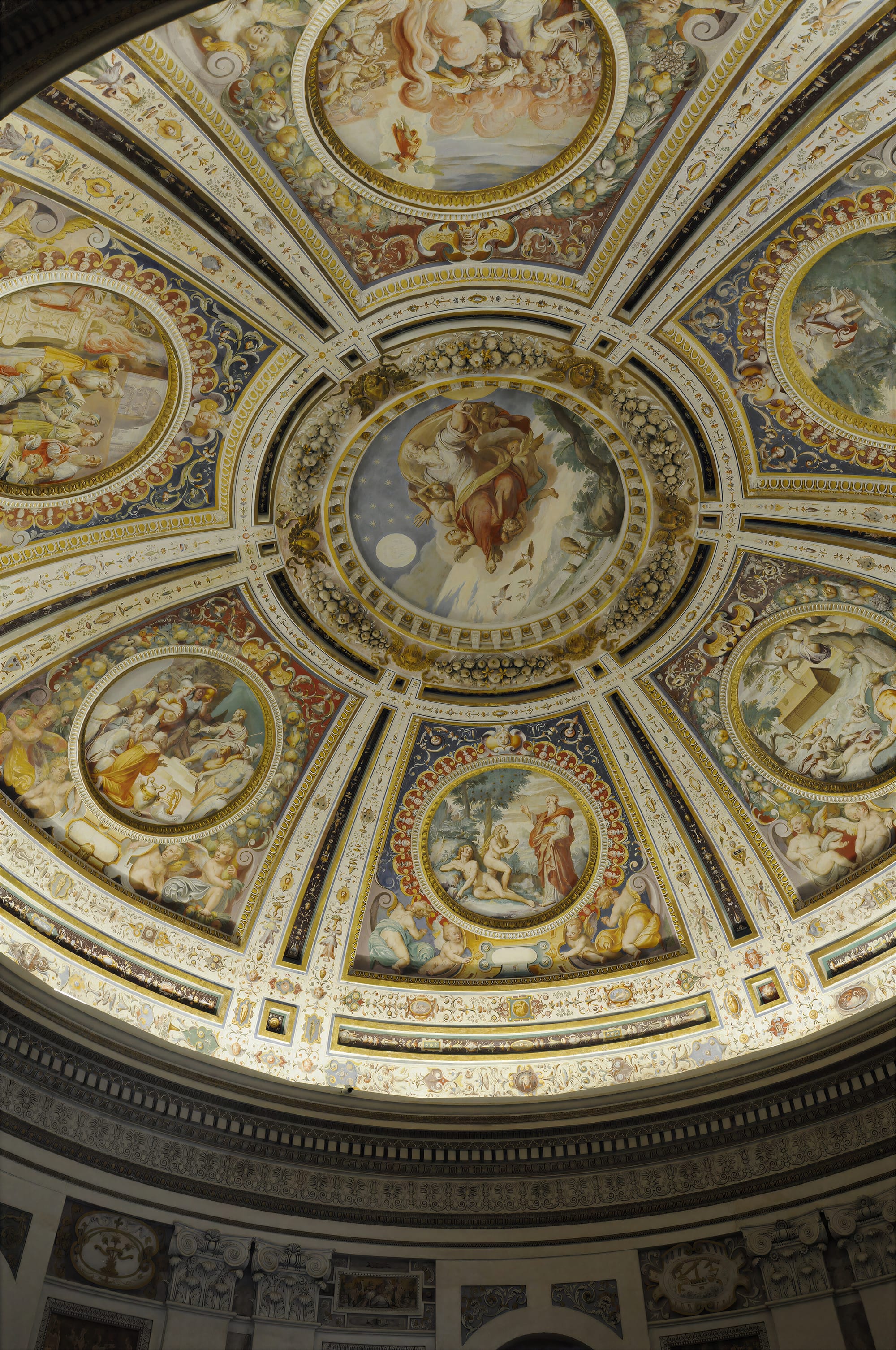
The private Chapel, perfectly circular, closes the circle literally. The circle in the Renaissance was a symbol of divine perfection — and the cardinal has his chapel in the most perfect space of the palace. Not out of humility. To declare that his relationship with God is direct, personal, and requires no intermediaries.
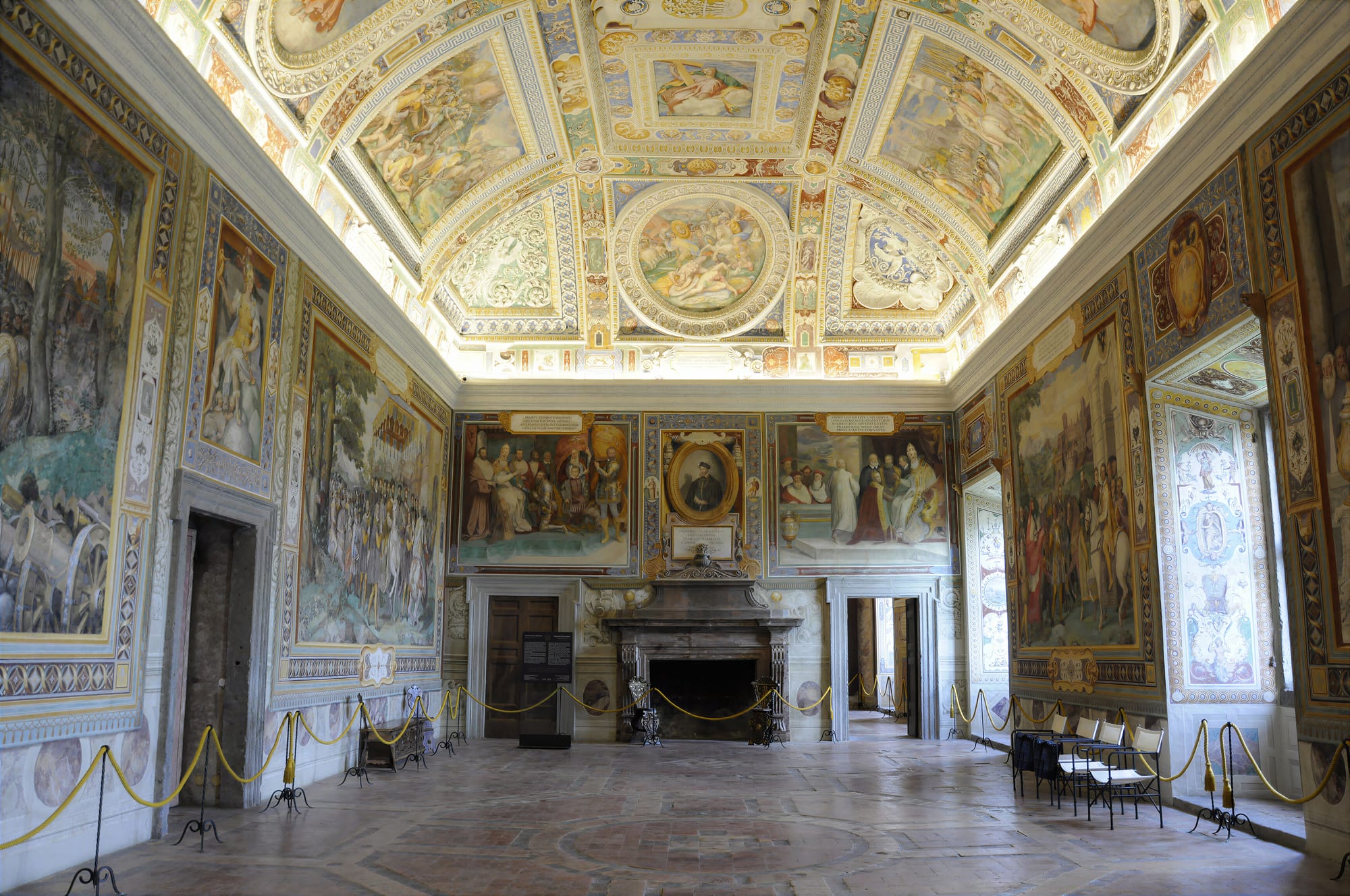
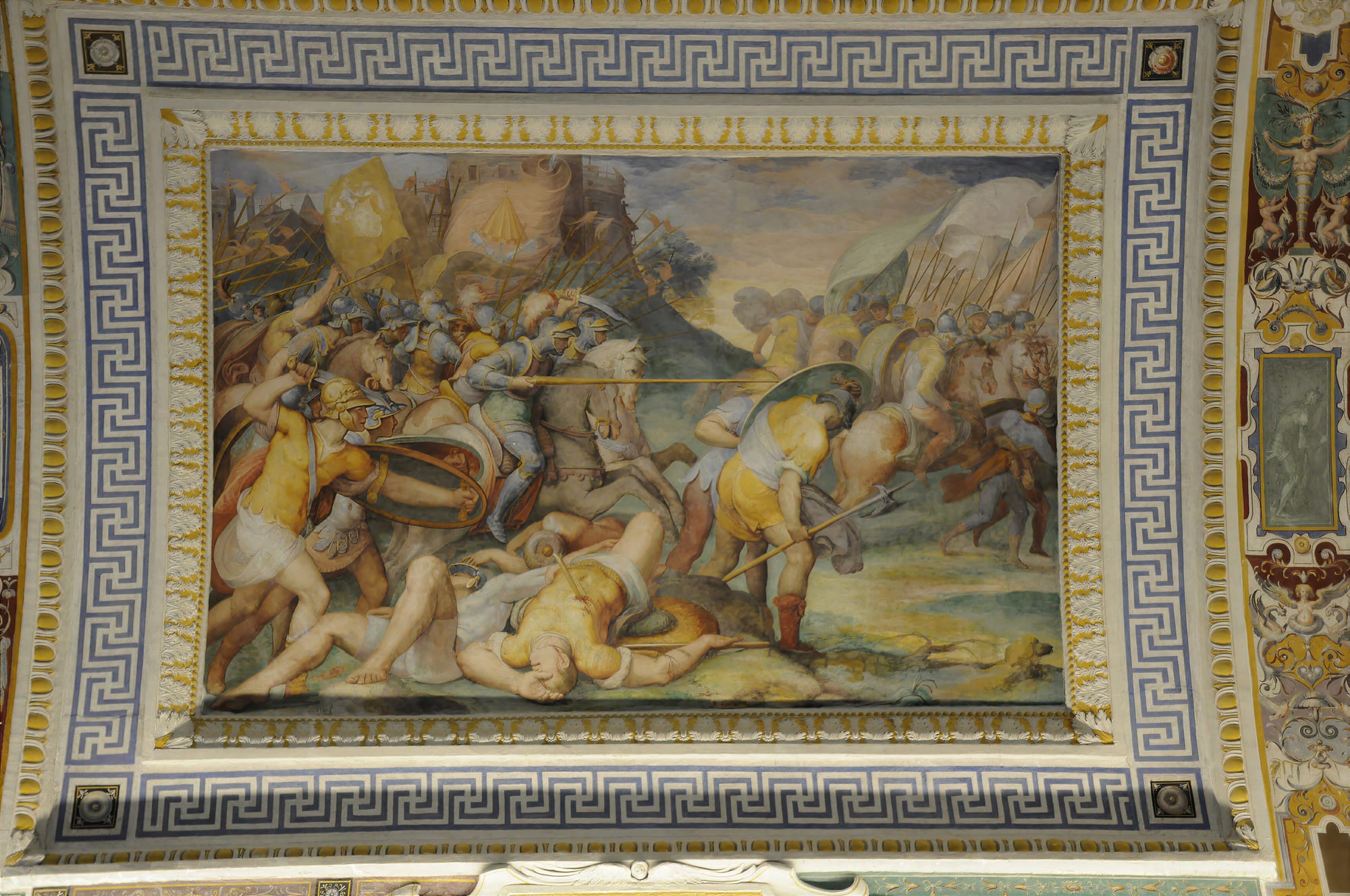
Then the Sala dei Fasti Farnesiani, and it's worth pausing to understand why it is the most brazen room in the palace. Taddeo Zuccari painted here the family's history as if it were the history of Christendom: Pier Luigi Farnese made captain of the Church, Farnese marriages into the royal houses of Europe, Parma returned to the family by a pope.
And in the next room, the Anticamera del Concilio, the claim becomes explicit: Paul III — Alessandro's grandfather — opening the Council of Trent; Paul III excommunicating Henry VIII of England. The Farnese not as patrons of private decoration, but as protagonists of the history of the universal Church. It is arrogance dressed as devotion. It is the claim that the greatness of a family coincides with the greatness of an institution. This is not nostalgia. It is identity as the foundation of power.
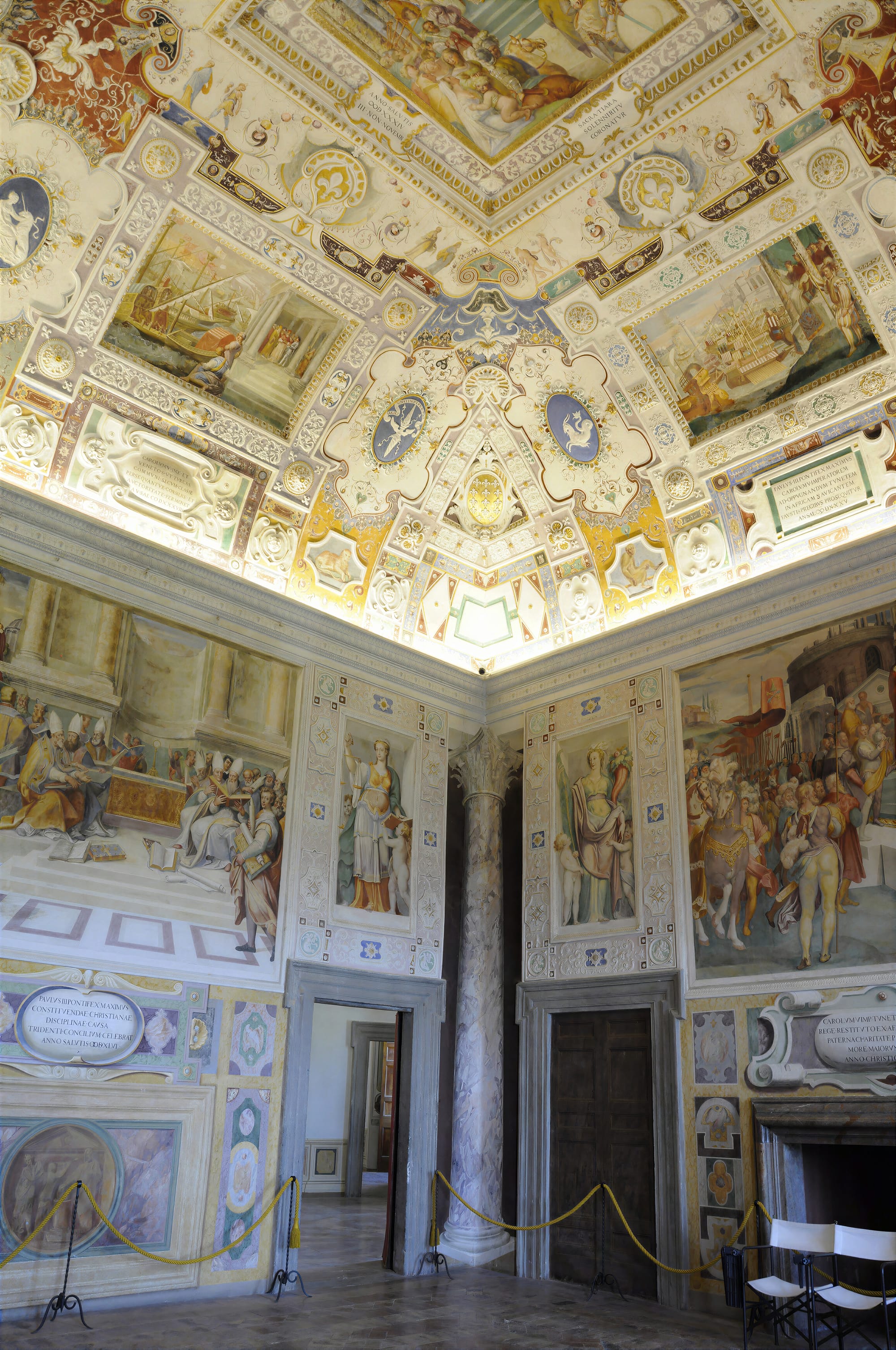
The Map Room: The World as It Was Believed To Be
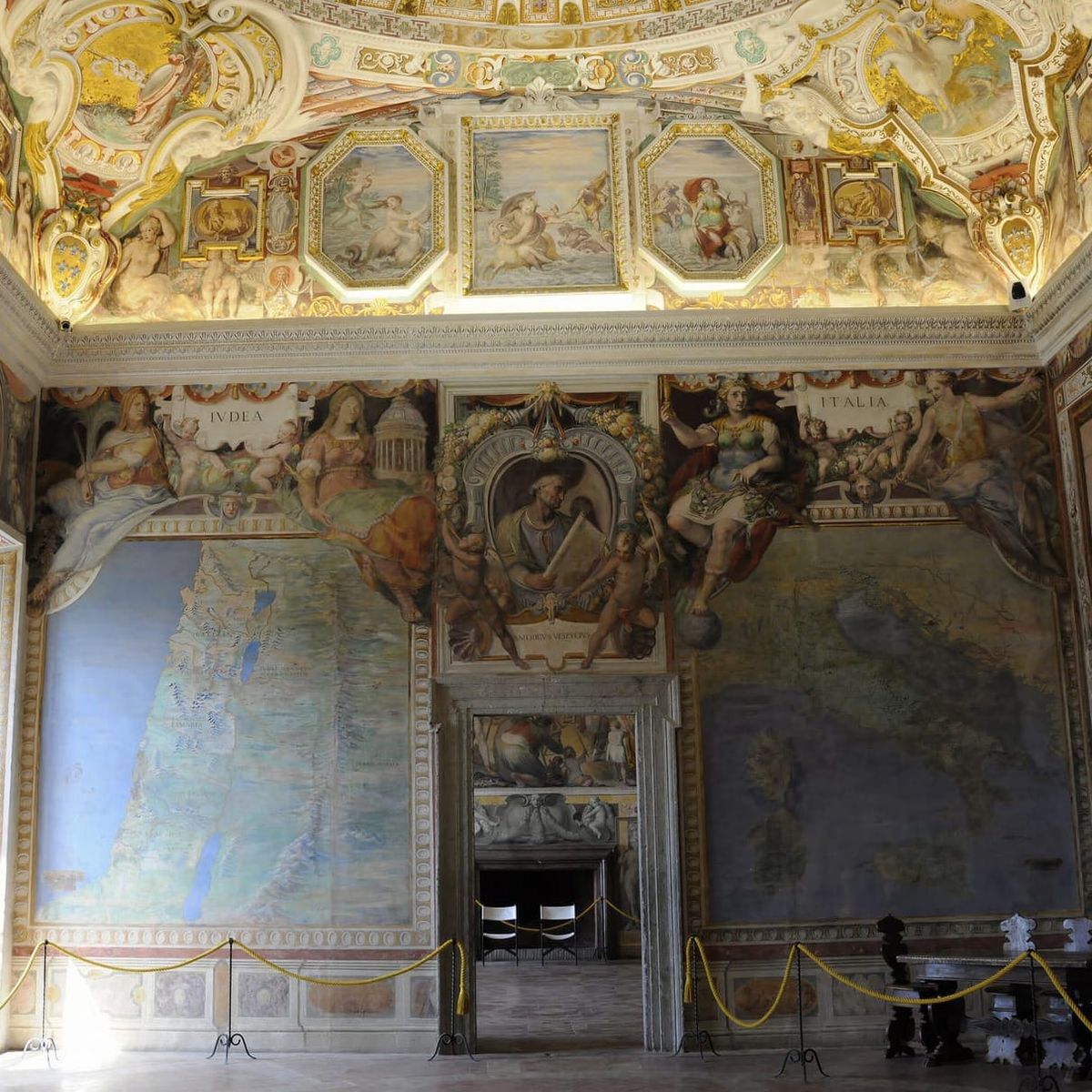
The most extraordinary and most discussed room in the palace is the Sala del Mappamondo, executed between the end of 1573 and 1575.
The programme was the work of Orazio Trigini de' Marii, a cosmography scholar presented to the cardinal by Fulvio Orsini; the maps were most probably painted by Giovanni Antonio da Varese, known as il Vanosino, a specialist in geographic decoration. Art historians still disagree on how much was his: some see him as an executor of others' ideas, others credit him with genuine cartographic competence.
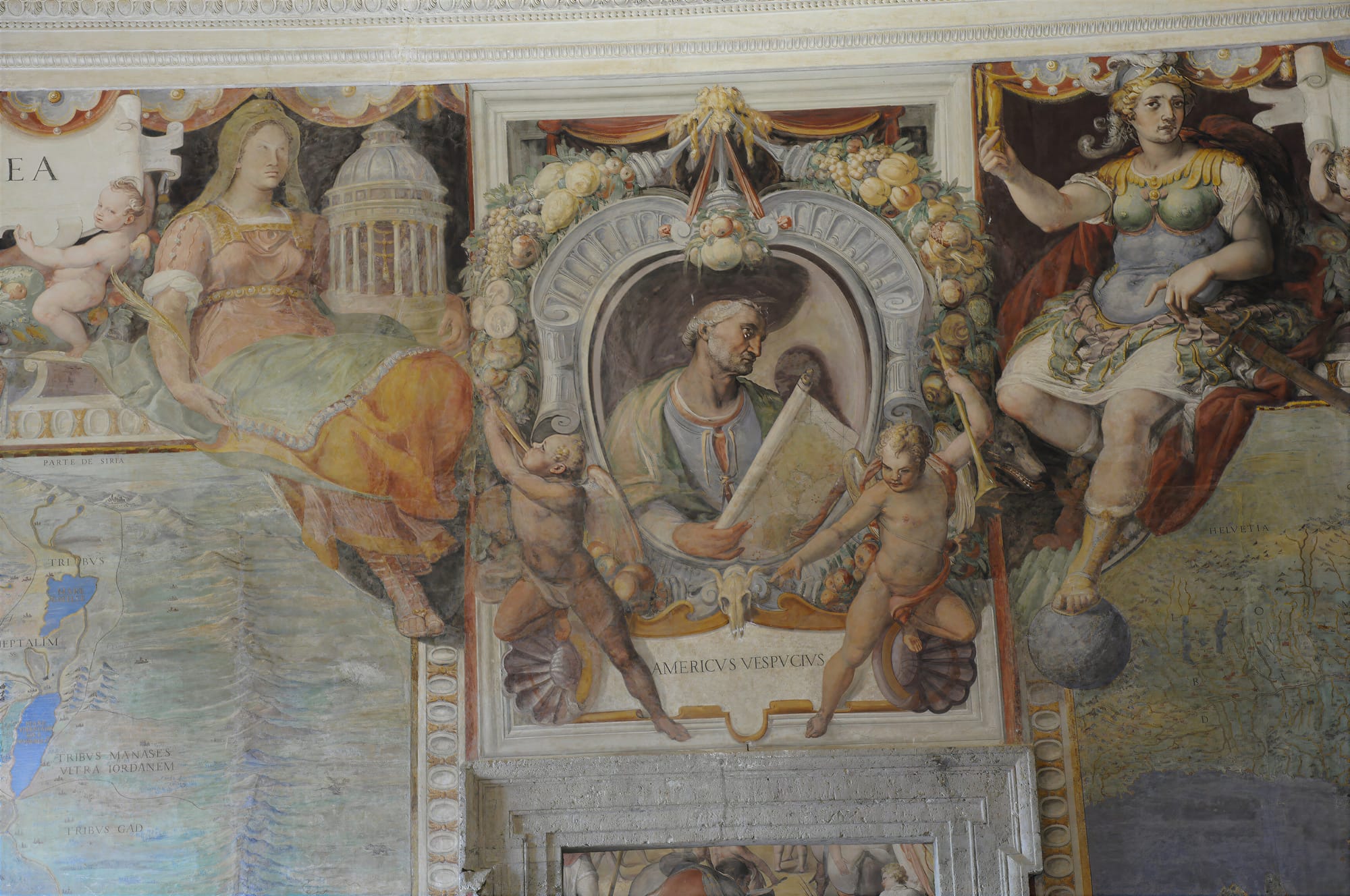
On the vault: the sky, with some fifty constellations and the signs of the zodiac. On the walls: the world — or rather, the world as 1575 believed it to be. A planisphere, the four known continents, the Holy Land, Italy.
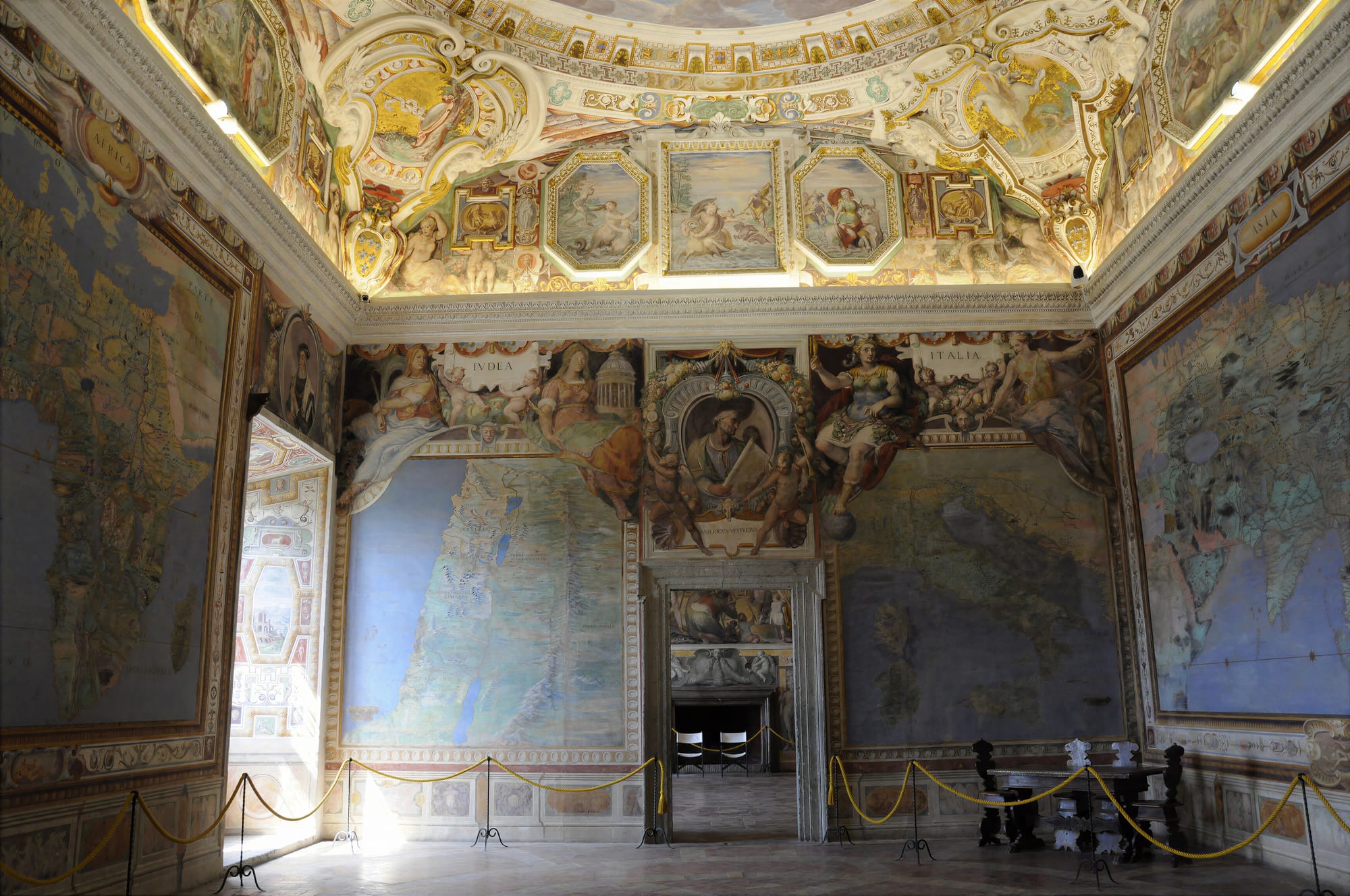
Look closely and the world doesn't add up. Australia isn't there: no European would sight it until 1606. Instead, along the whole bottom of the planisphere, beyond the Antarctic circle, stretches a vast continent that doesn't exist — the Terra Australis that sixteenth-century geographers imagined in order to balance the land of the northern hemisphere, for reasons of cosmic equilibrium rather than observation. And at the top, where the charts ran out, the painter wrote it plainly: MARE INCOGNITO, unknown sea. The world painted at Caprarola is not the real world. It is the world as the sixteenth century reasoned it must be — honest about where its knowledge stopped, and wrong exactly where it reasoned instead of looking. Those two words at the top are not an admission of ignorance. They are a method: I know this far. The rest is hypothesis.
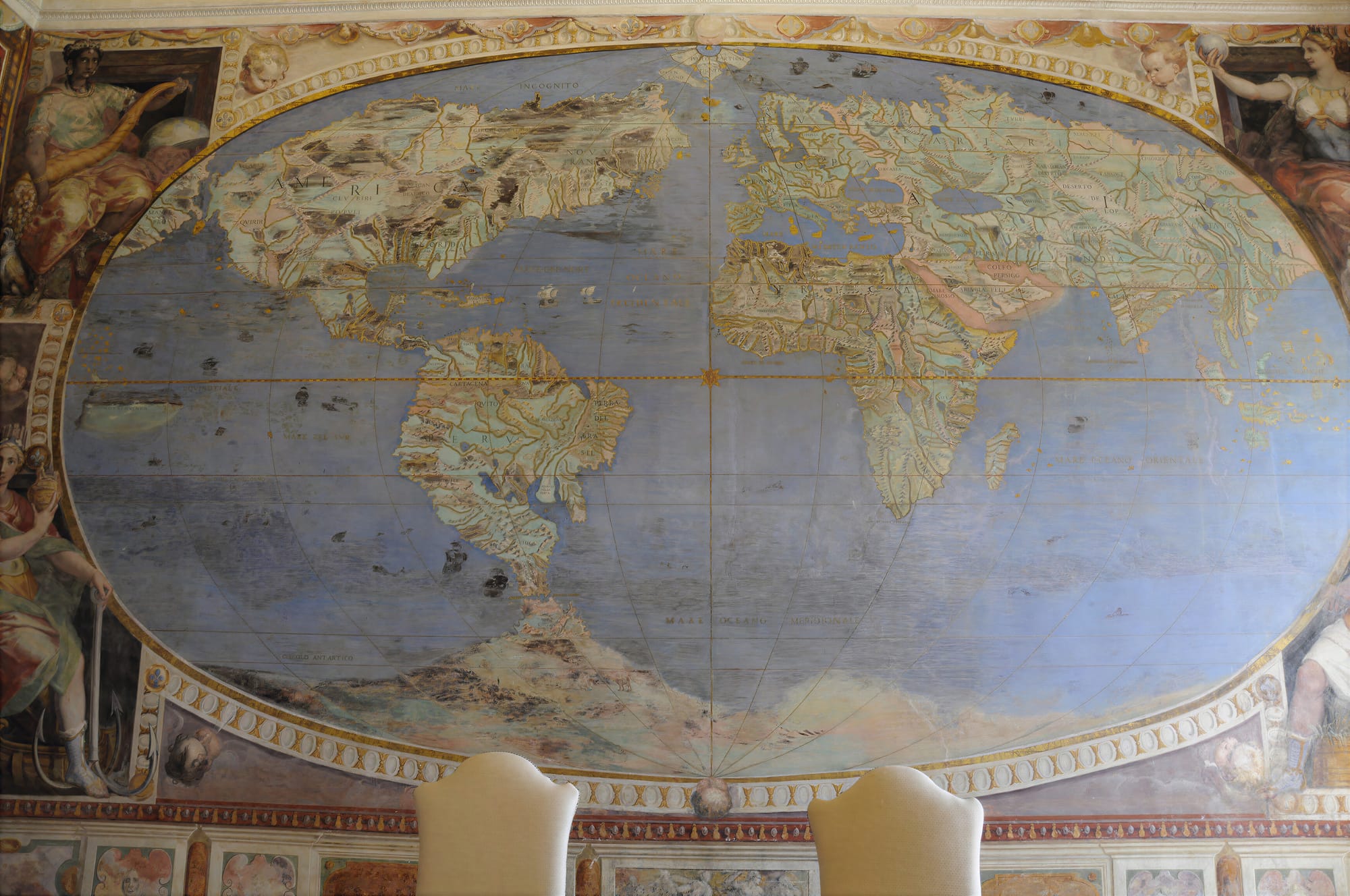
And it worked. In 1578 Pope Gregory XIII dined in this room. Two years later he ordered a gallery of maps painted in the Vatican — the Galleria delle Carte Geografiche that millions of people walk through today on their way to the Sistine Chapel, most of them without knowing that the idea came from a cardinal's palace in the Tuscia. Whoever wants to dominate the world must first be seen to know it. The Map Room is not decoration — it is a declaration of cosmic dominion, and the pope understood it.
The Cabinet of the Hermatena
Near the Torrione, at the tip of the pentagon, lies the most enigmatic room of all.
The Gabinetto dell'Ermatena — Federico Zuccari, 1566 — was probably the studiolo of Fulvio Orsini, the cardinal's librarian: the place where the man who thought up half of these rooms sat with his books.
The Hermatena is the fusion of Hermes and Minerva — the god of eloquence and communication with the goddess of wisdom — painted here as a single body. The idea is ancient: Cicero had asked his friend Atticus for a Hermathena to stand in the "Academy" of his villa at Tusculum, the place where he read and talked philosophy. Ficino, Pico della Mirandola, the Medicean circle had brought that pagan-Christian syncretism back to the centre of Renaissance culture. At Caprarola it enters not the chapel, not the reception hall, but a study. The most intimate kind of room — the one where you are alone with your books.
The message is clear to those who can read it: real power is not the territorial kind of the Hercules views, nor the ecclesiastical kind of the Fasti. It is intellectual — the capacity to hold together ancient and Christian wisdom, the visible world and the invisible one.
The Winter Apartment: After Zuccari
The break was not painless. Federico Zuccari left the building site in 1569 after clashing with the cardinal's entourage. He was not a man who swallowed slights: twelve years later, in Rome, over a different quarrel — an altarpiece rejected by a papal official in Bologna — he publicly exhibited the Porta Virtutis, a huge satirical cartoon with his opponent as Midas, donkey ears and all. It cost him two years of exile.
In his place came Jacopo Zanguidi, known as Bertoja. And the iconographic programme of the winter rooms, now in the hands of Cardinal Sirleto, changed register.
The Stanza della Penitenza opens the winter sequence with the Cross of Christ on the vault, crowned with thorns, under a Greek motto taken from the church historian Sozomen; on the walls, the hermit saints of the desert. What the room was for, no one knows for sure. Some scholars have thought it a dining room, others a studiolo or a space for prayer. If it was a dining room, the Cross presided over the cardinal's table — and the mixture of sacred and everyday would not be incongruous: for a prince of the Church there was no clear separation between the private and the sacred. Everything was representation.
The Stanza dei Giudizi has the Judgement of Solomon on the vault: Solomon as the model judge, wisdom as the guarantee of justice. Opening onto the gardens, it was probably a room for audiences — the place where petitions were heard. This is not humility. It is legitimation. Decisions taken under that vault participate in a divine order: whoever contests them contests not a man, but providence.
The Stanza dei Sogni speaks of dreams and visions. Its name invites you to imagine a bedroom; the sources say less than the name does. Perhaps that suits it.
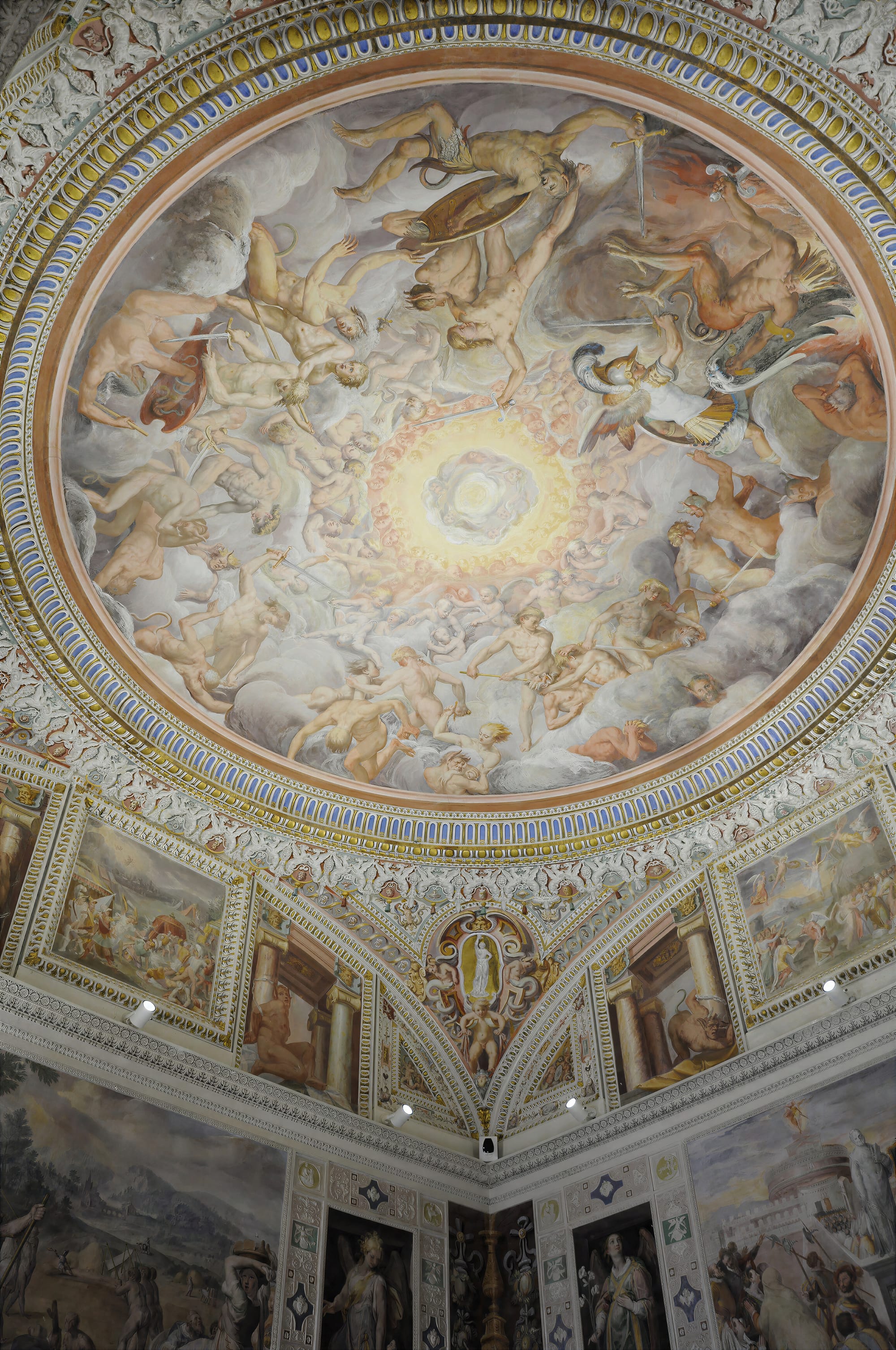
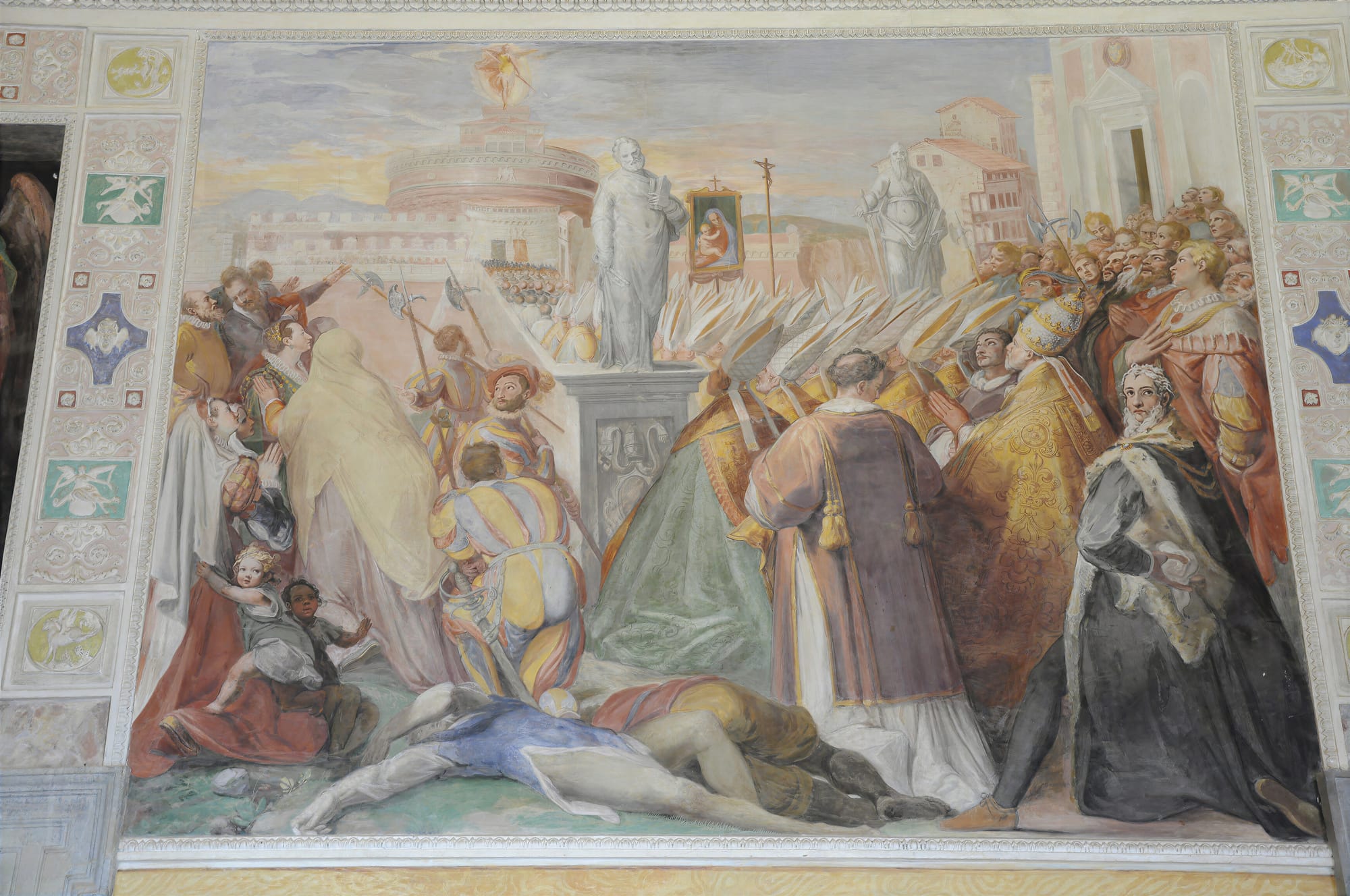
And then there is the Stanza degli Angeli.
On the vault, painted by Bertoja between 1572 and 1575, the rebel angels fall, cast down by Saint Michael; somewhere among them Bertoja painted himself, with donkey ears. And the room has a secret: stand in one corner and whisper, and the words arrive, perfectly audible, in the opposite one. Local tradition says Alessandro Farnese knew it and used it — that the room of the angels was also the room of the spies. No document confirms it. But the image is hard to forget: the fall of the rebels on the vault, and beneath it, perhaps, a cardinal listening. Theology and surveillance in the same space. If it isn't true, it is the Renaissance in a room all the same.
The Complete Argument
Re-reading the journey in the order I've proposed, the structure emerges with an almost brutal clarity.
It begins with physical power — territory, family, the history of the Church as family history. Then moves to knowledge — the world map, the cosmos, the world as known. Then to the more reserved intellectual power — the Hermatena in the private studiolo, the synthesis of pagan and Christian wisdom. Finally to the apparently intimate sphere — penitence, judgement, dream, and an echo in the corners.
From outside to inside, from public to private, from visible power to invisible power. And each layer more sophisticated than the one before — as if Alessandro Farnese had wanted whoever entered to understand, room by room, that there was always something more, always a further level.
This is not decoration. Few buildings in Italy say so completely what Renaissance power was, and how it wanted to be seen.
The next time you are at Caprarola, climb the staircase, enter the Sala di Ercole and stop. Don't look at the details — look at the sequence. Understand where you are going, and where you are being taken. Then enter each room knowing that someone, more than four centuries ago, decided with great care what you should be thinking at exactly that point, in that light.
Practical Notes and Further Reading
Photography rules inside the palace have changed over the years: ask at the ticket desk. For the frescoes room by room, the site of the licensed Viterbo guides, palazzofarnese.artinvistaguideviterbo.com, is not beautiful but is exhaustive and accurate — use it as a reference before or after the visit, not as reading.
Clare Robertson's Il Gran Cardinale: Alessandro Farnese, Patron of the Arts (Yale University Press, 1992) remains the essential English-language study of the cardinal as patron — rigorous on the humanists behind the rooms and on the political logic of the whole.
Alessandro Ricci and Carlotta Bilardi's Cartografia, arte e potere tra Riforma e Controriforma. Il Palazzo Farnese a Caprarola (Franco Cosimo Panini, 2020) is the most up-to-date scholarly treatment of the Map Room — useful if the Vanosino and the road from Caprarola to the Vatican gallery left you wanting more.
Both are in The Slow Library.