SIENA — THE CITY THAT NEVER REALLY LOST
Tuscany's second city, they say — as if that were a ranking that mattered. Siena lost the wars, kept the shape, and built an invisible river to stay alive. Walk it and it doesn't feel like a place that lost anything.
Ever gone back through old photographs and realised you didn't take the picture you needed?
This piece comes from a trip I made some time ago, before this blog existed and before I was photographing with anything in mind beyond being there. So the archive has gaps. There is no shot of the Hermes panel on the cathedral floor, because I don't think I understood at the time that it mattered. There is no bottino, because I never went down. Where the gap was too big to leave open, I've used images from Wikimedia Commons, credited at the foot of the page. Everything else is mine, and some of it is not very good.
I'm telling you this at the top rather than burying it at the bottom, because the whole argument of this blog is that you should look properly at what's in front of you, and I'm about to make that argument using photographs somebody else took. Fair is fair.
Tuscany, central Italy. The region's second city, they say. As if that were a ranking that mattered. Siena lost to Florence in 1555. Or that's the official version. Walk through the city and it doesn't feel like a place that lost anything.
How a City Is Built — The Three Hills and the Valley
Siena is built on three hills. This is not a geographical description — it is the key to understanding everything that follows.
The three heights — the Civita and Castelvecchio to the west, San Martino to the south-east, and Camollia to the north — were originally separate settlements, each with its own defensive logic, its own churches, its own dominant families. The city as we know it today is the result of their progressive fusion — a process that lasted from the early Middle Ages through the thirteenth century, and that left traces readable in the urban fabric, if you know what to look for.
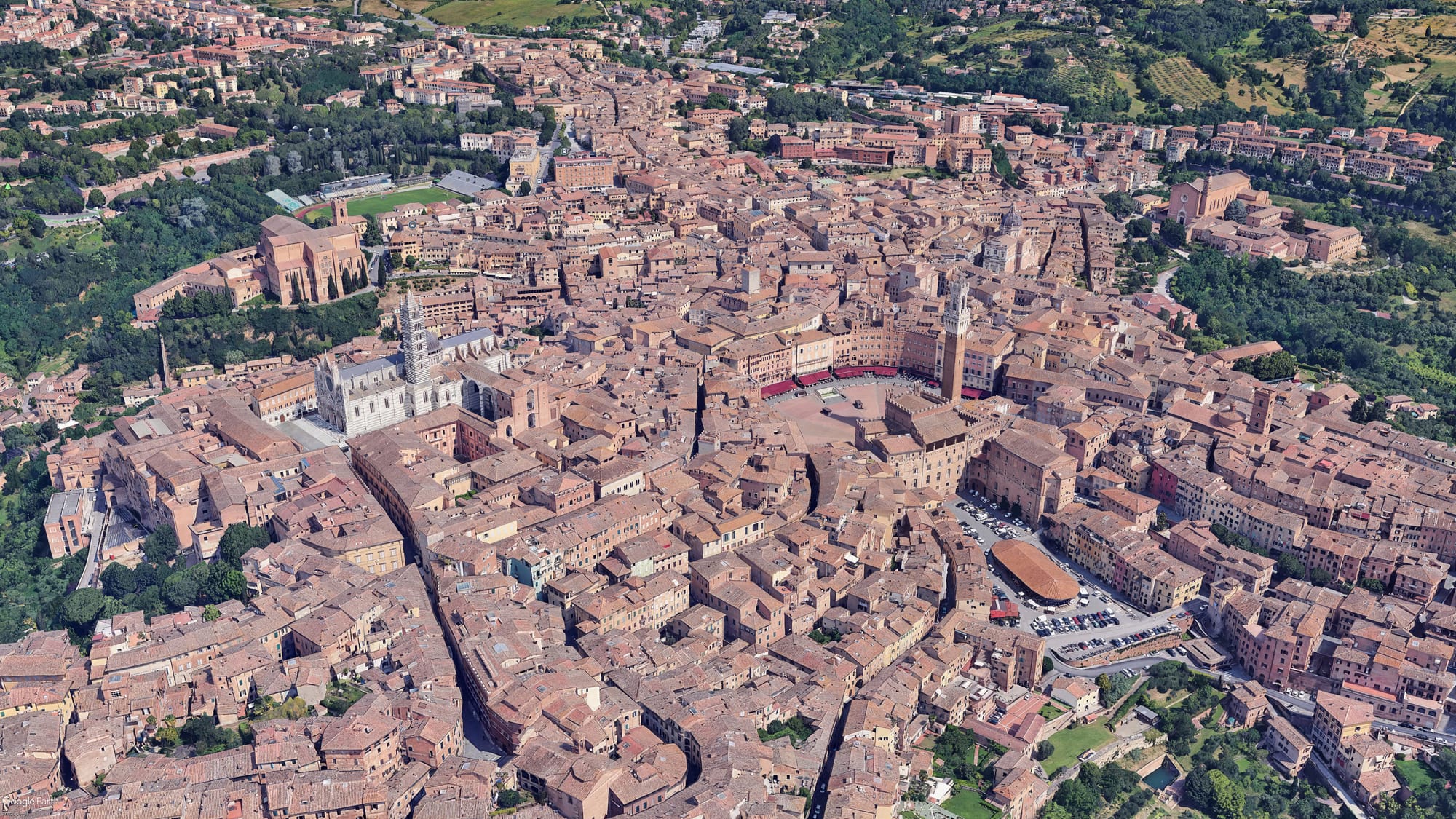
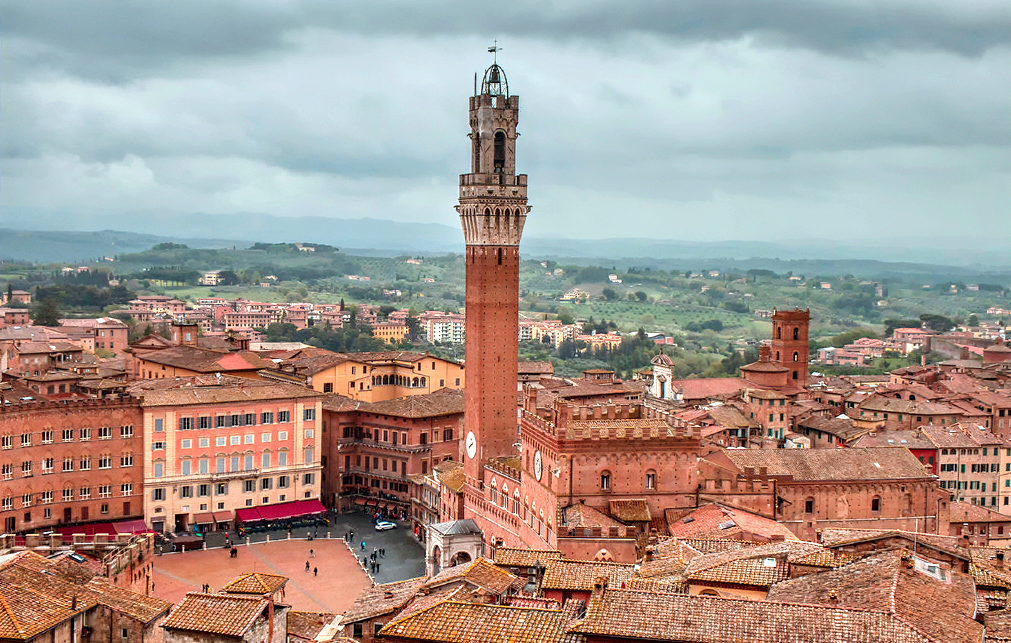
The point of junction of the three hills is a low valley, naturally concave. That is where the Campo stands. Not as an aesthetic invention — as an urbanistic necessity. It was the neutral meeting point of the three original settlements, the place where the three road systems converged naturally. The shape of the piazza is not a design idea. It is the shape of the ground beneath it.
The three main streets of Siena — Banchi di Sopra, Via di Città, Banchi di Sotto — are not ordinary streets. They are the ridgelines of the three original hills, crest paths that existed before the city and that the city absorbed as the axes of its fabric. When you walk along Banchi di Sopra you are walking along the ridge of the Camollia hill. Via di Città follows the ridge of the southwestern hill (the Civita), while Banchi di Sotto runs along the hill of San Martino. When you descend toward the Campo from any of these axes, you are descending toward the confluence of the three systems.
The lateral streets — the vicoli, the costarelle — follow the natural topography of the slopes. They are not perpendicular to the main axes by whim: every curve in a Sienese street is a contour line dressed as urbanism. The medieval city does not fight the territory — it follows it.
This organic quality is what makes Siena unreadable on a map but perfectly sensible on foot. You don't understand it by looking at a plan. You understand it by walking and paying attention to where the street rises and where it falls, where it widens and where it narrows, where a view suddenly opens and where a palazzo closes it. The topography is Siena's urban plan. Everything else is execution.
The Campo as a Political Act
Before it was one of the most beautiful squares in the world, the Campo was an act of defiance.
In the twelfth century, Siena's civic government chose this valley as a place of assembly and civic representation — as an explicit alternative to the Piazza del Duomo, seat of religious power. This is not a geographical preference. It is a declaration.
After the fall of the aristocratic government of the Twenty-Four, the idea emerges of a space independent of both ecclesiastical and noble power. The Campo is the urbanistic response to a political revolution: the commune wants a space that belongs neither to the Church nor to the great families. It belongs to the city.
And it is planned before it is built. In 1297 the commune issues specific regulations to standardise the facades, spaces and architectural profiles of all buildings facing the piazza — before those buildings exist. It is among the earliest examples in Europe of preventive urban planning — and it did not come from nowhere: Siena had already written urban form and civic beauty into its statutes in 1262. The city decides in advance what it should look like; it does not wait for it to grow disorderly. The civic statute — the Costituto — even specifies the type of windows permitted: "le finestre che si debiano fare a colonnelli." An exact architectural prescription, written into law, binding on anyone who builds at the Campo.
There are demolitions: the church of Santi Pietro e Paolo is pulled down because it projected beyond the established perimeter. Not even a church was above the project.
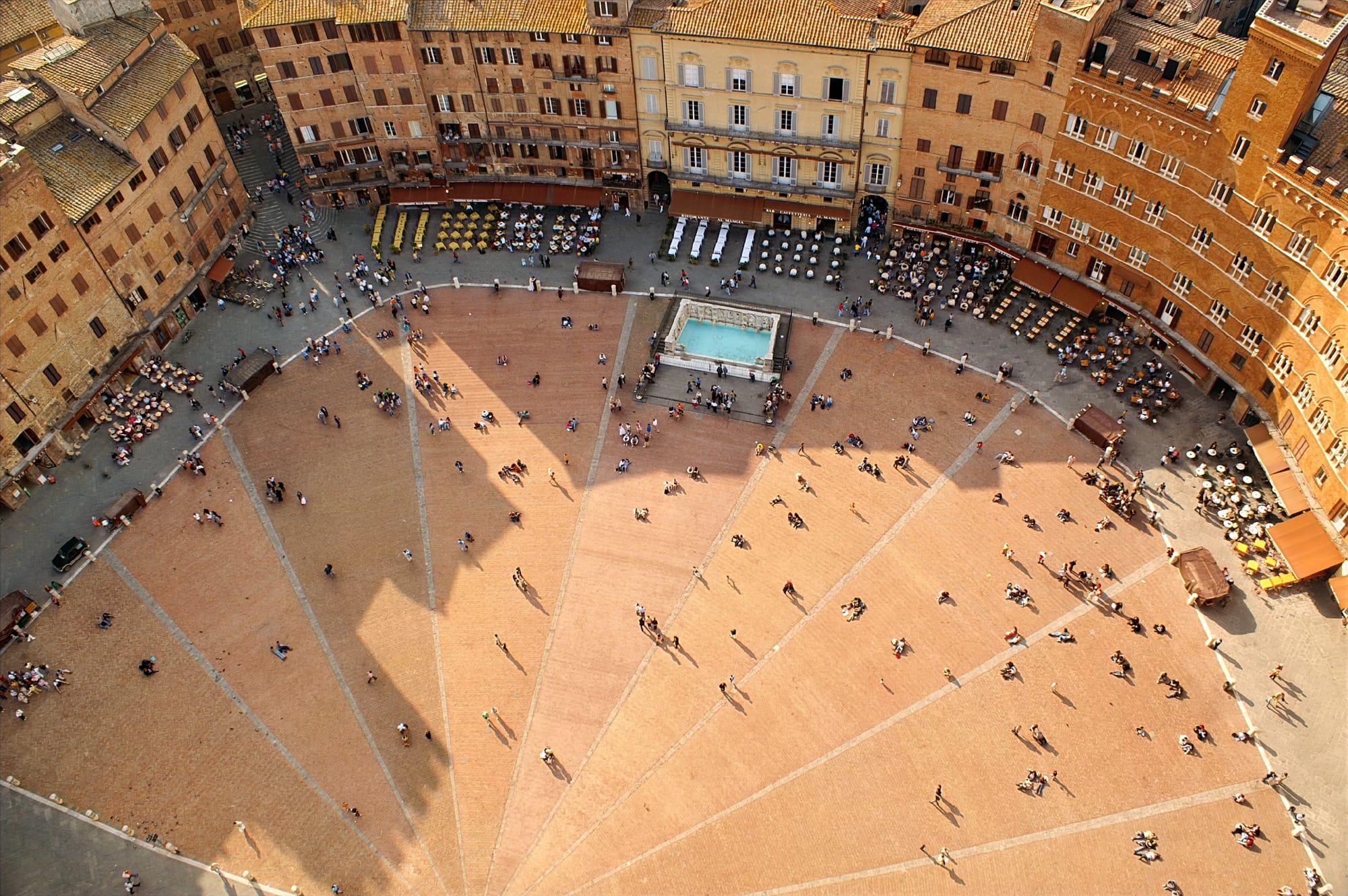
The paving arrives in 1349 — red bricks laid in a herringbone pattern, divided by ten strips of white travertine into nine sections converging toward the Palazzo Pubblico. Each section represents one of the nine governors. The geometry of the piazza is the map of Sienese power drawn in stone.
When you sit on the Campo and feel the slope carry you toward the Palazzo Pubblico, you are experiencing something designed with care seven hundred years ago: gravity as political metaphor. Everything converges toward civic government.
Not toward the Cathedral.
The Torre del Mangia and the Balance of Power
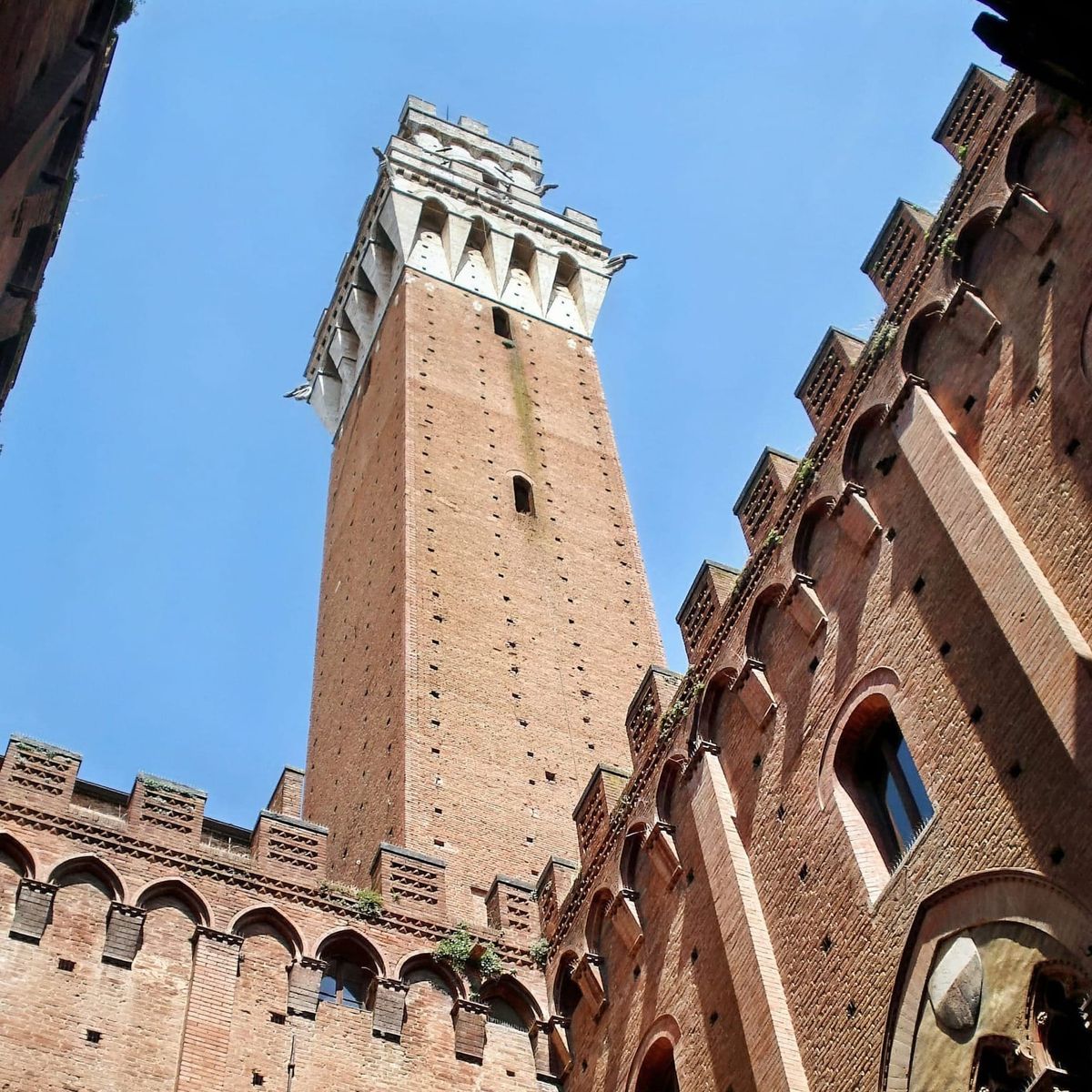
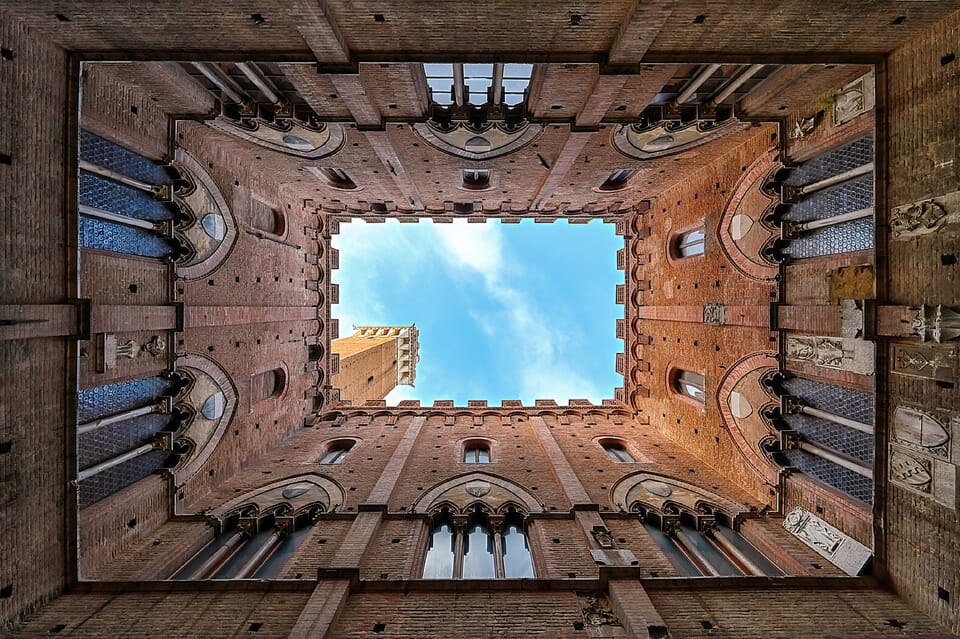
The Torre del Mangia rises some 87 metres above the floor of the piazza — 102 if you count the lightning rod at the tip. It was built between 1338 and 1348 — exactly ten years. Its name comes from Giovanni di Balduccio, the first bell-ringer, nicknamed Mangiaguadagni for his talent in spending his wages. But the folkloric etymology conceals the real story of the tower.
It was built to reach the same elevation as the Cathedral's bell tower — not the same height, but the same point against the sky. The campanile is shorter, about 77 metres, but stands on ground roughly ten metres higher. The two summits meet at the same altitude.
It was a deliberate act of optical balance — the symbolic declaration that civic and ecclesiastical power were equal. For fourteenth-century Siena, this was a revolutionary gesture. Medieval towers were measures of power, and measuring your tower against the bishop's was equivalent to saying: we are the same.
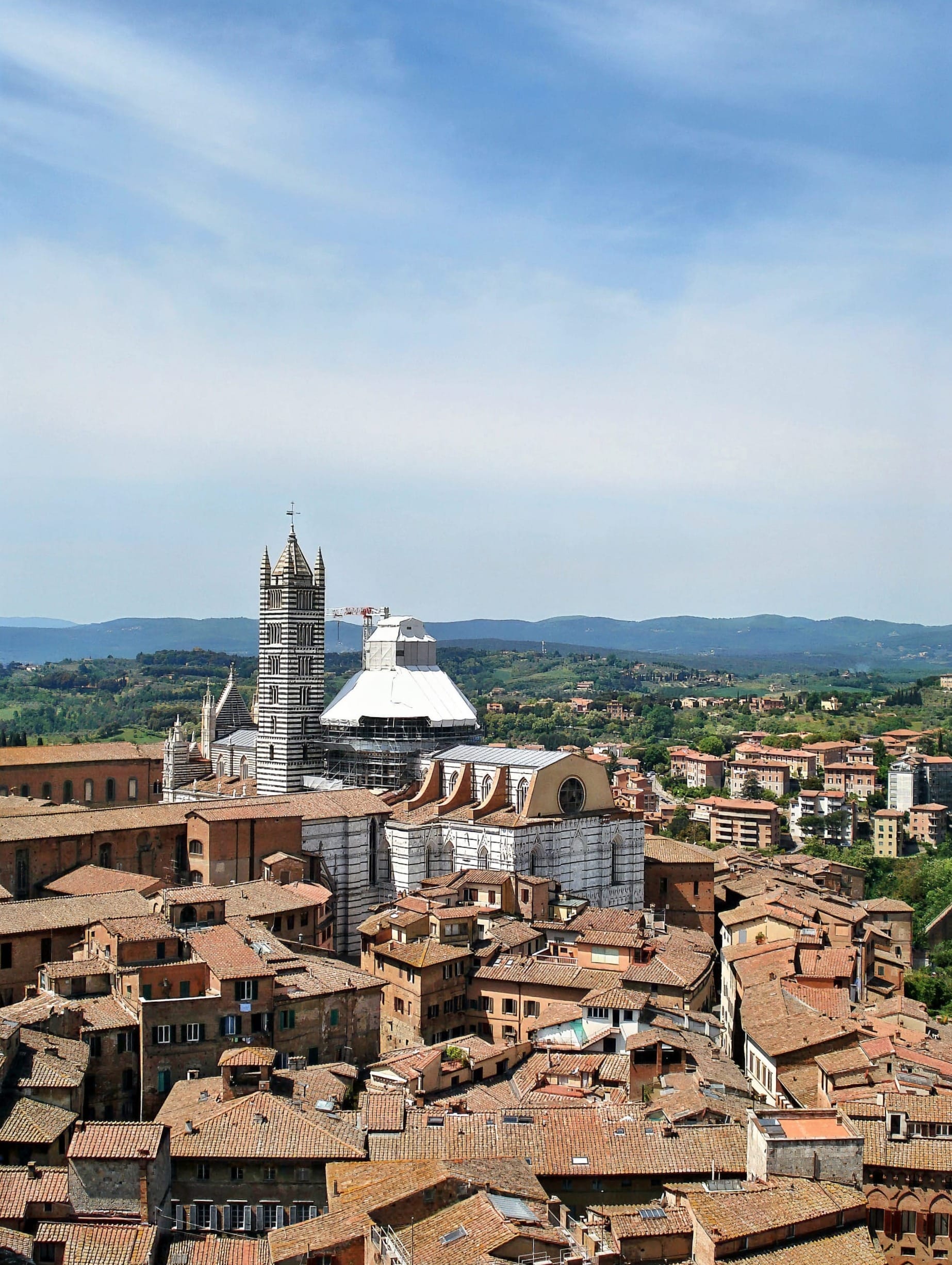
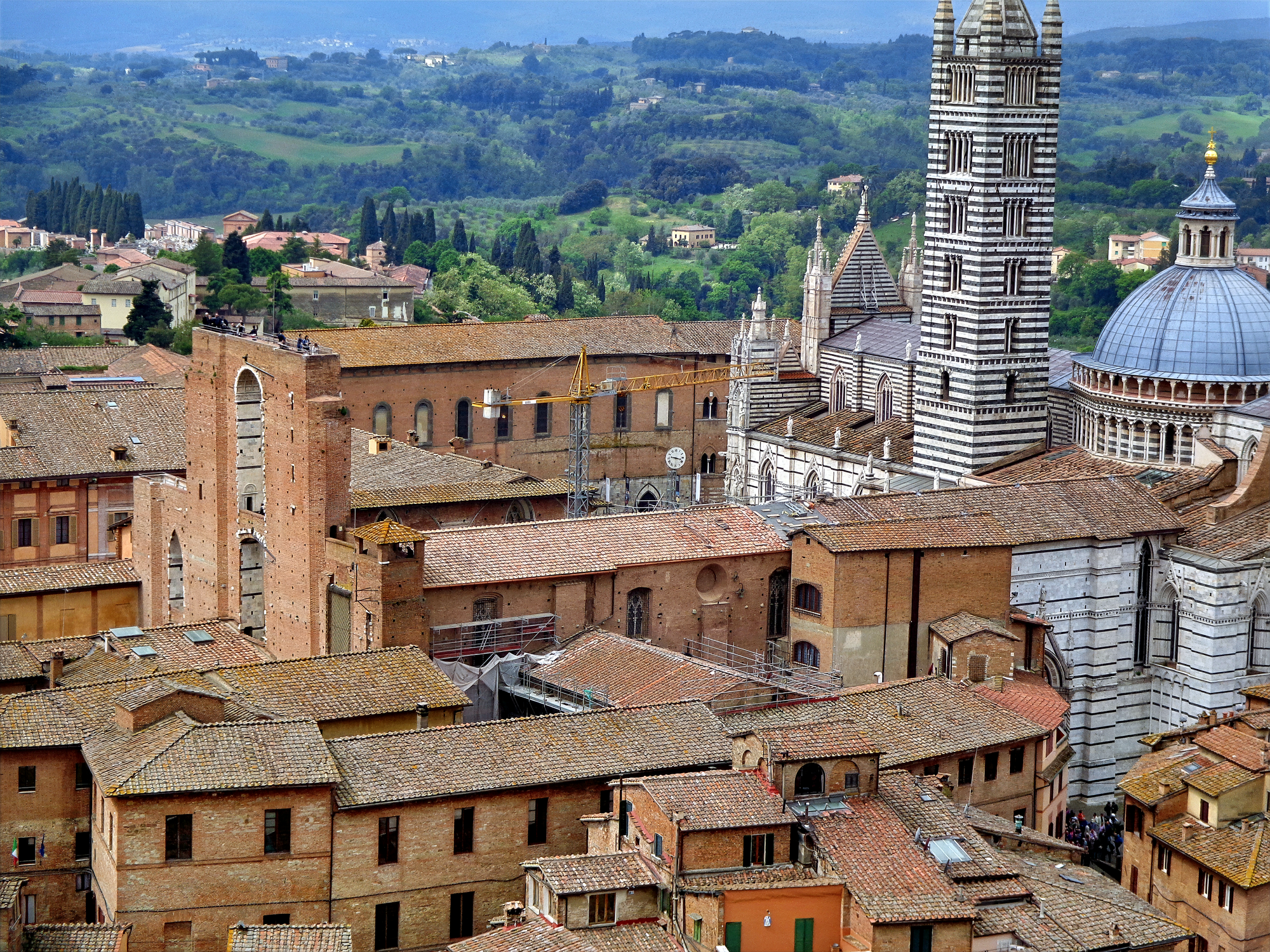
Climb the Torre del Mangia if it's open. From the top the city resolves itself into a pattern of terracotta rooftops and medieval towers that makes you understand, for the first time, how Siena was built as a deliberate act of urban will — not a city that grew, but a city that was designed. The three hill ridges read clearly. The Cathedral rises from the fabric like a white-and-green declaration above the red of the rooftops. And the Campo, seen from above, finally reveals its nine sections for what they are: the government's signature on the city.
The Cathedral That Never Was
There is a building in Siena more important than the Cathedral. It is the Cathedral that never existed.
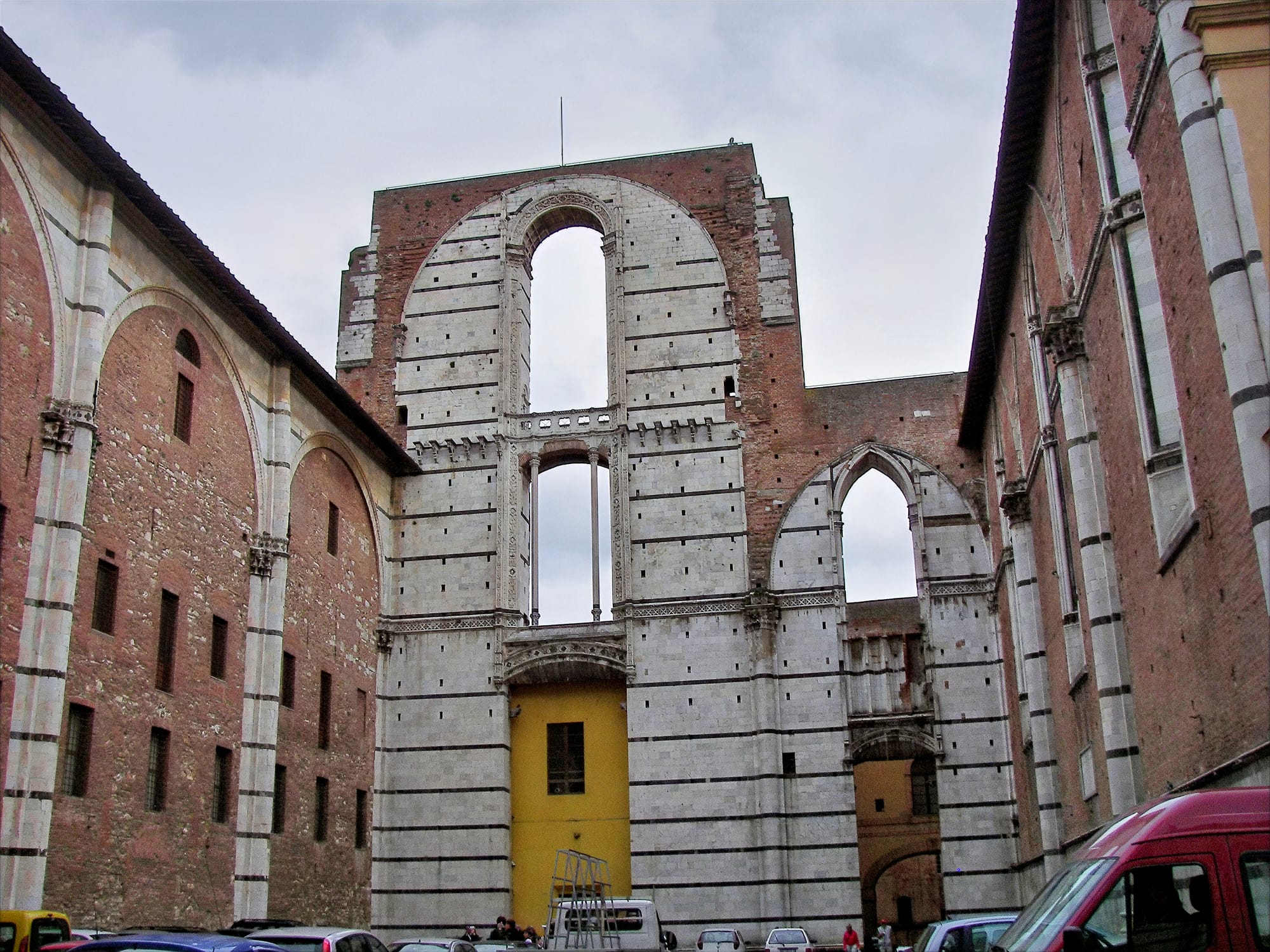
In 1339, at the height of the Governo dei Nove, Siena decided to build a new cathedral that would have made the existing one — already one of the largest in Italy — a mere lateral transept. The project was grandiose to the point of madness: a basilica so vast it would have exceeded any church in Europe, the definitive symbol of Sienese power. Against Florence. Against everyone.
The work began. The walls rose. And then the plague arrived in 1348.
Half the population died, and the money died with them. Cracks had already opened in what had been built. The site slowed, stalled, and never restarted: in June 1357 the governors ordered the unsafe portions taken down.
The bare walls of the Duomo Nuovo — the great facade, the flank walls, an aisle that leads nowhere — are still there, on the right flank of the piazza, now housing the Museo dell'Opera. From the Facciatone — the unfinished facade that you can climb — you see the existing Cathedral from above and understand exactly how large the new one would have been.
But there is another reading of this story, quieter. If the project had gone ahead, the city would have had to demolish entire neighbourhoods to make room for the new basilica. The plague, which seemed like the end of everything, preserved the medieval urban fabric of Siena from the ambition of its own builders. The unfinished walls saved the city we see today.
Catastrophe as a conservation act. It is one of the cruellest ironies in the history of architecture.
The Stranger in the Cathedral
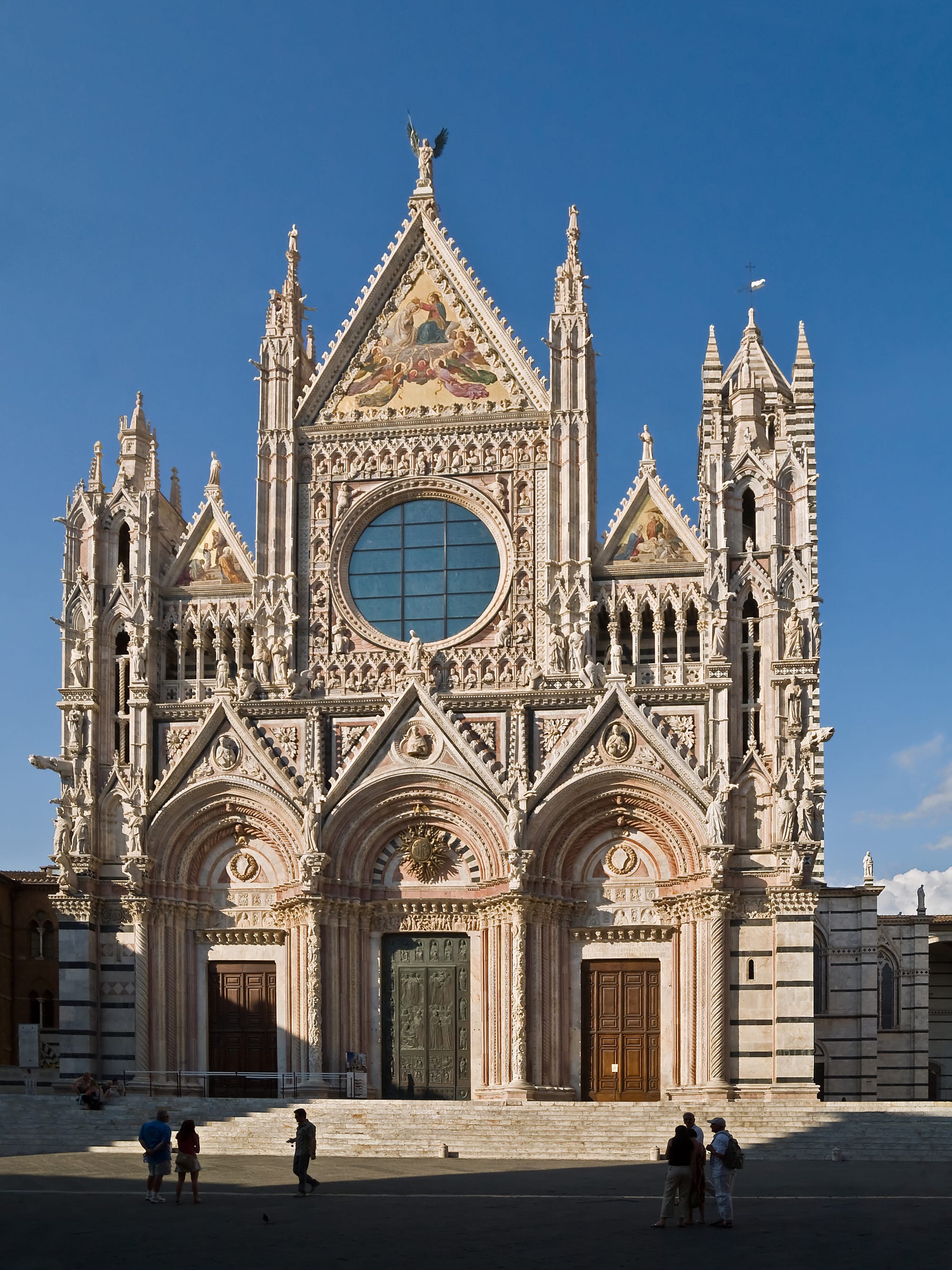
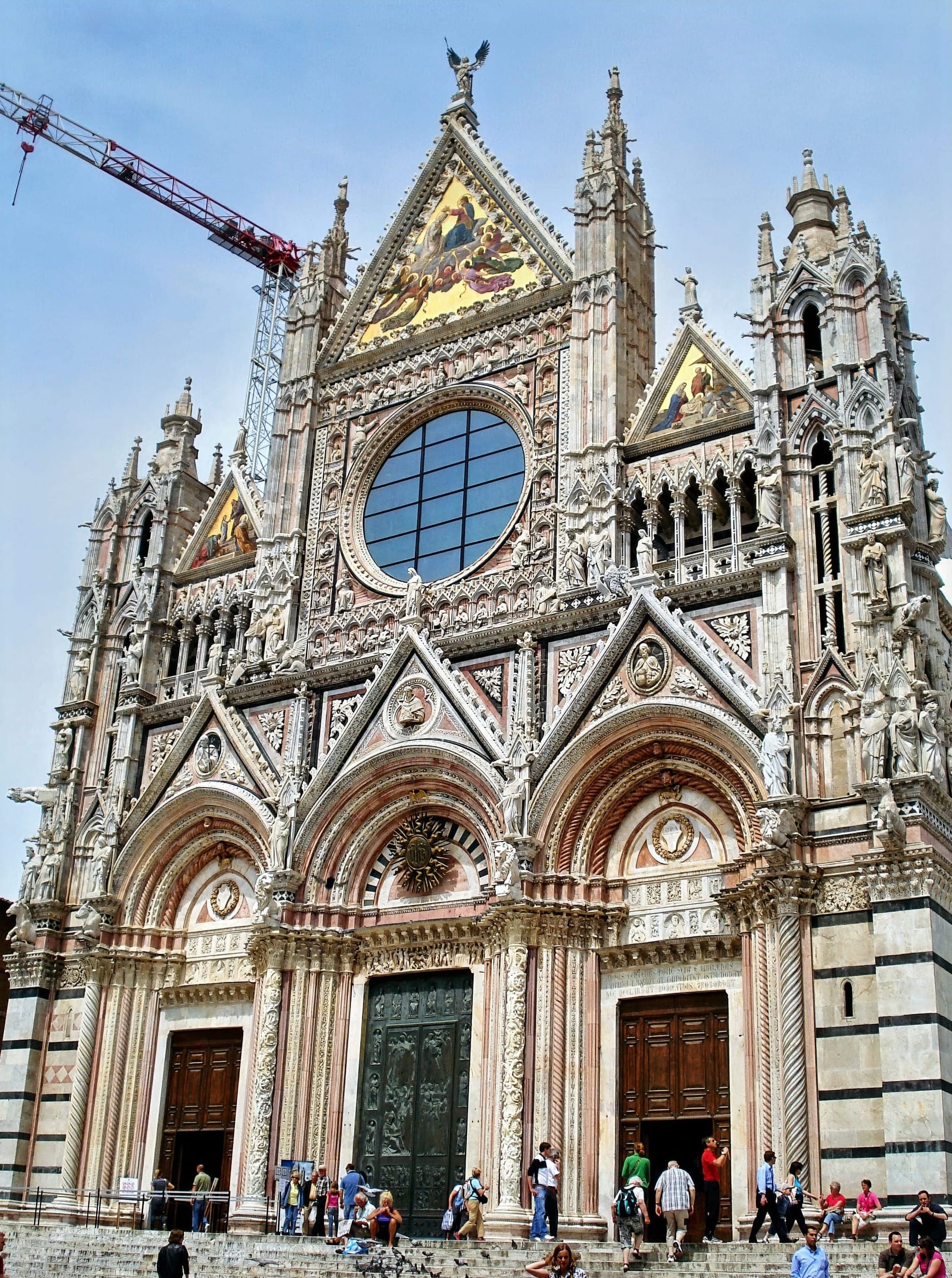
The Duomo di Santa Maria Assunta is one of the great Gothic cathedrals of Italy. Most visitors come for the Piccolomini Library, the Pisano pulpit, the inlaid marble floor. Few notice what's waiting just inside the main entrance.
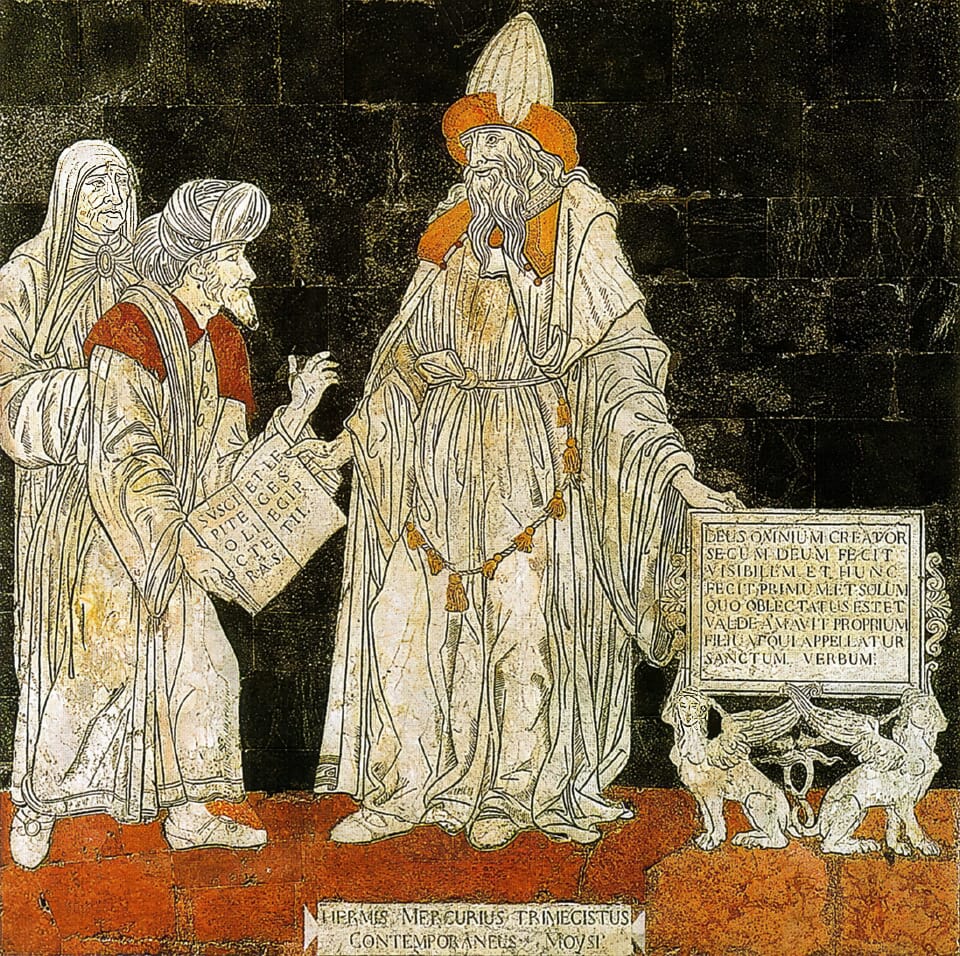
On the floor, just inside the central portal, is a large marble intarsia — a commesso marmoreo, laid in 1488 by the Sienese Giovanni di Stefano, probably at the instance of Alberto Aringhieri, the knight who ran the Opera del Duomo. It shows a venerable bearded figure handing a book to two younger men — one in eastern dress, one in a white tunic suggesting the West. At the base of the image, an inscription:
HERMES MERCURIUS TRISMEGISTUS / CONTEMPORANEUS MOYSE
Hermes Mercurius Trismegistus. Contemporary of Moses.
Hermes Trismegistus — the thrice-greatest Hermes — is the fusion of three figures: the Greek Hermes, the Egyptian Thoth, god of writing and wisdom, and a legendary sage of antiquity to whom alchemists and Renaissance philosophers attributed the origins of all knowledge. The Corpus Hermeticum — the body of texts ascribed to him — had been turned into Latin by Marsilio Ficino in 1463, on the orders of Cosimo de' Medici, and printed in 1471, seventeen years before this panel was laid. The Renaissance was still processing the discovery.
Siena put it on the floor of its cathedral.
His presence here is not a pagan anomaly — it is the typical product of Renaissance syncretism: the idea that ancient Egyptian, Greek and Christian wisdom were all faces of the same universal truth. The placement is precise and intentional: the profane at the entrance, the sacred at the altar, a narrative that accompanies the faithful from one to the other.
What to make of it? I'm not going to answer that. What I will say is that standing in front of this panel, in a cathedral full of tourists who walk straight past it, is one of those moments that makes slow travel worthwhile. You only see it if you stop.
Assuming you can see it at all. The floor of the cathedral is covered for most of the year to protect the intarsia, and Hermes spends the majority of his life under a wooden deck, waiting. Check the dates before you go: 2026 is unusually generous.
The Good Government — and the Irony That Follows
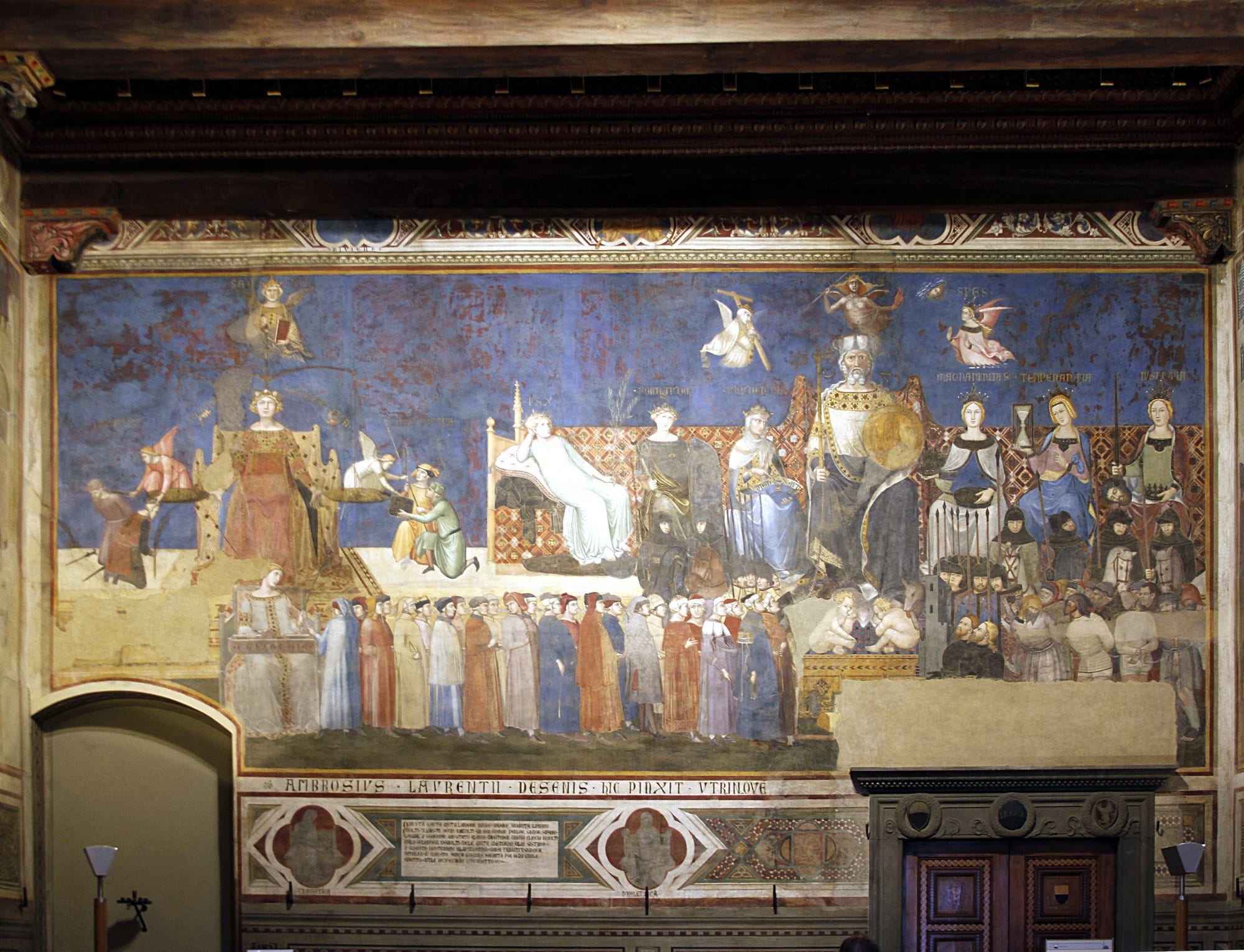
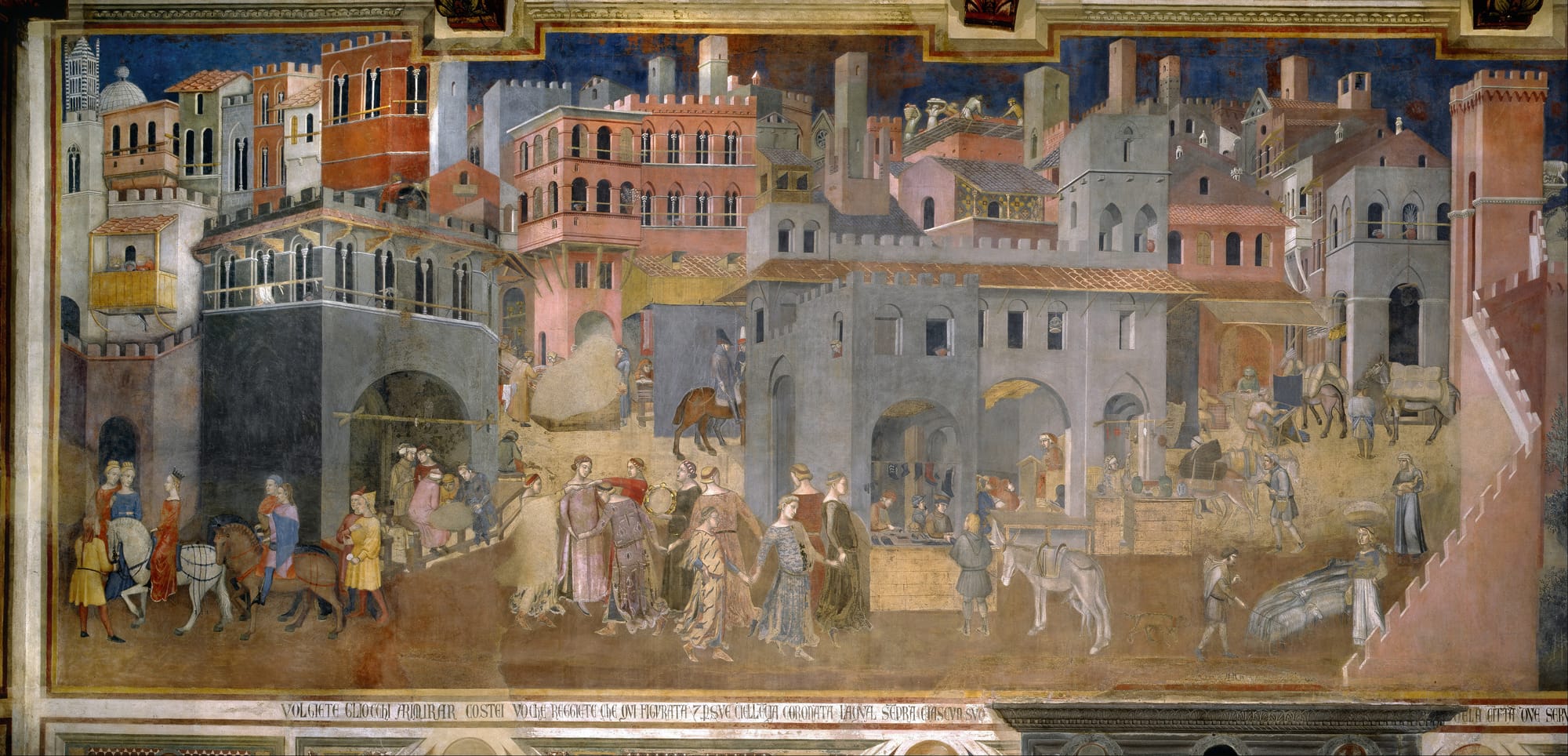
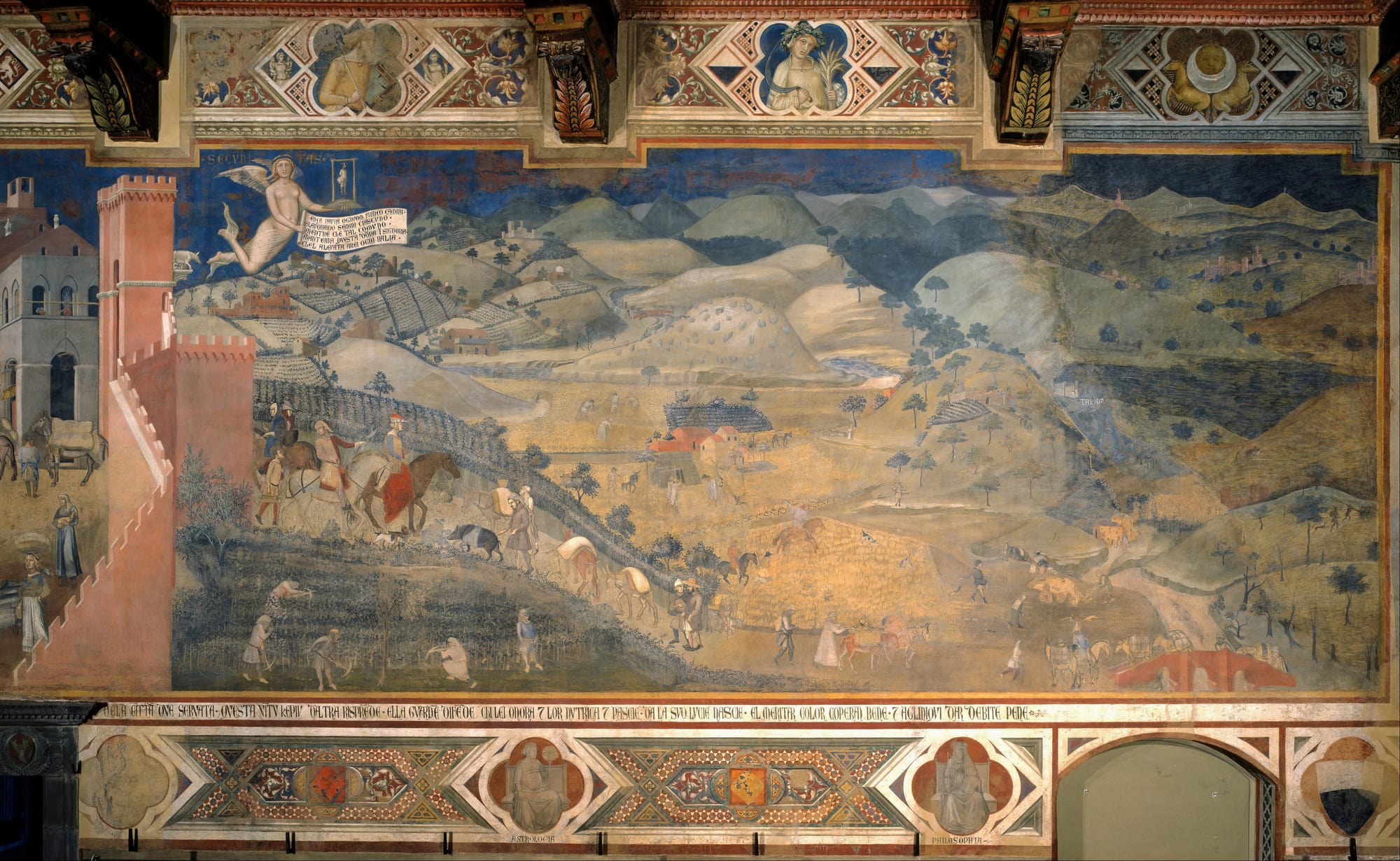
On the first floor of the Palazzo Pubblico, in the Sala dei Nove, Ambrogio Lorenzetti painted the Allegory of Good and Bad Government between 1338 and 1339. It is one of the most important works in the history of Western art, and almost no visitor truly understands what they are looking at.
It is not a religious fresco. It is a political campaign painted on a wall.
Lorenzetti represents in vivid detail the effects of good and bad government on city and rural life — the first secular work to explore political themes through the realistic representation of urban space. The crowded streets, the merchants, the children playing, the intact rooftops, the cultivated fields around the city. The client is the Governo dei Nove, and the message is explicit: look how well we live under us.
It is also the first realistic urban landscape in European painting. Before Lorenzetti, cities in paintings were symbols — stylised towers, conventional skylines. Here it is actual Siena, recognisable in its streets and buildings, painted with the attention of someone who knows it and lives in it.
And then there is the detail that no guidebook mentions: Lorenzetti paints all of this in 1338-39. Ten years later, in 1348, the plague kills half the population. The Governo dei Nove falls in 1355. Lorenzetti himself almost certainly dies of plague.
The fresco of the Good Government remained on the wall watching the city it described dissolve. It is one of the most devastating documents that medieval architecture has produced — not for what it shows, but for what happened after.
The Sienese School: Winning Without the Renaissance
There is a question worth asking in front of any work of the Sienese school: why is it so different from the Florentine?
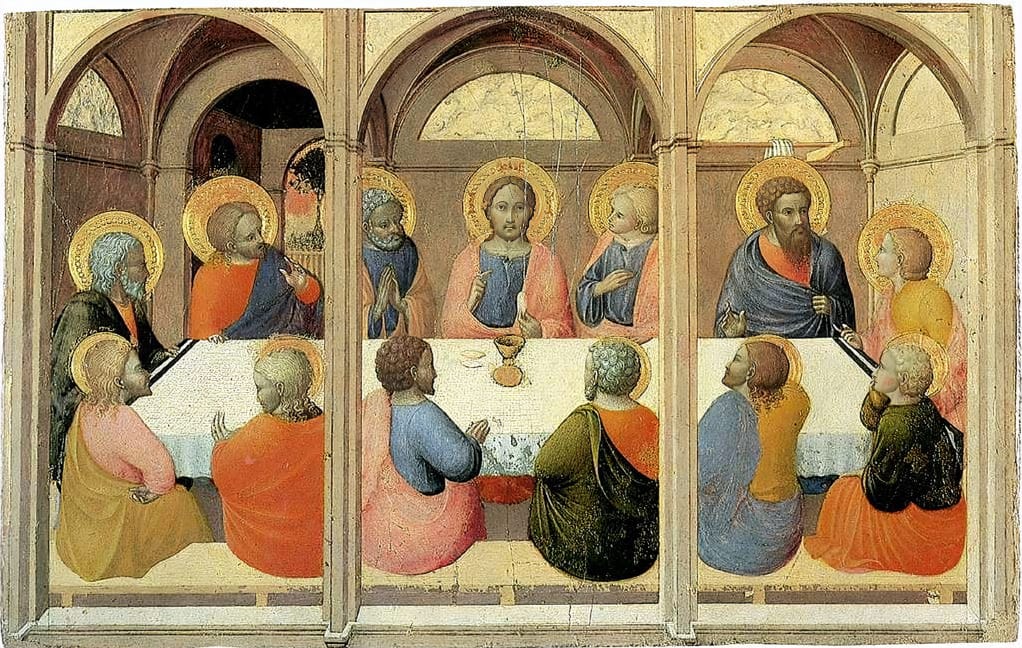
In Sienese painting you find the preciousness of Gothic style, an abundant use of gold, figures that are delicate and idealised, a narrative and emotional quality that Florence doesn't have. In the Florentines, perspective, volume and realism dominate. Duccio against Giotto. Simone Martini against Masaccio. Gold and grace against body and space.
The standard explanation is that Siena fell behind. But this only works if you ignore the political history.
Siena loses militarily at Colle Val d'Elsa in 1269. It loses definitively to Florence in 1555. In between: nearly three centuries of resistance. In the fifteenth century the fracture becomes explicit. Florentine humanist culture on one side, Siena's deliberate return to tradition on the other. Sienese painting does not follow the Florentine Renaissance — it studies it, takes what it needs, and for the rest remains faithful to Duccio, to Simone Martini, to its own visual identity.
This is not backwardness. It is a position.
In Sienese commissioning contracts of the fifteenth century, the explicit copying of earlier masters was often required — reproducing Duccio's style was not artistic laziness, it was the client's specification. The Sienese school had become part of a civic ideology: we are this, not what Florence wants us to be.
The result is a city that lost every military battle and won the cultural one. Works of the Sienese school are in museums in London, Washington, Los Angeles. Duccio's Maestà is one of the absolute masterpieces of European painting. The Pinacoteca Nazionale di Siena — Palazzo Buonsignori, a few minutes from the Campo — is the place where that entire story can be read from beginning to end, in chronological order, almost without crowds.
The Palio as Urban System
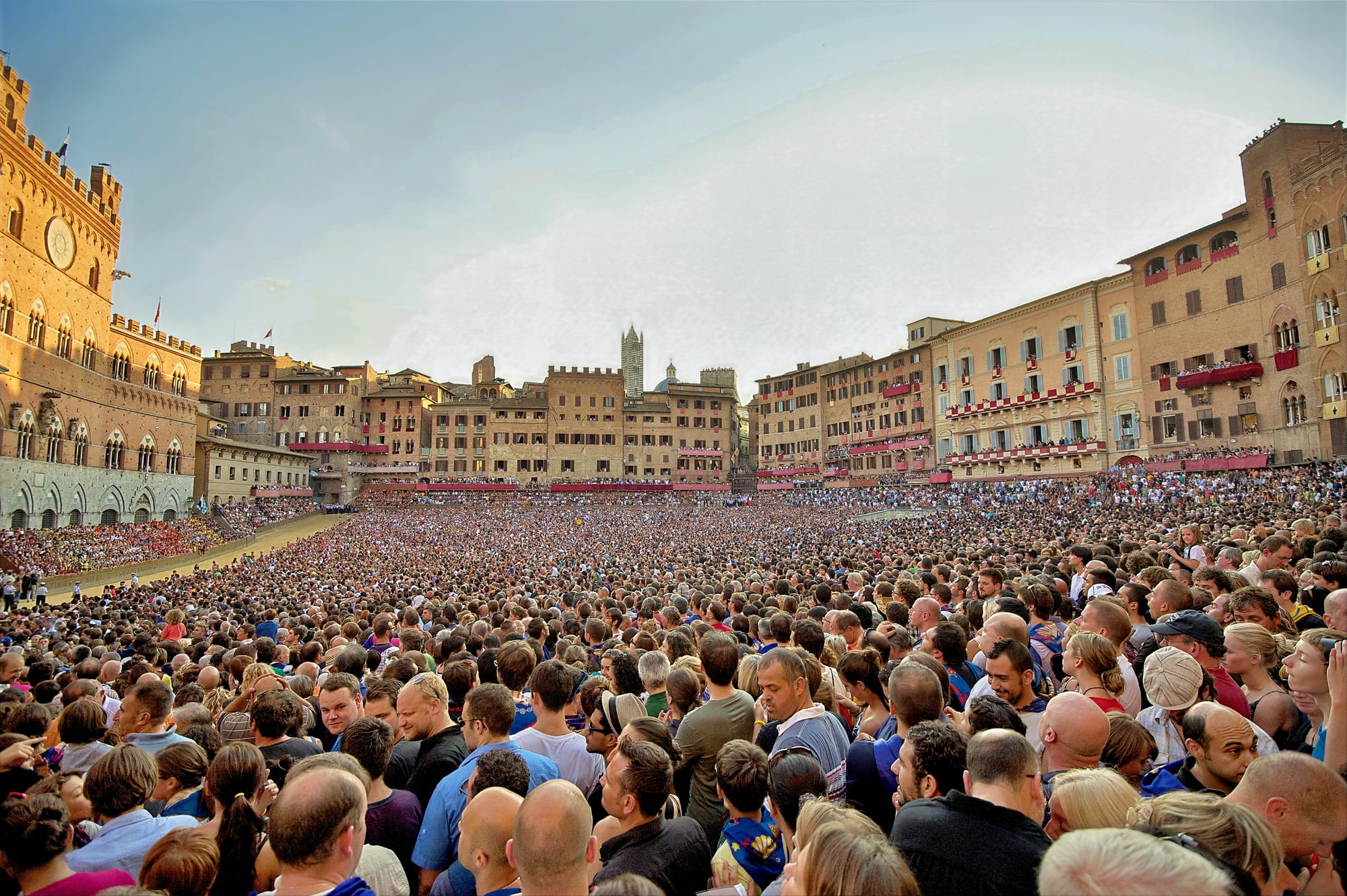
The Palio is not a historical re-enactment. It is not a show for tourists. It is the medieval political system of Siena, still functioning.
The seventeen contrade — Aquila, Bruco, Chiocciola, Civetta, Drago, Giraffa, Istrice, Leocorno, Lupa, Nicchio, Oca, Onda, Pantera, Selva, Tartuca, Torre, Valdimontone — originate in the thirteenth century as urban topographic units: zones of the city identified to record where the population lived, where it owned property, where it worked. They were not neighbourhoods in the modern sense — they were reference units of the medieval urban fabric. Over time they become communities, each with its own church, its own museum, its own colours, its own sworn enemies.
Their boundaries were fixed definitively in 1729 by Violante Beatrice of Bavaria in a decree regulating the "new division and reform of the boundaries of the Contrade of the city of Siena." Since then: nothing has changed. Not with the unification of Italy. Not with fascism. Not with twentieth-century urban expansion. The medieval map of the city is frozen in 1729 and still today governs every Sienese citizen's sense of belonging.
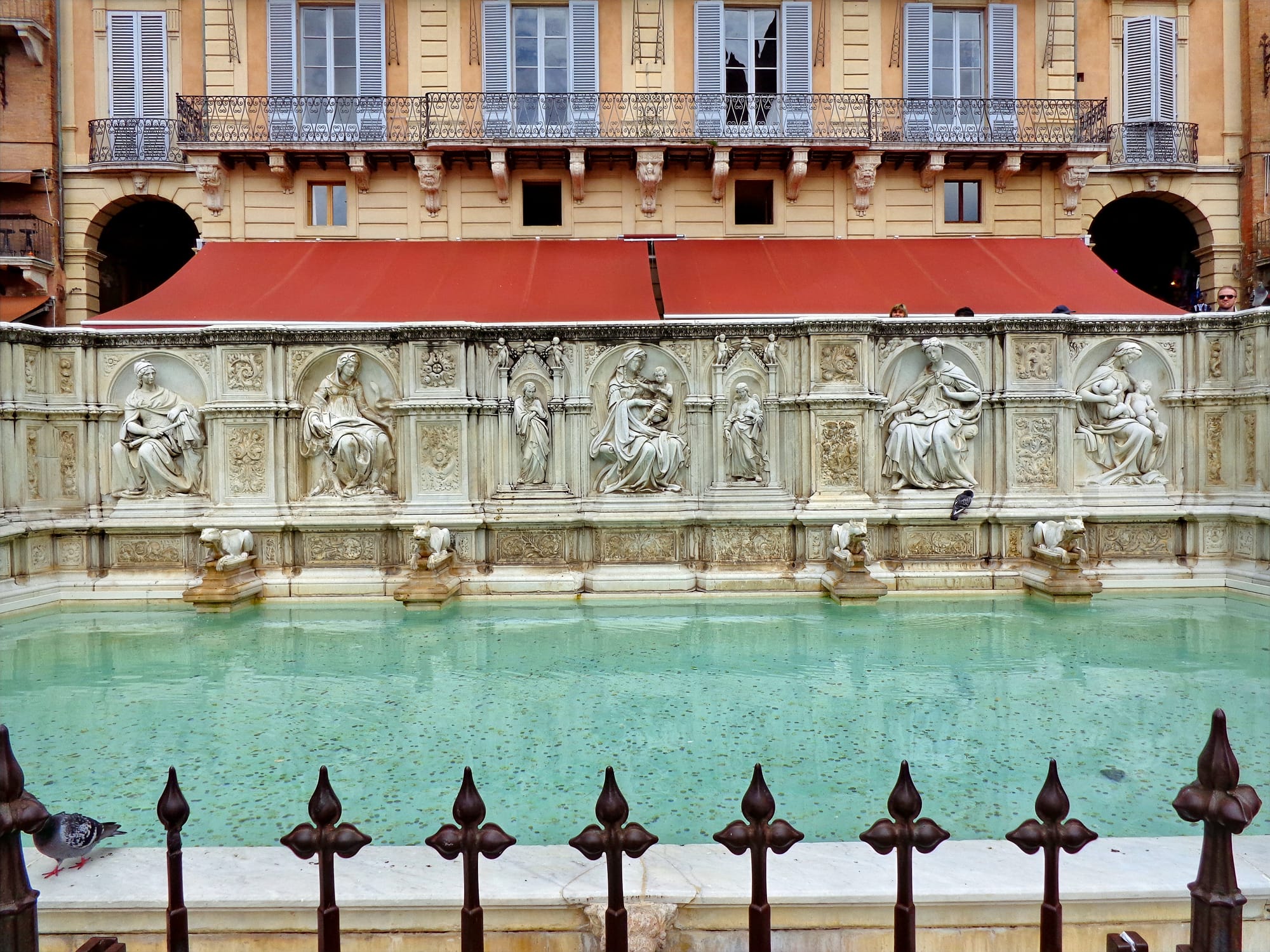
You are born into a contrada. You are baptised at its fountain — a rite parallel to Christian baptism. You carry that belonging for your entire life and are buried in its colours. Sienese citizens of the nineteenth century were simultaneously aware of their contradaiolo identity and committed patriots of the Risorgimento — the contrade raised funds for volunteers in the wars of independence. Multiple identity, anthropologists would call it today. But the Sienese had known it since 1848.
The Palio — the horse race run on 2 July and 16 August in Piazza del Campo — is the moment when this system makes itself visible. It doesn't last three minutes: it lasts a week of trials, alliances, betrayals, corruptions, ceremonies. The horse can win without a jockey. The rules are few, the exceptions many, and everything is permitted except striking an opponent's reins. It is medieval warfare sublimated into civic ritual — violent, sacred, and completely serious to those who live it.
An architect watching the Palio doesn't see a spectacle. He sees the city reorganising itself according to its original structure — the three Terzi, the seventeen contrade, the boundaries drawn seven hundred years ago — and understands that in Siena the Middle Ages didn't end. They simply became something else.
The Bottini: Siena's Invisible River
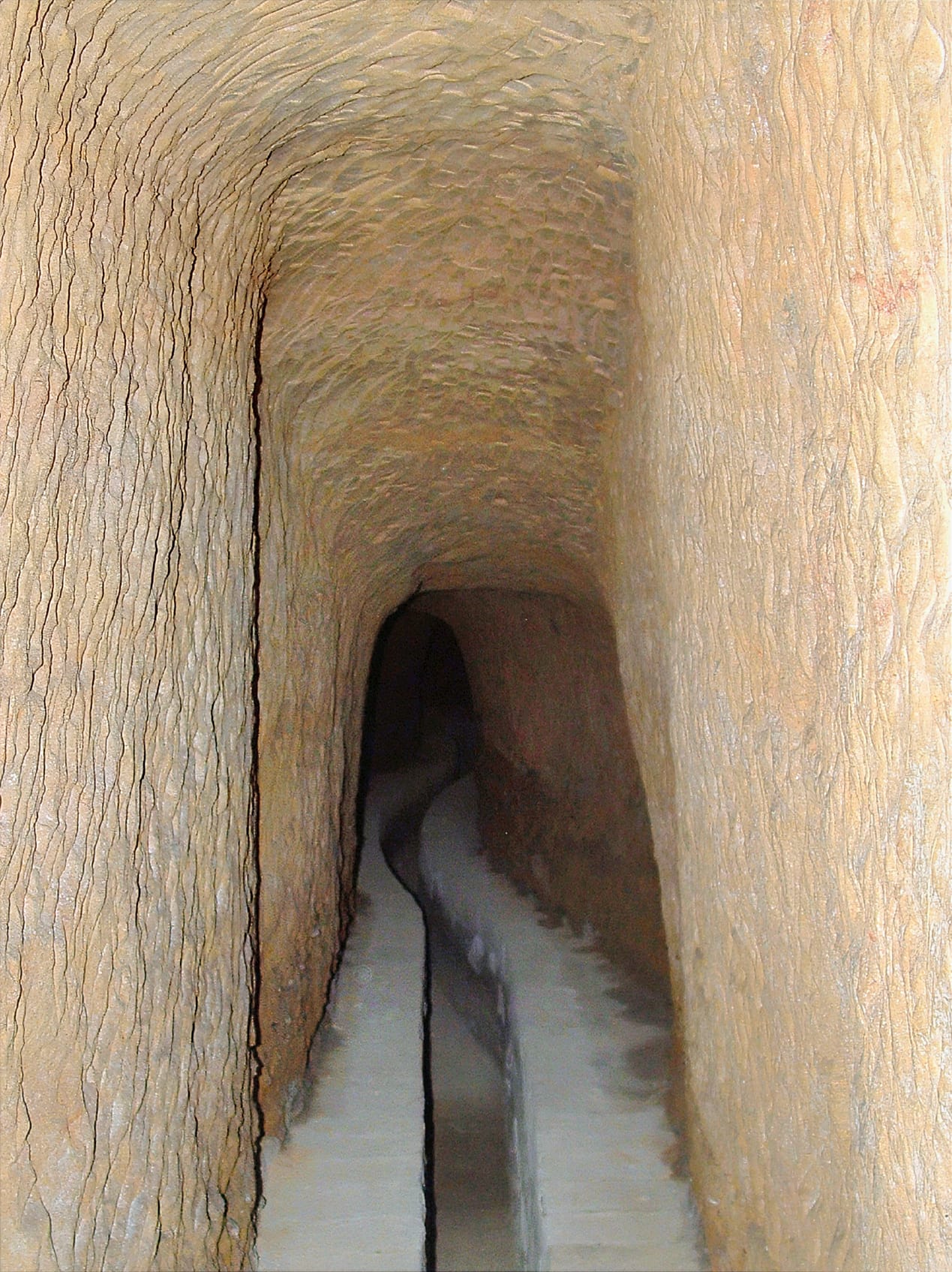
There is something flowing beneath your feet as you walk through Siena. It always has been, for eight hundred years. Almost nobody knows it.
Siena is built on three hills, with no river nearby. For a medieval city growing rapidly, without water you die — literally and militarily.
The solution Siena found was so audacious that Dante mocked it — not the Bottini themselves, but the parallel, more romantic ambition behind them: medieval Siena's conviction that a great underground river, which they named the Diana, ran beneath the city and could be found and tapped. The legend appears in Purgatorio XIII, in the mouth of the Sienese noblewoman Sapìa, and Dante's Florentine scorn for the obsession is unmistakable. The Diana was never found. It does not exist. But the engineers searching for it built something better than a myth: 25 kilometres of real galleries, patiently carved through the tufa, that did supply the city for six centuries. Dante was wrong about what mattered. He mocked the dream and missed the infrastructure quietly being built in its shadow
The guerchi — the workers assigned to the construction — often fled in terror: they saw the omiccioli, creatures like goblins, and the fuggisoli, sudden flashes of light in the darkness. The visions were probably caused by the fear of those unknown dark spaces and by the effects of alcohol, since part of the workers' pay was made in wine. The image remains: men carving for weeks beneath the city, in total darkness, paid in wine and frightened by ghosts, building the infrastructure that would allow Siena to exist.
The system served not only drinking water: it fed the medieval artisan industries dependent on water — dyers, tanners, millers. It was the invisible river that animated the entire city economy.
And then there is the military detail. The Sienese knew the tunnels were a weakness as much as a lifeline: in 1554, during the siege, the imperial army tried to get into the city through the bottini and came very close to succeeding. The other threat was cruder. Where the galleries surfaced outside the walls they could simply be broken, and a later Sienese source records that the Florentines wrecked the exposed stretches at Fonterutoli, north of the city, cutting into the supply that was keeping Siena alive.
Siena surrendered in April 1555, after fourteen months of siege, and what beat it was hunger. But hunger was engineered — the roads cut, the granaries emptied, the water broken where nobody could see it. The river the Sienese had dreamed of was never found. The one they built themselves was the last thing the enemy went looking for, which tells you what it was worth.
The Bottini can be visited in groups of ten, by reservation, on limited dates. You walk underground with a hard hat and a torch. It is the most unusual and most forgotten experience Siena has to offer. Bookings: ticket@comune.siena.it
Santa Maria della Scala
Across the piazza from the Cathedral, the former hospital of Santa Maria della Scala is one of the most underrated spaces in Siena. Founded in the ninth century as a hospice for pilgrims on the Via Francigena, it operated as a hospital until the 1990s and is now a museum complex. The frescoed halls — especially the Pellegrinaio, with its fifteenth-century cycle depicting hospital life — are extraordinary.
It is also a building that rewards the architectural eye: nine centuries of additions, modifications and adaptations, all legible in the walls if you know what to look for. The history of the city built layer upon layer, exactly like the Sassi of Matera — but in the open, in pale stone, under the Tuscan sun.
Before You Leave
Siena is best in the early morning or the late afternoon, when the day-trippers have gone. The Campo at dusk, with the Torre del Mangia lit against a darkening sky, is worth staying for.
If you are spending the night, the neighbourhood around San Domenico is quieter and less expensive than the centre, with views across to the Cathedral that are hard to leave.
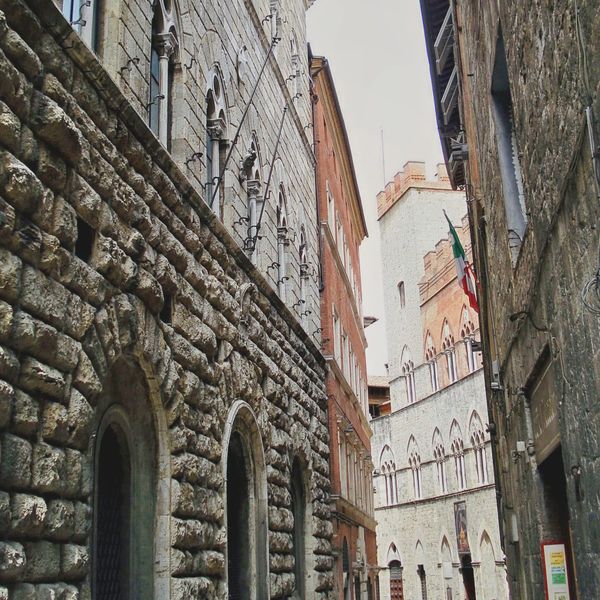
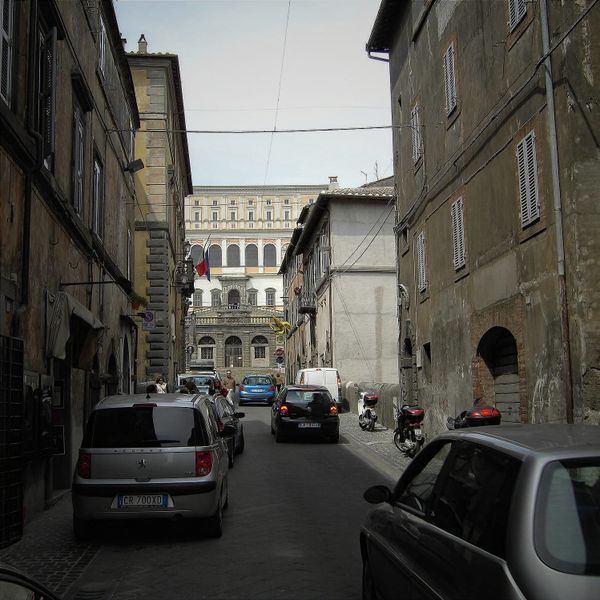
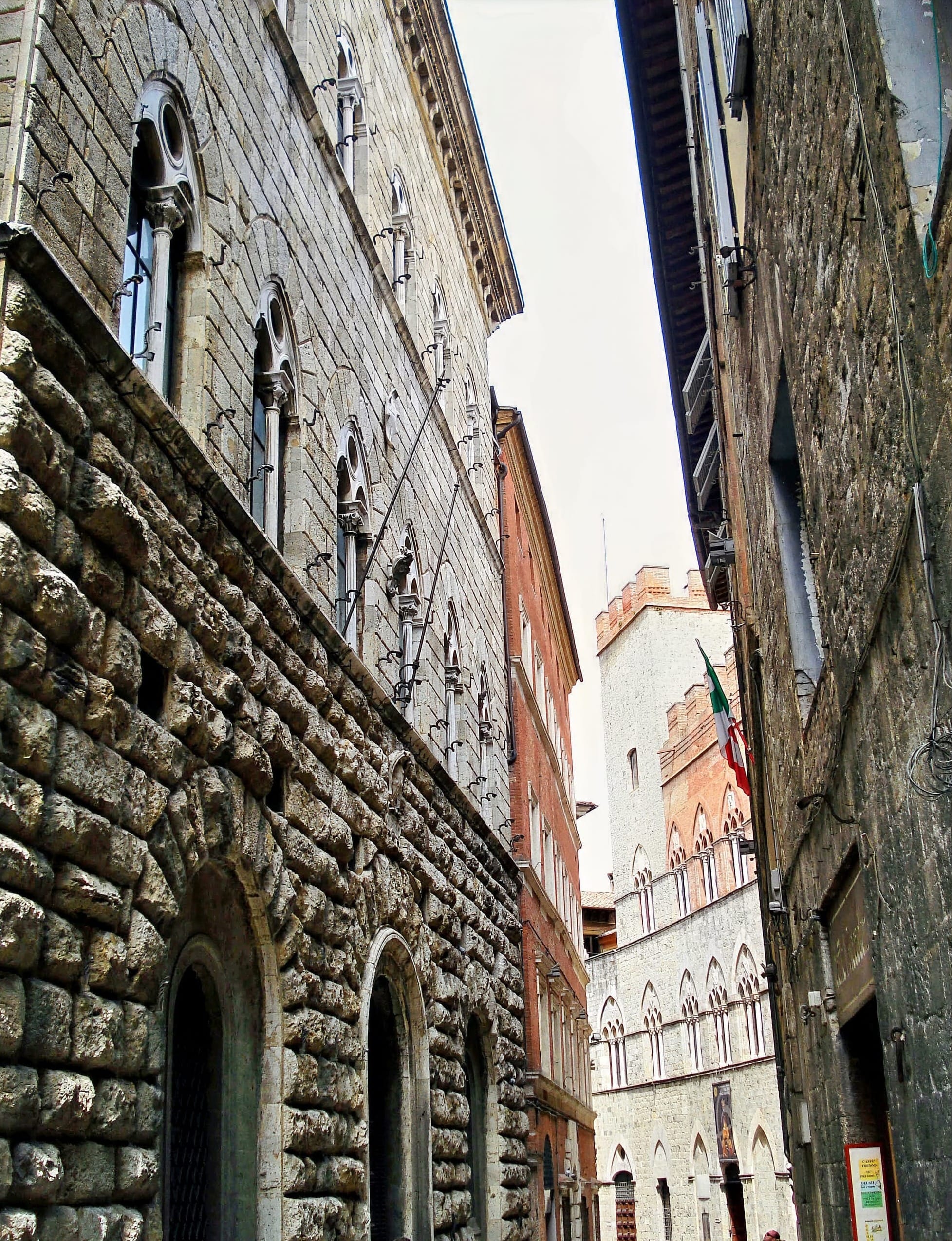
The alleys below the Campo — particularly Via di Città — show six centuries of Sienese architecture in one frame: the rusticated stone of Palazzo Piccolomini against the Gothic brick of the Palazzo Pubblico, neither built with the other in mind, both perfect together. Nobody planned it this way. That's the point.
Practical Notes
Getting there: From Florence, approximately 1.5 hours by train or coach. From Rome, approximately 3 hours. The railway station is 2 km outside the historic centre — take a bus or taxi. The centre is pedestrian.
Parking: Outside the walls, in the signposted car parks. Do not attempt to drive into the historic centre.
Torre del Mangia: €10, in person only at the Palazzo Pubblico ticket office — no online booking, no advance sales, same-day only, and a daily cap that sells out. Open 1 March–31 October, 10am–7pm; 1 November–28 February, 10am–4pm. Check before you plan your day around it: the tower has been closed for maintenance since late 2025 and, at the time of writing, had not reliably reopened.
Duomo: there is no cathedral-only ticket. Entry is by the OPA SI Pass, which covers the whole complex — cathedral, Piccolomini Library, Baptistery, Crypt, Museo dell'Opera and the climb up the Facciatone: €14, rising to €16 during the weeks the floor is uncovered. Valid three consecutive days; the full circuit takes about two hours. Add the Porta del Cielo — the walkway through the roof structure above the nave — and it's €21. Buy online, at the Piazza Duomo ticket office, or at the Dear Guests visitor centre on Via di Città, a minute from the Campo. Opening: 10am–7pm from 1 April to 31 October, last entry half an hour before closing. Sundays and feast days the cathedral opens only in the afternoon, 1.30pm, while the rest of the complex keeps normal hours — worth knowing if you have one day and it happens to be a Sunday. Shorter hours in winter, 10.30am–5.30pm.
The Cathedral floor: covered for most of the year. In 2026 it is uncovered 27 June–31 July and 18 August–15 November. If you want to see Hermes, this is the window — and it is the reason the ticket costs two euros more.
Palazzo Pubblico / Museo Civico: €10 (€11 with advance booking). The Allegory of Good Government is here. Do not miss it.
The Bottini: Reservation required. ticket@comune.siena.it. Visits on limited dates, maximum groups of 10. Book well in advance.
Pinacoteca Nazionale: Palazzo Buonsignori, Via San Pietro 29. Usually quiet. Always extraordinary.
When to go: Siena works in any season. Avoid the Palio dates (2 July and 16 August) if you don't want to find the city in a state of organised frenzy — or go precisely then, if you want to understand what it means for a medieval identity to survive into the twenty-first century.
Further Reading
Enrico Guidoni is the essential starting point for anyone who wants to understand Siena as an urban project. Il Campo di Siena (Quaderni dell'Istituto di storia dell'architettura, 1965) is the foundational essay — short, dense, still unsurpassed in its political reading of the piazza. The Atlante storico delle città italiane vol. 8 (Bonsignori, 1986) is the cartographic companion: maps, plans, the medieval city reconstructed layer by layer.
Guglielmo Villa, Siena medievale. La costruzione della città nell'età ghibellina 1200–1270 (Bonsignori, Civitates series) — the political context behind the architectural choices. If the Montaperti passage and the argument about Sienese cultural resistance stayed with you, this is the book that develops that argument with the primary sources.
Balestracci, I bottini. Acquedotti medievali senesi (Siena, 1984) — the book on the bottini. Technical, precise, the only systematic study of a hydraulic system that almost nobody knows exists. Not light reading, but if you have ever walked above those tunnels it is worth every page.
For an accessible introduction before you go, the Treccani entry on Siena (Arte Medievale) is free online and reliable — a good starting point if Sienese Gothic is new territory.