PALAZZO TE — RULE AND LICENCE
Mantua, empty in mid-August. The facade of Palazzo Te is brick and plaster pretending to be stone, and in the courtyard the triglyphs are slipping out of the frieze. Giulio Romano spent ten years building an order that fails on cue — and had to leave Rome to be allowed to do it.
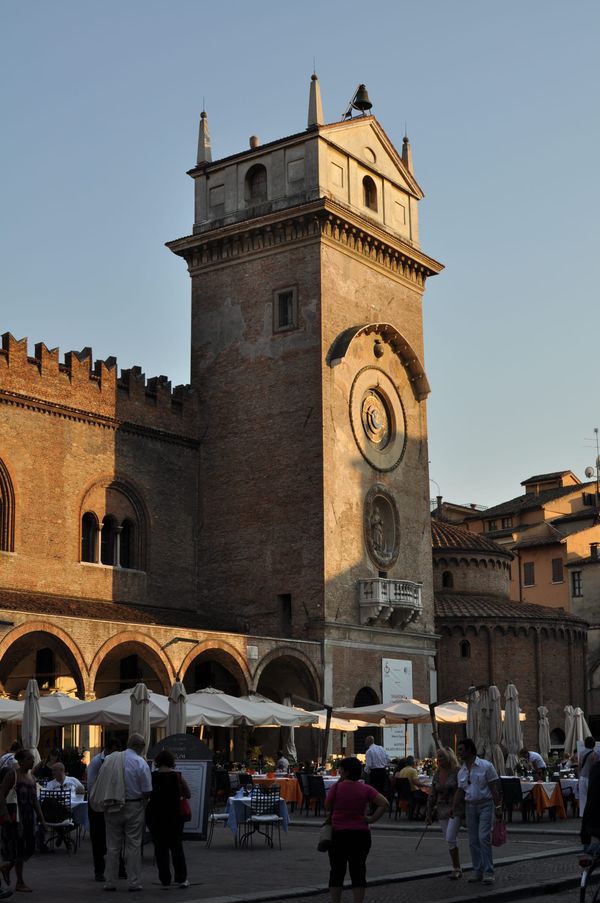
It was the fifteenth of August 2011 — Ferragosto — and the heat was the kind the Po valley produces as a local speciality: still, humid, inescapable. We had eaten the night before in Piazza delle Erbe, in a square where every table was taken. By morning that crowd had evaporated. Shutters down, no one in the streets, the whole city either at the seaside or asleep. Ferragosto does not empty a city all at once; it empties it in shifts.
The monuments were ours.
There is something strange about visiting a masterpiece with nobody around. The filter of the crowd is missing — the queue that tells you that you are about to see something important, the murmur that fills the silence. It is just you and the building, without mediation.
We had stopped in Mantua on the way home from the sea, deliberately, to see something neither of us had seen. I had my own reason on top of that: to do what all architects do, sooner or later — to see in person the things studied in books. Because architectural history books are not picture books — they are textbooks. The photographs are there, few of them, black and white in the serious essays, but they are not the point. The point is the words, the concepts, the interpretive categories. You buy those books to understand what proportion means, what system means, what language means. Not to see the buildings.
And then you go to see the buildings.
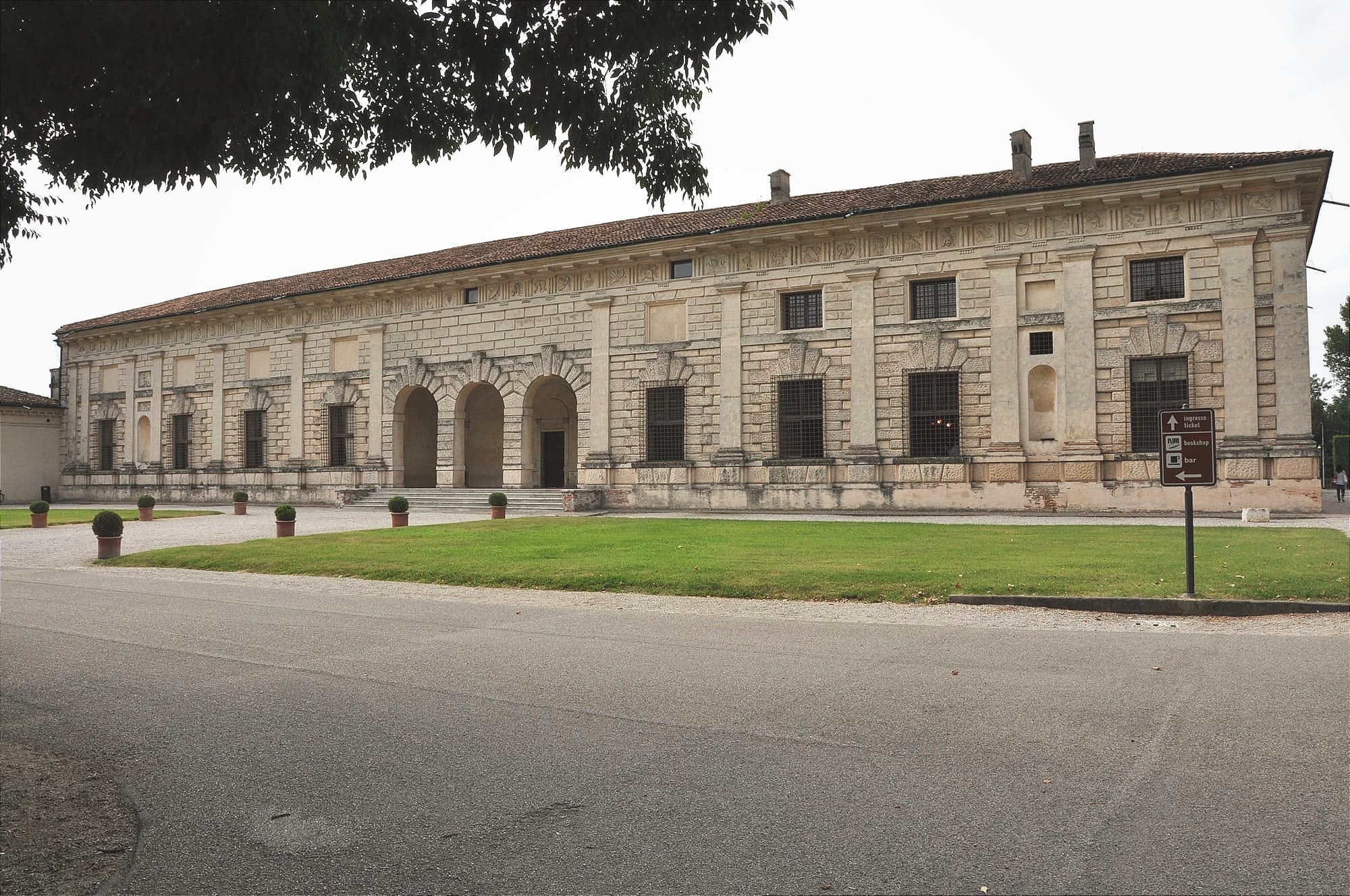
Palazzo Te stands outside the walls of Mantua, twenty minutes' walk from the station, in an area that today is peripheral and was once an island — the Teieto, a strip of land in the water south of the city. A place for horses, for leisure, for decorous idleness away from the obligations of court.
The water needs explaining, because it is neither natural nor the Gonzaga's. In 1190 the Comune of Mantua hired a hydraulic engineer from Bergamo, Alberto Pitentino, and asked him to make the city impossible to take. He dammed the Mincio — the river that comes down from Lake Garda — into four lakes: Superiore, di Mezzo, Inferiore, Paiolo. Mantua became an island, reachable by two bridges, and stayed one for centuries. This is one of the great works of medieval engineering, and it is a hundred and thirty-eight years older than the Gonzaga, who seized the city in 1328. They did not build the water. They inherited it, the way you inherit a house with good foundations, and then spent three hundred years decorating what somebody else had made possible.
Strategically it is perfect and it is also, as anyone who has spent an August evening here knows, a swamp with a reputation to protect. Still water in the Po valley is still water. In the seventeenth century the Mincio silted the lakes into malarial marsh; by the mid-1700s the Paiolo, the southern lake, had been drained. That is why Palazzo Te is peripheral today: the villa never moved, the water left. The island is landlocked, and the city is a peninsula pretending to remember being an island.
What survives is one of the most important wetlands in northern Italy — a nature reserve since long before anyone used the phrase, protected for its birds: red herons, night herons, little egrets, bitterns, marsh harriers, some three hundred species passing through or staying. And, spread across the Lago Superiore in floating islands that flower every July, the lotus. It is from India. Somebody put it in the water in 1921. It is magnificent, it is photographed by everybody, and it is officially classed as a weed.
Nothing in this landscape is what it claims to be. The lakes are a machine. The flowers are stowaways. And a kilometre south, a palace built of brick is doing an impression of one built of stone. Giulio Romano did not invent Mantuan artifice. He inherited that too. What he did was make it admit it.
Federico II Gonzaga commissioned it in 1524 from a twenty-five-year-old Roman newly arrived in the city: Giulio Pippi de' Jannuzzi, known as Giulio Romano, Raphael's favourite pupil.
In 1530 Charles V came to Mantua. He arrived on 24 March, stayed the better part of a month, and on 2 April Federico received him at the Te — the site still open, Giulio Romano directing the entire spectacle. On 8 April, in solemn ceremony, the emperor made him Duke of Mantua. The sequence invites a story in which the palace won the title, and the guides tell it. It is worth resisting: the dukedom was payment for an alliance Federico had been working on for years. But he chose this building as the room to be seen in — and that is the measure of what had been built. The complex itself would not be finished for another five years.
The Facade That Lies
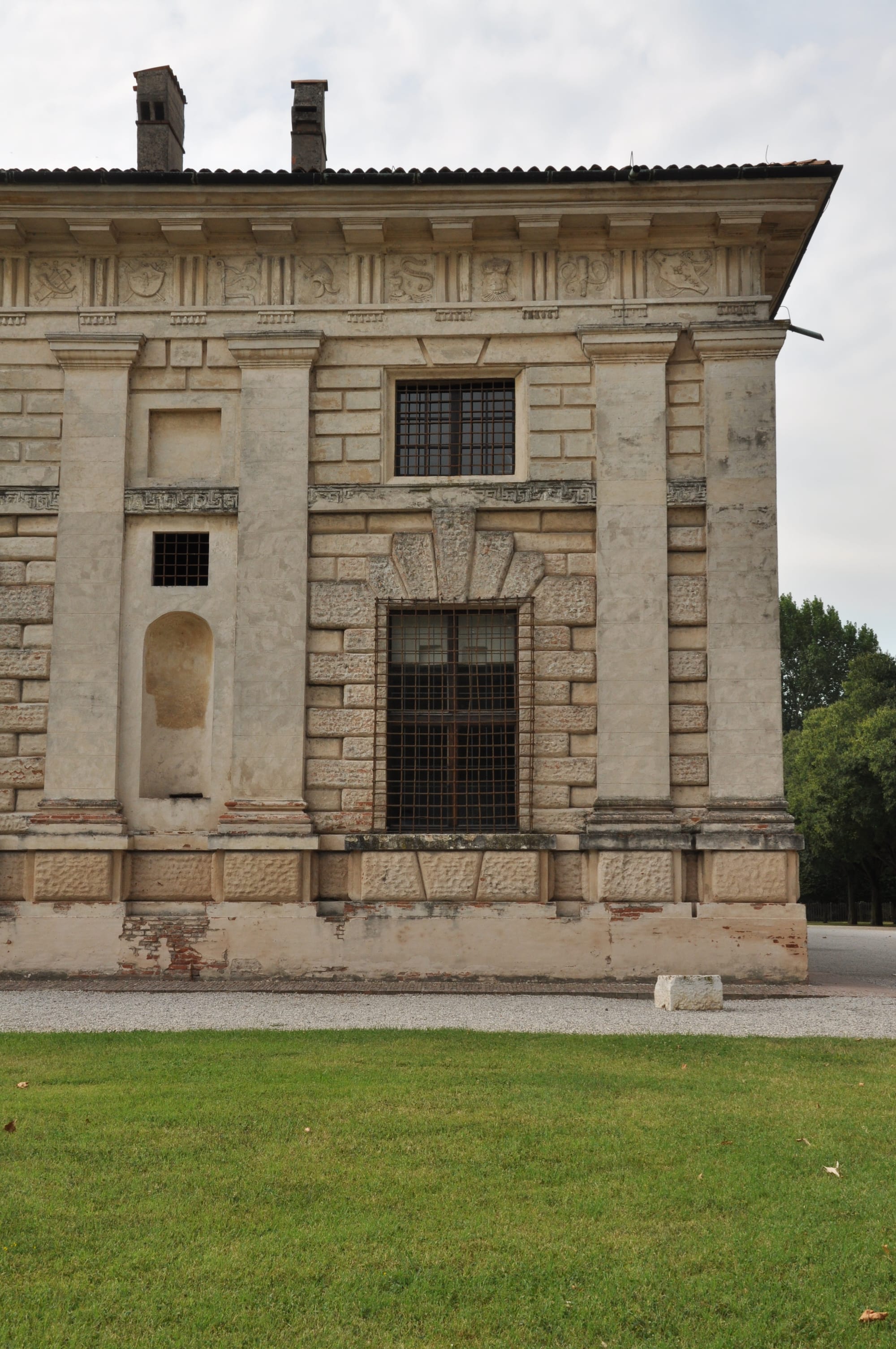
The facade is the first deception.
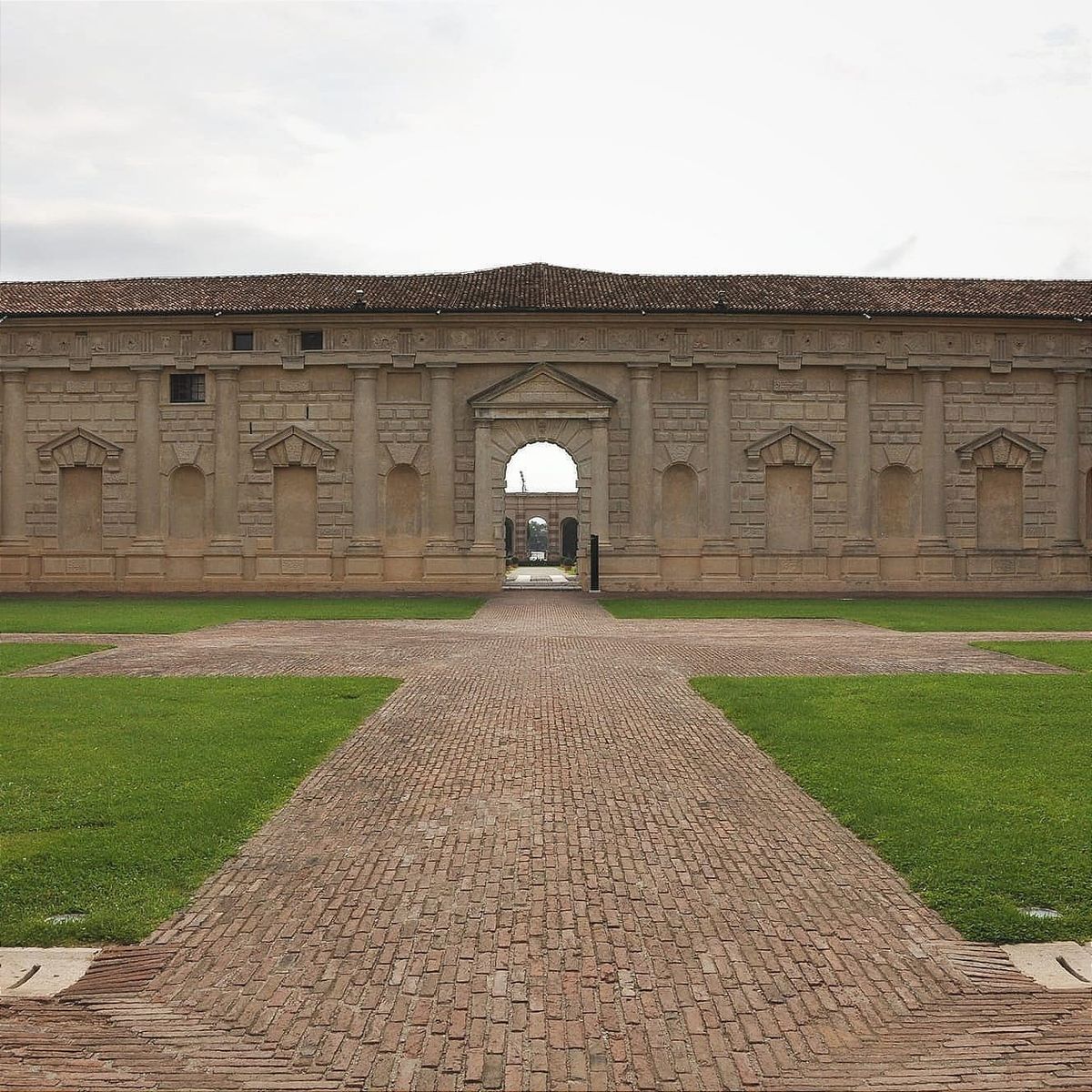
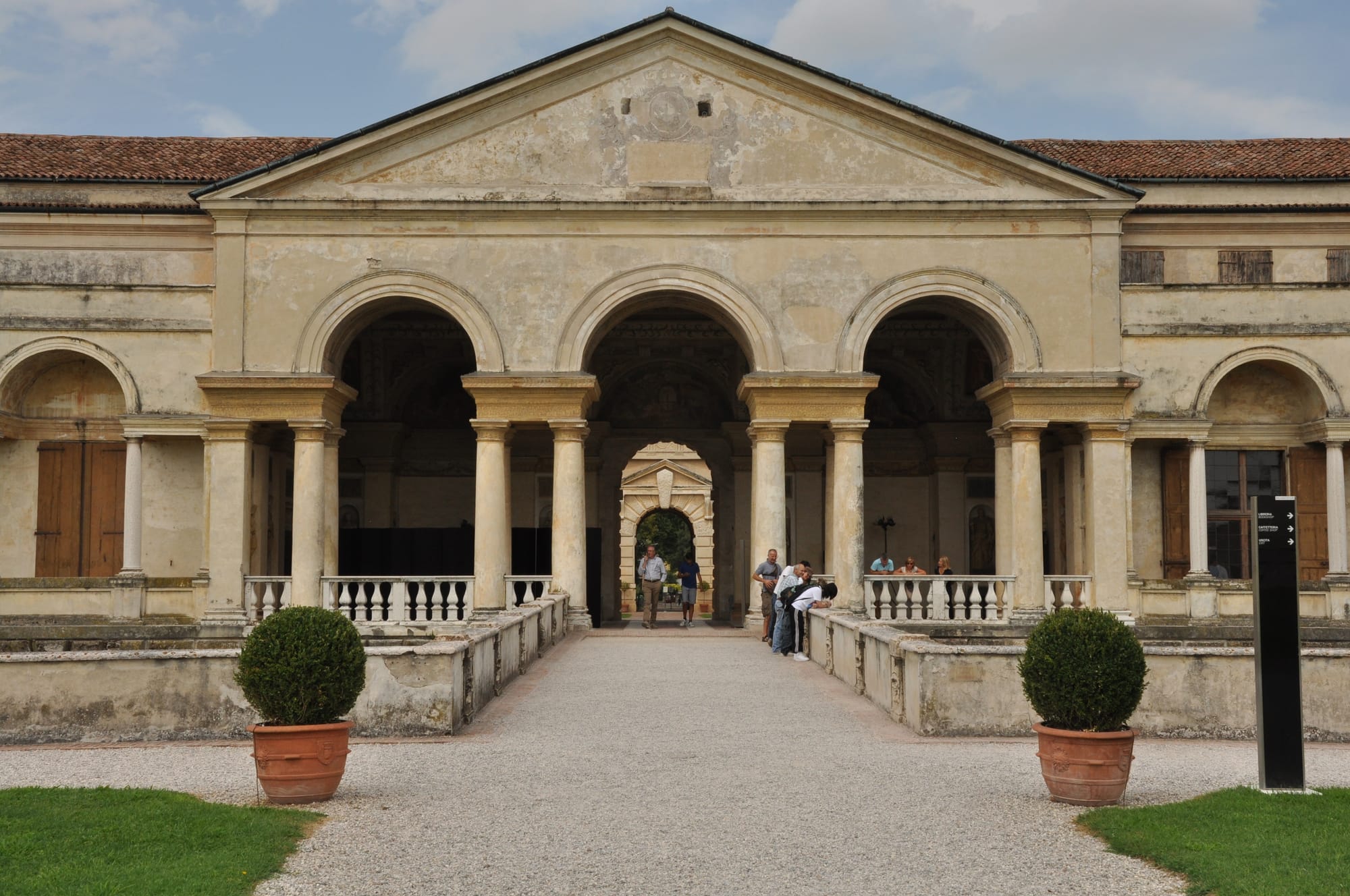
A giant Tuscan order, smooth pilasters on a high base, a Doric frieze with triglyphs and metopes. Classical. Composed. The kind of architecture Vitruvius would have approved of — or so it seems. But look at what the wall is made of. The blocks are not stone: they are brick and plaster, tooled and painted to imitate cut stone. And the rustication does not run evenly — a string course divides the rough lower register from the smooth one above, an alternation no orthodox classicist would have permitted. The palace's solidity is a material fiction. The building that looks the most massive is the lightest thing here, ordinary technique dressed as monumentality.
That is the first lie, and it is a polite one. The real breach happens once you cross the threshold and step into the Cortile d'Onore.
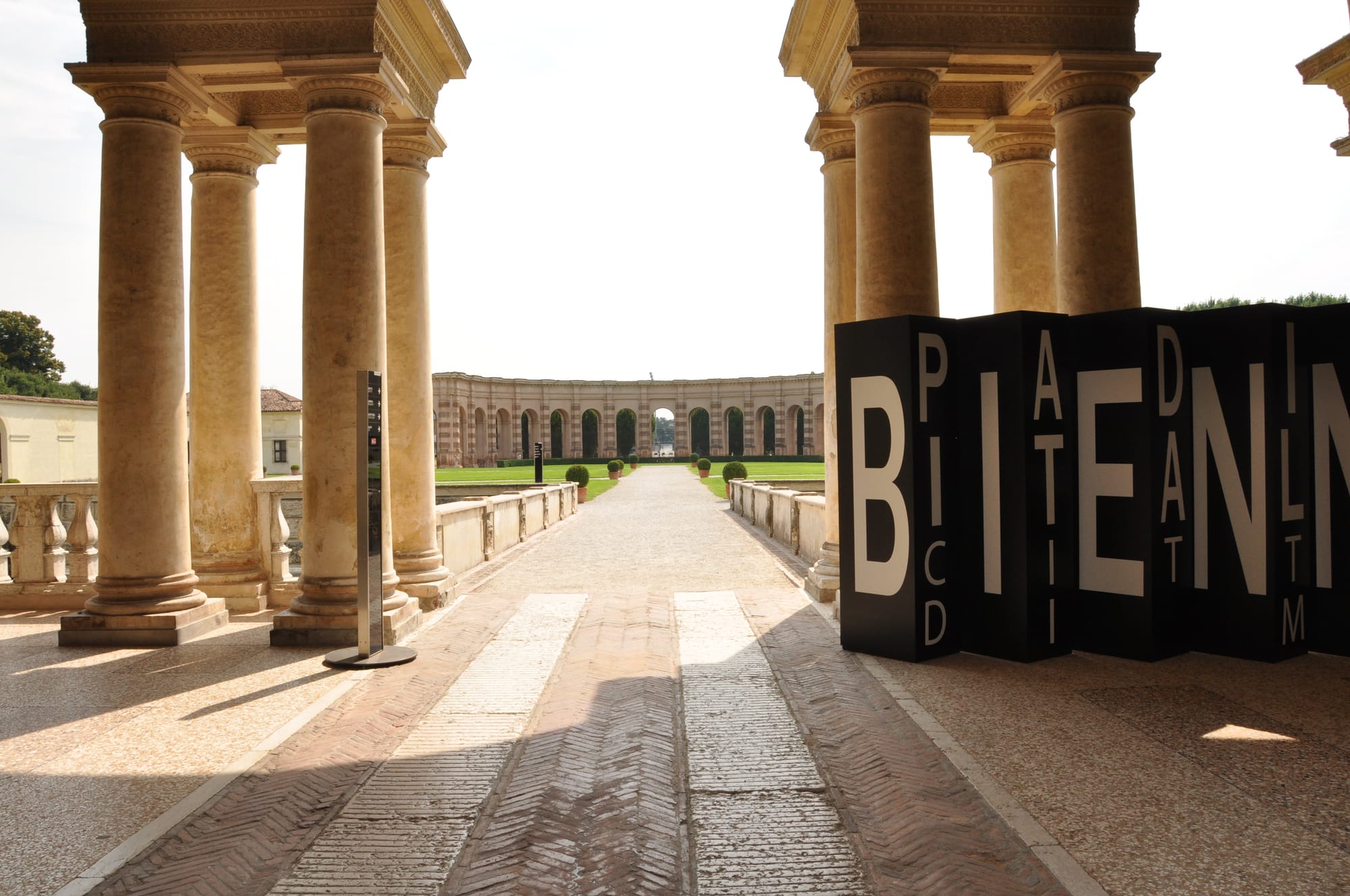
The order changes here: half-columns instead of pilasters, the same false ashlar, a Doric entablature running round all four sides. Look up at the two sides where the portals open — the one you came through, and the one leading to the Loggia di Davide. In the middle of each bay a triglyph has slipped. It has dropped below the line of the frieze and hangs there, like a keystone working loose from an arch. The entablature is coming apart. It has been coming apart for five hundred years.
Giulio is not solving a problem here, and he is not pretending to. He has taken the element that in a Greek temple was the petrified memory of a timber beam-end — the piece whose entire job is to say here the structure rests — and made it fall. The wall quotes a ruin while standing perfectly still. The portals do the same thing: pediments cracked open at the apex, keystones shoving up through them, order failing on cue and going nowhere.
This is not ignorance. It is deliberate misquotation.
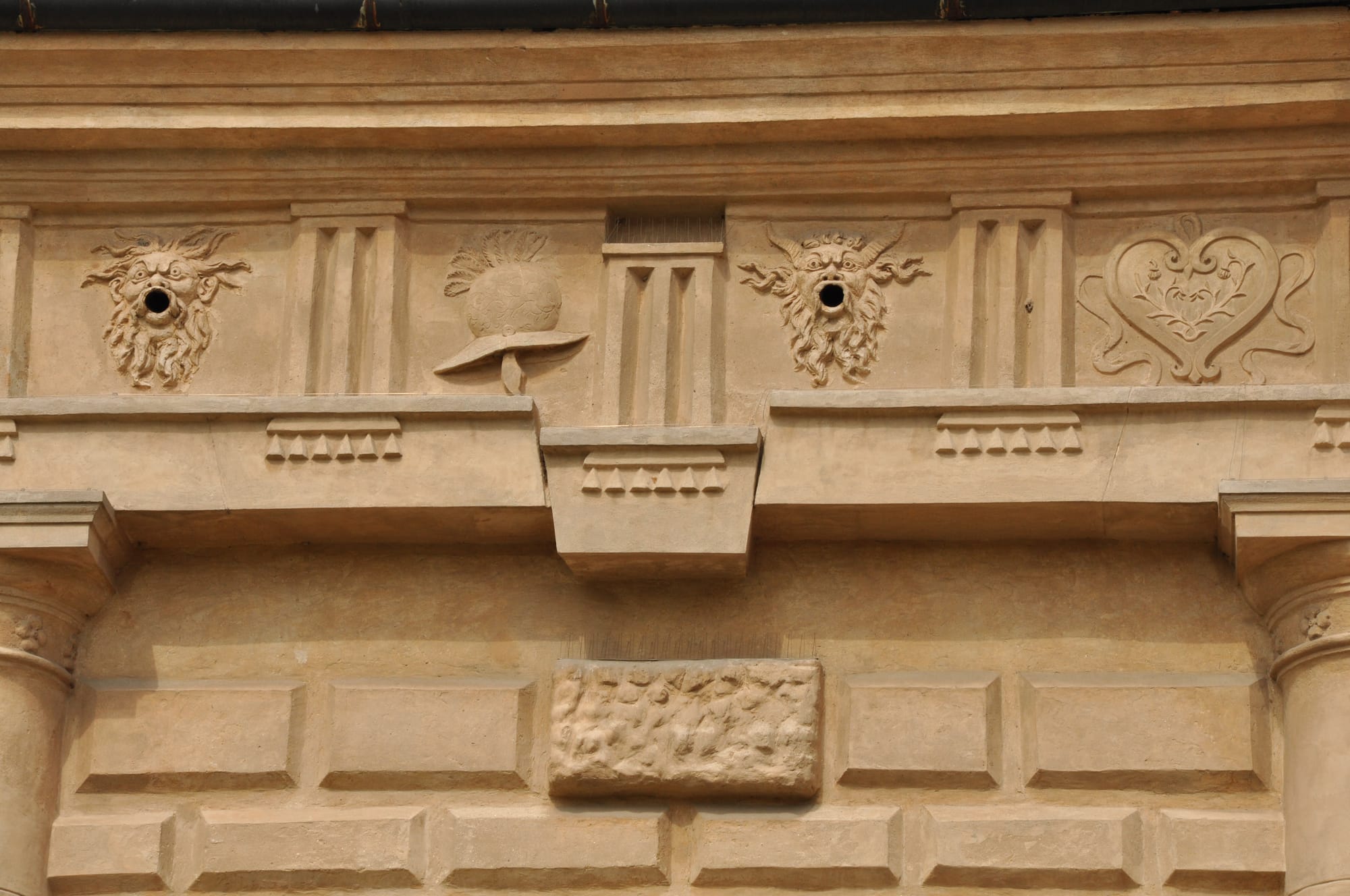
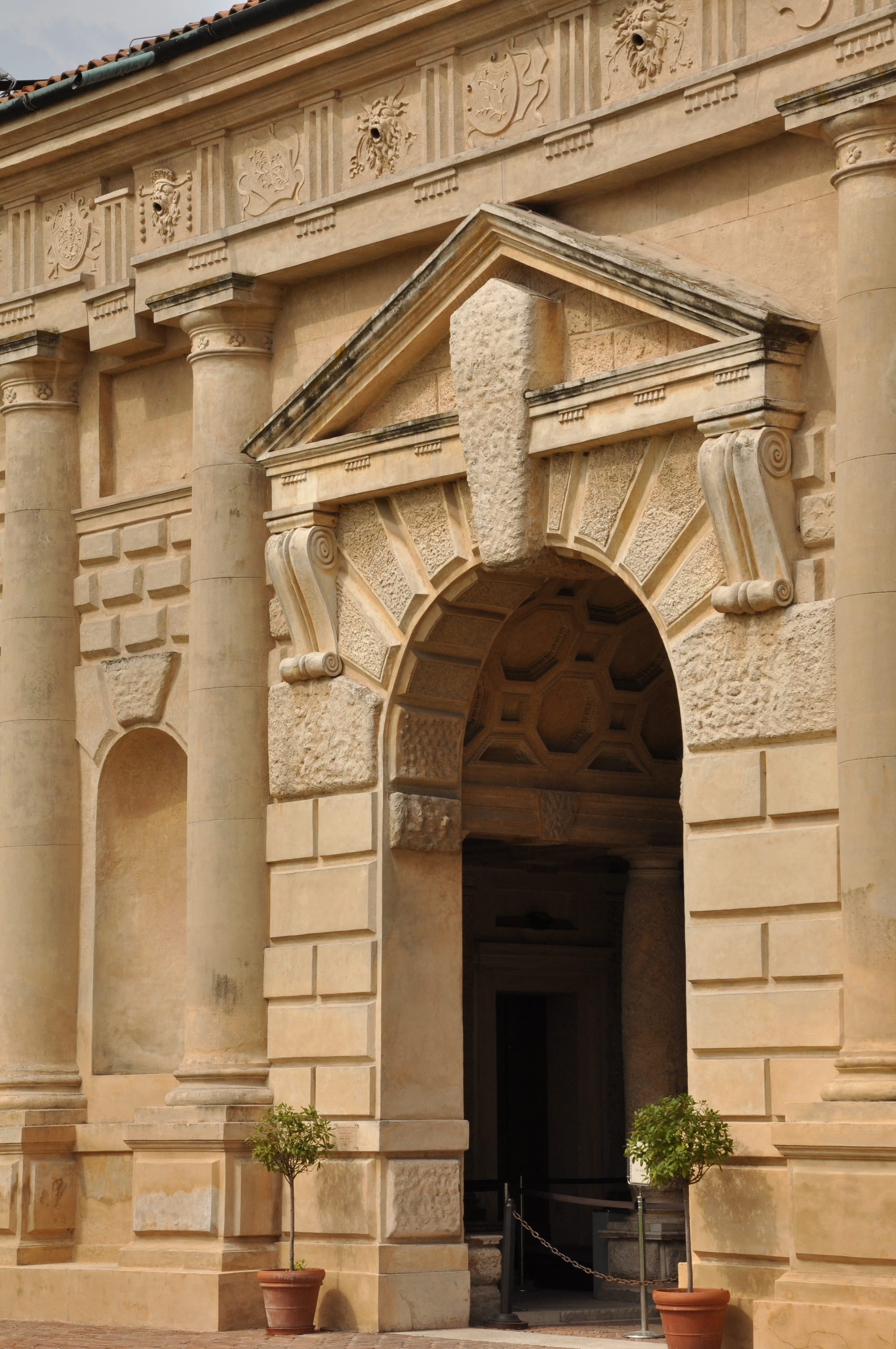
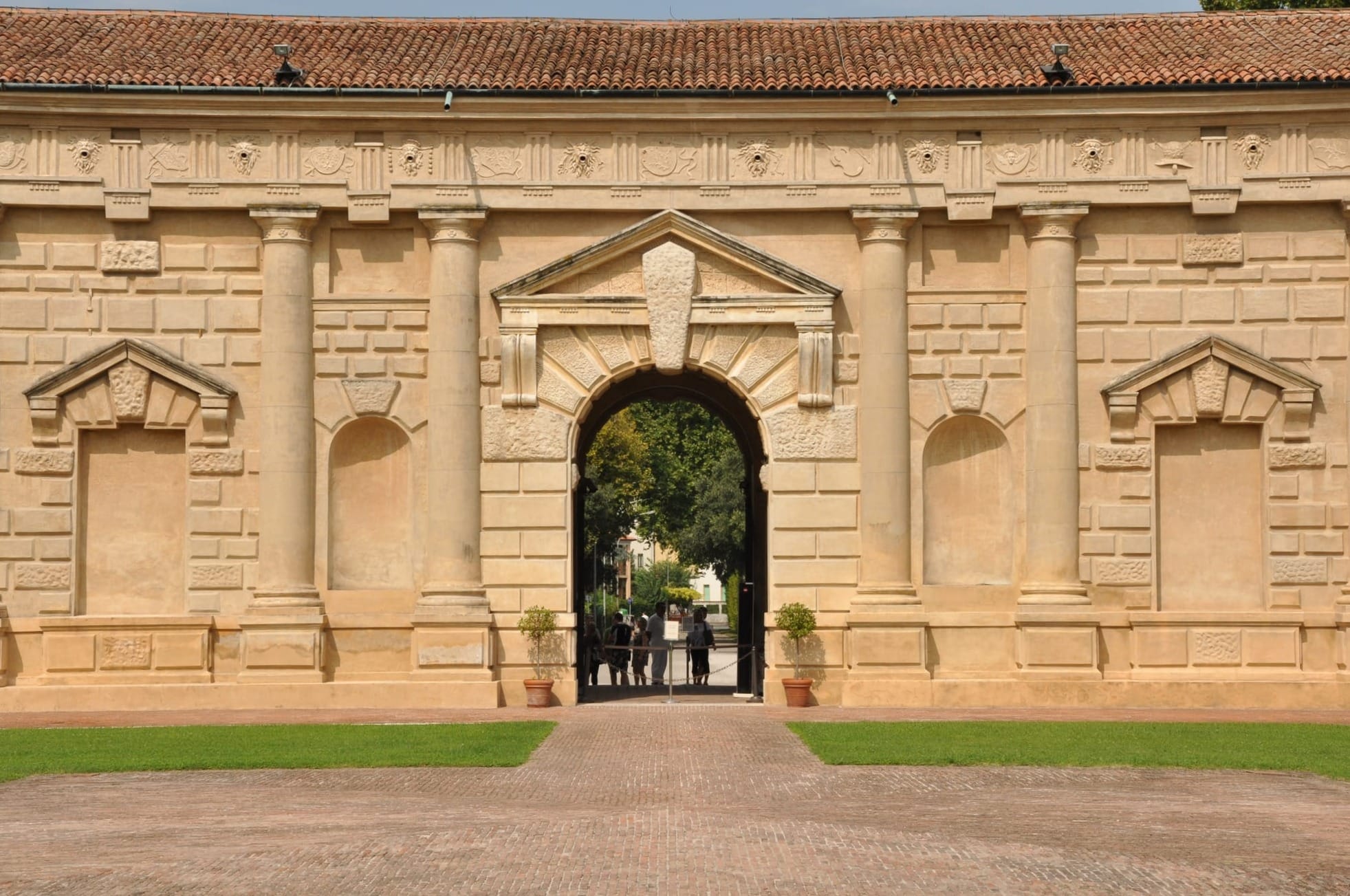
Sebastiano Serlio, Giulio Romano's contemporary, already had the words to describe what was happening at Palazzo Te: the relationship between rule and licence. Classicism as a system of shared rules — proportions, orders, relationships — and licence as the conscious deviation from those rules, possible only for someone who knows them well enough to bend them without breaking them.
I remember something I read years ago, in an essay on literary theory — the kind of book that has nothing to do with architecture and stays with you precisely for that reason. It said that writers, when they innovate, work on two planes: the lexicon and the concepts. And that the great ones never change both at once. They hold one steady — the words the reader knows, or the ideas the reader expects — and work on the other. Changing both together produces noise, not literature: the reader no longer has a fixed point from which to orient themselves.
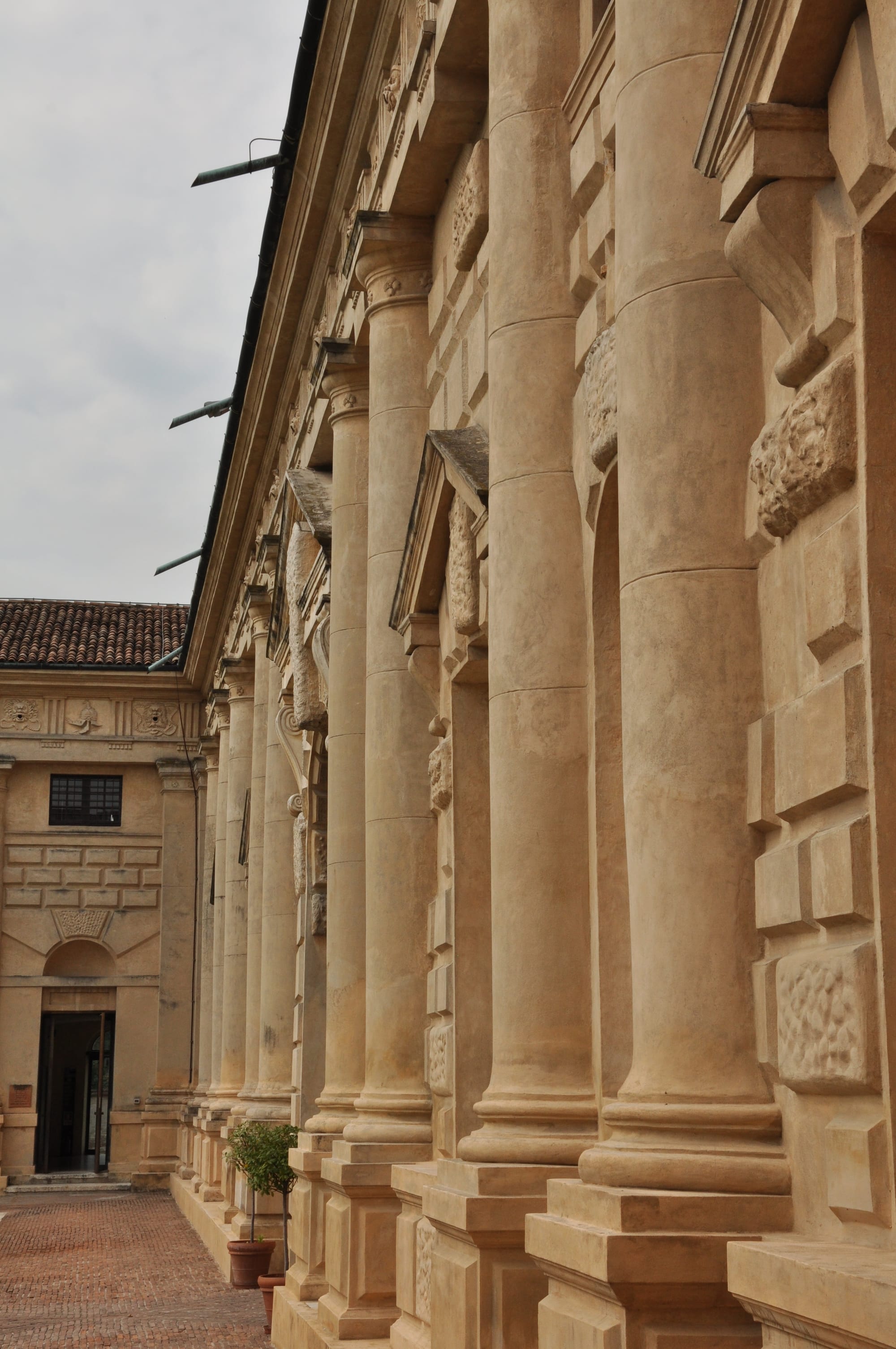
The same holds for architecture. Giulio Romano at Palazzo Te holds the vocabulary steady — Tuscan order, triglyphs, rustication, recognisable proportions — and works on the intention. He uses the right words to say the wrong thing. Or better: he uses the words of order to speak of something that order cannot contain. Not a rebellion against classicism — a dialogue with it, tight, ironic, at times cruel.
Why Mantua
To understand Palazzo Te you have to step back. And ask not only what Giulio Romano built, but why he built it here.
Rome, 1520. Raphael dies at thirty-seven, leaving the Vatican Stanze unfinished and a workshop full of pupils trained at the moment of maximum confidence in the classical system. Giulio Romano is the most gifted, the closest to the master. He completes the Sala di Costantino, reorganises the open worksites, inherits the responsibility of the workshop. But he also inherits something harder to manage: the master's shadow over everything he does.
In Rome, after Raphael, Giulio Romano cannot be anything other than Raphael's pupil. The city pins him to that identity. Every choice is measured against the master's model — and any deviation is read as error or betrayal, not as autonomous language. Already in the Sala di Costantino, completing Raphael's project, Giulio modifies the original plans in a tenser, more unstable, more restless direction. He does it while still in Rome, but Rome does not have the tools to read that deviation as invention. It reads it as excess.
In 1524 Federico II Gonzaga calls him to Mantua. Giulio accepts, and it is not hard to see why: Mantua is small, provincial, far from the centre — and for precisely that reason it is free. In Mantua he becomes "Giulio Romano" for the first time, identified by the place he comes from rather than the master he comes from. For the first time he has a name of his own.
In 1527, three years after his arrival, the troops of Charles V sack Rome. In a few days, the city that had produced Raphael, the Stanze, Villa Madama, is destroyed. Artists flee in every direction. The cultural centre of the Italian world ceases to exist as such within weeks.
Giulio Romano is in Mantua, safe, with the Palazzo Te worksite open. In 1530, when Charles V is received at the Te with the worksite still open, the emperor who destroyed Rome is entertained in the palace built by Raphael's heir. The system Rome had failed to contain finds its definitive space in a provincial city, far from the centre.
The Chamber of the Giants is completed between 1532 and 1535. Jupiter destroying the rebels with thunderbolts. Architecture collapsing. A world ending.
There is no need to establish a direct equivalence — the iconography of the Gigantomachy had a long history before Giulio Romano. But a man who had to leave his own city to find the freedom to be himself, who then watched that city destroy itself, and who paints the fall of those who dared to challenge divine order in a room that negates itself as architecture — that man knows something about the fragility of systems that cannot be learned from books.
Rule and licence are not only an intellectual position. They are also a question: how far can an order bend, before it collapses? And to keep that question open — to be able to build it, stone by false stone — Giulio Romano needed to be far enough from the centre to answer to nobody.
Inside
The interiors proceed by degrees.
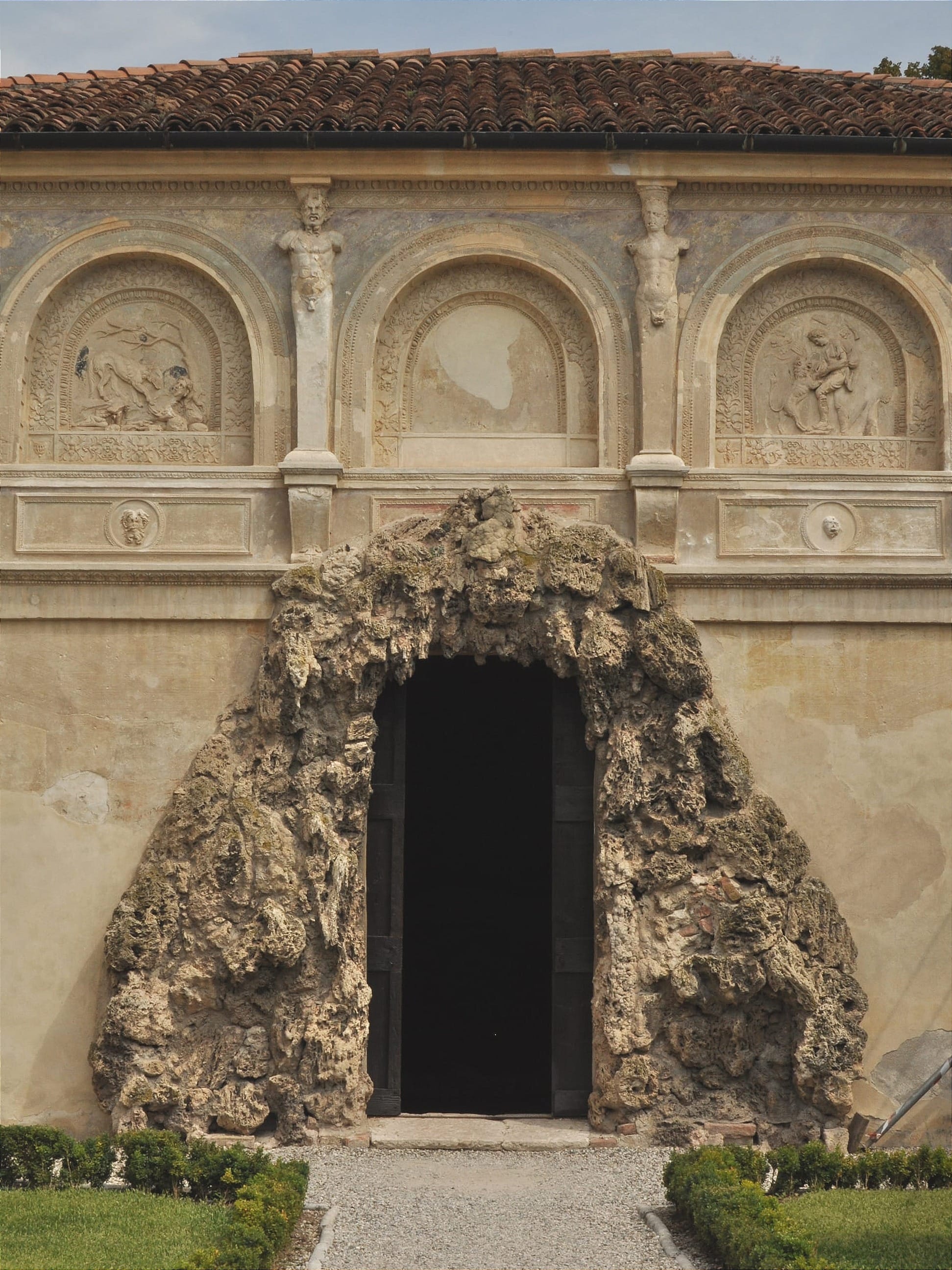
The grotesque rooms, the octagonal vestibule, the loggias — refined spaces, where architecture is still present as a frame, where painting decorates without subverting. They are the corridor. The preparation. The palace accustoming you to a rhythm before changing it.
The Chamber of Cupid and Psyche is already a step further: the painting invades the surfaces, the figures escape their frames, the boundary between architecture and decoration begins to grow porous. But the walls are still walls.
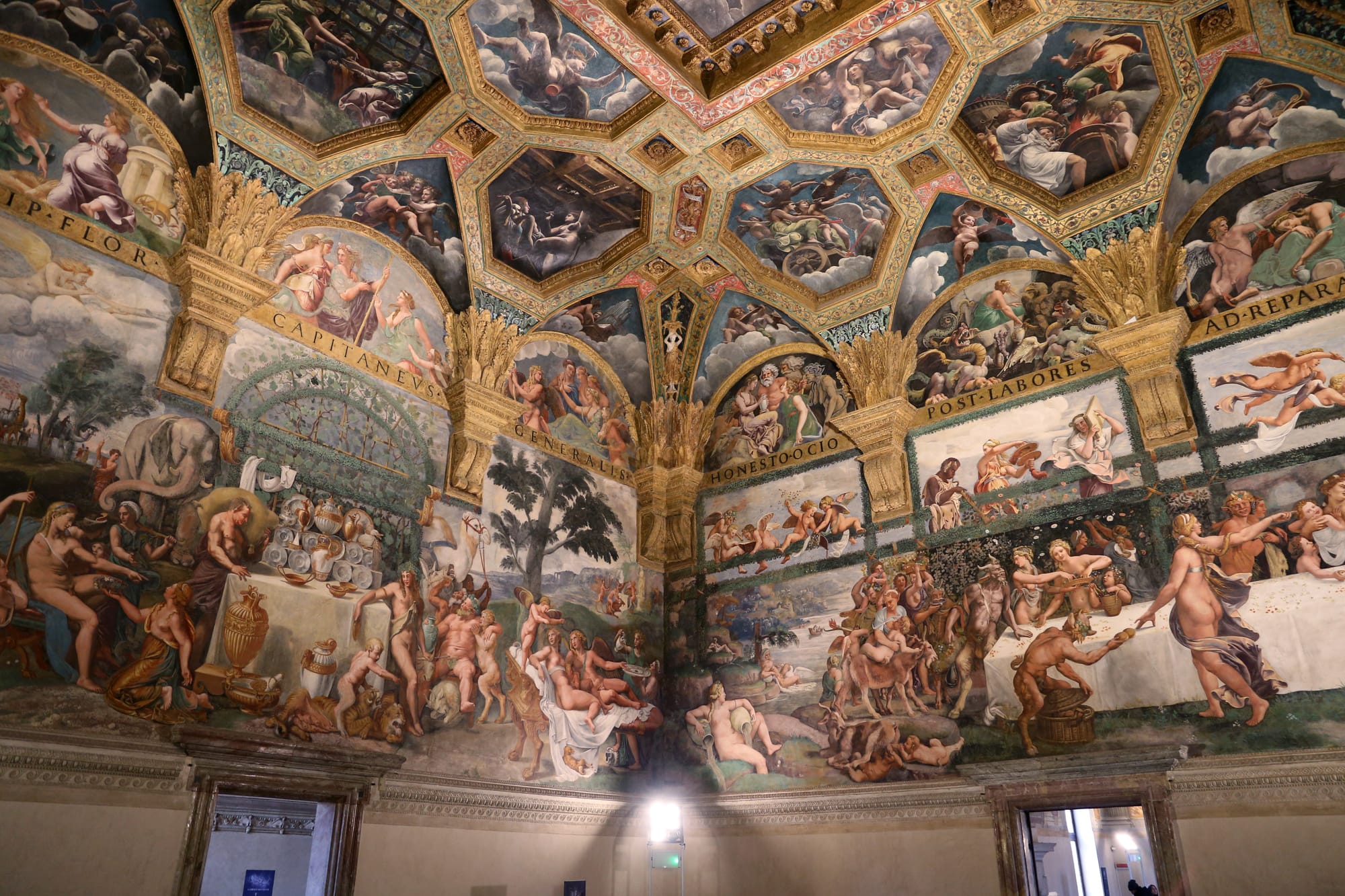
Then you reach the Chamber of the Giants.
It is the only room in the palace without plastic decoration. Giulio Romano rounded off the edges between the walls and the ceiling so that the painting would find no physical interruptions, would meet no architectural limits. The result is a room without corners — or rather, with corners you cannot see because they are covered in sky, in rocks, in falling figures.
The painting covers everything. Floor, walls, vault — a single continuous fresco that places the viewer at the centre of the Gigantomachy: the fall of the Giants punished by Jupiter for attempting to scale Olympus. Rocks collapsing. Columns snapping. Bodies contorting with grotesque, dishevelled expressions, ugly with an ugliness that is part of the programme. Vasari searched for the words and wrote that no work of the brush more horrible and frightening could ever be seen.
The room's fireplace, when a fire is lit in it, shows the giants burning — their crushed bodies painted around the real flame, physical heat becoming part of the fresco. The floor was originally made of river pebbles that continued, painted, up the base of the walls. The distinction between real and represented was erased even underfoot.
Whisper in one corner of the room and you can be heard in the opposite corner. The acoustics are part of the design. The palace deceives the eyes, deceives the hands, deceives the ears.
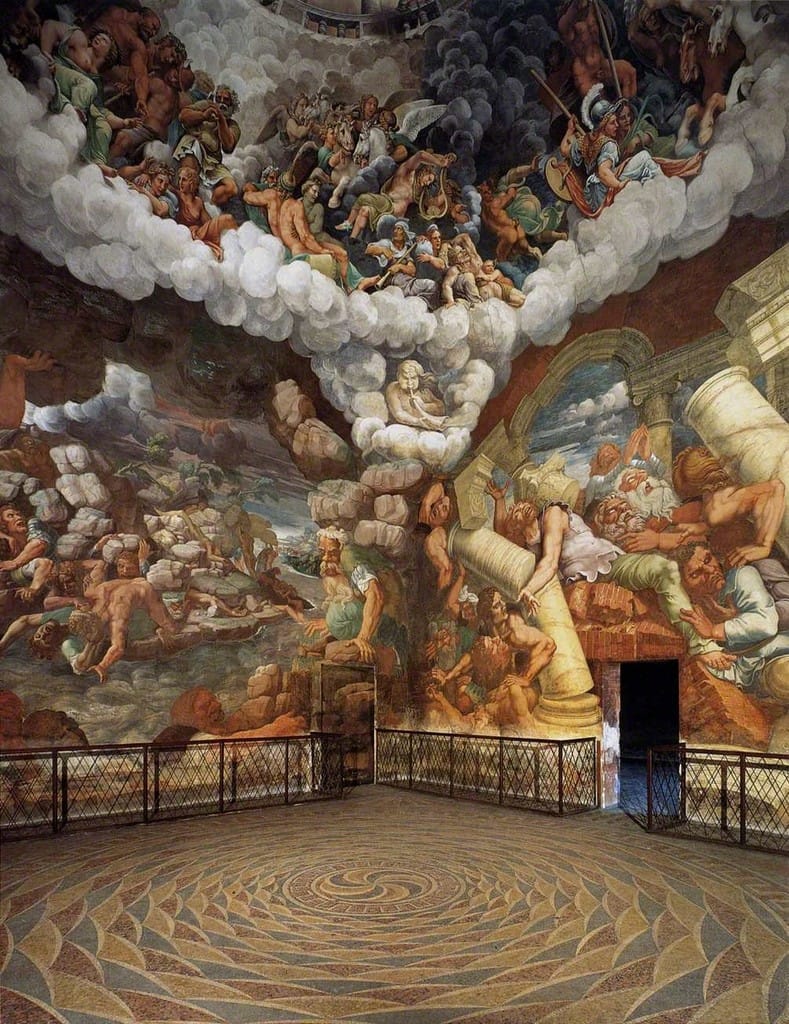
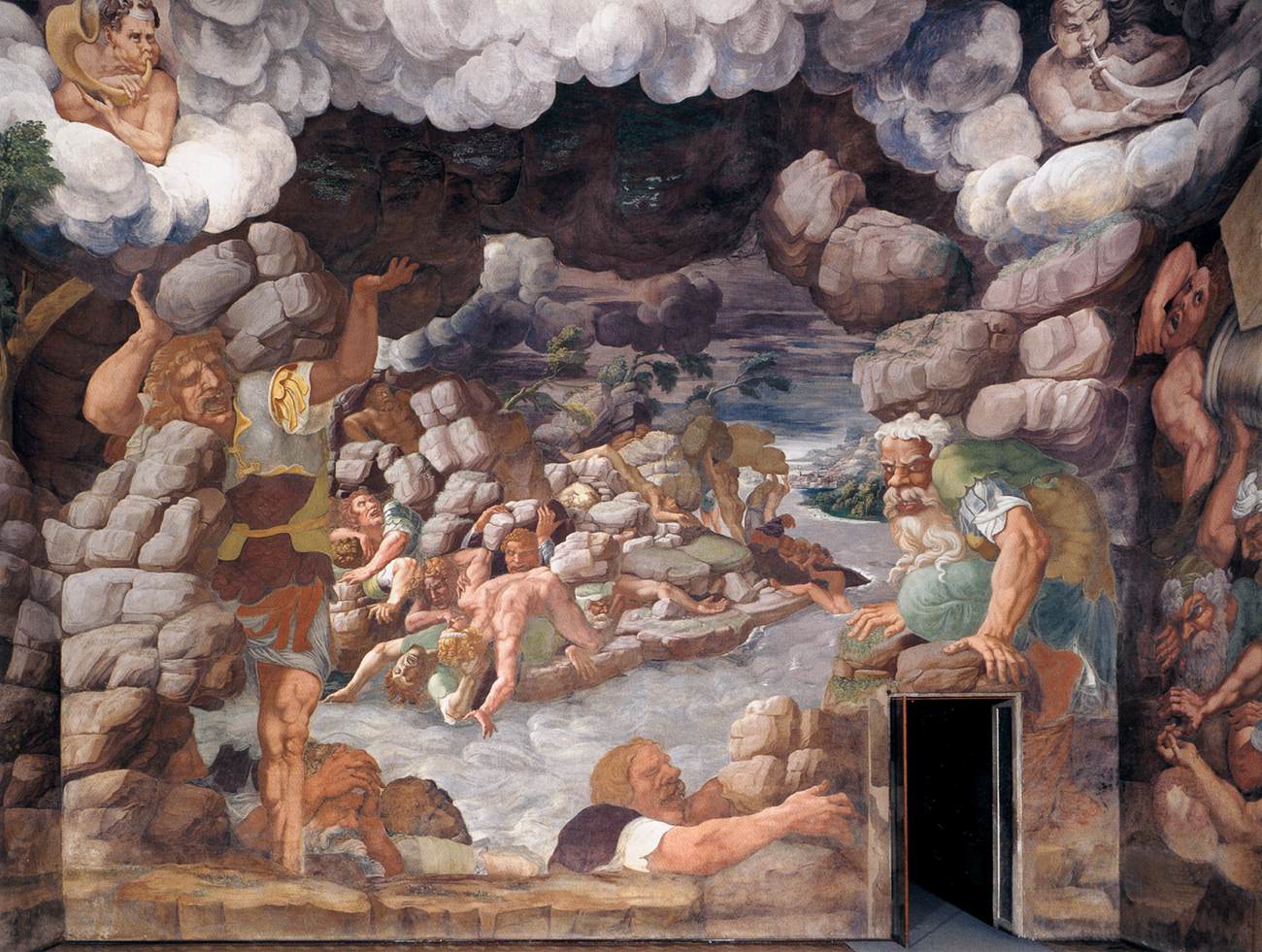
Here the principle of rule and licence reaches its logical conclusion. The palace no longer holds anything steady. The rule that had remained fixed — architecture as container, as the system that organises space — is negated by the painting. The container becomes the content. The building quotes itself in order to dissolve.
What the Books Don't Give You
The thing no essay can transmit is the physical experience of the moment when you understand all of this in your body instead of your head.
That August day the Chamber of the Giants was empty. No groups, no guides, no murmur — only the heat pressing from outside and that room which had been collapsing for five centuries without ever finishing its collapse. At some point Kat moved on to the next room. I did not notice her go, and I could not say how long I stood there. I know that at a certain point I stopped looking for the details I knew from the books and simply let the room do what it had been built to do.
The rocks fall. The ceiling collapses. The walls multiply in the painting, lose their edges, stop being surfaces and become space. You feel the artifice as sensory fact, not as concept.
And you understand that rule and licence are not historical categories. They are the structure of any language that wants to say something not banal. Hold steady what your interlocutor knows. Then move, within that margin of trust you have built, toward the place where the words you both know begin to mean something different.
Giulio Romano knew how to do this with pilasters and triglyphs. He had learned the system from the best, in a city that left him no room to go beyond it. Then he went elsewhere. And there, in a provincial city on a reclaimed island, he built one of the most radical things of the Italian Renaissance.
They call it Mannerism. But the principle has always been the same.
There is a reason this blog is signed with his name. I won't explain it — if you have read this far, you already understand.
Practical Notes
Mantua is reached by train from Verona in about 45 minutes, from Milan in a little over two hours — there is no fast line, only the appearance of one on the booking sites. Palazzo Te is twenty minutes' walk from the station, and the walk through the historic centre is worth it. Open Monday 9am–7pm, Tuesday 1pm–7pm, Wednesday to Sunday 9am–7pm, last entry one hour before closing, closed only on 25 December — but check centropalazzote.it before you go. Give it at least two hours: the first for the courtyard and the grotesque rooms, the second for the Chamber of the Giants — go inside, wait until you stop photographing and start looking.
With children: yes, without reservation. The collapsing giants are not frightening — they do what children understand better than anyone: the world overturning its own rules.
Further Reading
The catalogue Giulio Romano, edited by Manfredo Tafuri and others for the great Mantua exhibition (Electa, 1989), remains the most complete scholarly reference. Not light reading, but the one that holds.
Ugo Bazzotti, Palazzo Te a Mantova (Skira) — the most rigorous and readable guide to the palace. To carry with you, or to read the day before.
Sebastiano Serlio, The Seven Books of Architecture — for anyone who wants to understand how Giulio Romano's contemporaries read the problem of rule and licence. Book IV, on the orders, is the starting point: it lays out the system exactly as it was meant to be obeyed, which is the only way to see how precisely Giulio disobeys it.
Vasari, The Lives of the Artists — the biography of Giulio Romano is long and passionate. Reading it after the visit changes the way you look at the rooms.