BOMARZO — THE GARDEN THAT DOESN'T EXPLAIN ITSELF
Every great sixteenth-century garden answers your questions before you ask them. Bomarzo doesn't. On the wood without an axis, and the grief that built it.
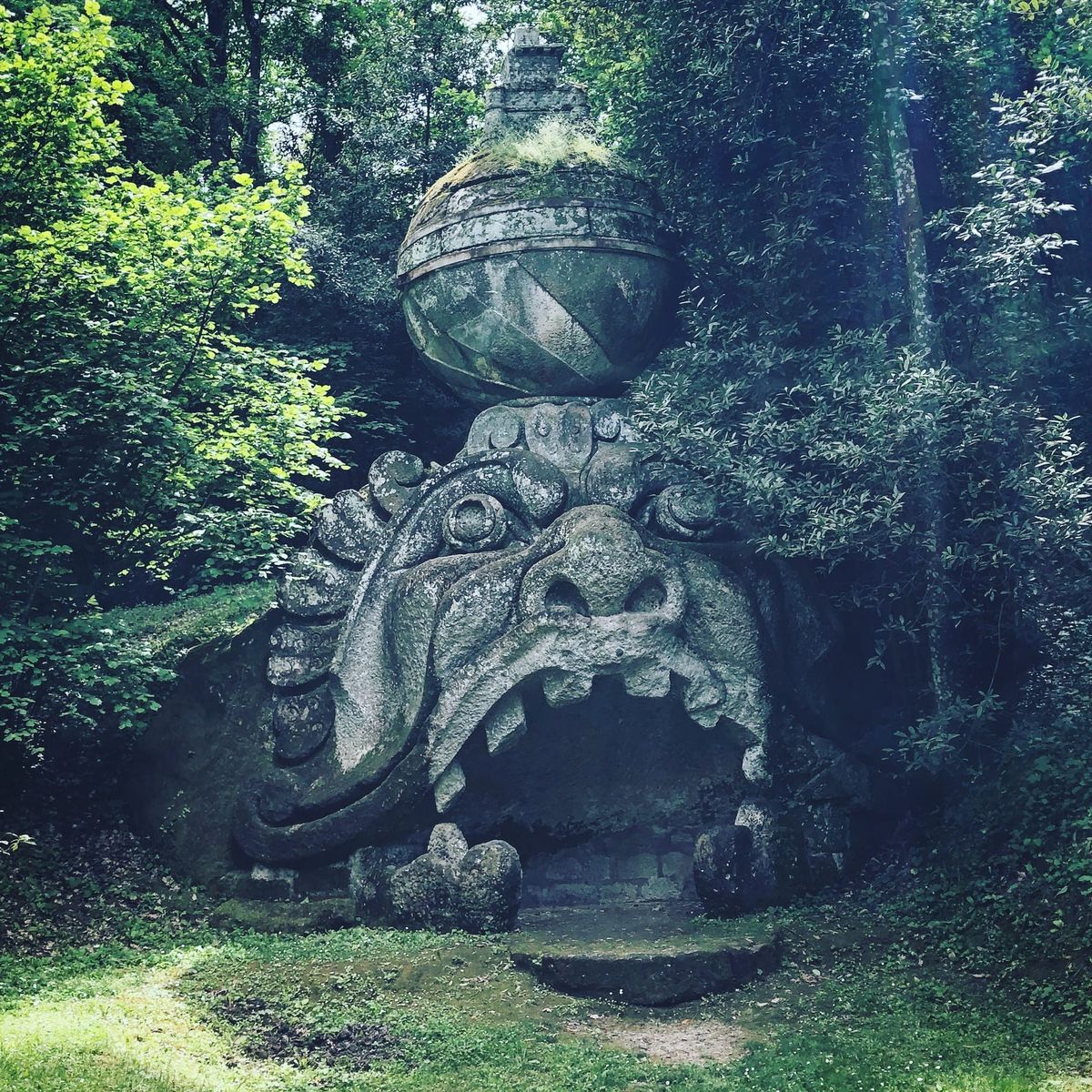
I arrived from a hot road, on a motorbike, with April already doing what summer does in other months. And then the gate, the wood, and in three steps a different temperature, a different smell, a different light. Moss, dense foliage, green grass becoming dark earth. The coolness of a place that didn't need the sun to be alive.
I hadn't seen anything yet. But something had already changed.
The sculptures don't reveal themselves all at once. They let themselves be discovered — one at a time, in glimpses, behind a curve in the path or at the end of a space that seemed empty. There is no point from which you can see them all, no perspective that organises them. You are already inside before you understand where you are, and when you see the first one — whichever it is, depending on where you walk — it is already too late to be objective.
If you are planning the trip, the practical guide is here.
Without an Axis
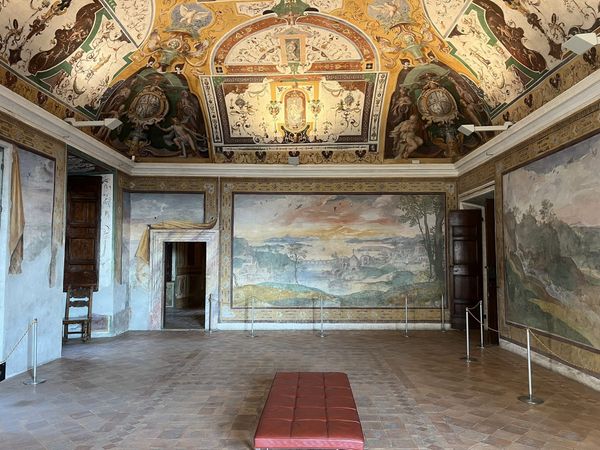
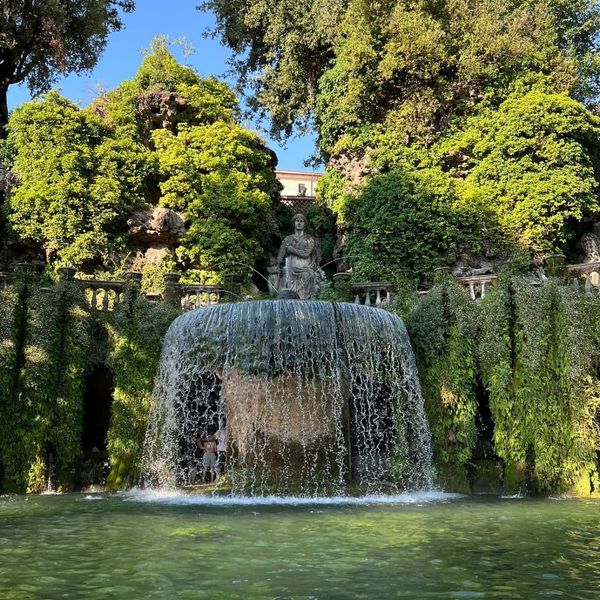
All the great gardens of the sixteenth century answer your questions before you ask them. Villa d'Este has an axis — you descend along a sequence of fountains and every step tells you where you are in the journey. Caprarola has the Via Diritta — thirty kilometres to the south, a family related by marriage, the same architects, and a road that points you at the palace from the bottom of the town without leaving room for doubt. Villa Lante at Bagnaia too: there is always an architecture of movement, an order that precedes you.
Here the path turns, breaks off, doubles back on itself. You can walk the wood clockwise or anticlockwise, start from the sphinxes or from the Orcus, stop for five minutes or fifty — and the experience changes radically each time, but none of the versions is the right one.
It takes a moment to understand that the absence of direction is not a deficiency.
The Stone Was Already Here
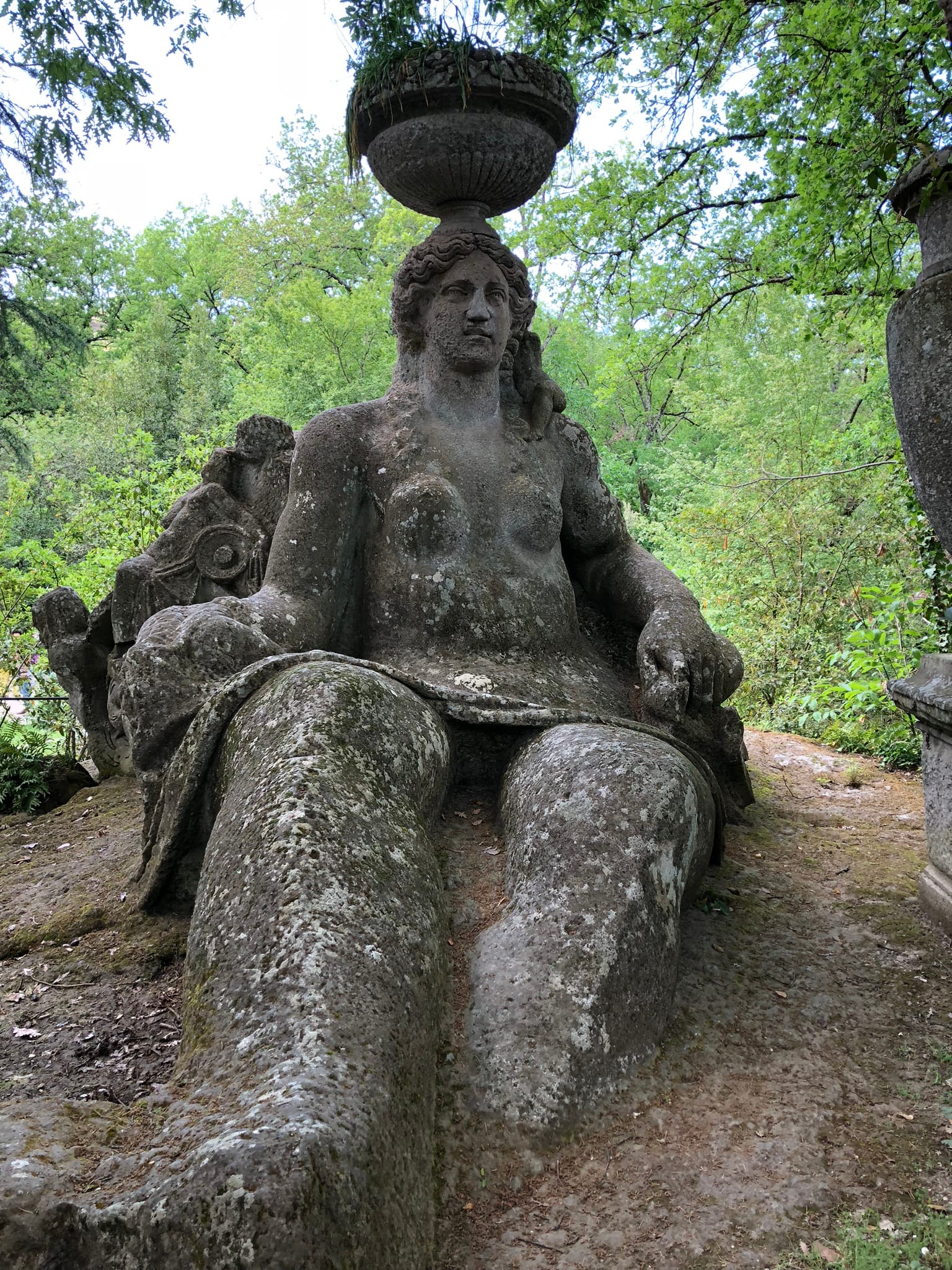
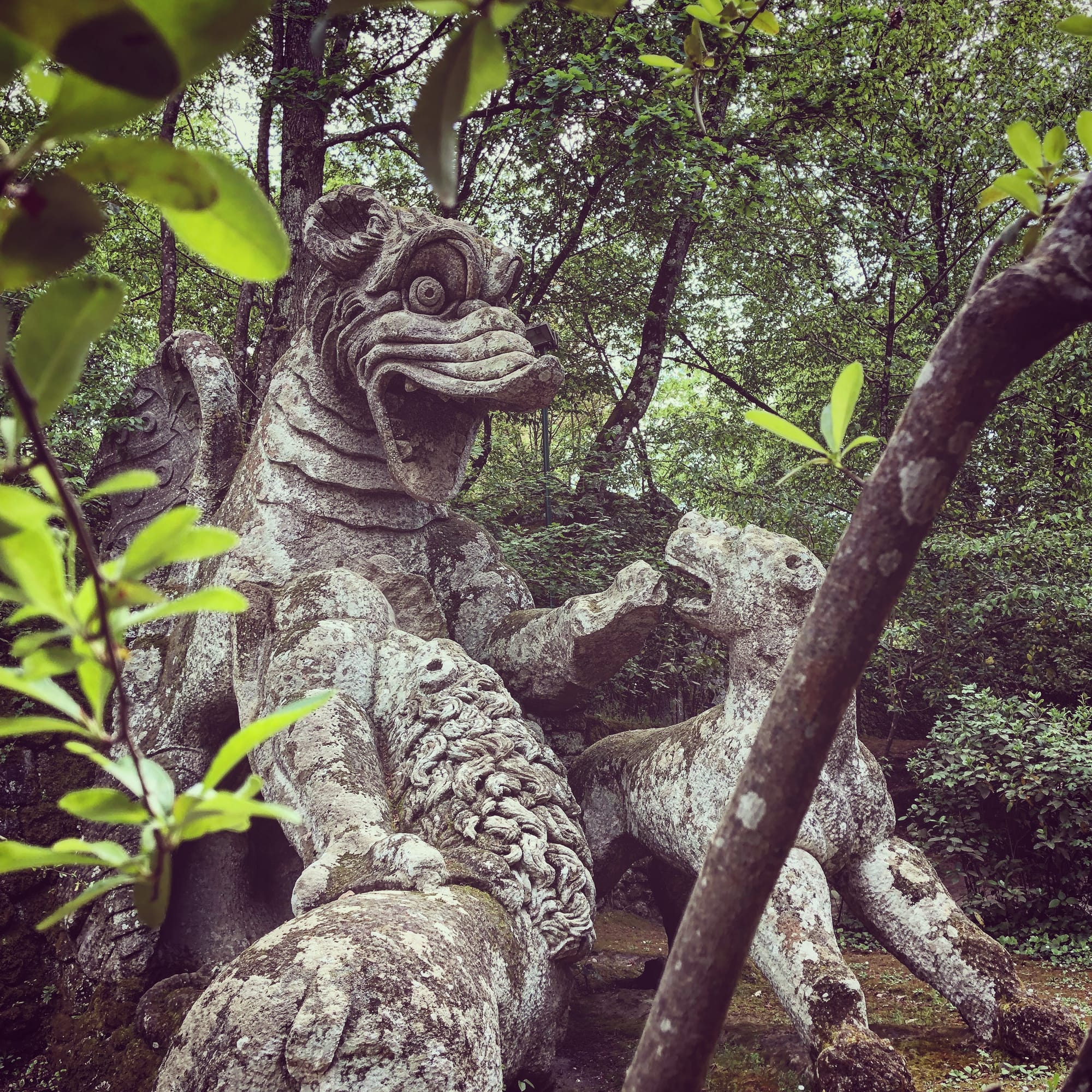
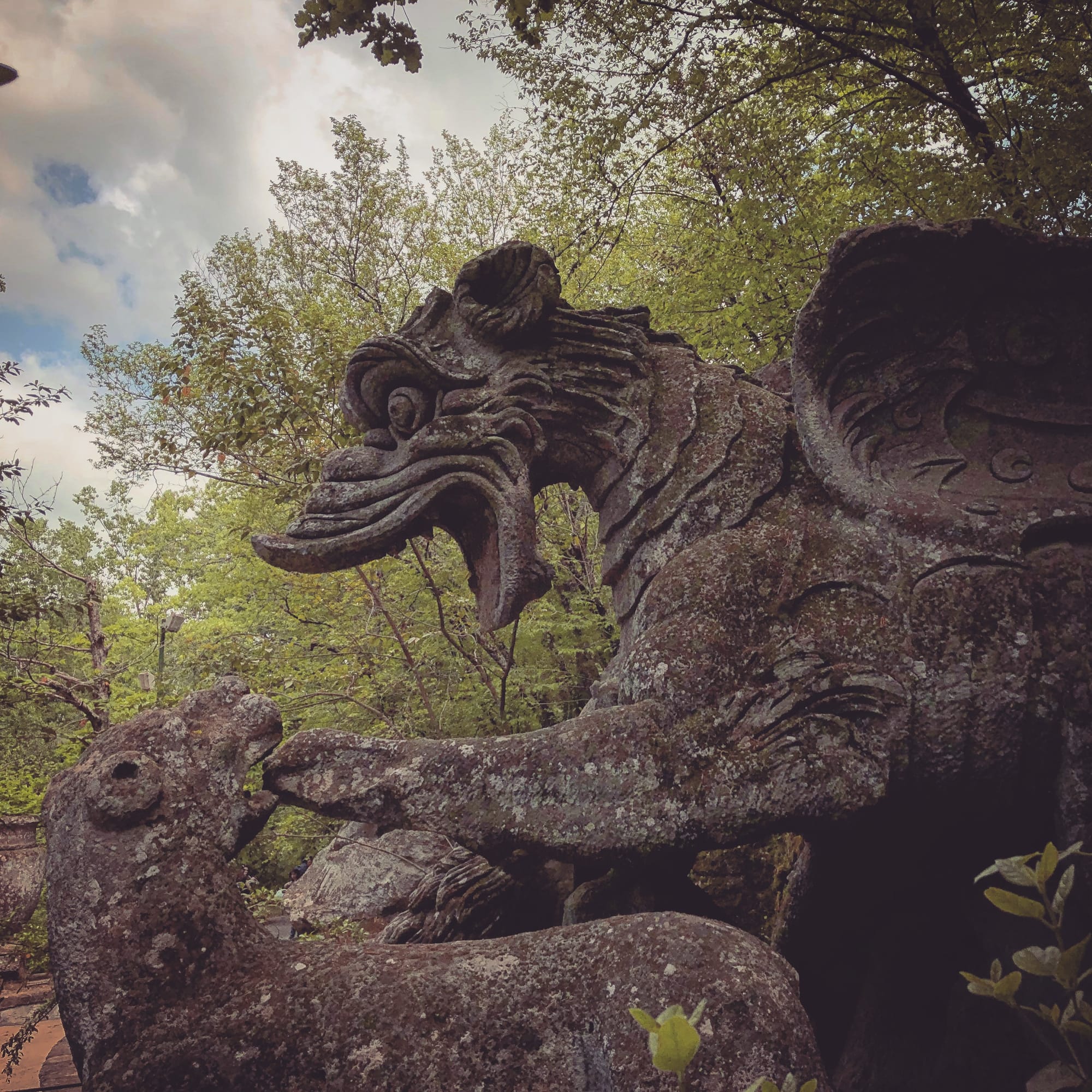
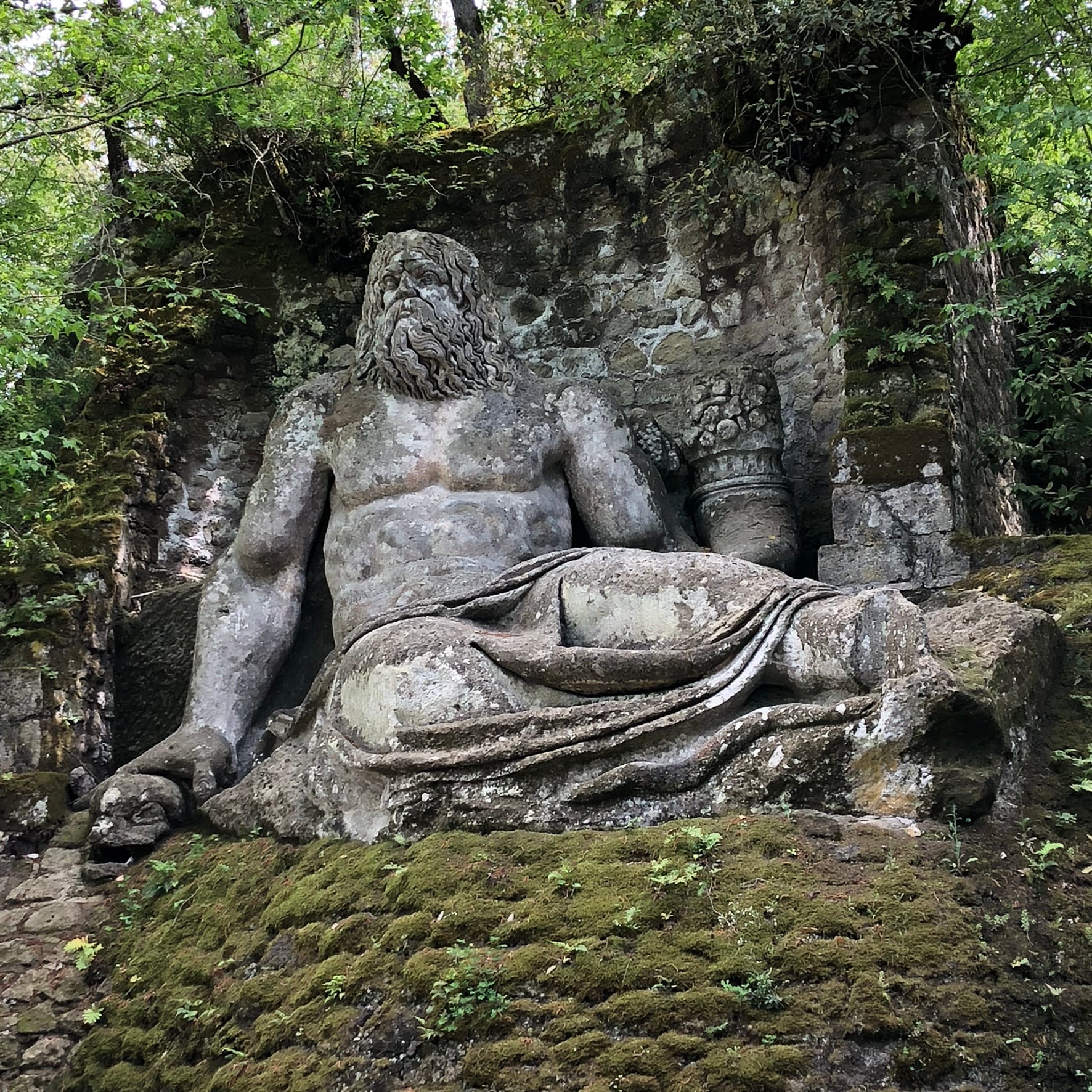
Touch the stone. It is peperino — local volcanic tufa, the same material as the soil beneath your feet, the rocks outcropping in the wood, the hills around Bomarzo. It was not brought here. It was already here.
Pirro Ligorio — the architect to whom the design is usually credited, the same man who designed Villa d'Este and who briefly succeeded Michelangelo at St Peter's — found those boulders and decided not to move them. To carve them where they stood.
In the great gardens of the sixteenth century, sculptures are commissioned and then placed according to a precise iconographic programme. The topography is modified, terraced, subjected to the project. At Bomarzo it is the opposite: the peperino boulders were already in the wood, emerging from the ground as they always had. The sculptures were not brought into the wood. They emerged from it.
This is why there is no axis: you cannot build an obligatory direction when the sculptures depend on where the boulder happened to be. The wood imposed its logic on the project. And someone decided to accept it.
Sol per sfogare il core
Vicino Orsini had the means to build something ordered.
He was related to the Farnese by marriage. He had access to the same architects. The expertise was the same, the resources comparable. And yet Bomarzo is the opposite of Caprarola in every possible choice.
Born in Rome in 1523, taken prisoner in Germany in 1546 during a military campaign — months of captivity, depending on a ransom negotiation while you wait. He came back in 1547. But it was not over. In 1553, fighting in Flanders, he was captured again, and this time it lasted years.
When he was finally free, he withdrew to Bomarzo. The wood begins there.
Giulia died in the early 1560s. He never remarried.
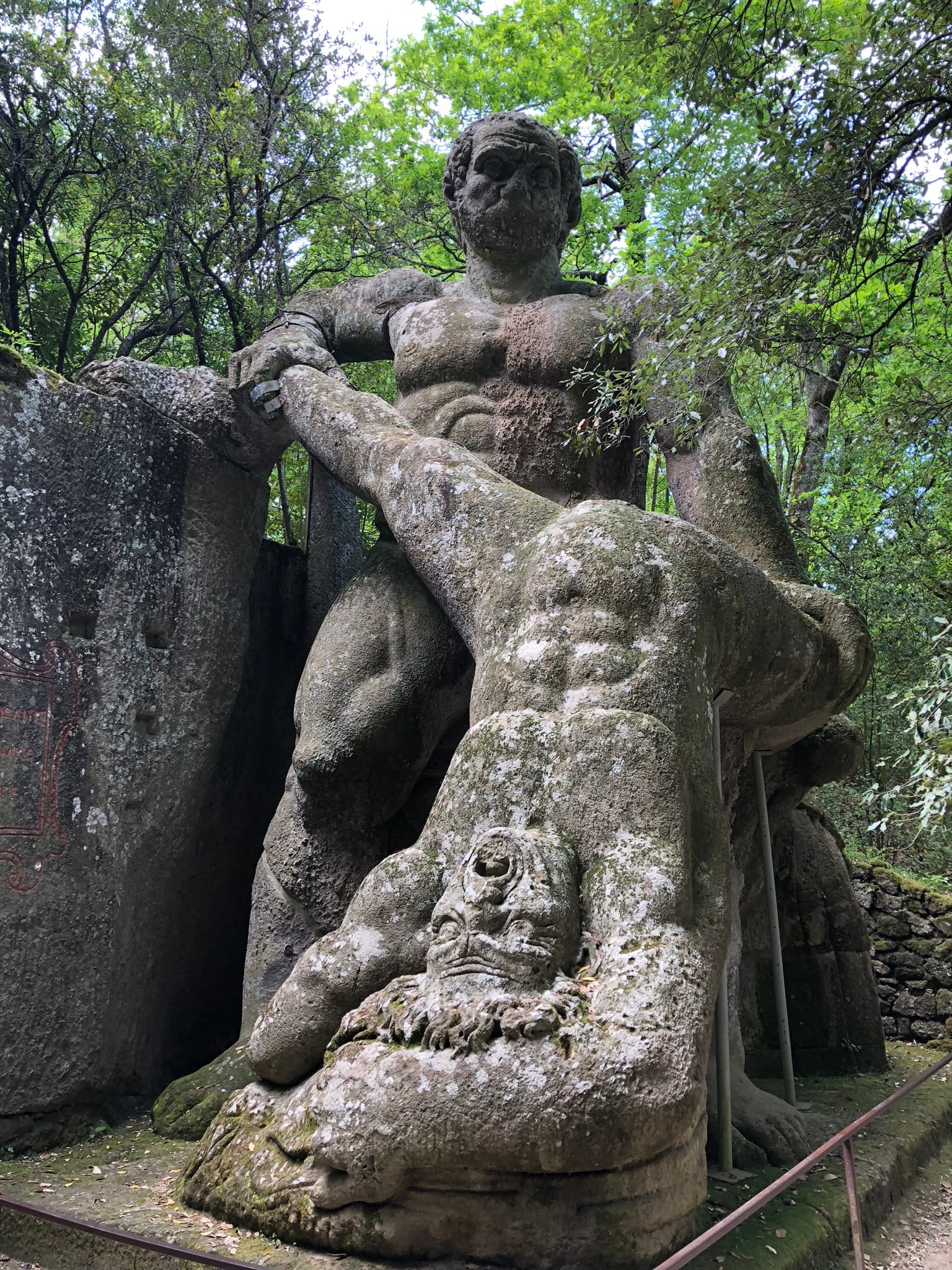
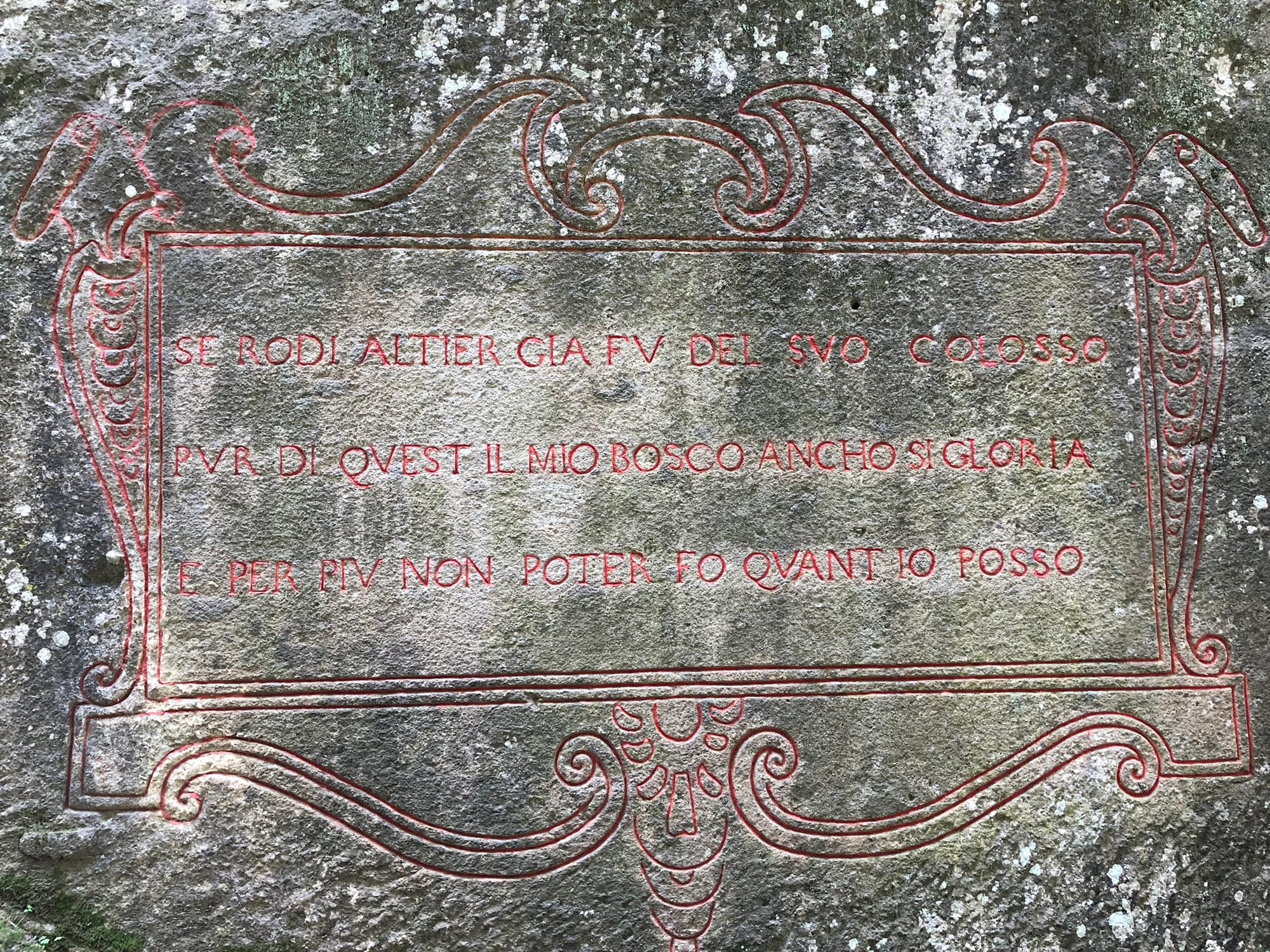
Sol per sfogare il core. The phrase is carved on an obelisk in the wood. Not to remember. To release. And a release has no axis because grief has no direction.
A man who has seen enough order imposed from outside — military, feudal, familial — to understand that order saves nobody, builds deliberately something that answers to no logic but his own. And that logic resembles the wood you walked through in April: without sequence, without an overall perspective, with the sculptures letting themselves be discovered when they decide.
Inside
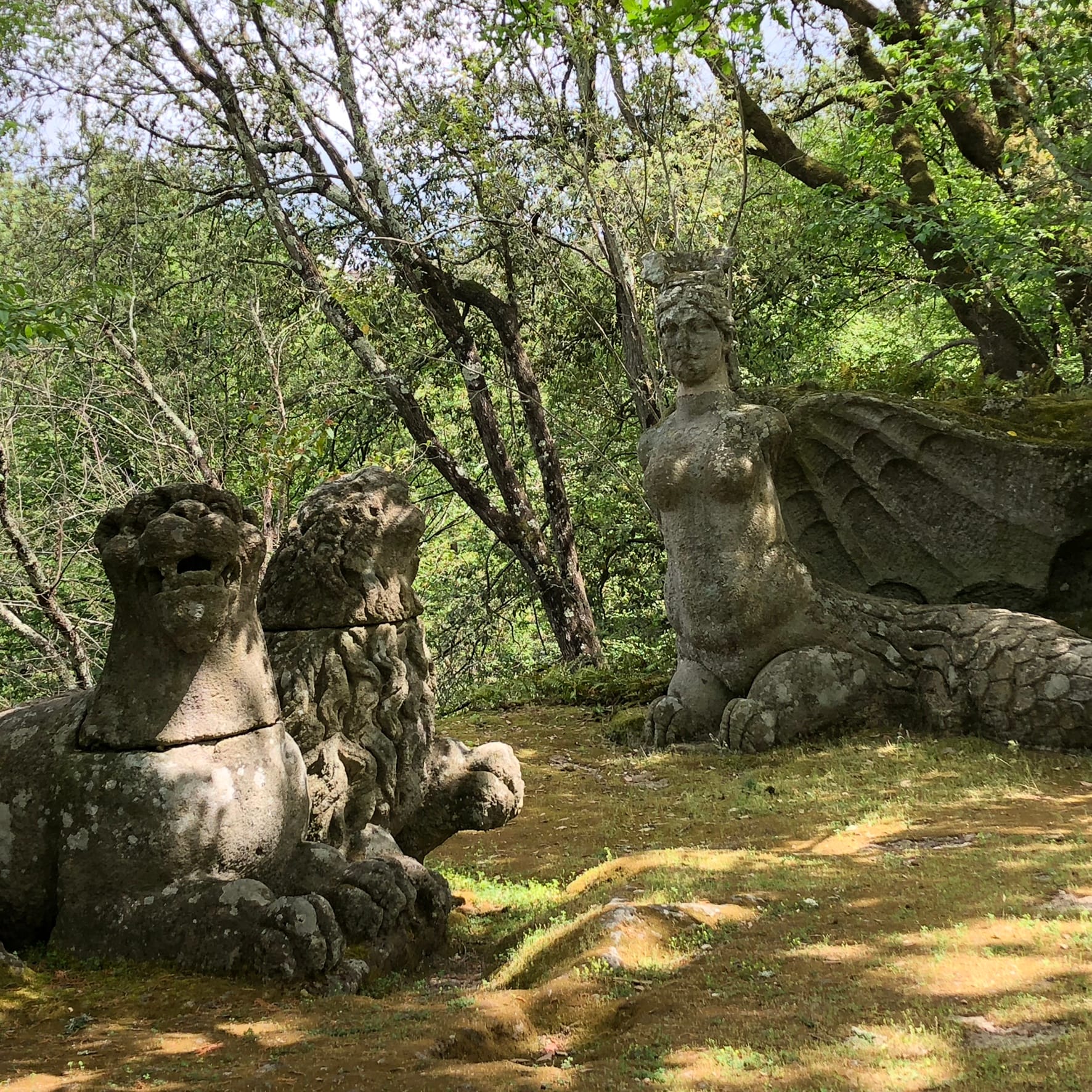
The sphinxes at the entrance carry inscriptions in hendecasyllables: whoever crosses this wood without concentration will fail to appreciate even the seven wonders of the world. This is not a welcome — it is a condition. Something is asked of you before you enter.
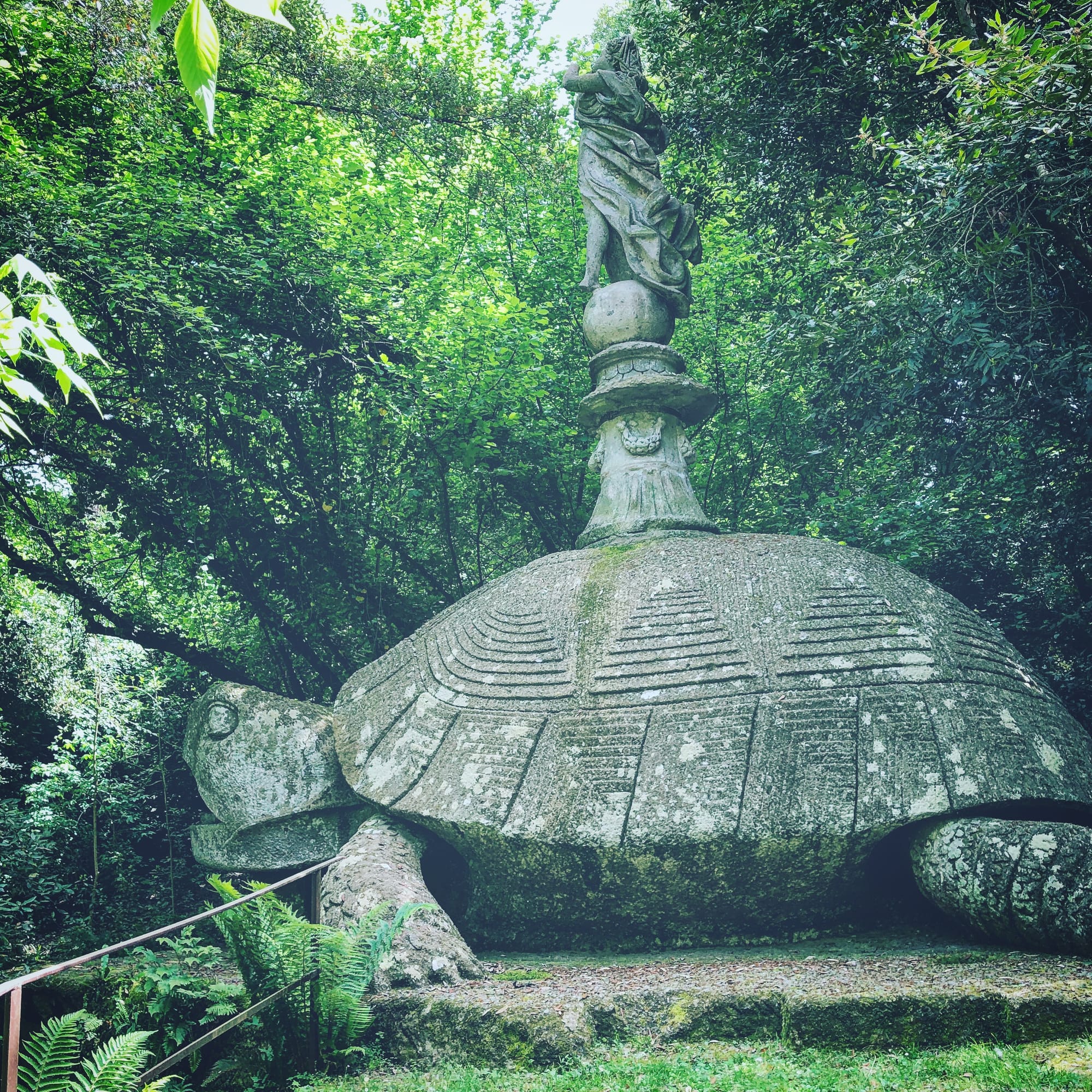
The tortoise with the winged Fame on its back carries speed on its shell — Festina lente, make haste slowly. The only sculpture in the wood that embodies a temporal contradiction. It doesn't tell you where to go. It tells you at what pace.
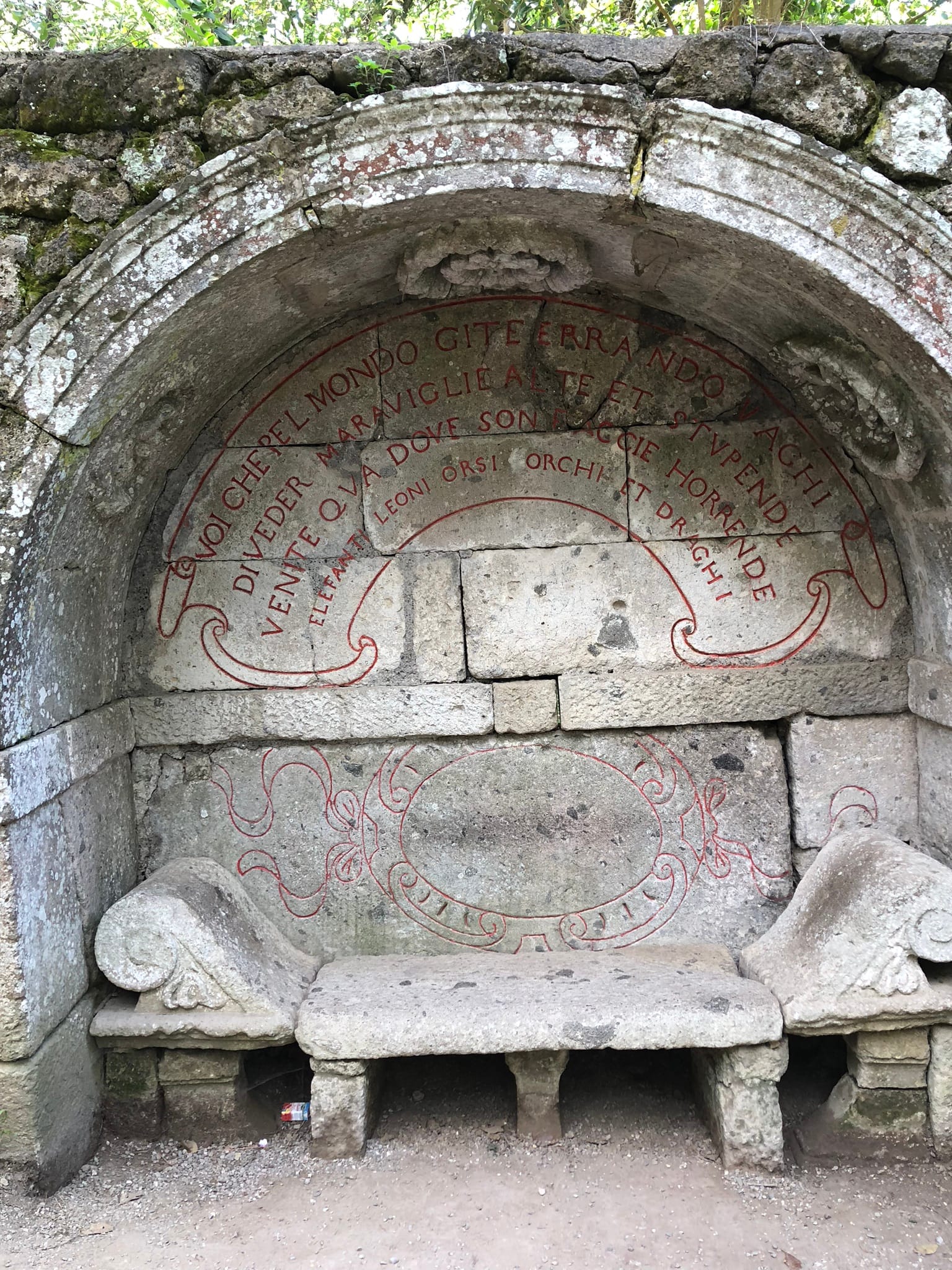
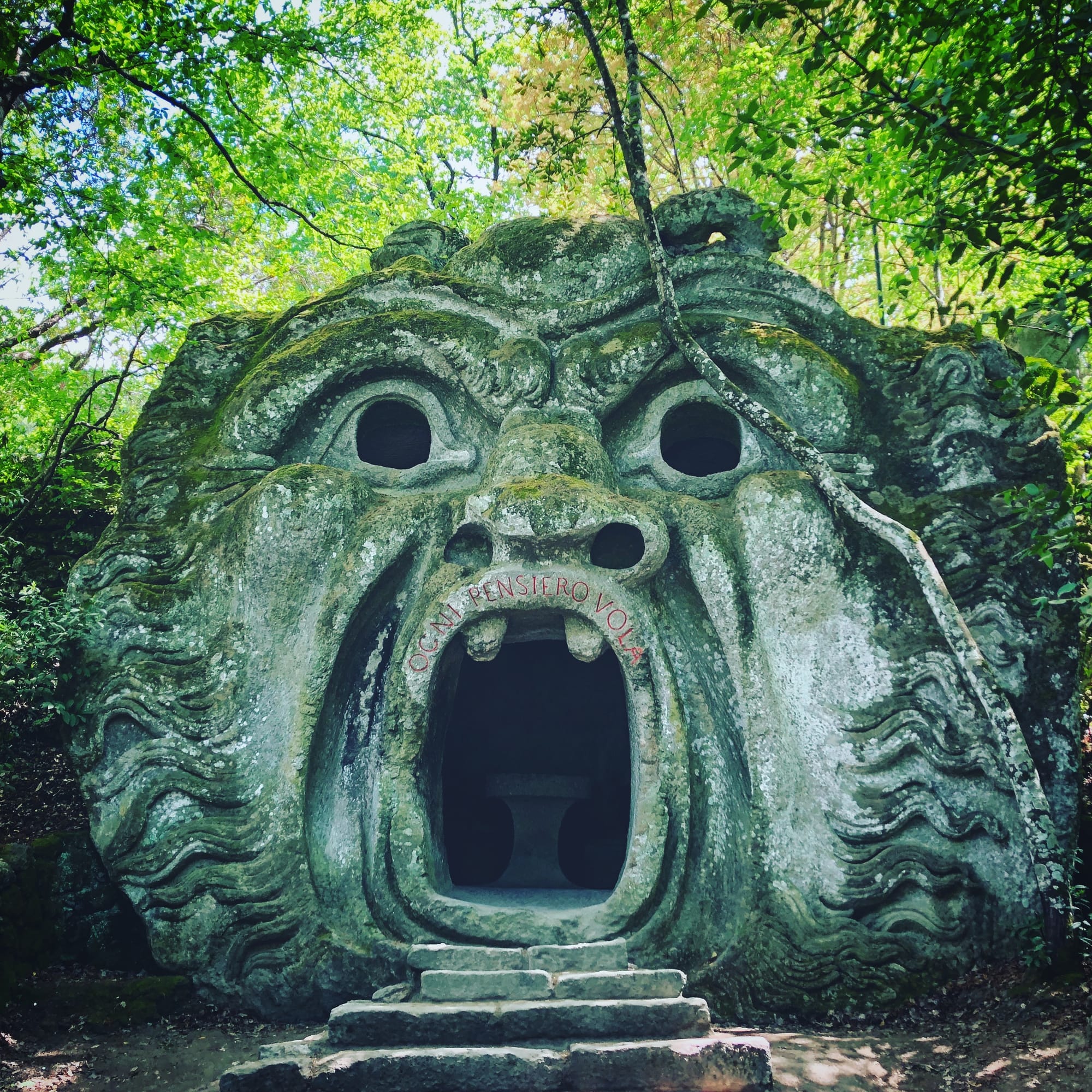
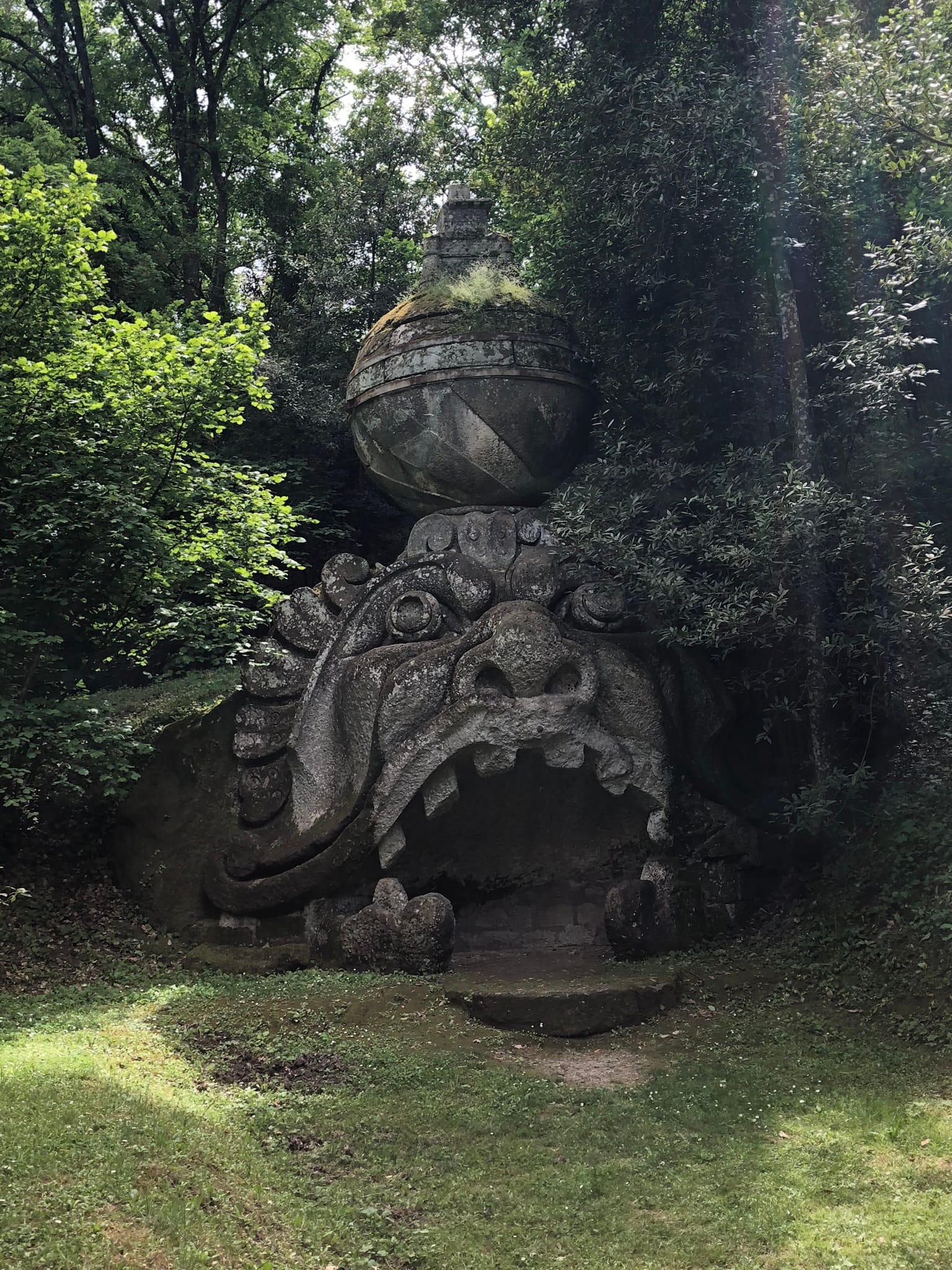
The Orcus — the gaping mouth — is the most precise Dantesque variation in the wood. Its lip reads today OGNI PENSIERO VOLA, every thought flies; but a drawing of 1604 records the original line: Lasciate ogni pensiero, voi ch'entrate — abandon all thought, you who enter. Not hope, as in Dante: thought. The noise of the mind. Go inside, sit on the stone benches and look outward. What seemed a threat becomes a shelter. The same space, the same stone — but from the other side.
The tilted house is the one building in the wood made to unsettle you — a room built deliberately off-plumb. Entering it produces immediate physical disorientation. The equilibrium you take for granted stops working. It is the only point in the wood where Orsini does not ask you to look at something. He asks you to feel something in your body.
The small temple — attributed to Vignola, dedicated to Giulia — is the quietest place. Classical architecture, controlled proportions, silence. The only point where the disorder stops. Perhaps it is no coincidence that it is the monument to the person for whom all of this was made.
Three Centuries of Silence
When Orsini died in 1585 the wood was left abandoned. His heirs had neither the resources nor the temperament to maintain it. The vegetation reclaimed the ground, the monsters disappeared into the green. For the local farmers they were simply there, like the Etruscan ruins scattered across that part of Lazio — inexplicable, ancient, belonging to a world that had no useful relationship with the present.
For three and a half centuries, Bomarzo ceased to exist.
Salvador Dalí is said to have found it in 1938 — already returned to wilderness, frequented only by shepherds — and to have been struck by it; in 1948 the newsreel cameras of the Istituto Luce filmed him there among the monsters. In 1962 the Argentine writer Manuel Mujica Láinez published the novel Bomarzo, which transformed Orsini's story into an epic of immortal souls and alchemy. In 1967 it inspired an opera by Alberto Ginastera — premiered not in Rome but in Washington.
The monsters had waited three hundred and fifty years. They have that patience.
The architectural historian Enrico Guidoni advanced the hypothesis that behind the Sacro Bosco was Michelangelo as hidden director, with Leone Leoni and other students as executors. The hypothesis has found no documentary confirmation — more recent scholarship points to the Florentine sculptor Simone Moschino as the likely author of the sculptures — but it has the merit of raising the right question: a place like this feels as though it was born from a conversation among people who shared the same historical moment. The trauma of the Sack of Rome in 1527. The Counter-Reformation. Mannerism as a collective response to a world that had lost its certainties. Orsini was at the centre — not necessarily the sole author.
What Remains
There is a moment at Bomarzo when you understand you are in the wrong position. Not because the place is wrong — because you are doing the wrong thing. You are visiting. You are processing, photographing, moving toward the exit.
The wood lets you, patient, because it has seen all of this before and knows it ends.
The sphinxes at the entrance had said it clearly, in sixteenth-century hendecasyllables: concentration, or you will see nothing. Orsini did not build a place to visit. He built a place to be in — without direction, without axis, without an order telling you what to look at next. With the sculptures letting themselves be discovered when they decide, with the smell of moss arriving before sight, with the coolness of the foliage changing you before you have seen anything.
That April morning, with the heat of the road still on me and the wood changing everything in three steps, I had understood something without yet having the words for it. The words came later, and these are them.
Festina lente. The tortoise already knew.
Further Reading
If you read one book, read Bredekamp: Vicino Orsini e il Sacro Bosco di Bomarzo. Un principe artista e anarchico (Edizioni dell'Elefante, 1989; German original 1985) is the most rigorous study that exists on the subject — iconography, sources, political context. It is not easy reading, but it is the one that holds.
Mujica Láinez's novel (Bomarzo, 1962) is historically unreliable and entirely worth reading. An epic of immortal souls and alchemy that does not explain Bomarzo but amplifies it. Read it after the visit, not before.
Calvesi (Gli incantesimi di Bomarzo, Bompiani 2000) is the most accessible of the serious scholars — a good entry point if sixteenth-century Mannerist iconography is new territory.
Guidoni (Il Sacro Bosco di Bomarzo nella cultura europea, Davide Ghaleb Editore, 2006) is the most controversial. He advances the hypothesis of Michelangelo as hidden director — a position that has remained isolated but that asks the right questions about the intellectual context of the wood.
For the most current scholarly consensus, the volume edited by Sabine Frommel with Andrea Alessi (Bomarzo: il Sacro Bosco, Electa, 2009) collects the latest research and points to Simone Moschino as the most probable sculptor.
More books on the wood, and on everything around it, are in The Slow Library.