Todi, Italy: Is It Worth Visiting? Things to Do, Parking, and a Night Between Rome and Florence
No train, one of Umbria's finest squares and a Renaissance church below the walls. You can do Todi in a day from Rome, but it repays a night.
A small town on top of a hill, with no train, one of the finest squares in Umbria and a Renaissance church at the bottom of the slope. You can do it in a day from Rome, but it repays a night: arrive in the evening, wake up inside the walls.
Is Todi worth visiting? The short answers
Is it worth it? Yes, if you want a whole town rather than a single monument. Todi is small, and that is exactly why you can see all of it: I would not skip anything.
How long? You can do it as a day trip from Rome, but there and back is a long day. It repays a night, as a short weekend, or as a stop on the way to Florence.
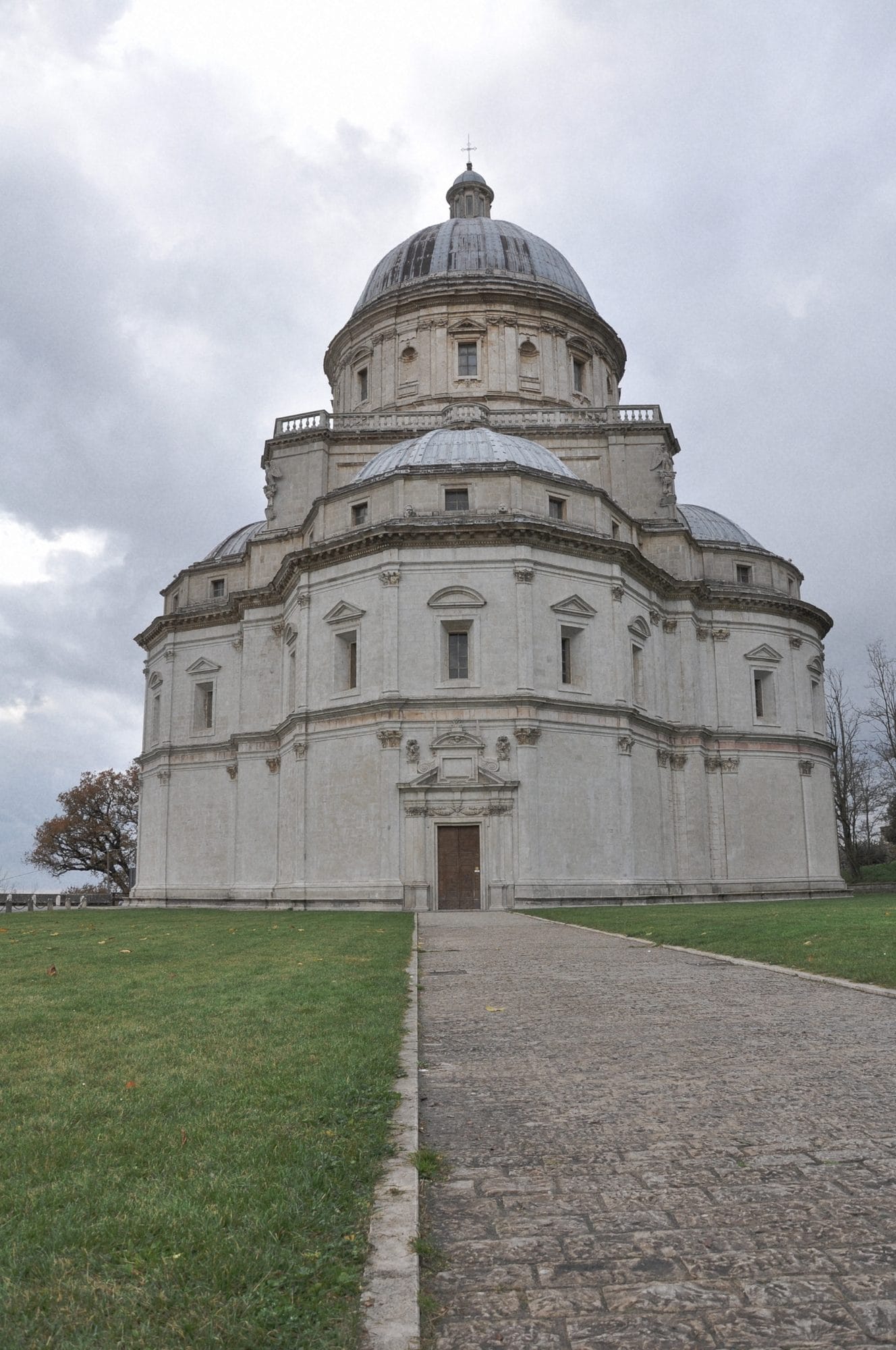
What is it known for? Its square, one of the finest in Umbria, with the public palaces around it and the Duomo at its head, and the Consolazione, the Renaissance church at the bottom of the slope, outside the walls.
Train, bus or car? The car. There is no train to Todi at the moment, and the bus leaves you at the bottom, in the valley.
Todi or Orvieto? If you can only do one, Orvieto, for its cathedral, which has no rival. Todi, though, is perhaps a little more ready for visitors, small as it is, and the two are forty kilometres apart: with two days you can do both.
Nearest airport? Perugia, about 45 kilometres away, forty minutes by car. From Rome Fiumicino it takes an hour and three quarters.
Before you set off, ring the tourist office: museum hours change often, and the sources online do not agree with each other.
How far is Todi from Rome, and how to get up there
We arrived on a December evening, on the spur of the moment. We had one of those gift boxes where you choose the place yourself, and Kat and I had pointed to Todi, because we wanted to do Todi and Assisi. In the end, that year, the trip was Todi and Civita di Bagnoregio. It was very cold. It was December 2011, and my memories of that trip are a little hazy: where memory falls short, this guide tells you what you will find today.
By car from Rome, take the A1 towards Florence as far as Orte, then the E45 dual carriageway towards Perugia, exit Todi: about 130 kilometres, an hour and a half on paper, an hour and three quarters with Rome's traffic.
Forget the train for now. The line through Todi, the old Ferrovia Centrale Umbra, has been closed for works since 2017 and is served by replacement buses. Its reopening has been announced for years and postponed for years. In October 2026 the Region put the reopening of the Terni–Ponte San Giovanni section, the one through Todi, at the end of 2027 at the earliest.
The direct buses from Rome Tiburtina, run by Sulga and FlixBus, take an hour and a half or a little more, but they stop at Pian di Porto, down by the dual carriageway: from there you go up to the centre on the town shuttle, as far as Porta Orvietana.
The old town is a limited traffic zone, with two camera-controlled gates, on Viale della Consolazione and on Via San Carlo. They are not always active, especially at weekends, and the hours are on the sign at the entrance: read it, because the fine is posted to your home. If you are staying at a hotel inside the walls you can drive in, but you have to send the form to the town council by email within 48 hours: ask the hotel about it when you book. The simplest advice is still to leave the car below.
There are several car parks below the walls, and these are the two most convenient. The Consolazione car park, next to the church, free and always open: from there it is an uphill walk to the centre, or you can take the town buses. And Porta Orvietana, which you pay for: since 2025 there has been a 27-metre glass tower whose two lifts usually take you up towards the centre for free. As of October 2026, town bus lines A and E are free, every day from 8am to 8pm.
I don't remember where I parked. I remember that the centre was already closed to traffic, all pedestrian, and that walking around it in the evening was a real pleasure. In the square they had put up an ice rink. In recent years the rink has come back at Christmas more than once, but there is no guarantee it will be there every year: if you find it, take it as a gift.
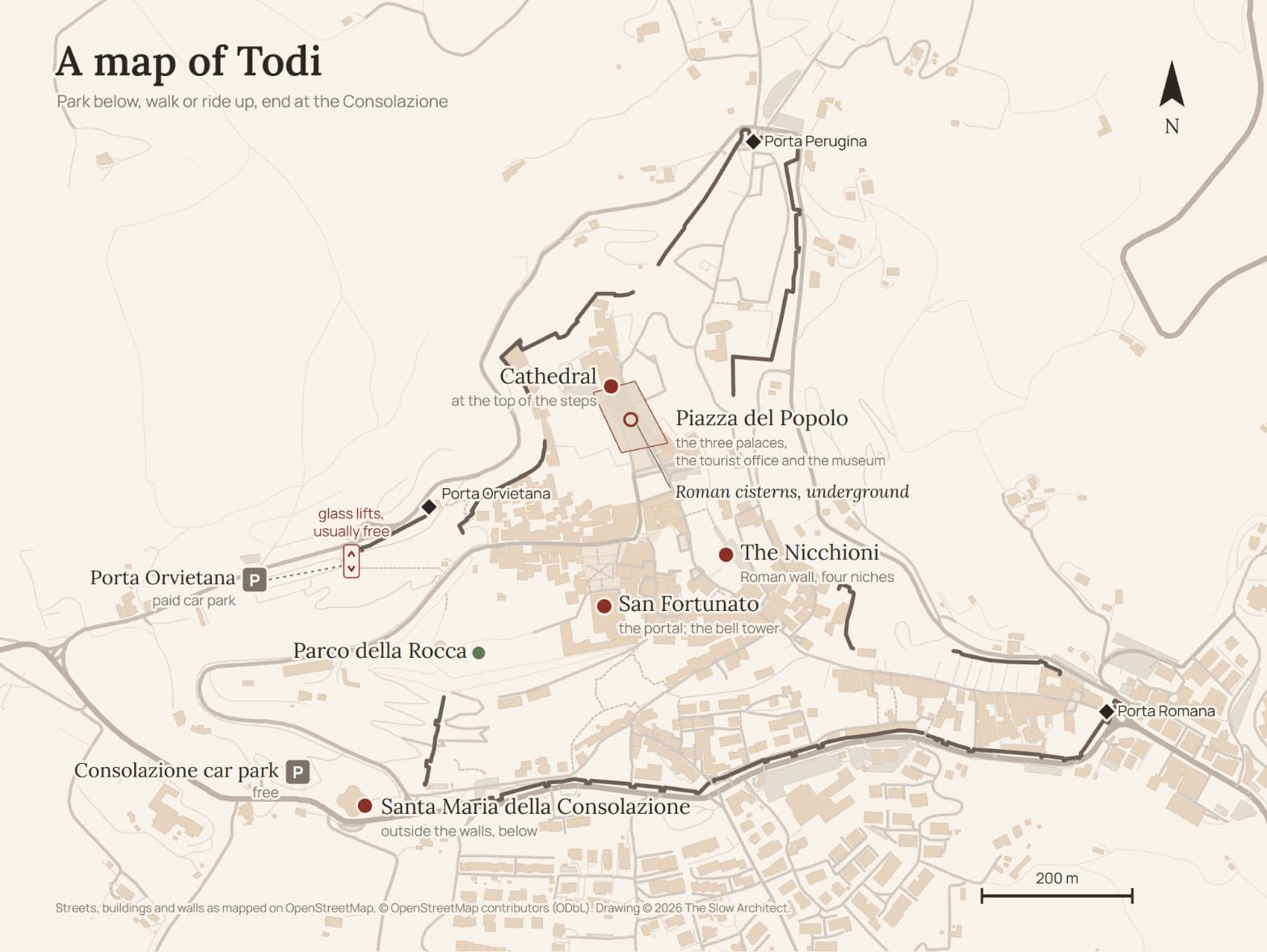
A map of Todi
The whole town fits on one page: the square at the top, the churches and the Roman wall below it, the car parks and the lifts outside the walls, and the Consolazione at the bottom of the slope.
Todi, in the right order
Piazza del Popolo. Start here, because everything else revolves around it. It was the forum of the Roman town, and its cisterns are still under your feet. At one end the cathedral at the top of its steps; at the other the Palazzo dei Priori, built from the late thirteenth century onwards and remodelled until the sixteenth, for centuries the seat of the town's government.
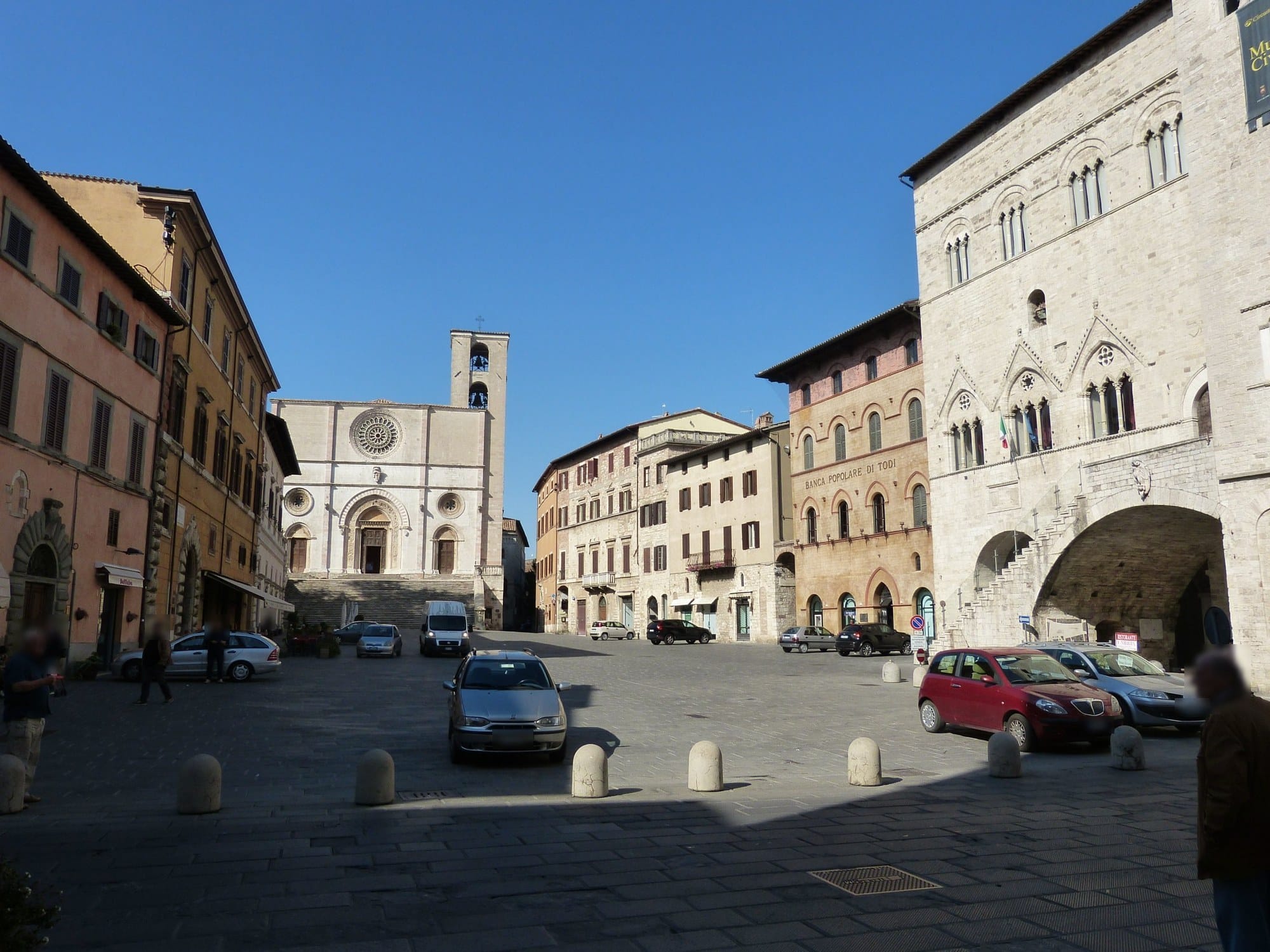
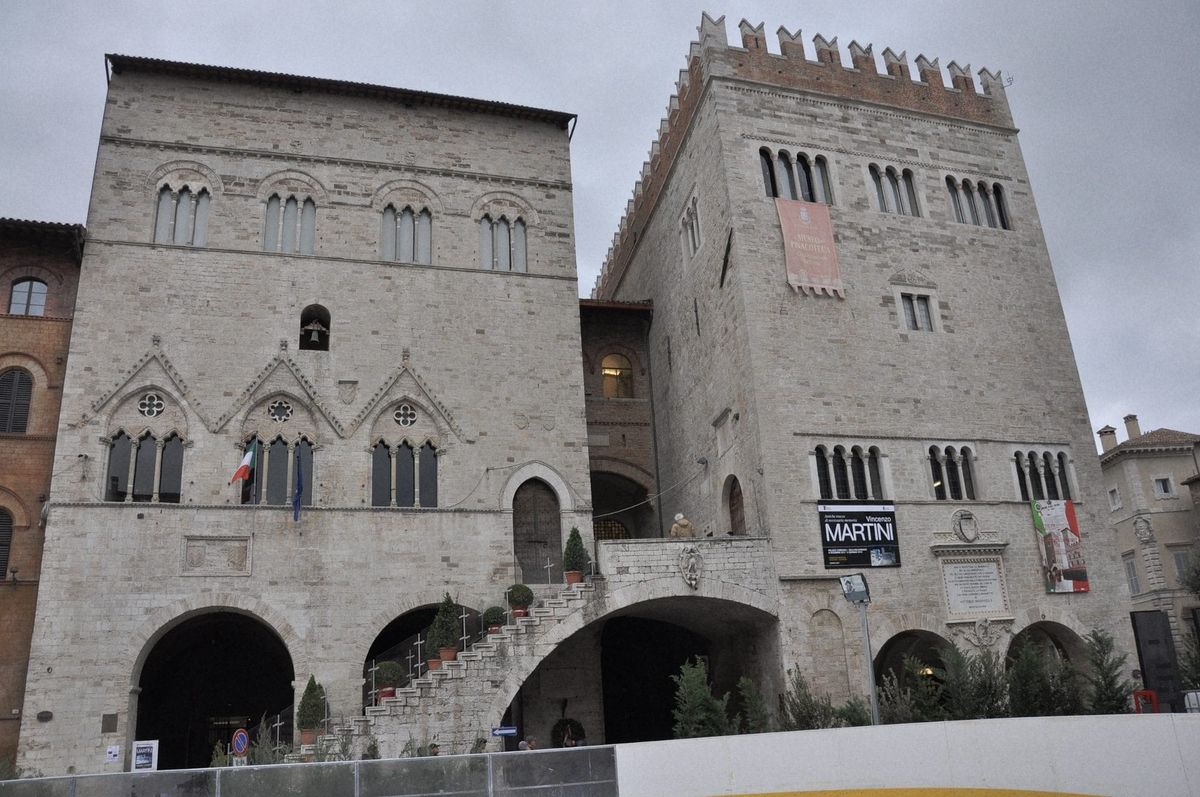
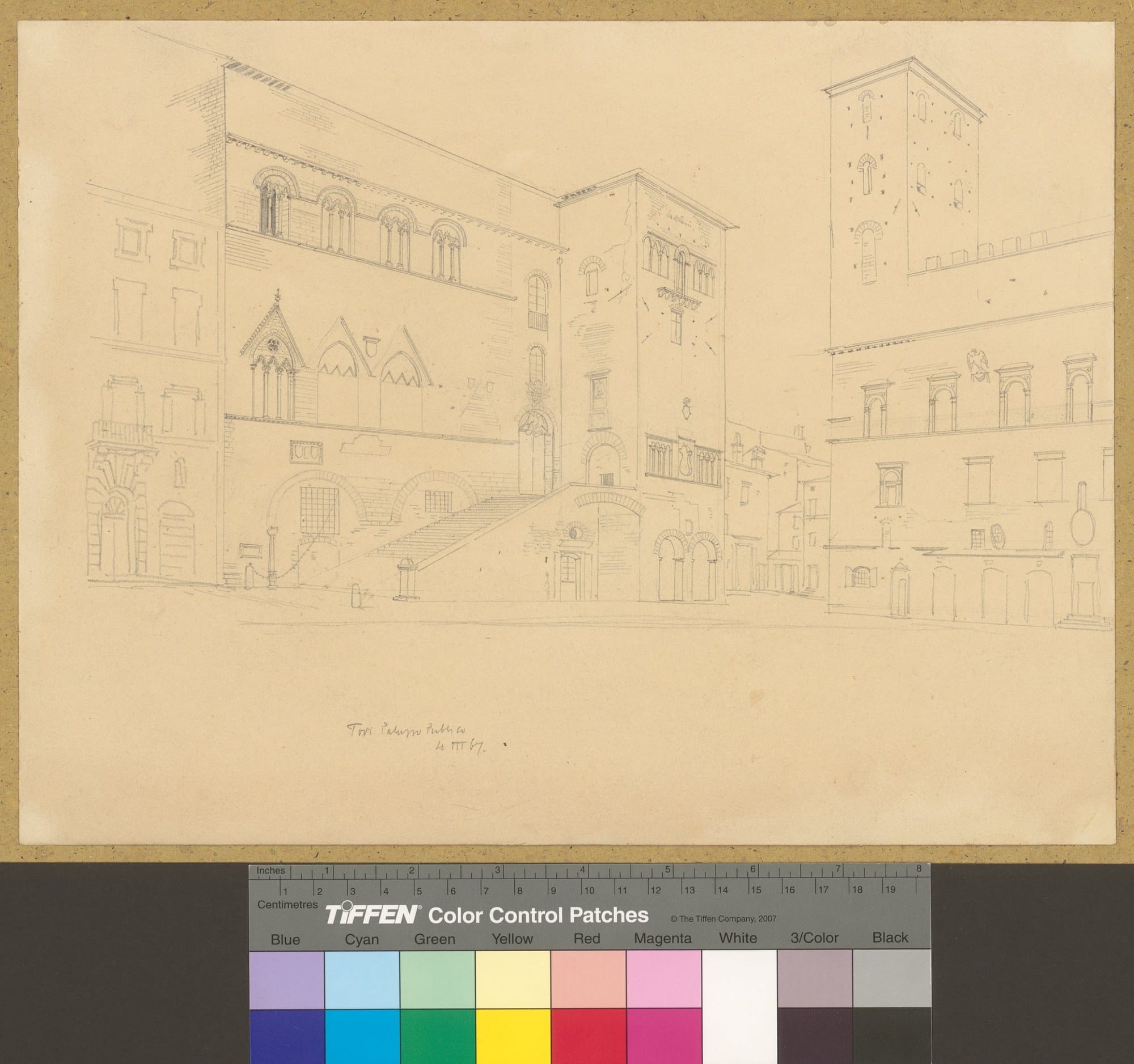
The Palazzo del Popolo and the Palazzo del Capitano. They are the two palaces side by side in the opening photograph, and they make the square more than anything else. The Palazzo del Popolo, the one with the battlements, was begun in 1213 for the podestà, the town's chief magistrate; the Palazzo del Capitano, with the great outside staircase, dates from 1293, for the captain of the people. Over the centuries they were joined together, and the top floor of both holds the Civic Museum and Picture Gallery: among other things, you will find the wooden model of the Consolazione church, worth the climb if you are going to see the church itself afterwards. On some days the museum opens only in the morning, and the hours change: ask at the tourist office, which is right under the palaces' porticoes. If it matters to you, go there first thing.
The Roman cisterns. Under the square lie two twin cisterns from the second half of the first century BC, when Todi became a Roman colony: each is divided into twelve rooms that open into one another. You can visit one of them, the western one, open to the public since 2003, with the entrance on Via del Monte. The tourist office tells you how and when you can go in, and sells the ticket. I didn't go down that time, but they are interesting: if you are passing through Todi, ask at the tourist office.
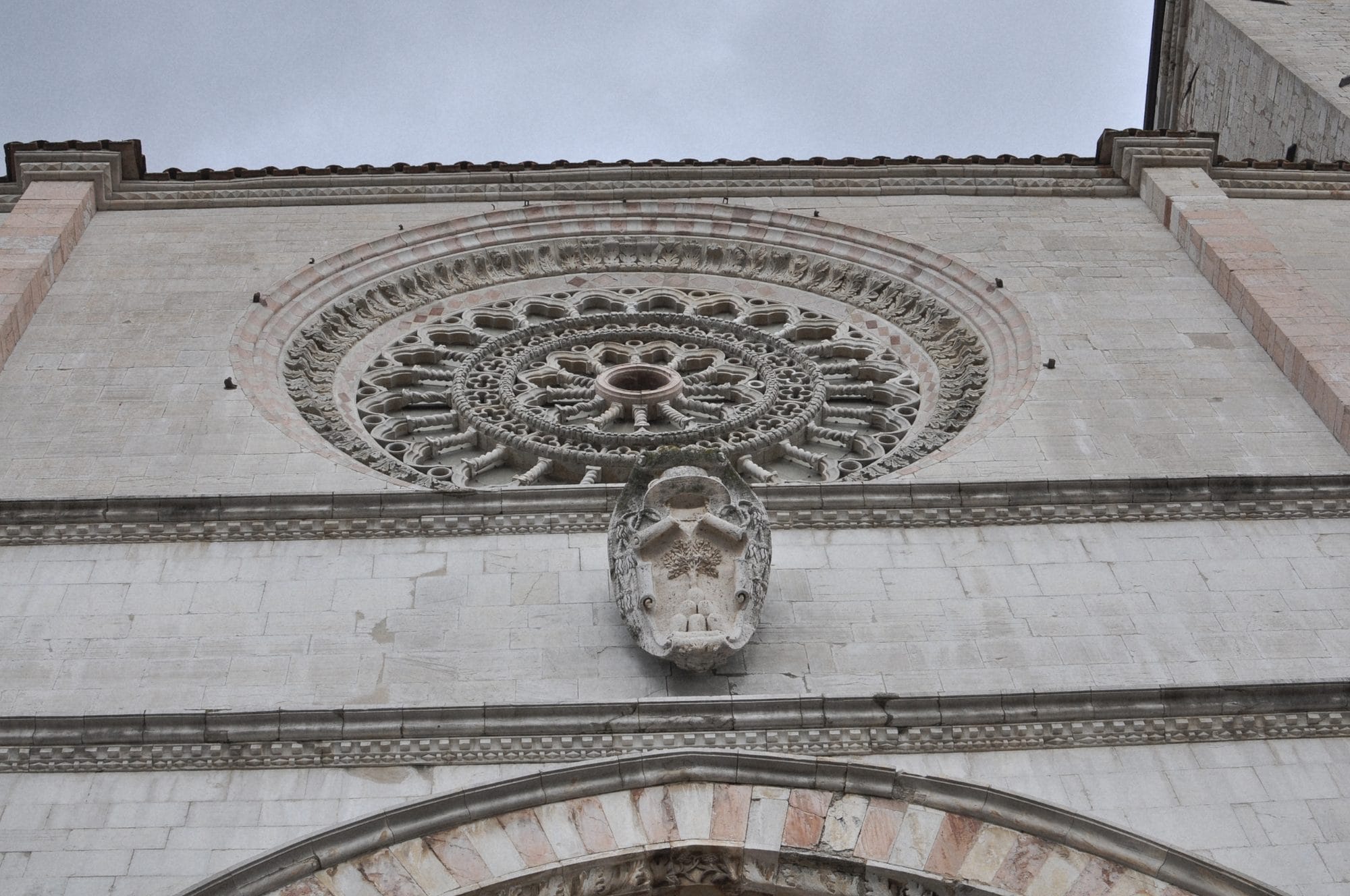
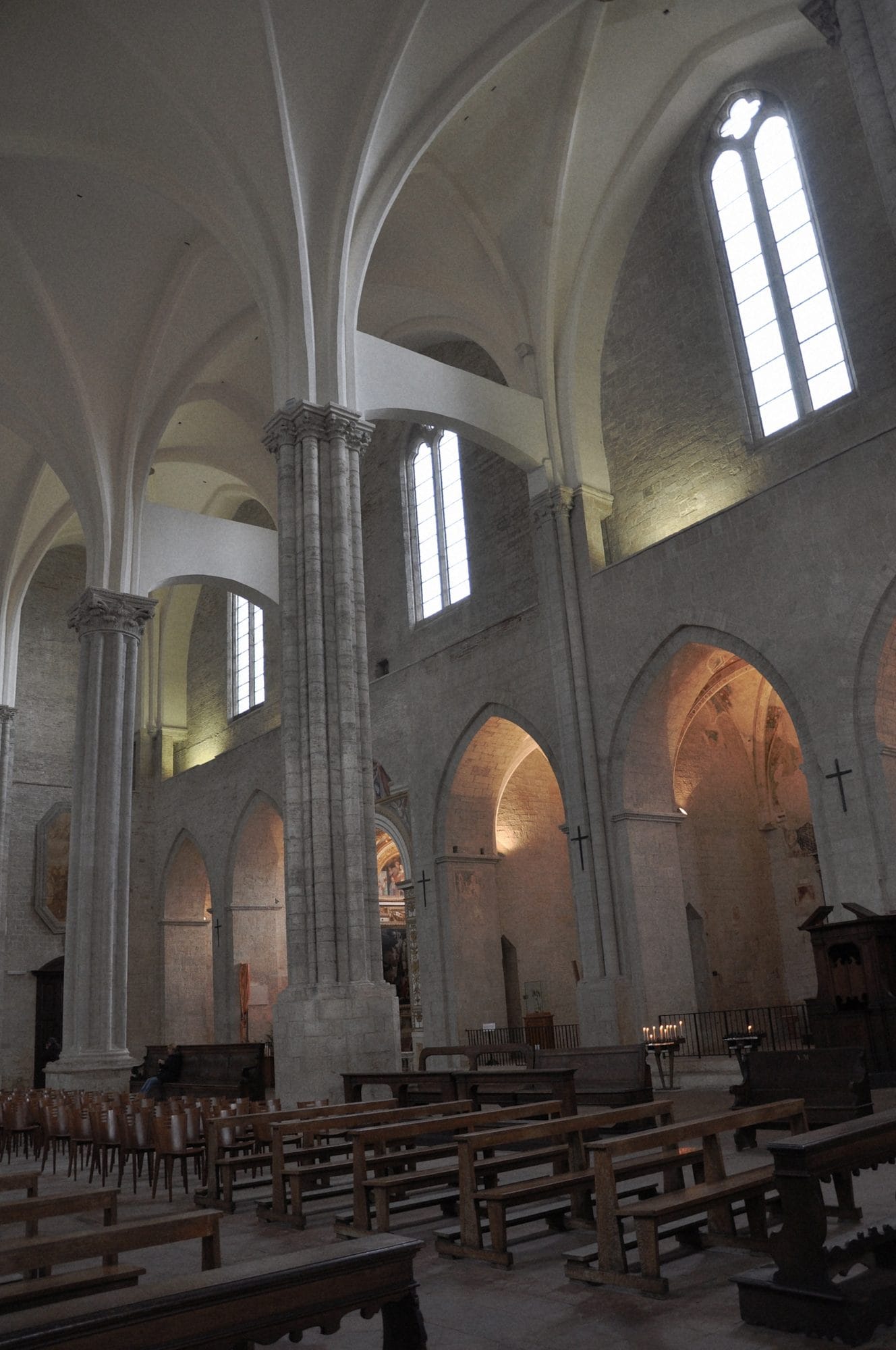
The cathedral. The Co-Cathedral of the Santissima Annunziata stands at the top of the steps, over Roman remains. It was begun before the twelfth century and finished in the fourteenth, and the façade was reworked until the sixteenth: the great rose window dates from those years, between 1515 and 1523. As you go in, turn round: on the inside of the façade there is a large Last Judgement by Ferraù Fenzoni, known as il Faenzone, finished in 1596 and inspired by Michelangelo's. Go down into the crypt too, where there are three sculptures that once stood on the façade, two of them attributed to Giovanni Pisano. Inside it is beautiful. It is open in the morning and afternoon, closing at lunchtime.
San Fortunato. I have written about the portal in the essay, and it is all there: where to stand, at what time, what to look for in the spiral colonnettes. Inside, in the crypt, is the tomb of Jacopone da Todi. You climb the bell tower on foot, and you ask for the ticket at the tourist office. I didn't climb it that time: if you have the legs and a clear day, try it yourselves.
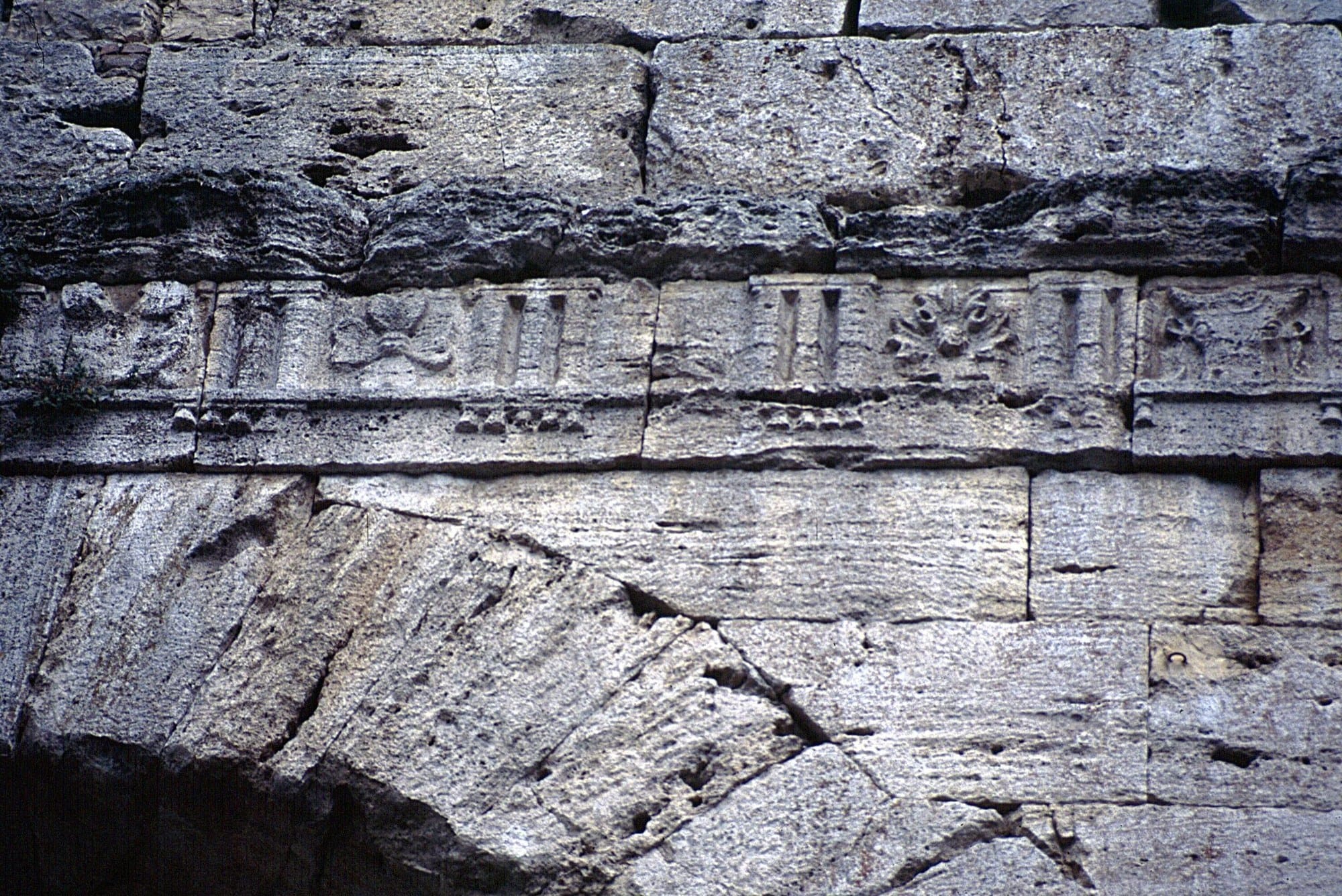
The Nicchioni. Going down towards Piazza del Mercato Vecchio you come across a Roman wall with four great niches, from the first century BC, holding up the terrace above. For a long time people thought it was a temple of Mars. It is in the open and you can always see it.
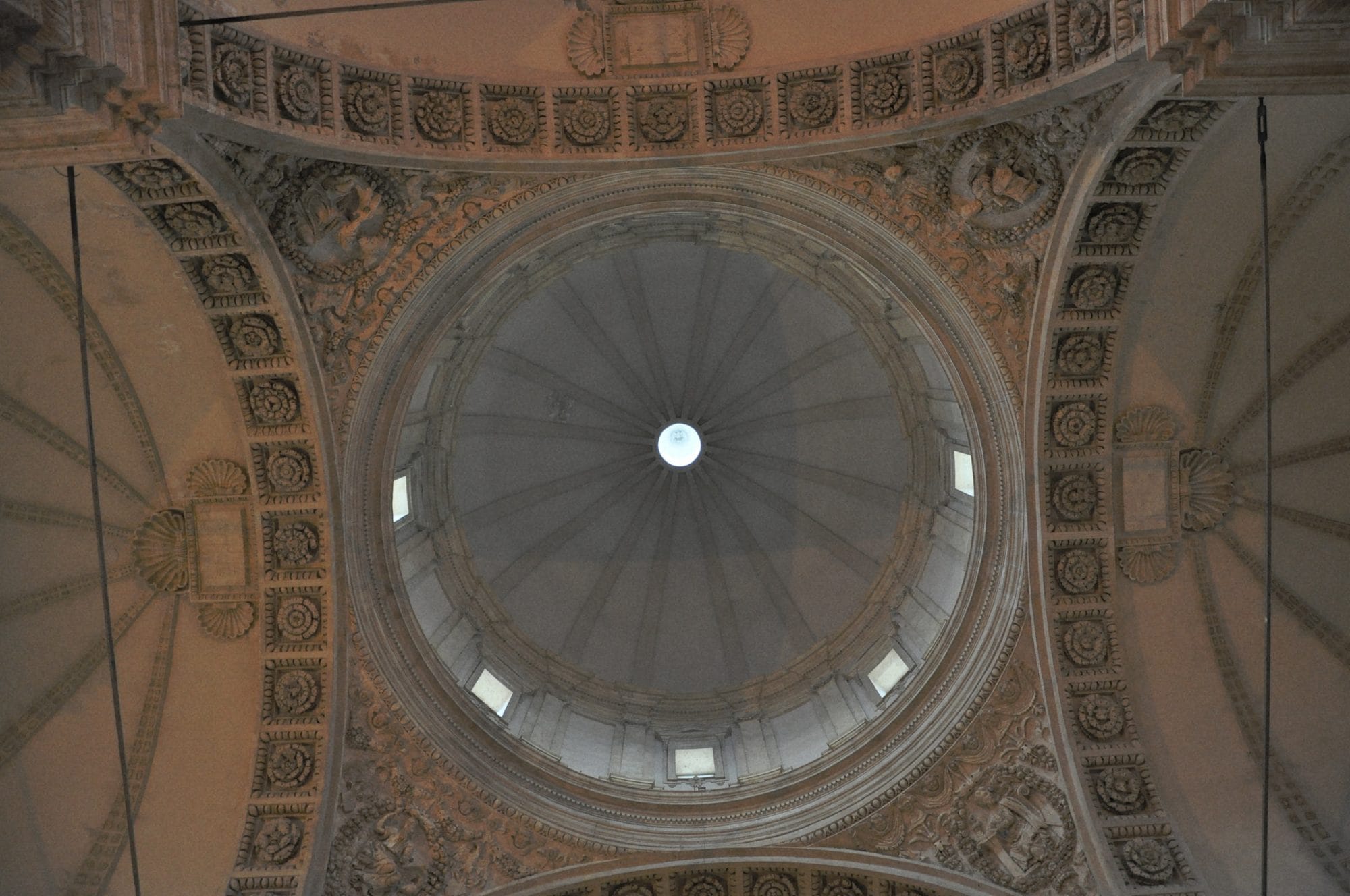
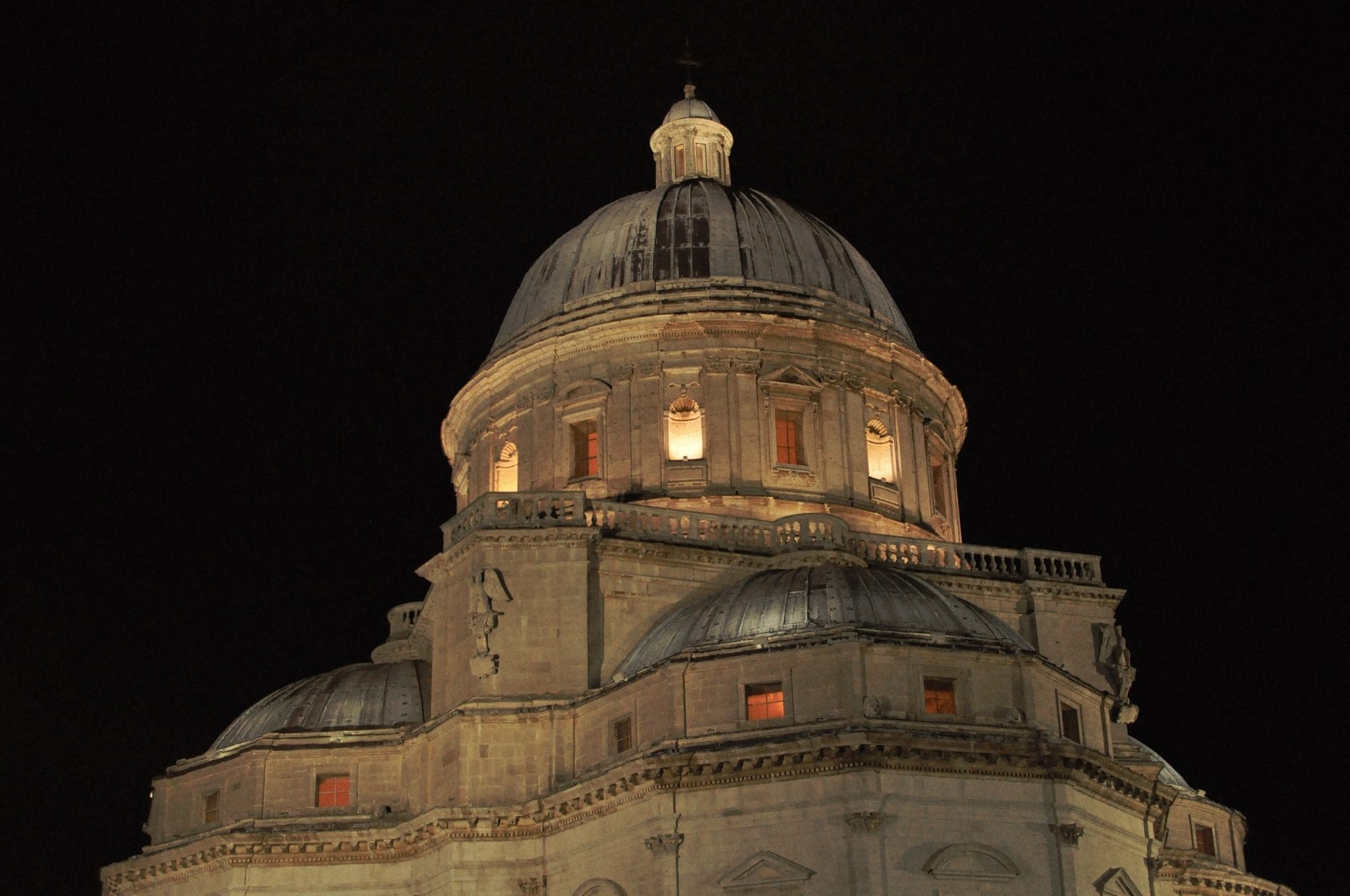
The Consolazione. Outside the walls, below the town, stands the church of Santa Maria della Consolazione: begun in 1508, attributed to Bramante or his circle, finished a century later, in 1607. It is a building made to be looked at from a distance: look at it from above first, then walk down to meet it. I went inside, and it was magnificent. The hours change with the seasons, and the sources do not agree on the closing day (the town council says Tuesday, except in October and over the Christmas holidays): check the website of ETAB, the body that owns it. If you left the car at the Consolazione car park, it is also the last stop before you drive off.
In the sun, and in the rain
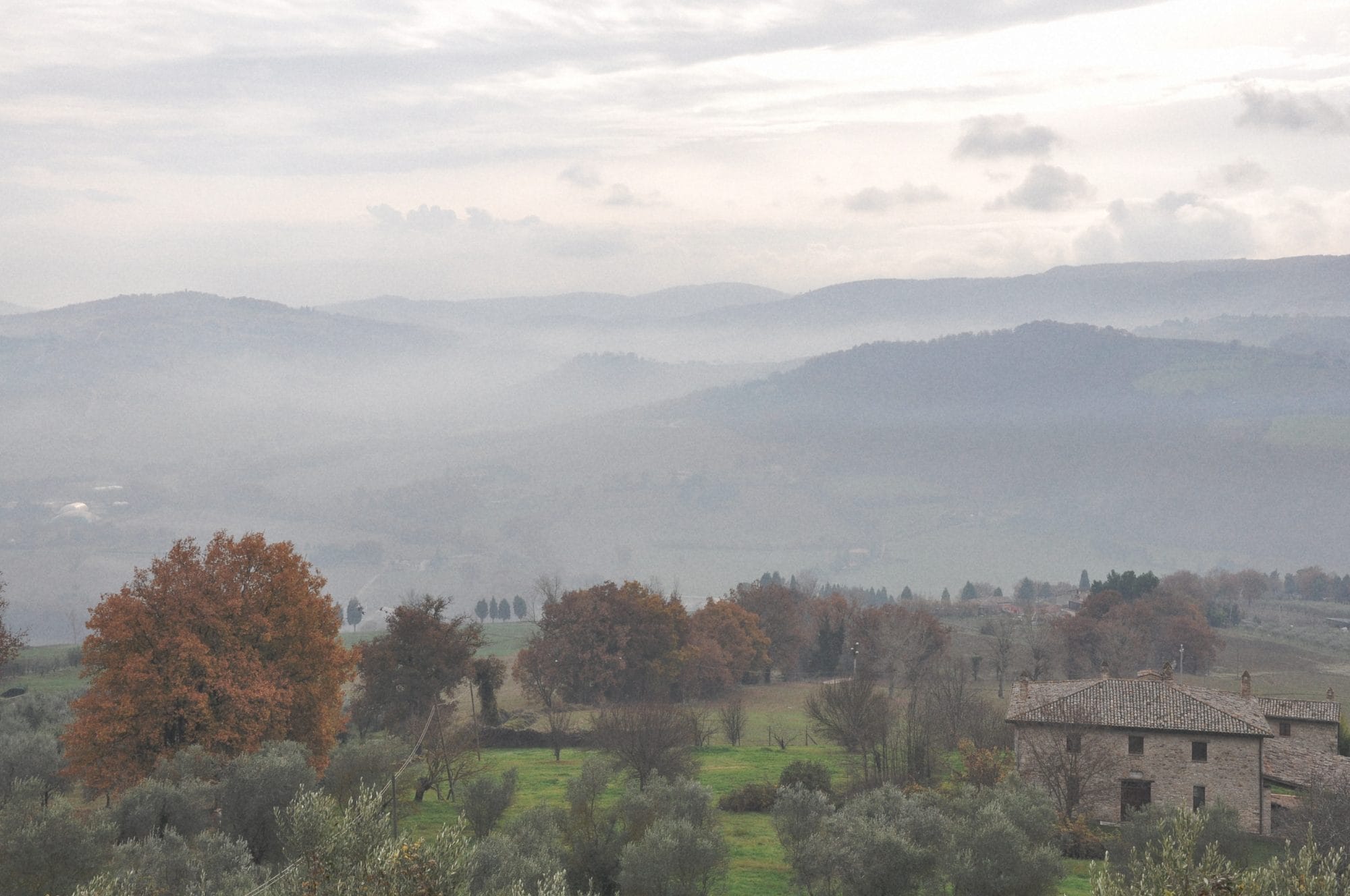
In Todi the weather can decide the order of the day. If the sun is out, walk: the walls, the Parco della Rocca at the top of the town, the views over the Tiber valley, the walk down to the Consolazione. If it rains, go indoors: the cathedral, San Fortunato, the picture gallery, the Consolazione. That is the only choice there is to make, because you will see everything else anyway.
One night, or two
On the evening we arrived we ate somewhere whose name I don't remember, and we slept in an enormous room. I wrote about that night in a letter. Sleeping inside the walls gives you only one thing, but it is worth the trip: early in the morning the square is empty, and it is all yours.
Pitfalls
Museum hours: ask before you go. The bus from Rome that leaves you in the valley. The car in the old town, with the camera gates and the fine that arrives at your home. And the phrase you will find in many guides, "the most liveable city in the world": it is a label born at a conference in Todi in 1991, and never backed by a study.
Moving on
Todi lies roughly halfway between Rome and Florence, which is why it also works as an overnight stop: drive from Rome to Todi, sleep, and set off the next day towards Perugia and Florence. To the west, the SS448 runs down to Orvieto along Lake Corbara, about forty kilometres: drive it in daylight.