WHY DOES ROMAN CONCRETE LAST?
It was not stronger than ours. It was made of volcanic ash, quicklime and patience, and there was no iron in it. Why Roman concrete is still standing.
Why, exactly? · It was not stronger than ours. It was made of volcanic ash, quicklime and patience, and there was no iron in it.
The short answer. Roman concrete lasts for three reasons, and none of them is a secret recipe. The first is volcanic ash, pozzolana, which keeps reacting with lime and water for centuries and grows new minerals in the pores and the cracks. The second is the way it was mixed: at least at some sites, the Romans used quicklime, which left small white lumps in the mix, and those lumps can seal cracks when water gets in. The third is what is missing: iron. A Roman concrete wall has no reinforcement to rust and split it from the inside, and it is built to work mostly in compression. On the other hand, it was much weaker than the concrete we use today.
That is the short answer. The one that gets passed around most is a different one, and it is wrong.

The myth: "stronger than ours"
You will read almost everywhere that Roman concrete was stronger than modern concrete. It is not true, and the measurements show it. Cores taken from imperial buildings and tested in the laboratory have an average compressive strength of about 13 megapascals; those from the Basilica of Maxentius, less than 5. Ordinary concrete today reaches 20 to 40. Roman concrete does not win on strength. It wins on durability, in certain conditions, and on its resistance to cracking.
So the right question is not why it was strong. It is why, weak as it is, it is still there.
What it was
Today it is called opus caementicium, and the caementa were not cement but the rubble: chips of stone, tufa, broken brick. They were bound together by a lime mortar mixed with a special sand. Vitruvius, in the second book of De architectura, describes it as a powder that by nature produces astonishing results: it is found around Baiae and in the lands of the towns around Vesuvius, and mixed with lime and rubble it sets even under water, so that piers are built with it out into the sea. In Latin it was the pulvis puteolanus, the dust of Pozzuoli, and that is where the word pozzolana comes from.
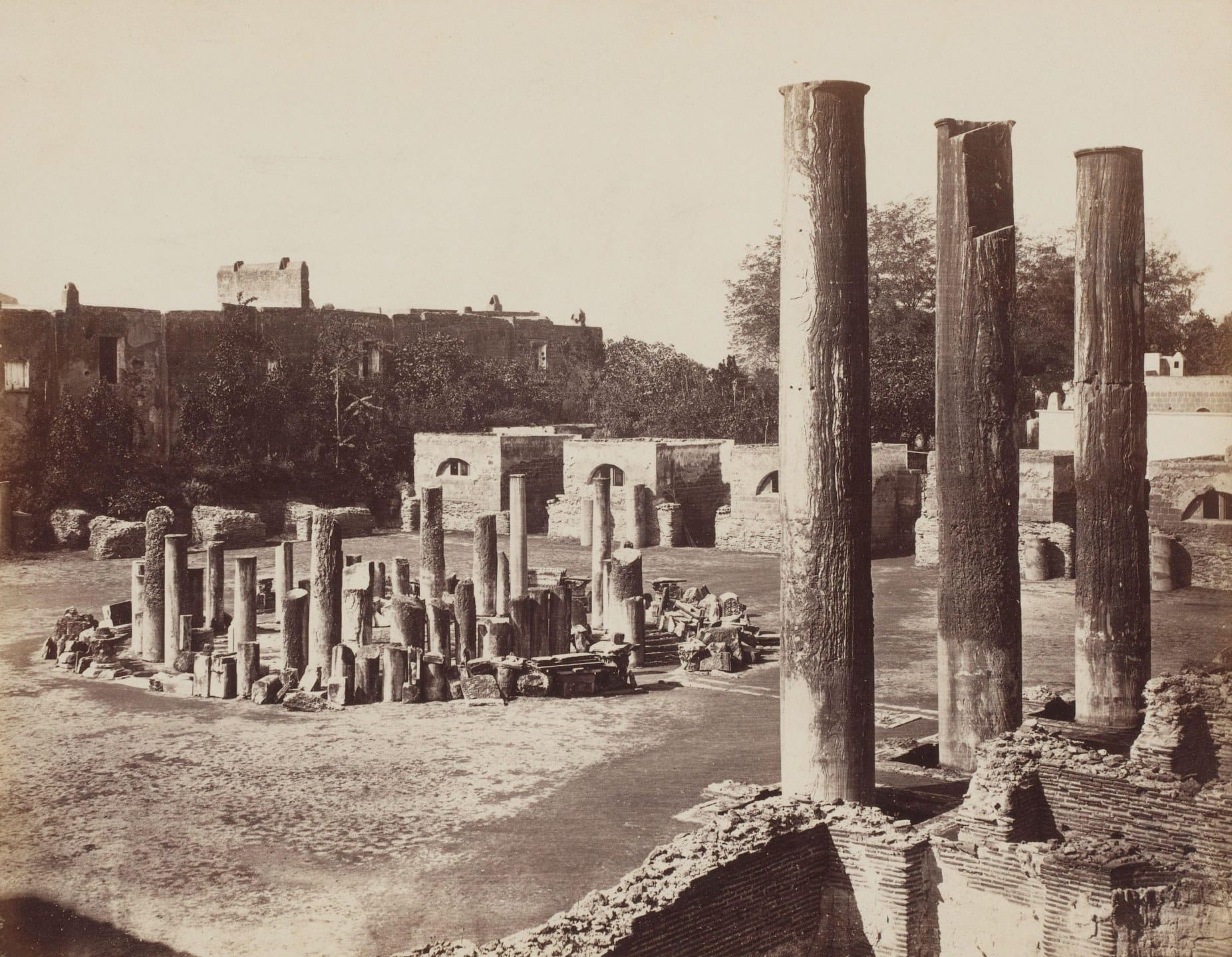
On land, Roman concrete was not poured the way ours is. The mix was stiff: it was packed in, with the rubble pressed into the mortar, between two faces of tuff or brick that rose together with the core. At sea, it went into timber boxes built in the water.
What the Romans knew
Enough to write it down. Vitruvius gives the doses: for ordinary lime mortar, three parts of pit sand to one of lime, or two of river or sea sand to one; for building in the sea, two parts of pozzolana to one of lime. The full recipe, ingredient by ingredient, gets its own answer. He also explains why, in his view, pozzolana works, with a theory of underground fire and hot springs that does not hold up today. Pliny the Elder, about a century later, writes that the dust of the hills of Pozzuoli makes a barrier against the waves, "impregnable" and "every day stronger". It was a writer's phrase, not a measurement. Two thousand years later, under the microscope, it turned out he had seen something real.
At sea: minerals that grow
Between 2002 and 2009 a team of archaeologists and engineers, the ROMACONS project, drilled 36 cores from the concrete of eleven Roman harbours and a fishpond, from Cosa to Anzio, from Baiae to Caesarea Maritima, on the coast of today's Israel, where Herod built the harbour with pozzolana shipped from the Bay of Naples. In 2017 the geologist Marie Jackson and her colleagues published what is inside some of those cores, from Cosa, Baiae, Anzio and Portus. Seawater, seeping through the concrete for two thousand years, had dissolved part of the volcanic ash and grown two minerals in the pores, phillipsite and an aluminous tobermorite. Nobody, Jackson said, has ever produced tobermorite at 20 °C. In the Roman piers it grew at the temperature of the sea.
It is the opposite of what happens to modern concrete in the sea, which can crumble within decades. Roman concrete, in a sense, went on building itself. Pliny, without knowing it, had described a chemical reaction.
On land: lumps of lime
Look closely at a Roman wall and you will see white grains in the mortar, a few millimetres across. For a long time they were read as a defect: badly mixed lime, the sign of hasty work. In 2023 a team at MIT led by Admir Masic studied samples from the walls of Privernum, near Priverno, and proposed another explanation. The Romans did not use only slaked lime. At Privernum they also mixed in quicklime, which on contact with water raises the temperature of the mix by 55 or 60 °C, and in places by far more. This is hot mixing. It sets faster, and it leaves those lumps of lime in the mix, porous and brittle.
When a crack opens in the wall, it runs through the lumps, because they are the weak point. The water that gets in dissolves a little lime, and the lime, reacting with the air, turns to carbonate and seals the crack. In the laboratory, on concrete remade by the same method and cracked on purpose, water stopped getting through after a few weeks; the same mix without quicklime never sealed. In 2025 a building site at Pompeii, left half-finished with its materials still heaped up ready for laying, showed quicklime mixed dry with pozzolana before the water went in.
As early as 2014 Jackson's team had found another defence, in the mortar of Trajan's Markets, from around AD 110: dense plates of a mineral, strätlingite, growing in the contact zones between the grains of volcanic scoria and the rest of the mortar. In modern concrete the corresponding zones are where cracks start. In the Roman mortar, the crystals stop them.
The iron that isn't there
But the simplest reason is an absence. Most structural concrete today is reinforced: there are steel bars inside, which let it work in tension too, and make long beams and thin slabs possible. The price is that the steel, when water and air reach it, rusts, swells and splits the concrete that covers it. Corrosion of the reinforcement is the main cause of decay in concrete structures. Anyone who has seen a balcony from the 1960s with its bars showing knows what that looks like.
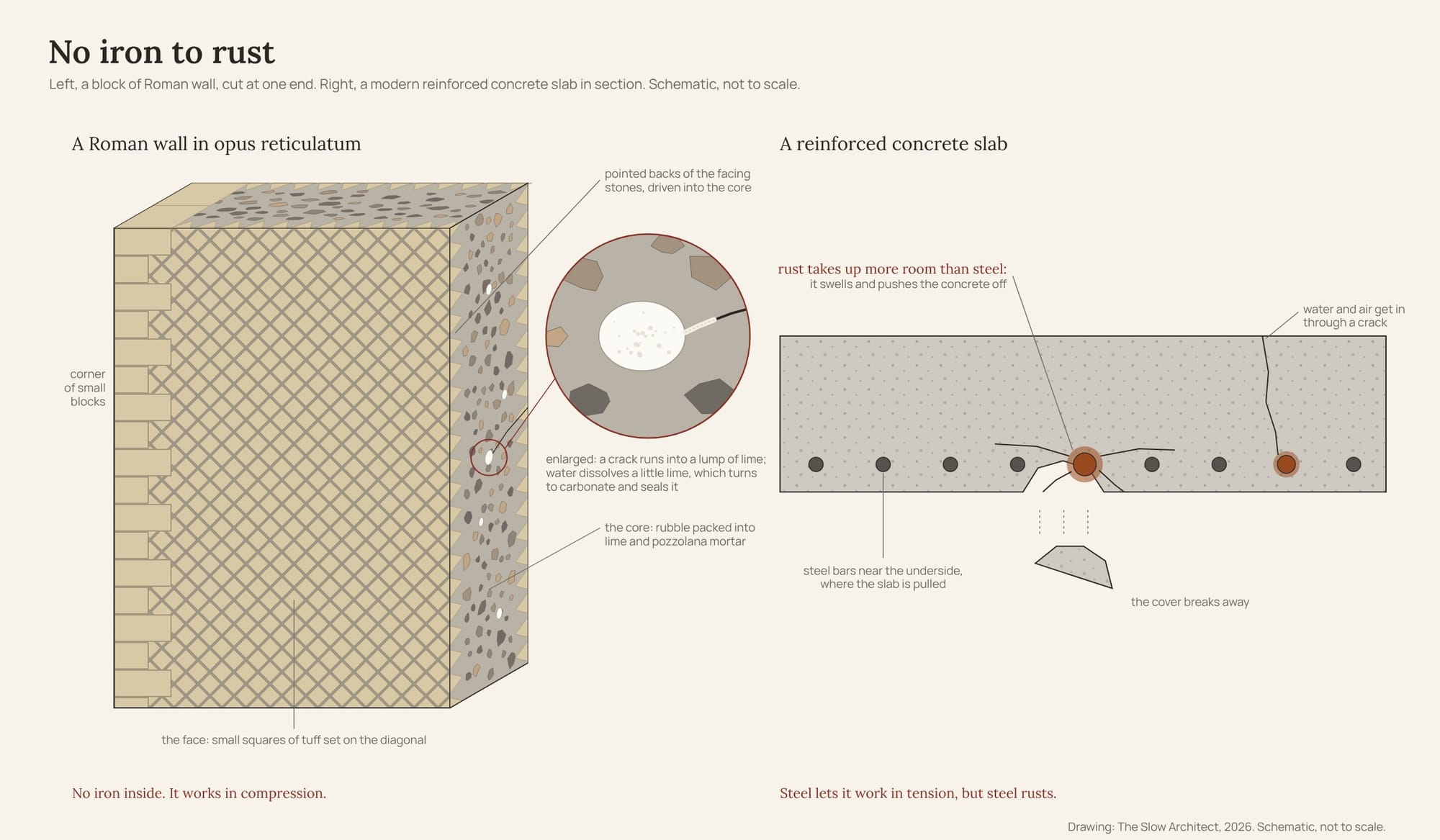
A Roman concrete wall has nothing to rust. Nor does it need any, because it is built to be squeezed, not pulled: thick walls, arches, vaults, domes, all shapes that carry the weight down to the ground mostly in compression. Roman concrete is weak in tension, like every mortar, and the Romans built so as to ask as little tension of it as they could.
Then there is a reason that no study measures, but which has to be said: we see the buildings that survived. The ones that were badly built, or made with poor pozzolana, or stood on ground that gave way, fell down centuries ago, and they are not in the photographs.
The lost recipe?
It is also often said that the recipe was lost with the fall of Rome and has only now been found again. That is not quite right. The recipe was written down, and Vitruvius's treatise was never lost: some eighty manuscripts of it survive, the oldest from the first decades of the ninth century. In 1756, for the Eddystone lighthouse off Plymouth, the English engineer John Smeaton went looking for a mortar that would set under water, and used a hydraulic lime with pozzolana brought from Civitavecchia; the lighthouse was finished in 1759. In 1824 Joseph Aspdin patented Portland cement, the name today's cement still carries.
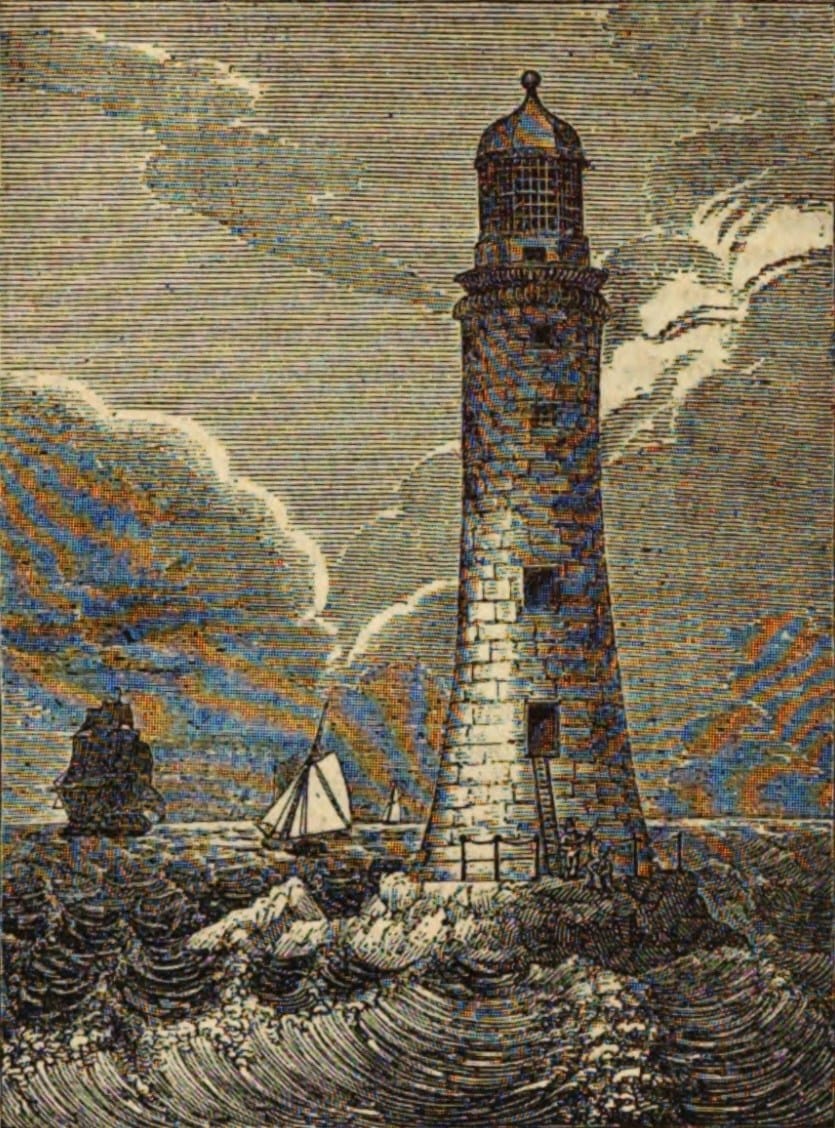
What nobody knew was not the ingredients but the reason: the minerals that grow in the sea, the lumps of lime that can seal the cracks. That is what the studies of the last fifteen years have begun to explain.
The Pantheon
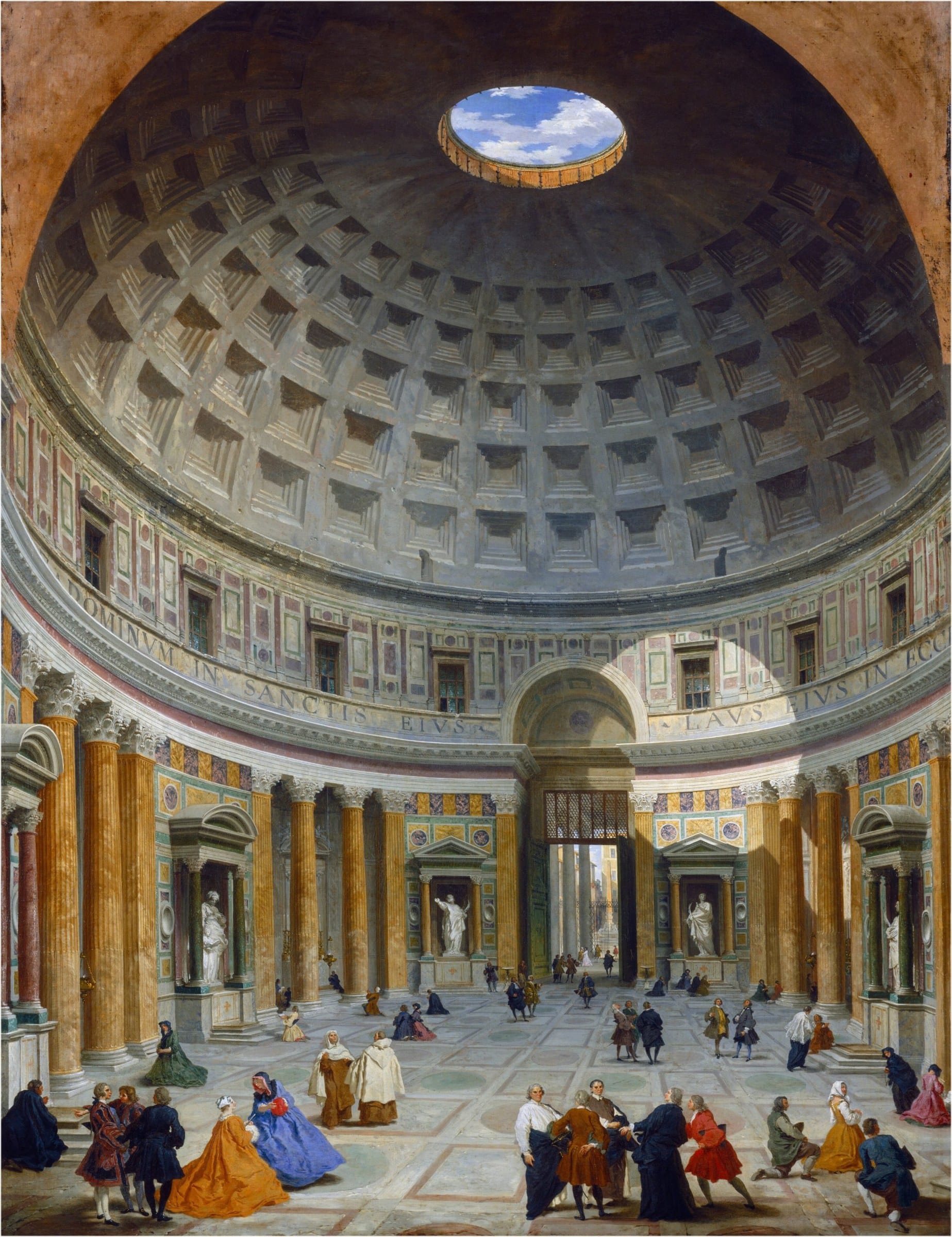
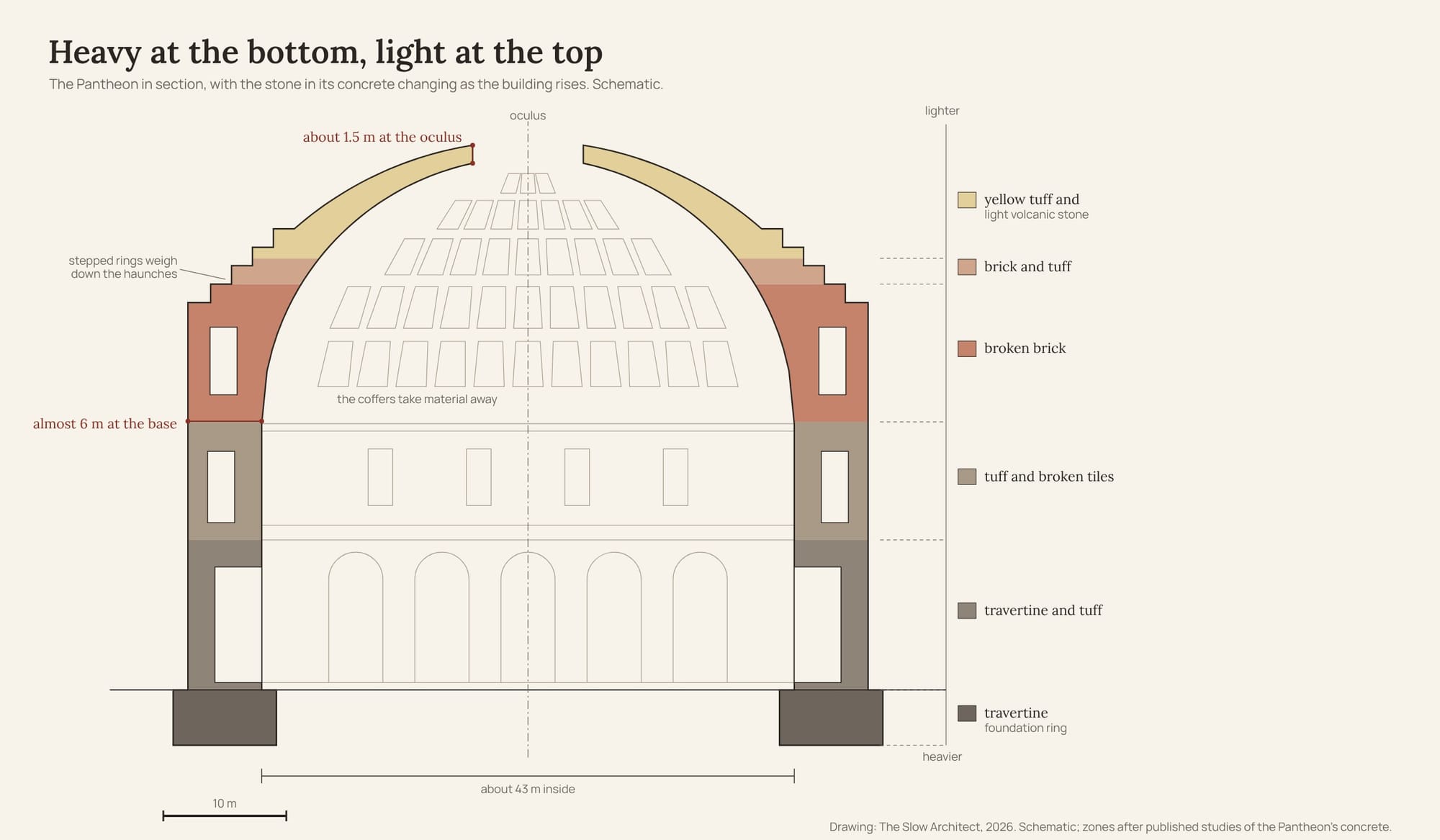
The most famous proof is over the head of anyone who walks into the Pantheon: still the largest unreinforced concrete dome in the world, about 43 metres across, begun under Trajan and finished under Hadrian, around 125. The builders changed the mix as they went up, heavy rubble at the bottom, light tufa and pumice at the top, and the dome thins from almost six metres at its base to about a metre and a half around the oculus. Outside, a series of stepped rings weighs down the haunches; inside, the coffers take material away. It is a weak concrete, put exactly where it is needed. Why there is a hole at the top is another question, and it will get its own answer.
Why we don't use it
Because it is slow, and weak. The pozzolana reaction that makes it last so long is the same one that makes it harden in months rather than days, and a building site today cannot wait. The block rebuilt in 2004 in the harbour at Brindisi following Vitruvius, about two metres on each side, had after a year a compressive strength of 4.5 to 5.6 megapascals, against 20 to 40 for ordinary concrete.
Still, it is worth studying, and not out of nostalgia. Roman lime was burned at 850 to 900 °C, the clinker of Portland cement at 1,450 °C, and cement today accounts for several per cent of the world's carbon dioxide emissions. For marine structures, for repairs, for walls that have to last more than they have to carry, Roman concrete is a research question again.
Where to see it
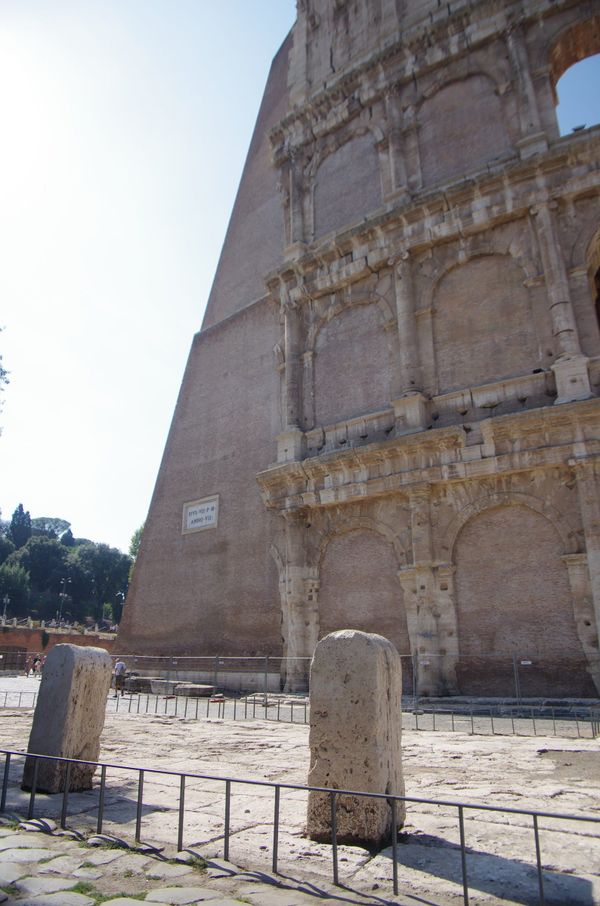
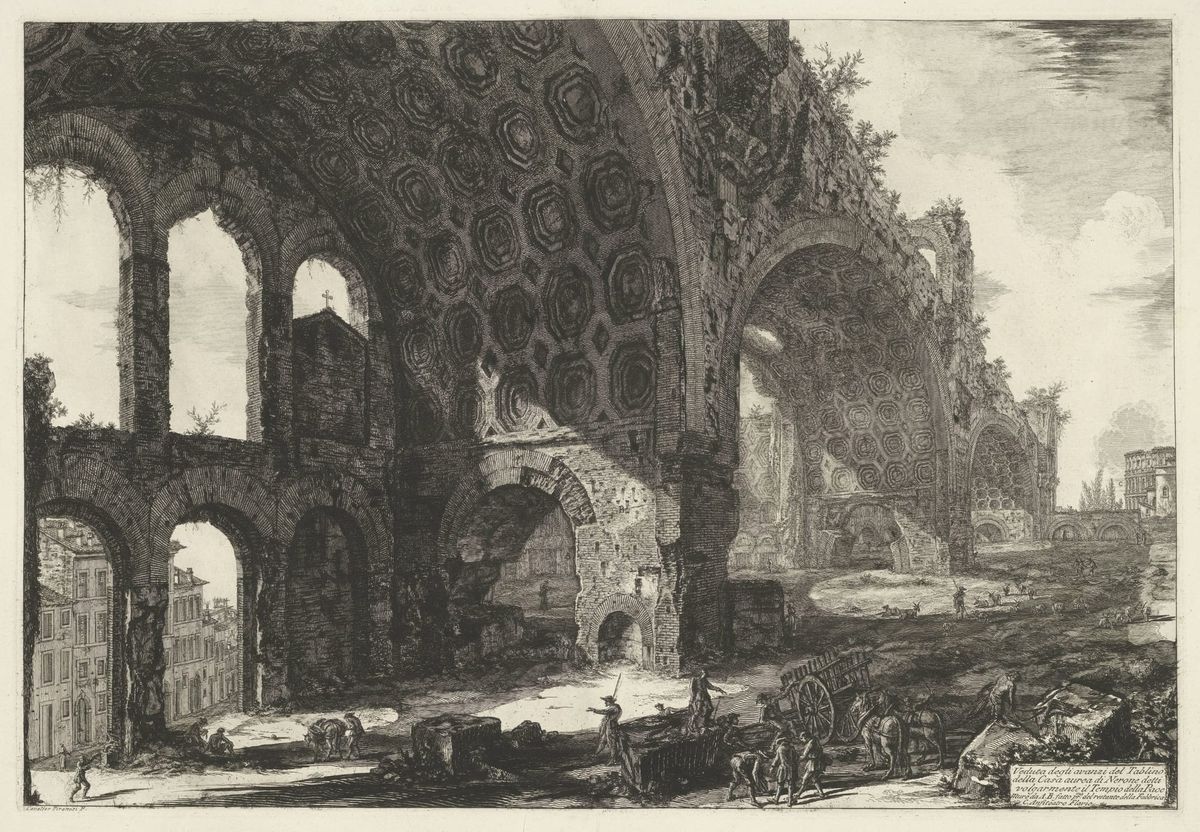
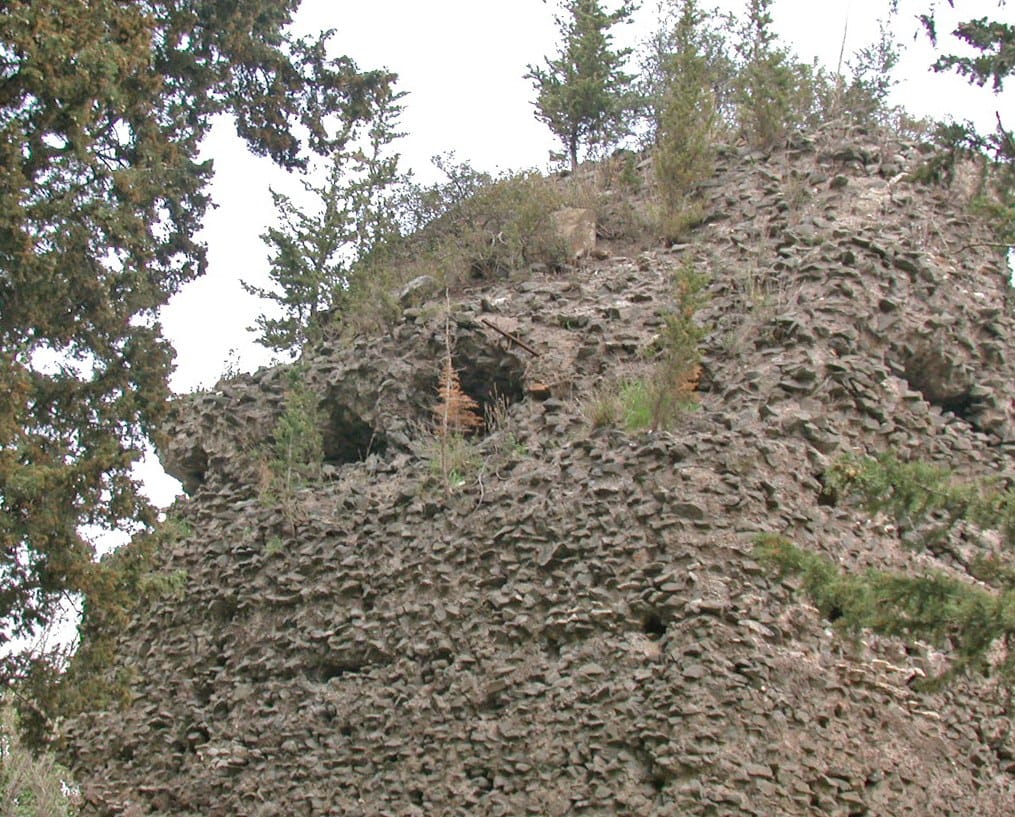
The best place to look inside it is the Appian Way. Along the road many tombs have lost their facing of marble and stone blocks, carried off over the centuries as building material, and are left with nothing but their concrete core: the so-called tomb of Geta, just past the Marrana della Caffarella, and that of Priscilla, almost opposite the church of Quo Vadis. You can see the layers, the chips of lava and tufa, the grey mortar. In the centre of Rome, Trajan's Markets show the same material still dressed in brick.
…, Exactly? answers one question about a building, properly. If there is one you have always wondered about, reply to any Slow Letter and ask.
Sources: Vitruvius, De architectura II.5–6 and V.12; Pliny the Elder, Natural History XXXV.166, quoted in the translation used by Jackson et al. (2017); C. J. Brandon, R. L. Hohlfelder, M. D. Jackson, J. P. Oleson, Building for Eternity (Oxbow, 2014); E. Gotti et al., "A Comparison of the Chemical and Engineering Characteristics of Ancient Roman Hydraulic Concrete with a Modern Reproduction of Vitruvian Hydraulic Concrete", Archaeometry 50 (2008); L. Brune, R. Perucchio, A. R. Ingraffea, M. D. Jackson, FraMCoS-7 (2010); M. D. Jackson et al., "Mechanical resilience and cementitious processes in Imperial Roman architectural mortar", PNAS 111 (2014); M. D. Jackson et al., "Phillipsite and Al-tobermorite mineral cements…", American Mineralogist 102 (2017); L. M. Seymour et al., "Hot mixing: Mechanistic insights into the durability of ancient Roman concrete", Science Advances 9 (2023); Vaserman et al., Nature Communications 16 (2025); M. D. Jackson, M. J. Heap, V. L. Pavlovics, A. G. Sinner, "Caementiciae Structurae: Ancient Roman Concrete Structures Fabricated with Reactive Volcanic Rock", Annual Review of Earth and Planetary Sciences 54 (2026); Parco Archeologico dell'Appia Antica, guide to the Appian Way (2015).