Assisi from Rome or Florence: Why It's Worth the Night Halfway Between
Is Assisi worth visiting? Halfway between Rome and Florence, it works as a day trip, but it's better with a night. Trains and parking, a map of the town, the two churches of the Basilica and the vault that looks whole, Santa Chiara and the Eremo.
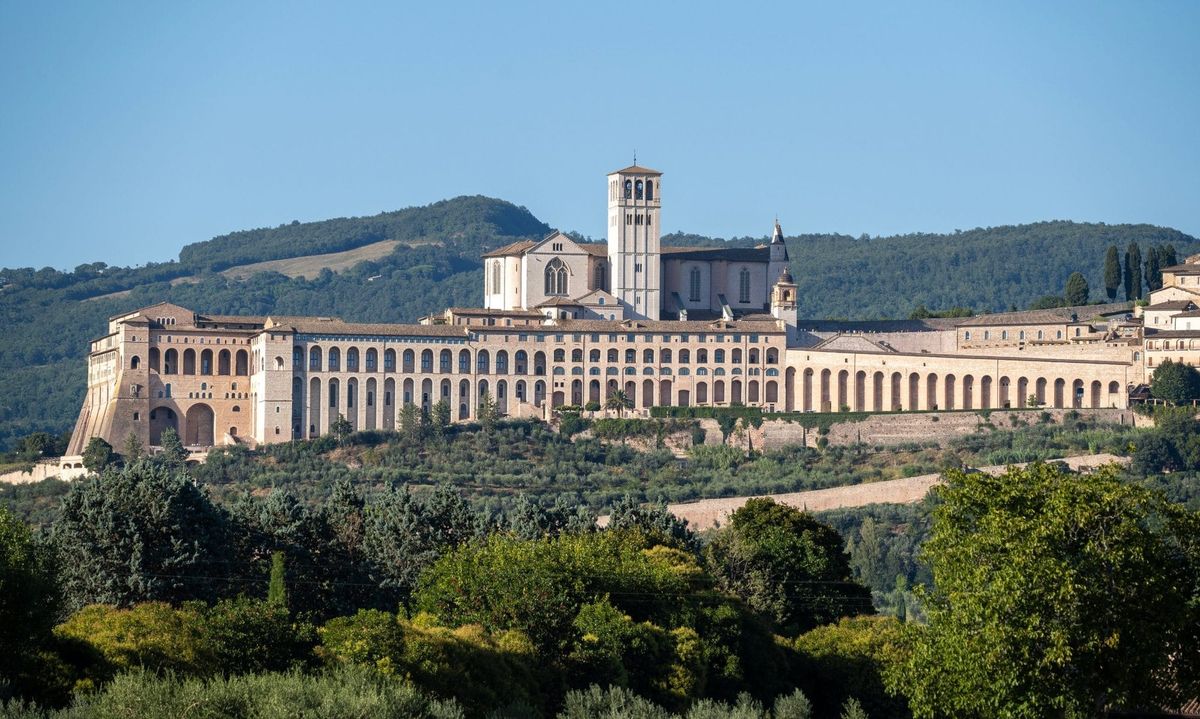
Assisi sits halfway between Rome and Florence, a little over two hours' drive from each. You can do it in a day, but I think it's better with a night.
Is Assisi worth visiting? The short answers
Is it worth it? Yes, even if you don't come for faith. I don't come for that: many people arrive as pilgrims for Francis, I come out of curiosity, to see the architecture. In Assisi the two things are in the same place, and this guide tries to serve both.
A day or a night? A night. From Rome or Florence you can do it in a day, and if a day is all you have, that's fine: there's time for the Basilica and the old town. With the night, the next morning you can go up to the Eremo without rushing.
Train or car? Both work. The train leaves you down on the plain, at Santa Maria degli Angeli, and from there you go up by bus. The car leaves you below the walls, in one of the car parks, and from there you go up on foot or by escalator.
What to skip? If you only have the day, leave the Eremo for next time. Santa Maria degli Angeli, if you arrive by train, is on your way.
My times in Assisi
I have been to Assisi several times. The first time I was still a child, before the earthquake, and I have a lovely memory of it. Then what stayed with me were the collapses and the restoration of the church, which went on for years, and as soon as it reopened I went to see it.
The freshest memories are from December and August. In December we arrived on the 31st, Kat and I with two friends, a last-minute decision, with little money in our pockets: an ugly little flat, a bottle that had been a gift, which none of us knew and which made me fall in love with that wine, as well as with the town, and sparklers instead of fireworks, which burned my coat. In August, in 2020, I passed through on a tour of the wineries in the valley, and my own photos of the Basilica on this page are from that morning.
Why halfway
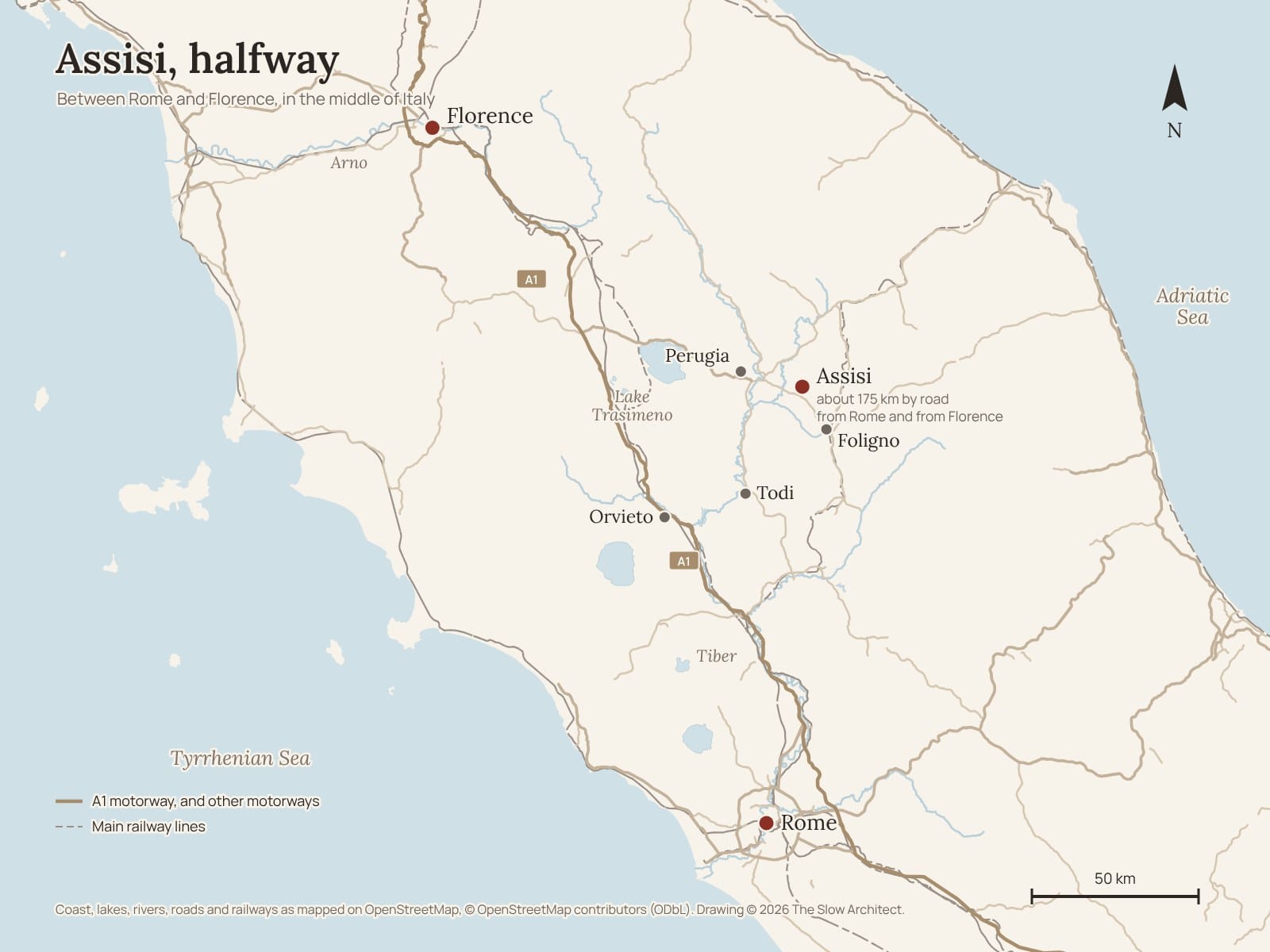
By car Assisi is about 175 kilometres from Rome and the same from Florence, a little over two hours' driving from each. That is why it works in two ways: as a day trip from either city, or as the overnight stop on a journey from Rome to Florence, or the other way round. Orvieto and Todi are on that road too, before or after.
Rome to Assisi by train or car
By train. From Roma Termini there are direct regional trains to Assisi station, in about two hours; others change at Foligno. Check the Trenitalia timetable before you set off.
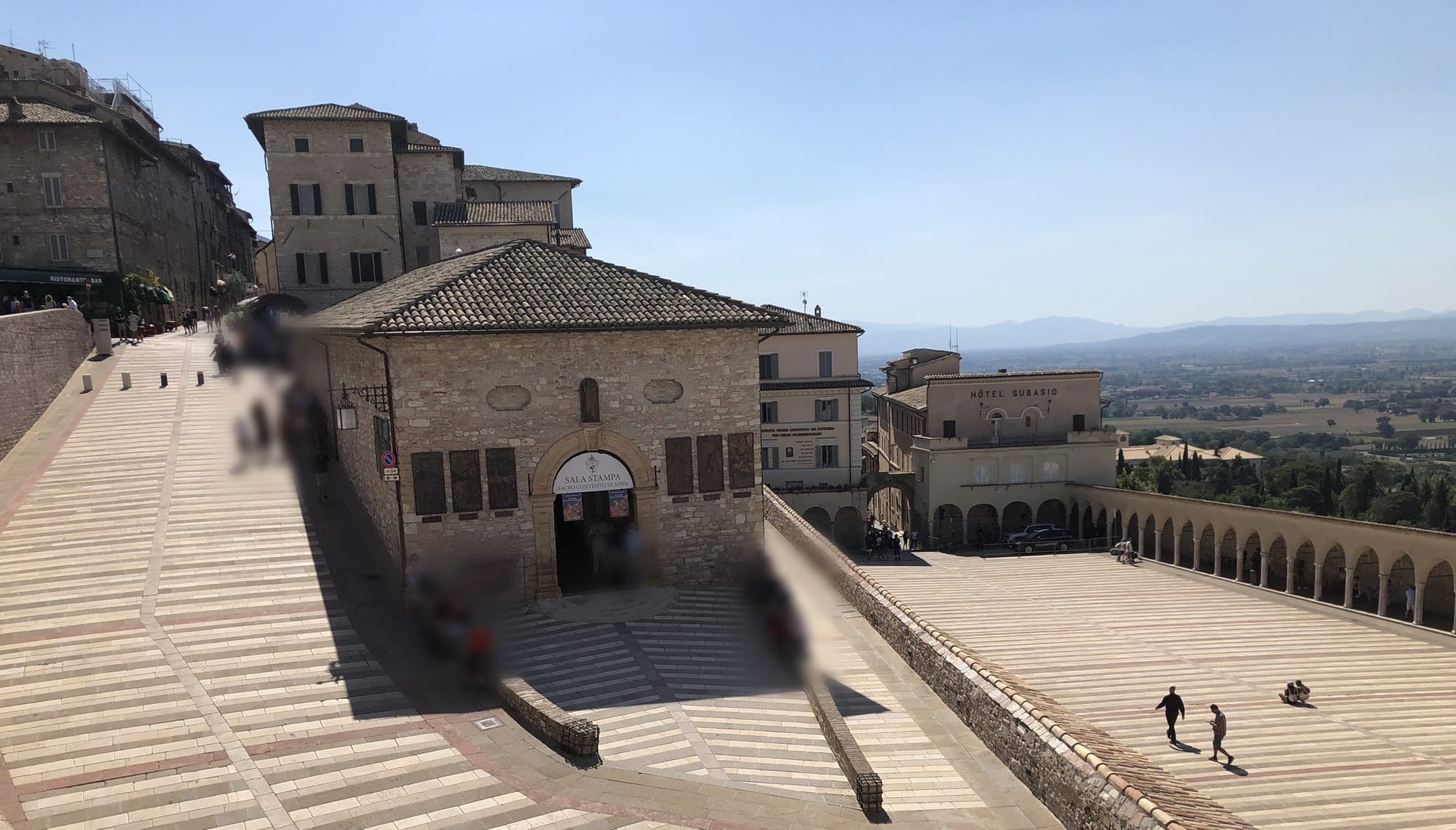
By car. About 175 kilometres, a little over two hours. The road ends below the walls: the old town is a limited traffic zone (ZTL), with electronic gates, and the hours are set by the Comune. If you are staying inside the walls, ask your hotel how to get in by car. Otherwise leave it in one of the car parks listed below.
Florence to Assisi by train or car
By train. From Firenze Santa Maria Novella it takes about two and a half hours. The sources don't agree on direct trains: some list a few, others say you always have to change, at Terontola or Foligno. Check the Trenitalia timetable for the day you travel.
By car. From Florence too it is about 175 kilometres, a little over two hours, and the same rules apply for the ZTL and the car parks.
From Assisi station to the town
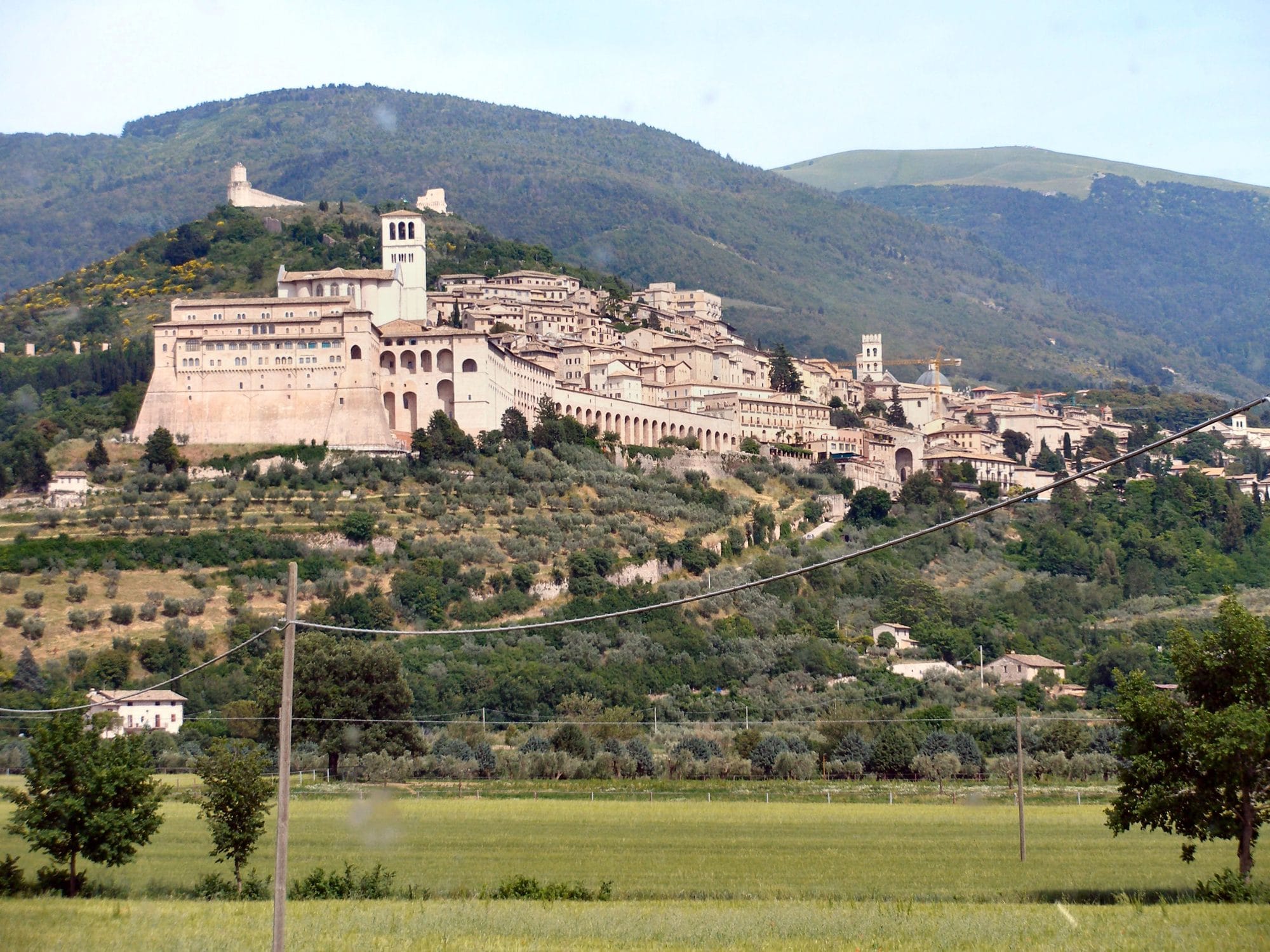
Assisi station is not in Assisi. It is down on the plain, at Santa Maria degli Angeli, four or five kilometres from the old town, which sits on the side of the mountain. It's too far to walk, uphill, with luggage. Line C of Busitalia stops in front of the station and goes up towards the Basilica and the old town: the timetable is on the Busitalia website.
The great dome you see down on the plain as you leave the station is Santa Maria degli Angeli. More on it below.
Parking in Assisi
The four main car parks, all paid, are around the walls and are run by Saba. Giovanni Paolo II is the closest to the Basilica. Mojano has escalators that take you up towards the centre. Matteotti is at the top, near the Duomo and the Rocca; Porta Nuova is at the other end of town, near Santa Chiara. Prices are on the Saba website. Which one suits you depends on your route; see below.
The order of the visit
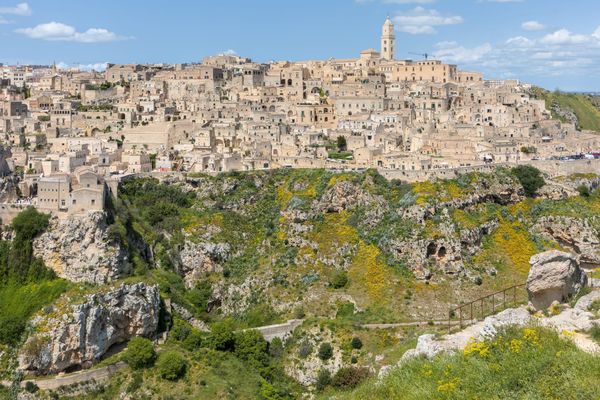
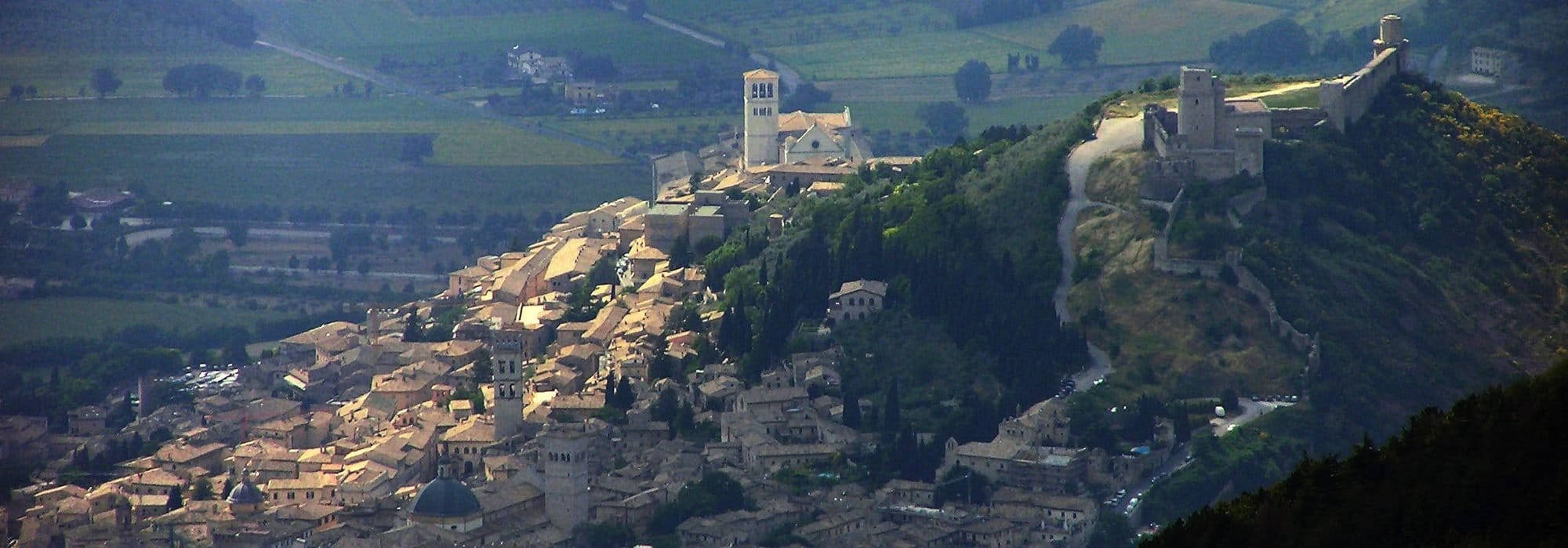
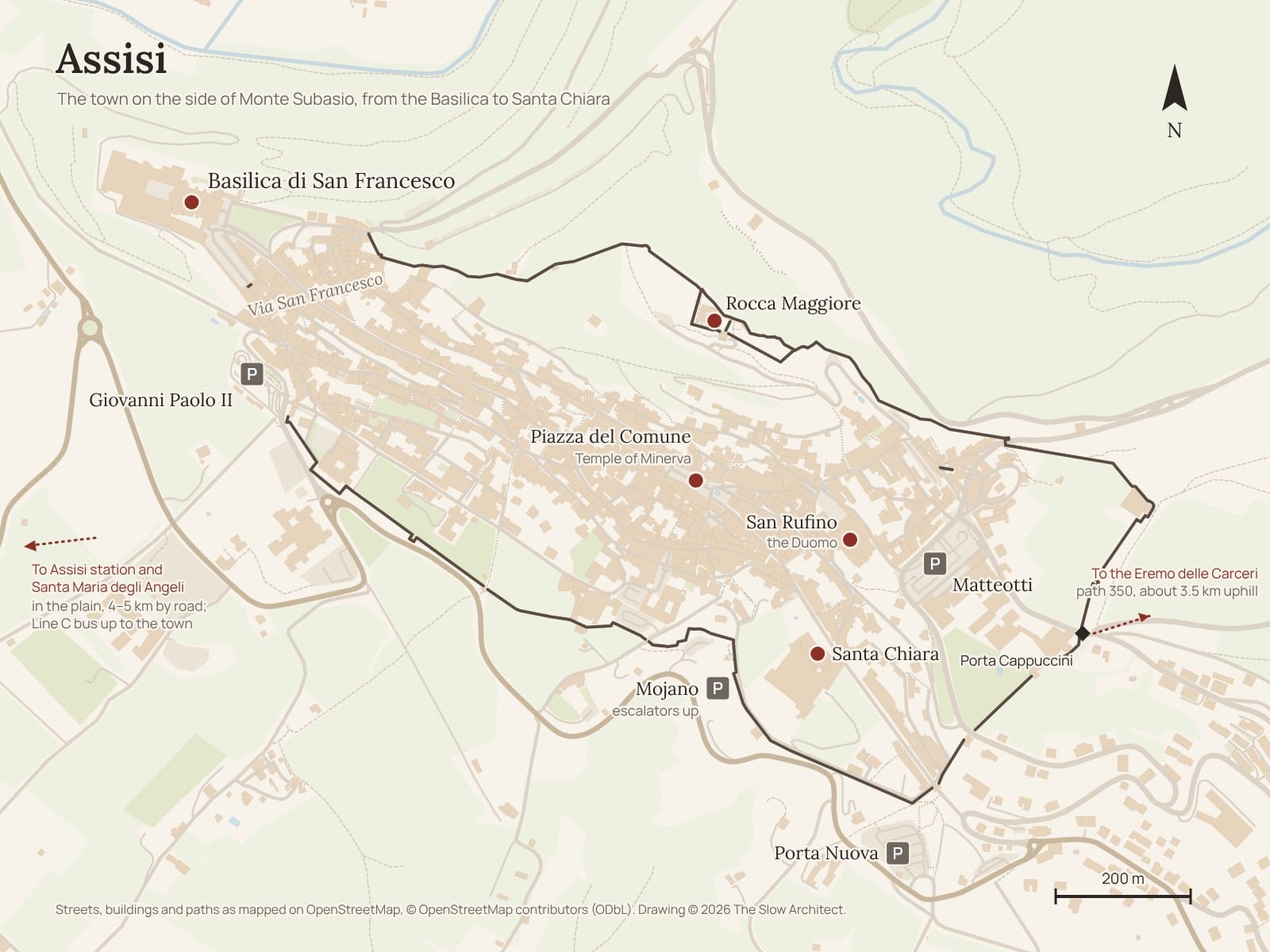
Assisi is a town on a slope, along the side of Monte Subasio. The Basilica is at the bottom, at one end; Santa Chiara at the other; the Piazza del Comune in between; the Duomo and the Rocca at the top. You can do it in two ways.
From the bottom. Leave the car at Giovanni Paolo II, or get off the bus at the Basilica, and start with Francis. Then walk up Via San Francesco to the Piazza del Comune, and from there to the Duomo, the Rocca and Santa Chiara. It is uphill all the way.
From the top. Leave the car at Matteotti, start with the Rocca and the Duomo, walk down to the Piazza del Comune and then to the Basilica, which becomes your last stop. Santa Chiara is a little off this line, towards Porta Nuova: go there before you walk down. You only climb once, at the end, to get back to the car.
If you have the night, do the upper town on the first day and the Basilica the next morning, when it opens. In winter the Rocca closes in the afternoon: check the hours before you climb up.
A map of Assisi
The map puts the town on a single page. Off the map to the west, down on the plain, are the station and Santa Maria degli Angeli; on it, the road up and the four car parks around the walls; at the top, the line that runs from the Basilica to Santa Chiara by way of the Piazza del Comune, with the Duomo and the Rocca above. Both routes, from the bottom and from the top, can be followed on it.
The Basilica of San Francesco: the two churches and the tomb
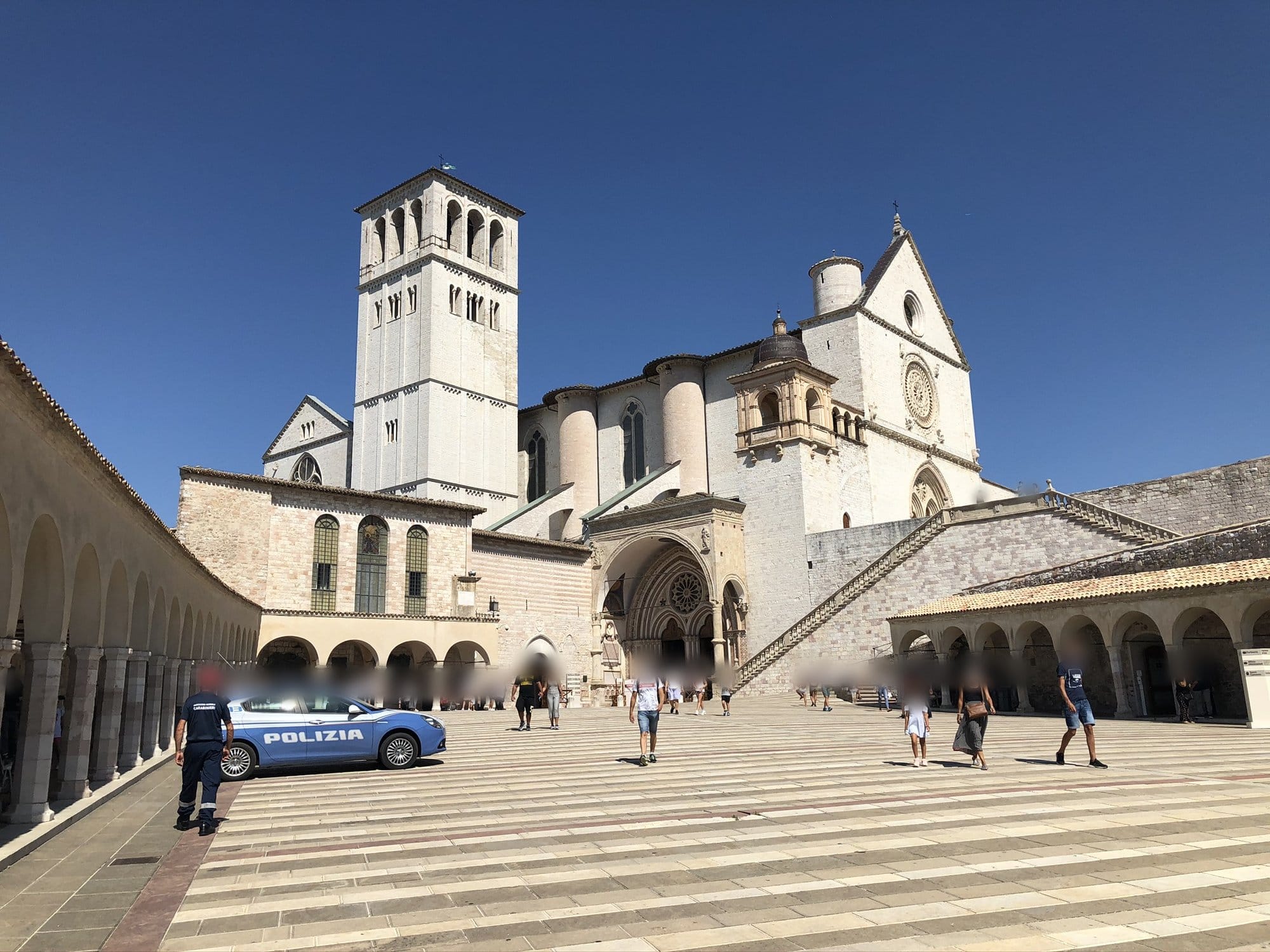
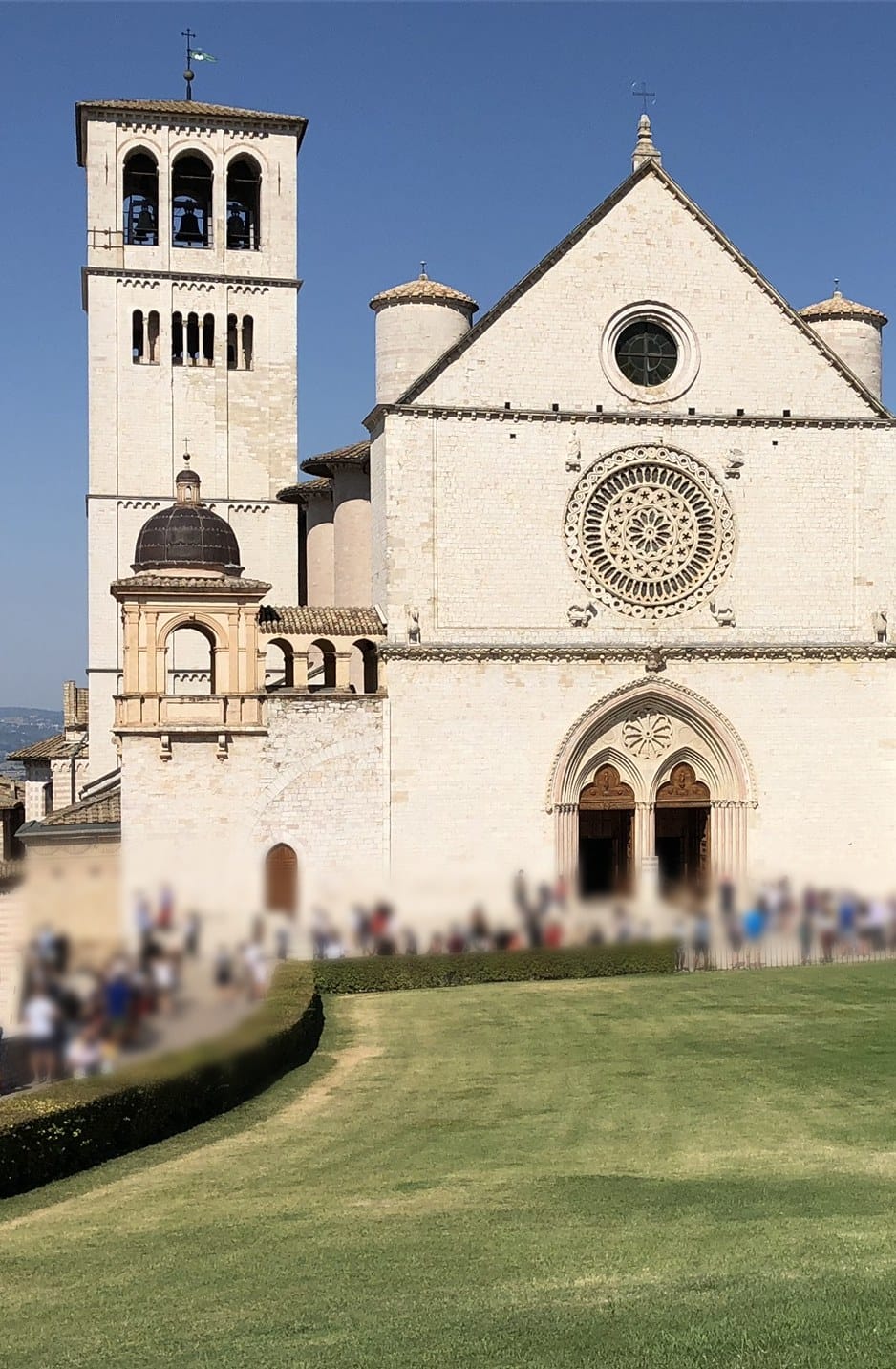
You go in from below, from the lower square. The Basilica is two churches, one on top of the other. The lower one was begun in July 1228, the day after Francis was made a saint, and was ready in 1230, when his body was brought there. The Basilica was consecrated in 1253. According to tradition, the hill it stands on was the one where executions were carried out.
The lower church is low and dark, and there is hardly a wall without painting. Cimabue, Giotto and his workshop, Pietro Lorenzetti and Simone Martini all worked here. The first chapel on the left is Simone Martini's, with the stories of Saint Martin, painted in the second decade of the fourteenth century: if you have time for one thing only, that's it. From the nave you go down to the crypt, to Francis's tomb. The body had been hidden under the altar to protect it from relic thieves, and for centuries no one knew any longer where it was: it was found only in 1818, after almost two months of digging.
Then you go up to the upper church, tall and full of light. Along the nave, in the lower band, run the twenty-eight scenes of the life of Francis. Vasari attributed them to Giotto, and historians are still arguing about it: some say Giotto, some say other painters working on the same site. Look at them one after another, and make up your own mind.
On 26 September 1997 the earthquake brought down two parts of the vault of the upper church and killed four people, who had gone in to check the damage from the tremor of the night before. The church reopened two years later, but the work on the frescoes went on until 2006: more than three hundred thousand fragments of painting were gathered from the rubble, catalogued and put back together. Another part of the work you can't see: inside the structure there are anti-seismic devices, put there so that the damage won't happen again. Where to look for the rest is just below.
The practical things, as of October 2026. Entry is free for individual visitors; groups book. From April to October the lower church is open from 6am to 7pm and the upper church from 8.30am to 6.45pm; from November to March the lower church closes at 6.30pm and the upper at 6pm. On Wednesdays the lower church closes an hour earlier. The tomb is open from 6am to 6.15pm. Shoulders and knees must be covered. Photography is not allowed, at least in the lower church and the crypt.
One step to the side: the vault that looks whole
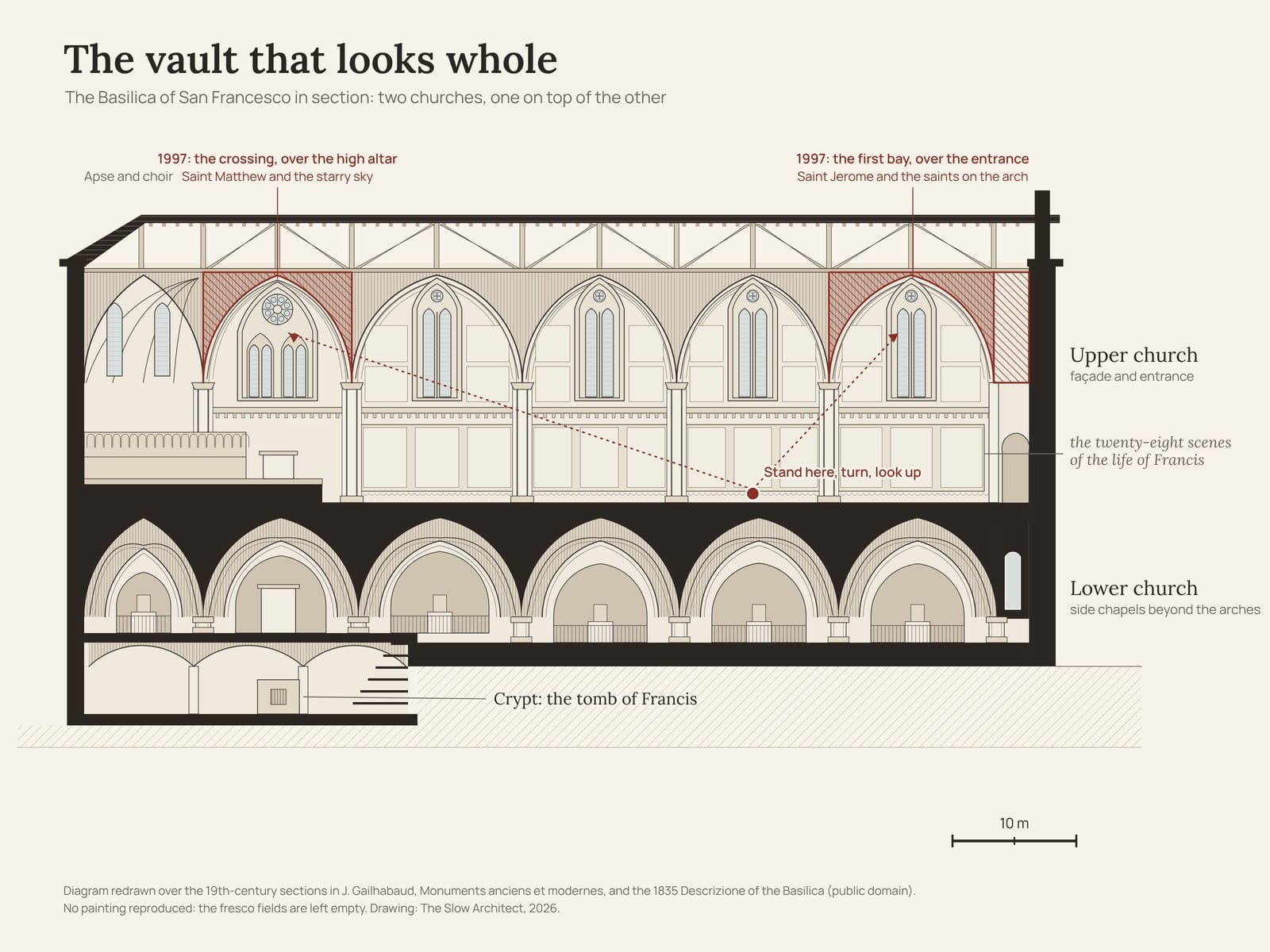
In the upper church it comes naturally to look at eye level, along the stories of Francis. Take one step to the side and look up. Above you, in 1997, the ceiling came down in two places, and if you don't know it you won't notice.
The first is at the entrance. Go in, take a few steps along the nave and turn back towards the door. The first bay has four vault segments with the four Doctors of the Church: Augustine, Ambrose, Gregory and Jerome. Saint Jerome's, attributed to the young Giotto, had shattered into about fifty thousand pieces, and went back up in 2002, after the saints on the arch above the door. The second place is over the high altar: the segment with Saint Matthew painted by Cimabue and the one next to it, with the starry sky, back in place in 2006.
They don't look broken because the restorers wanted it that way. The missing parts were not marked with hatching, which nobody could make out from twenty-two metres below. In the Saint Matthew they were filled with a neutral colour, matched to the original, so that from the ground the painting reads as a whole. About two thirds of the Saint Jerome came back. Of the Saint Matthew, a quarter or a little less, and the rest is plaster and colour: Giuseppe Basile, who led the restoration of the paintings, said that saint should be considered lost. Now that you know, look at the two segments again, and compare them with the others.
Above the Basilica: the Temple of Minerva, the Duomo and the Rocca
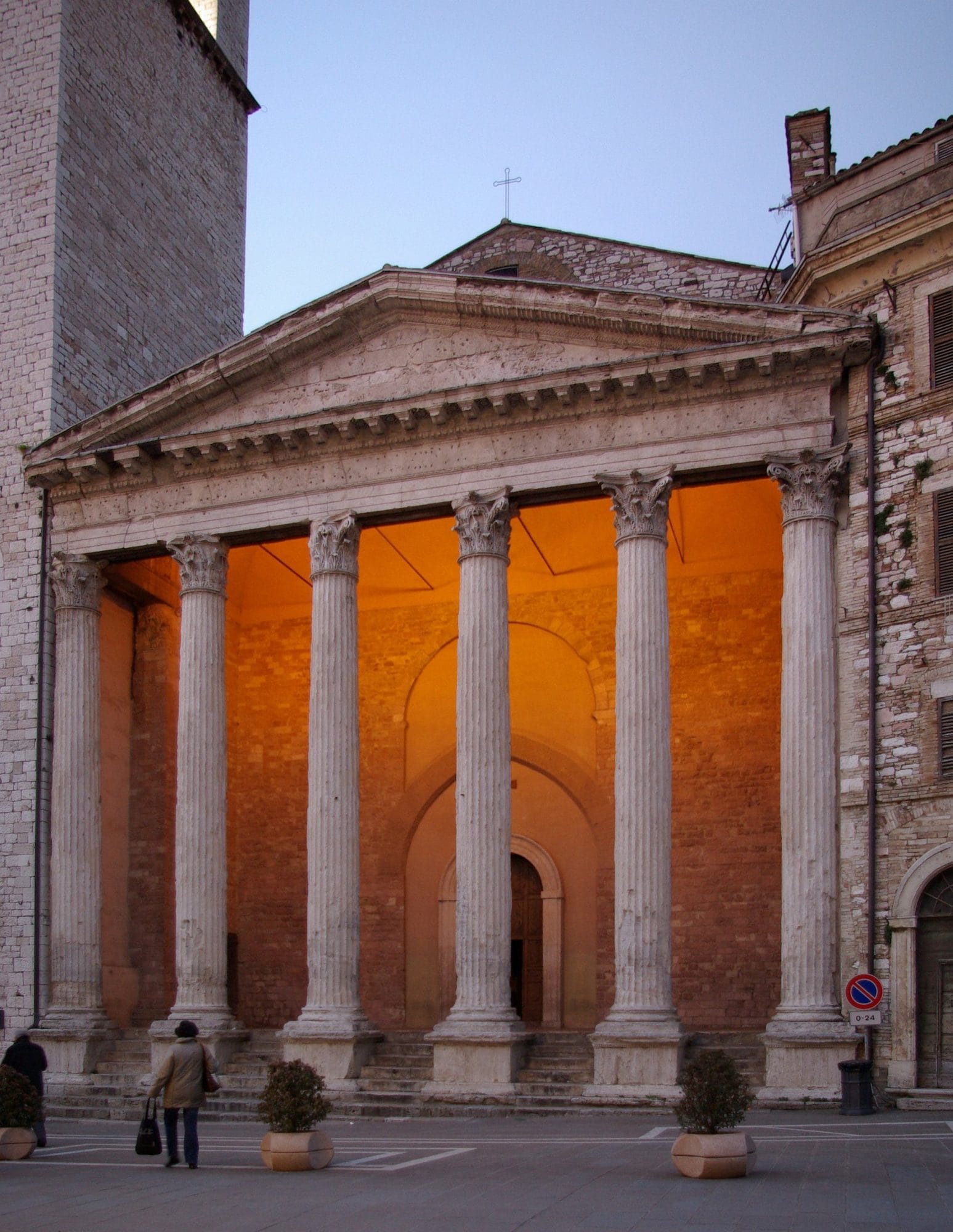
From Via San Francesco you climb to the Piazza del Comune. On its long side stands the Temple of Minerva: six Corinthian columns from the first century BC, their bases set on the steps of the stairway because there wasn't enough room. Since 1539 the inside has been a church. Goethe arrived on 26 October 1786 and wrote that it was the first complete ancient monument he had seen. If you've come for the architecture, stop here: a Roman temple with its front still whole, inside a medieval square.
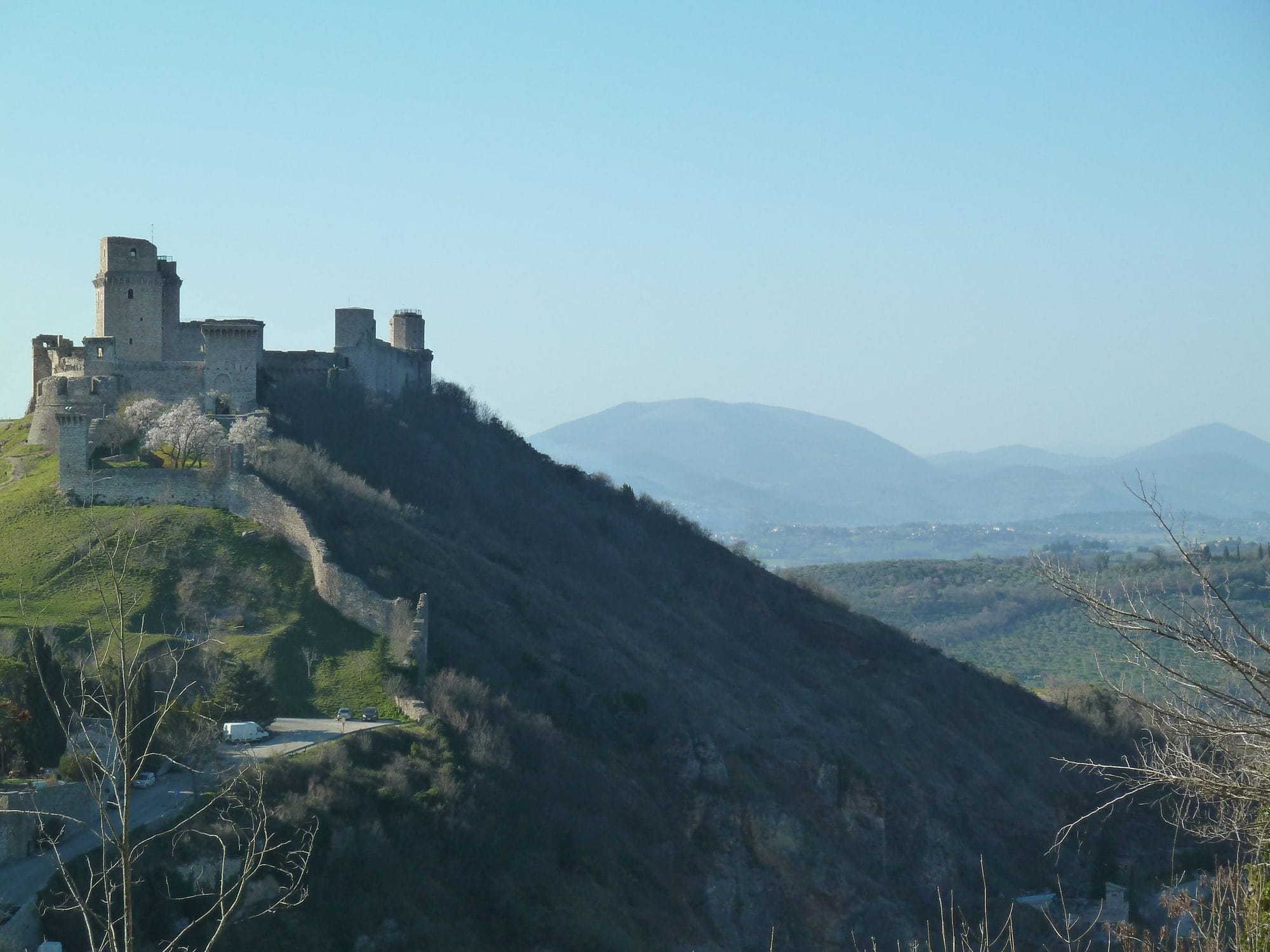
Higher up is San Rufino, the Duomo. The front is Romanesque, with three carved doorways and three rose windows, and inside is the font where, according to tradition, Francis and Clare were baptised. Higher still, above everything, is the Rocca Maggiore, rebuilt after 1174 and again in the fourteenth century: from the top you can see the valley. The Rocca's hours change with the seasons and with exhibitions: ask at the tourist office in the Piazza del Comune.
Be warned, though: Assisi is a very touristy town. The centre is full of shops: some sell things that are frankly ugly, souvenir stuff, a few sell nicer things. If you're looking for the saint and his teaching, you'll have to make an effort to find them. I did come away with a sense of commercialisation.
The Basilica of Santa Chiara
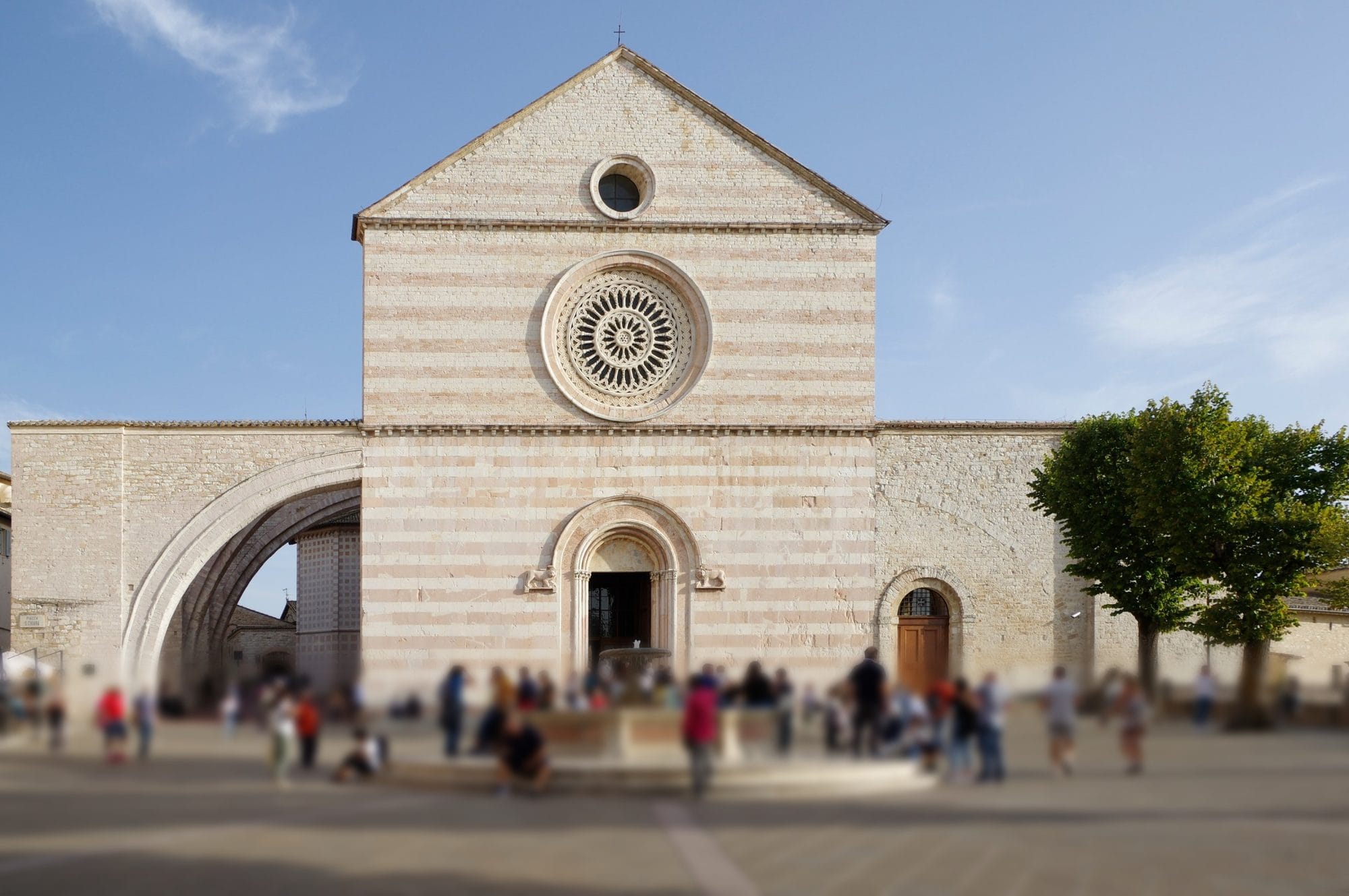
At the other end of town, towards Porta Nuova, is Santa Chiara. It was built between 1257 and 1265, in bands of white and pink stone from Monte Subasio, and the three great arches that prop it up along its side were added in the fourteenth century. Inside, in the chapel of San Giorgio, is the crucifix of San Damiano, the one that, according to tradition, spoke to Francis. From the square in front of the church you can see the valley.
If you have the next morning: the Eremo delle Carceri and Santa Maria degli Angeli
The Eremo delle Carceri. It is in the woods of Monte Subasio, about four kilometres from the town and at around 800 metres above sea level: it is where Francis withdrew to pray. From Porta Cappuccini you can walk there on path 350, three and a half kilometres uphill; you can also get there by car or taxi. Entry is free.
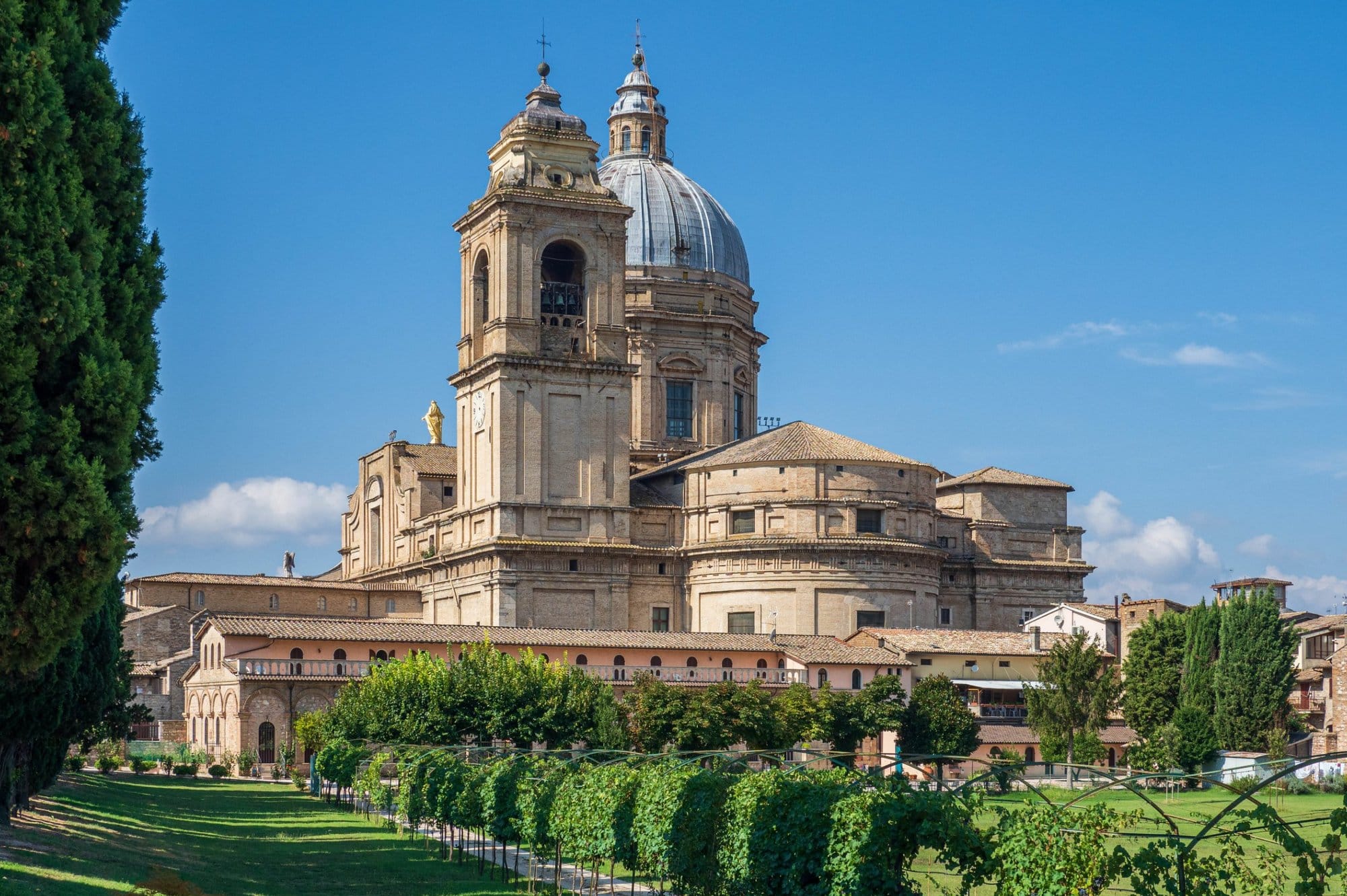
Santa Maria degli Angeli. It is the dome down on the plain, near the station. It is a huge basilica, built between 1569 and 1679 to a design by Galeazzo Alessi, around a tiny chapel, the Porziuncola, the first home of Francis's friars. Inside is also the Cappella del Transito, where Francis died in 1226. A church inside a church: if you're leaving by train, stop.
When to go
The day to avoid is 4 October, the feast of Francis: since 2026 it has been a national holiday again, for the first time since 1977, and in 2027 it falls on a Monday, so the weekend before it becomes a long one.
Sleeping, and drinking
Stay inside the walls: the night is the reason it's worth stopping. That time, on a budget, we had an ugly little flat.
For wine, look towards Montefalco and Bevagna, where I did that August tour: wine matters enormously there, and there are a great many wineries.