Montefalco and Bevagna, Italy: Sagrantino Country in Umbria
Montefalco looks down over the whole valley, and you come for the Sagrantino. The Carapace, the winery Arnaldo Pomodoro designed, the bottles worth drinking, the truffles, Bevagna in the plain and, on the road back to Rome, the Tempietto del Clitunno.
A night or two in the valley between Assisi and Spoleto: the wineries, the truffles, Bevagna down in the plain and, on the road back to Rome, the Tempietto del Clitunno.
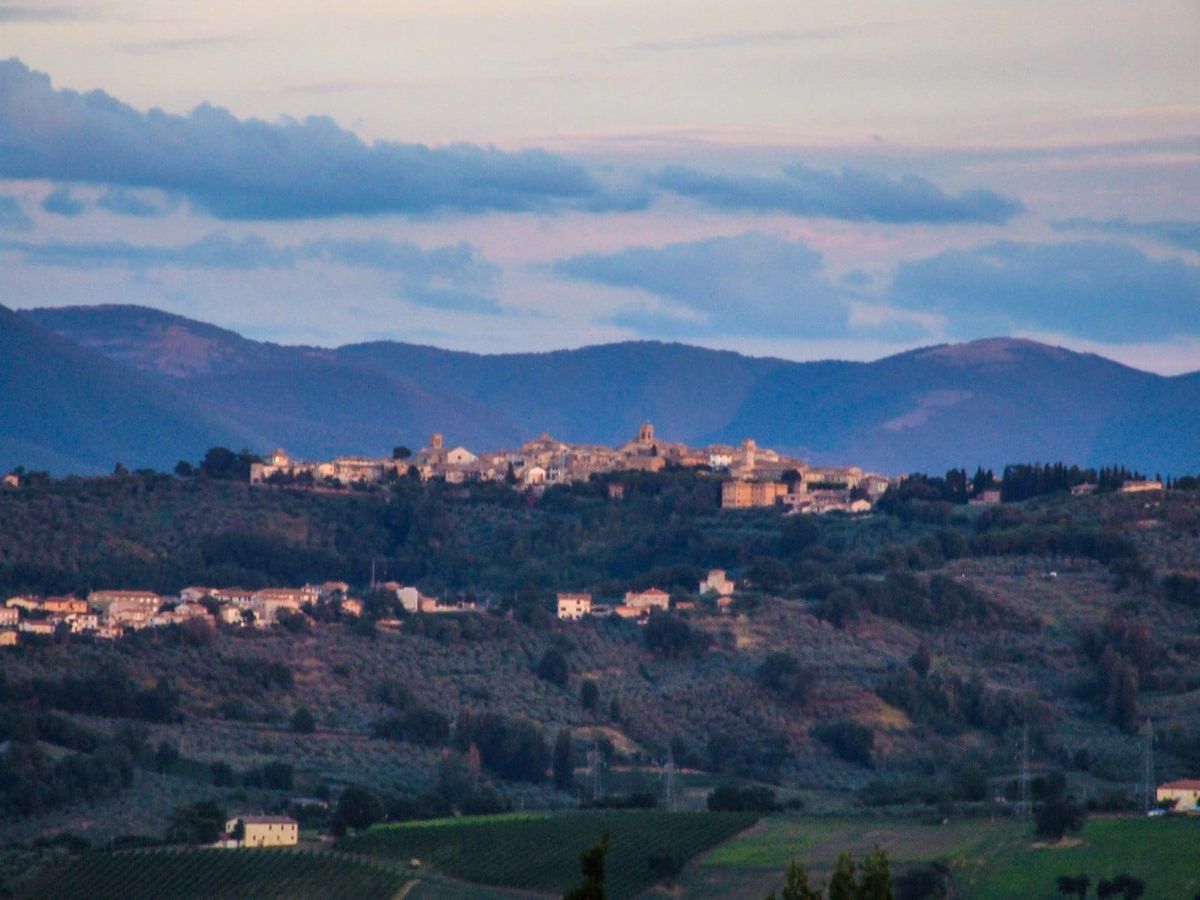
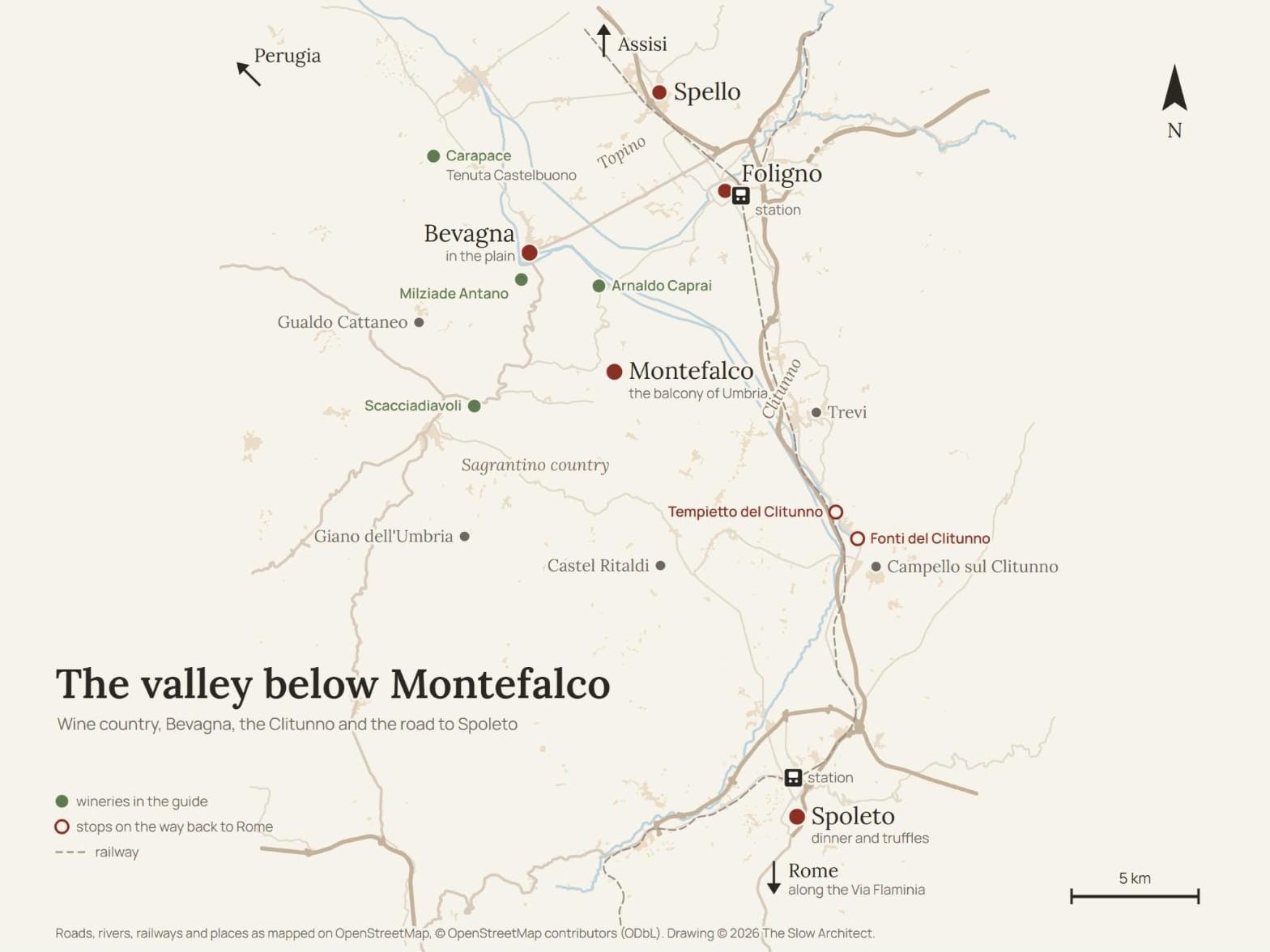
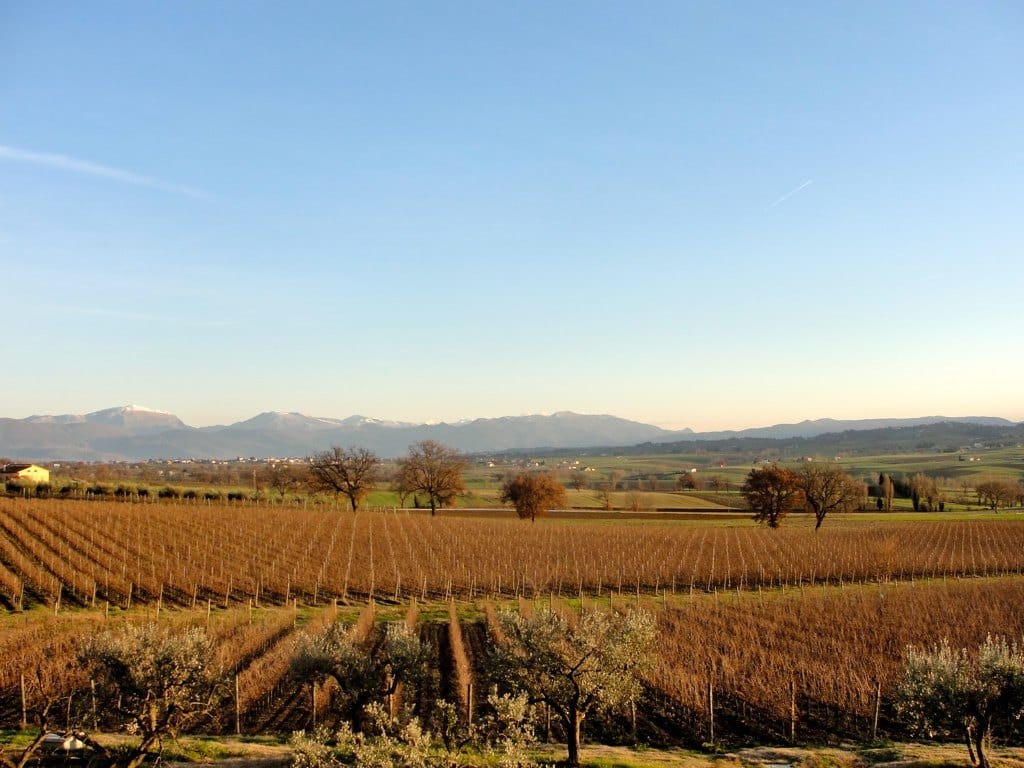
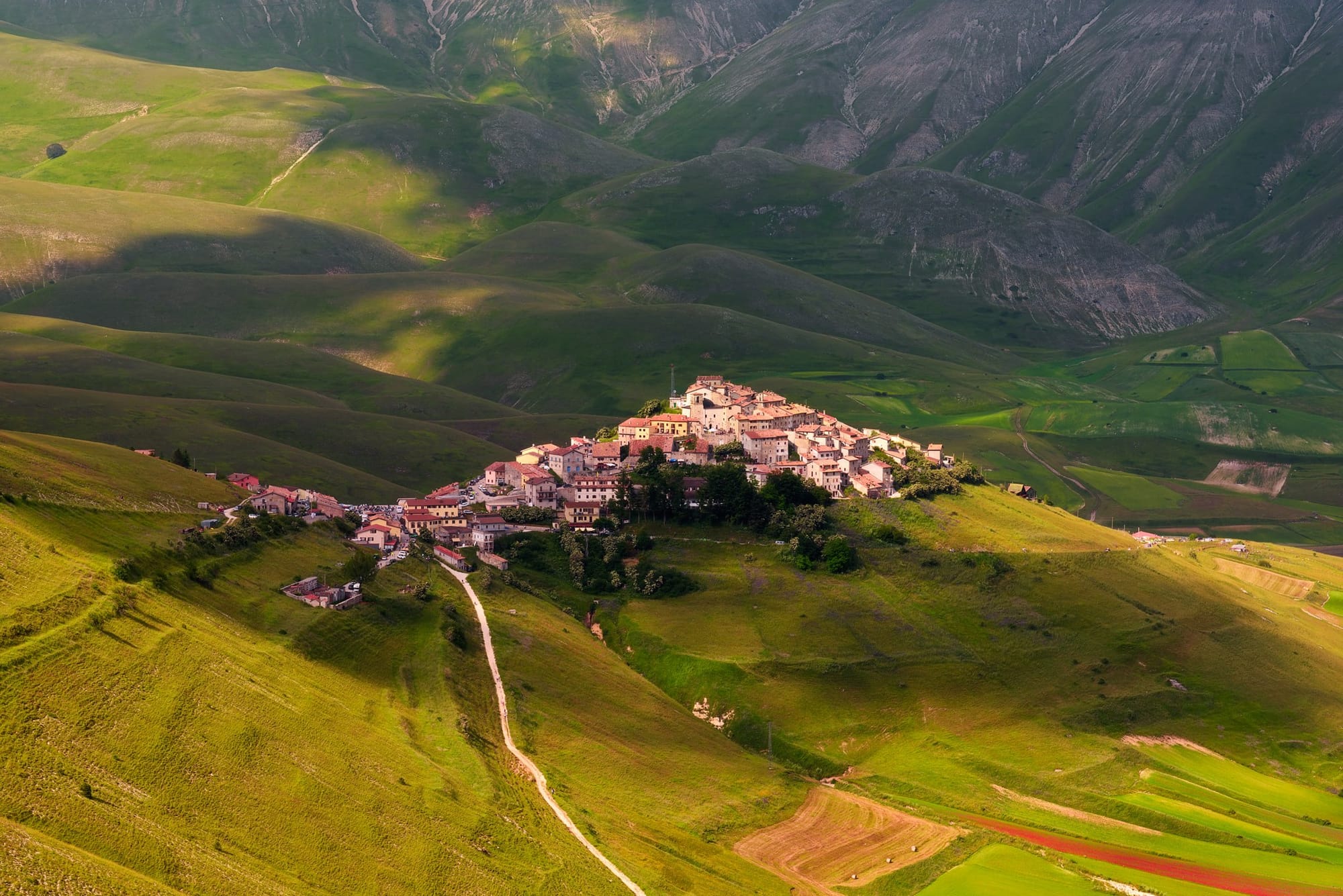
Montefalco sits on a hill in the middle of the valley, and from up there Umbria opens out all around you: that is why they call it the balcony of Umbria, the ringhiera dell'Umbria. From the lookout your eye runs over the valleys of the Clitunno, the Topino and the Tiber, and comes to rest on Foligno, on Spello, on Assisi and, further off, on Perugia. This guide starts there, because nearly everything in it can be picked out from that railing: Bevagna down in the plain, Spello leaning against the side of Monte Subasio, Foligno spread across the flat land with its station, and to the south the road that follows the Clitunno all the way to Spoleto.
But above all, you come to Montefalco for the wine. Here wine matters enormously: there are a great many wineries, the countryside is beautiful, and you end up doing a lot of rounds between the vineyards and the table. The frescoes and the squares are there too, and they are worth the stop, but they come second, almost a pause between one glass and the next.
I was here at the end of August 2020, on the same trip that took me through Orvieto and Assisi. We had rented a flat, near Montefalco if I remember rightly. A few years have gone by since then, and what follows mixes my memories with what you will find today, checked against the sources.
Montefalco and Bevagna in short
Montefalco and Bevagna are for people who love red wine, and for anyone travelling between Rome and Florence who wants somewhere to stop for a night, or two, halfway. If you don't drink and are just looking for a pretty town to see in an hour, you may find half the trip missing: Montefalco is quick to walk round, and the rest of it lives in the wineries. One night is the minimum; with two there is time for Spello, the Clitunno and dinner in Spoleto as well. Either town makes a good base: Montefalco for the view and the evenings in the square, Bevagna if you would rather have a flat town you can walk round without effort.
Montefalco, the balcony of Umbria
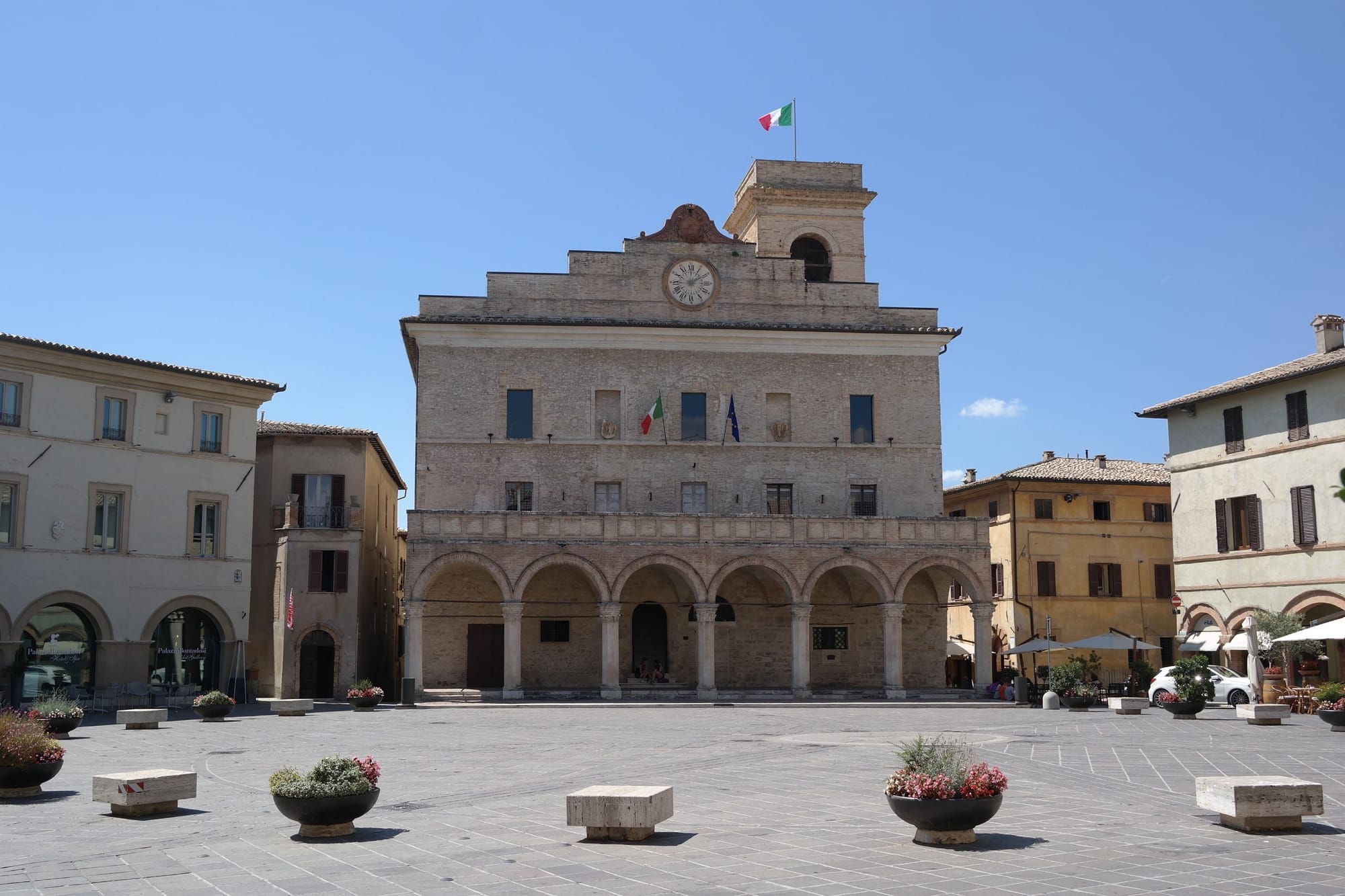
The town is small, and you can walk round it unhurried in very little time. Everything leads to the Piazza del Comune, which is almost round: you get there, have a coffee, and then go to the lookout to look at the valley. After that view, every name in these pages will have its exact place.
The one visit to make is the museum of San Francesco, a fourteenth-century church that is now the town museum. In the apse, Benozzo Gozzoli painted scenes from the life of Saint Francis in 1452, and in the same church there is also a Nativity by Perugino.
Under the church, wine again. In 2006, during restoration work, the friars' cellars came to light again, with their presses and the vats for the must, and today they house the Museo del Sagrantino: wine was being made here inside the convent. In the 2025–26 season, on Saturdays at four, the wine consortium ran a guided tasting in the same building, "Montefalco nel bicchiere", to be booked by the Friday. If you have come without a car, it is the simplest way to taste several wines without having to drive.
On Corso Mameli there is Nobili Sapori, a wine shop with the wines of the area and the food of Umbria. When we went in, it was very well stocked. We bought some wine, and I took a Trebbiano: a magnificent white, which struck me because I am not a lover of white wine; perhaps that was the day I became one, a little. The owner of the shop also introduced me to a winery, Raína, which I come back to further on.

There was another table I had in mind. Some evenings I watch Giorgione's videos on YouTube, a big man with a beard and dungarees who cooks in a rustic, mouth-watering way, and that day in Montefalco I really wanted to go and meet him and eat at his place. Giorgione, whose real name is Giorgio Barchiesi, is the cook of the Gambero Rosso television programmes, and in Montefalco he has his restaurant, Alla Via di Mezzo, in an old fourteenth-century olive mill on Via Santa Chiara. Too bad: when I tried to phone, it was fully booked for months and months, so that one is still waiting for me. If it matters to you, book well ahead.
A small territory, full of wineries
The Sagrantino area is small: the whole of the comune of Montefalco and part of its four neighbours, Bevagna, Gualdo Cattaneo, Castel Ritaldi and Giano dell'Umbria. Put together, the five comuni have about twenty-two thousand people. And yet, across these and the neighbouring comuni, the consortium counts more than sixty member wineries, and that is not all of them: two of the ones I recommend below, Raína and Borgese, are not on its map of members.
It is a small territory with a great many wineries, and the way I see it, wherever you go, you can't go wrong. So you don't need a packed programme: book one visit and then let the road take you, as it runs for a few kilometres at a time between vineyards and olive trees from one village to the next.
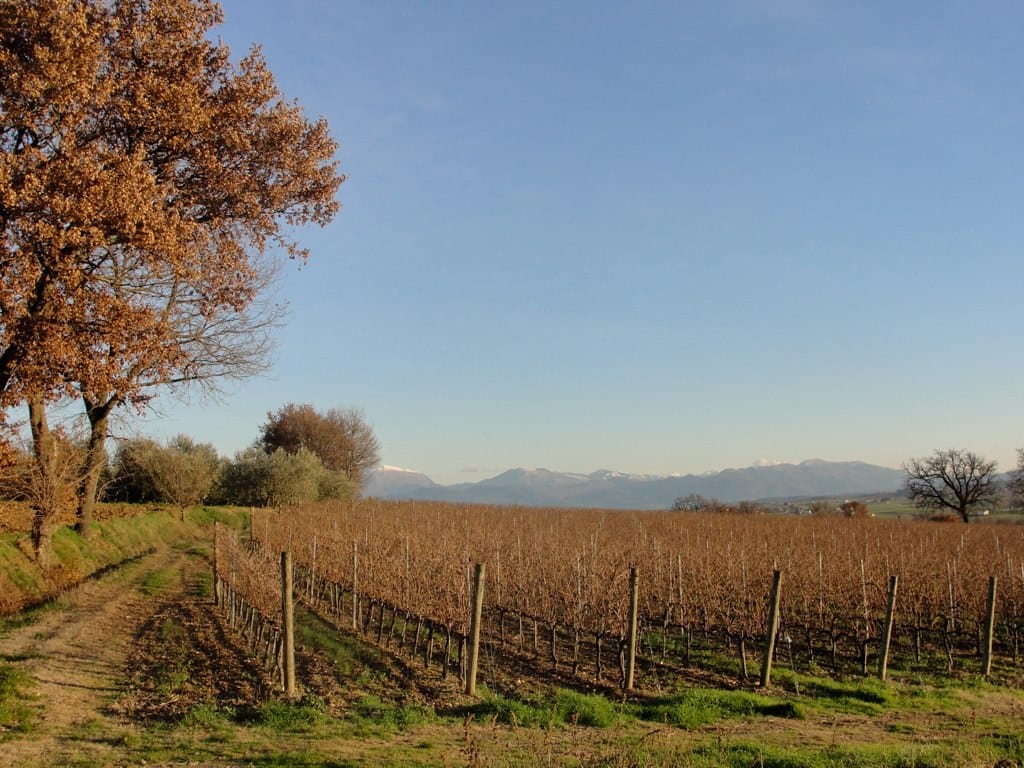
Before the first glass, two things help. Montefalco Sagrantino is made only from Sagrantino grapes, dry or passito, and it waits more than three years before it goes on sale, at least one of them in wood. It is a wine that asks for time, with strong tannins, and the consortium pairs it with meat and aged cheeses. Montefalco Rosso is a different story, more everyday: mostly Sangiovese, with a little Sagrantino in it, the wine you open at the table without thinking too hard. I am a lover of reds, and the passito does nothing for me. To find your way into the area, start with the Rosso, and come to the Sagrantino once your palate knows what to expect.
The Carapace: the winery Arnaldo Pomodoro designed
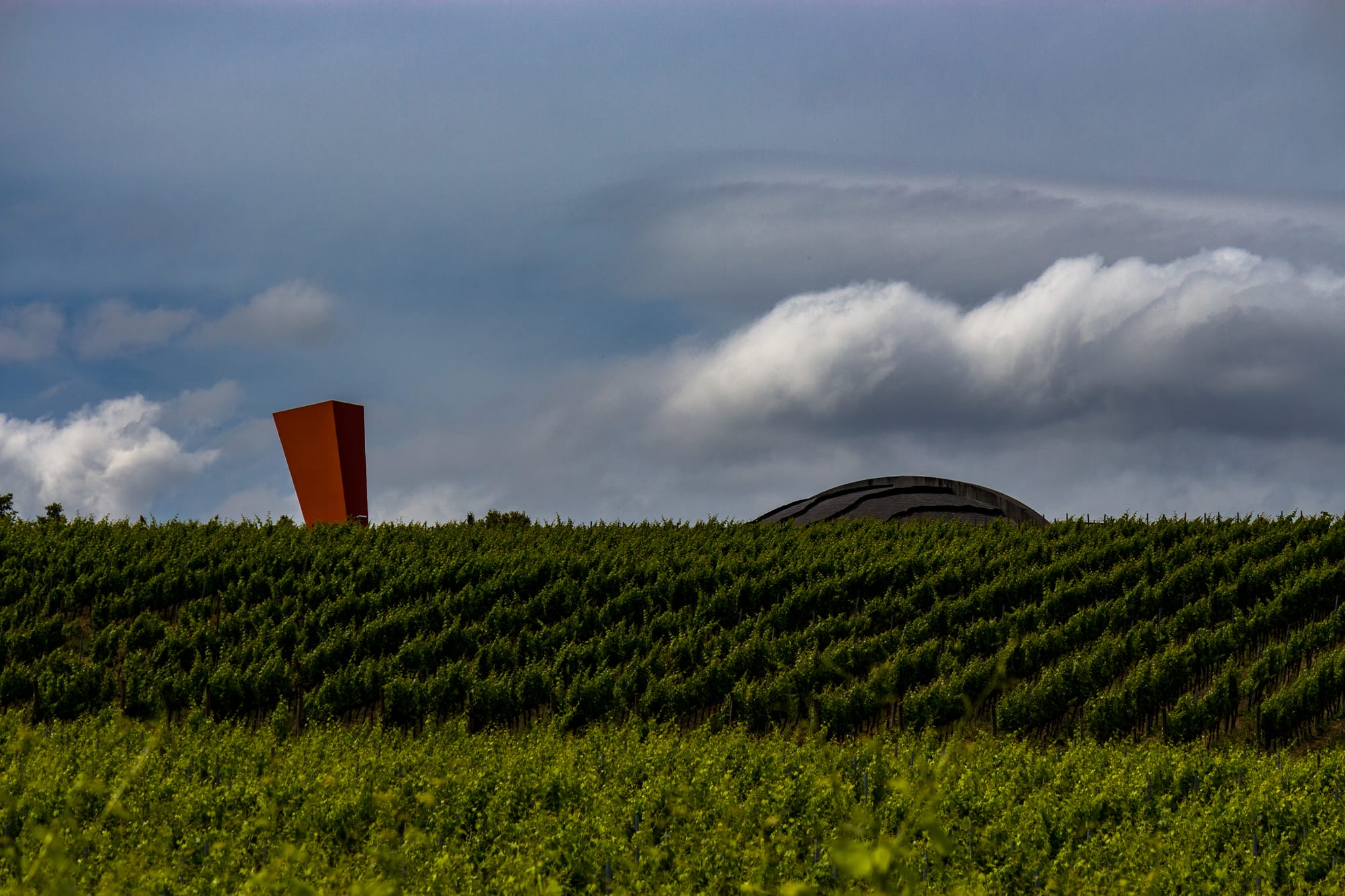
Caprai, Raína, Borgese, Milziade Antano and Scacciadiavoli I know from their bottles. The only winery I went into was Lunelli's, the Carapace, and not by chance: it was the one I was most excited to see, as a piece of architecture, as sculpture. It is the winery of Tenuta Castelbuono, which the Lunelli family, the family behind Ferrari sparkling wine in Trento, bought in 2001: thirty hectares of vineyards between Bevagna and Montefalco.
It was designed by Arnaldo Pomodoro, with the architects Giorgio and Luca Pedrotti, and opened in 2012. The name comes from a tortoise's shell, and as you arrive between the rows of vines you can see why: in front of you rises a great dome covered in engraved copper, like the back of an animal resting on the hill. Pomodoro thought of it as a work that is both architectural and sculptural.
It is beautiful, and really very unusual to see. Inside, I drank the Montefalco. The wine is good, but you go to the Carapace to see the winery; at least, that was the case for me. Visits are by booking only.
Sagrantino, Montefalco Rosso and what to drink
The wines of the area. Montefalco Rosso: the everyday wine, mostly Sangiovese with a little Sagrantino. Montefalco Sagrantino: the big red of the area, Sagrantino grapes only, more than three years before release. Sagrantino passito: the sweet version, from dried grapes. Trebbiano Spoletino: the white of the area, with its own appellation since 2011.
Carapace, Tenuta Castelbuono. The winery I went into. I drank the Ziggurat, their Montefalco Rosso, and the Sagrantino named after the winery. The wine is good; the reason to go is the winery.
Raína. Recommended to me by the owner of the wine shop in Montefalco where I bought the Trebbiano, and it surprised me. It is a small winery, founded in 2002 and farmed biodynamically, and it is named after the farmer who worked the land before, by the name he went by. I drank Le Campette, a red of Sangiovese, Merlot and an old local grape, and Campo di Raína, their Sagrantino.
Borgese. A family winery in Montefalco. I drank the Montefalco Rosso, the Unorosso, a Sagrantino with nearly a third Merlot, and the Adamantis, a white of Grechetto and Trebbiano Spoletino.
Milziade Antano, Fattoria Colleallodole. A family winery on the hills between Bevagna and Montefalco. Milziade worked the land as a sharecropper until, at the end of the 1960s, he bought thirty hectares of his own; today his son Francesco runs it. I drank the Montefalco Rosso and the Sagrantino, and both are exceptional.
Arnaldo Caprai. With Scacciadiavoli, one of the historic and best-known wineries, and to me, of the two, the more commercial. It was founded in 1971, and for many it is the winery that made Sagrantino known. I drank the Montefalco Rosso and the Sagrantino Collepiano.
Scacciadiavoli. The other historic winery, and the oldest in the appellation. Prince Ugo Boncompagni Ludovisi founded it in 1884 as a wine factory modern for its day, and its name, "devil-chaser", comes from an exorcist who lived in the next village. I have never been to the winery, but I have drunk a good many bottles, many times over, the Sagrantino and the Montefalco Rosso, and I promise you it is really good.
Foot of the box: I have drunk the bottles of Caprai, Raína, Borgese, Milziade Antano and Scacciadiavoli, but I have not been inside those wineries; the Carapace I have, and it is by booking only. For the others, write to the winery before you go. Whoever is driving doesn't drink: on a day of tastings, one of you sticks to water.
Black truffles: Spoleto, Norcia and the hills below Montefalco
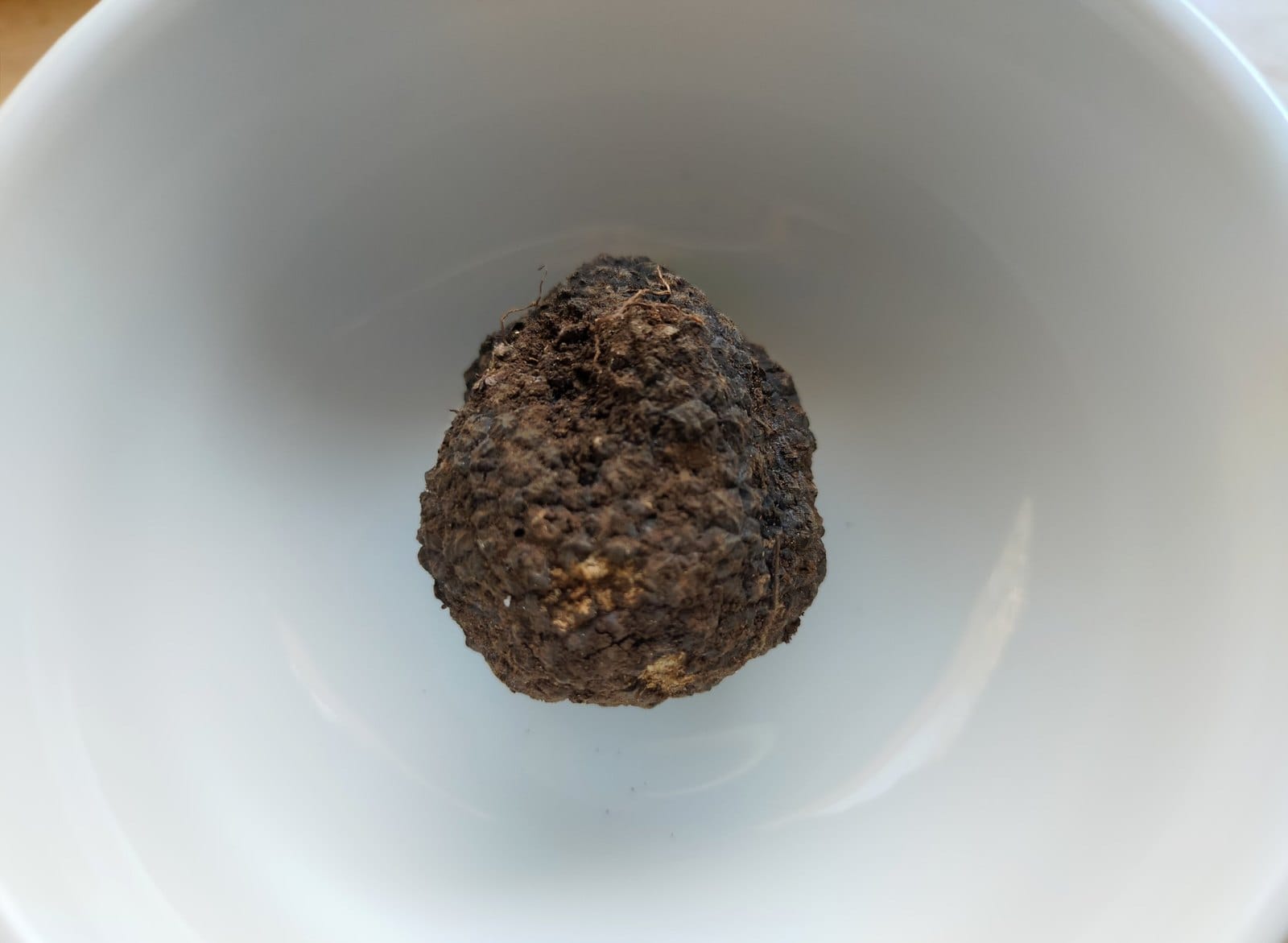
Montefalco is wine, but as you head south towards Spoleto the hills begin to hide another kind of wealth: truffles. The prized black truffle carries the names of Norcia and Spoleto, and the Umbria Region includes in its production area, besides Norcia and the Valnerina, Spoleto, Campello sul Clitunno, Castel Ritaldi and Giano dell'Umbria. The last two are Sagrantino comuni too: on those hills, wine and truffles live off the same earth.
The prized black truffle is hunted in winter; in summer it is the turn of the scorzone, the summer truffle. If you go in summer and find fresh truffle on the menu, ask which one it is. And between February and March, Norcia holds its black truffle fair.
I ate it in Spoleto, one evening, with friends from the town, in the simplest way there is: an egg, with truffle on top. We were at La Torretta, a trattoria in the old town on Via Filitteria, which also has tables outside overlooking the belvedere.
Bevagna, in the plain
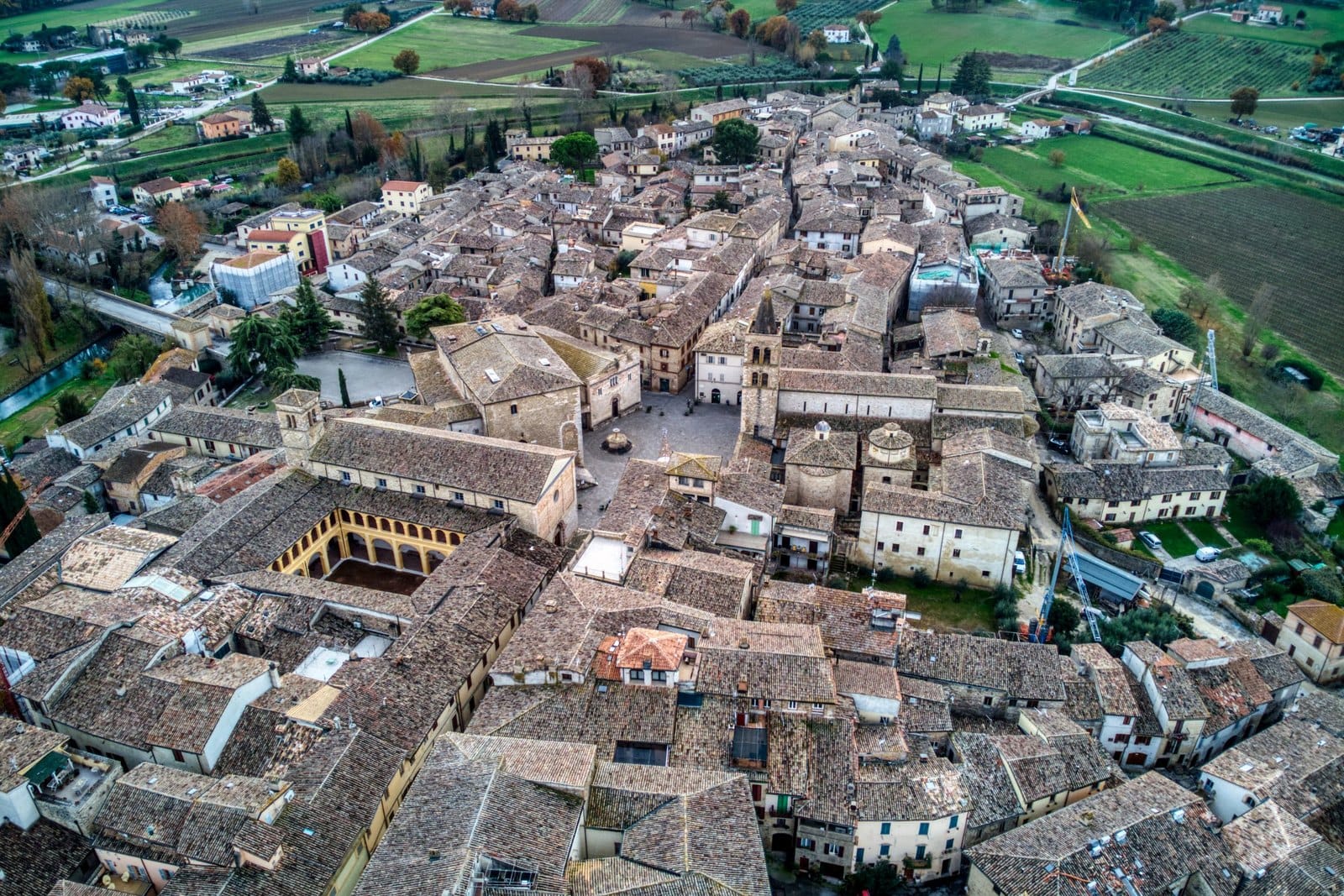
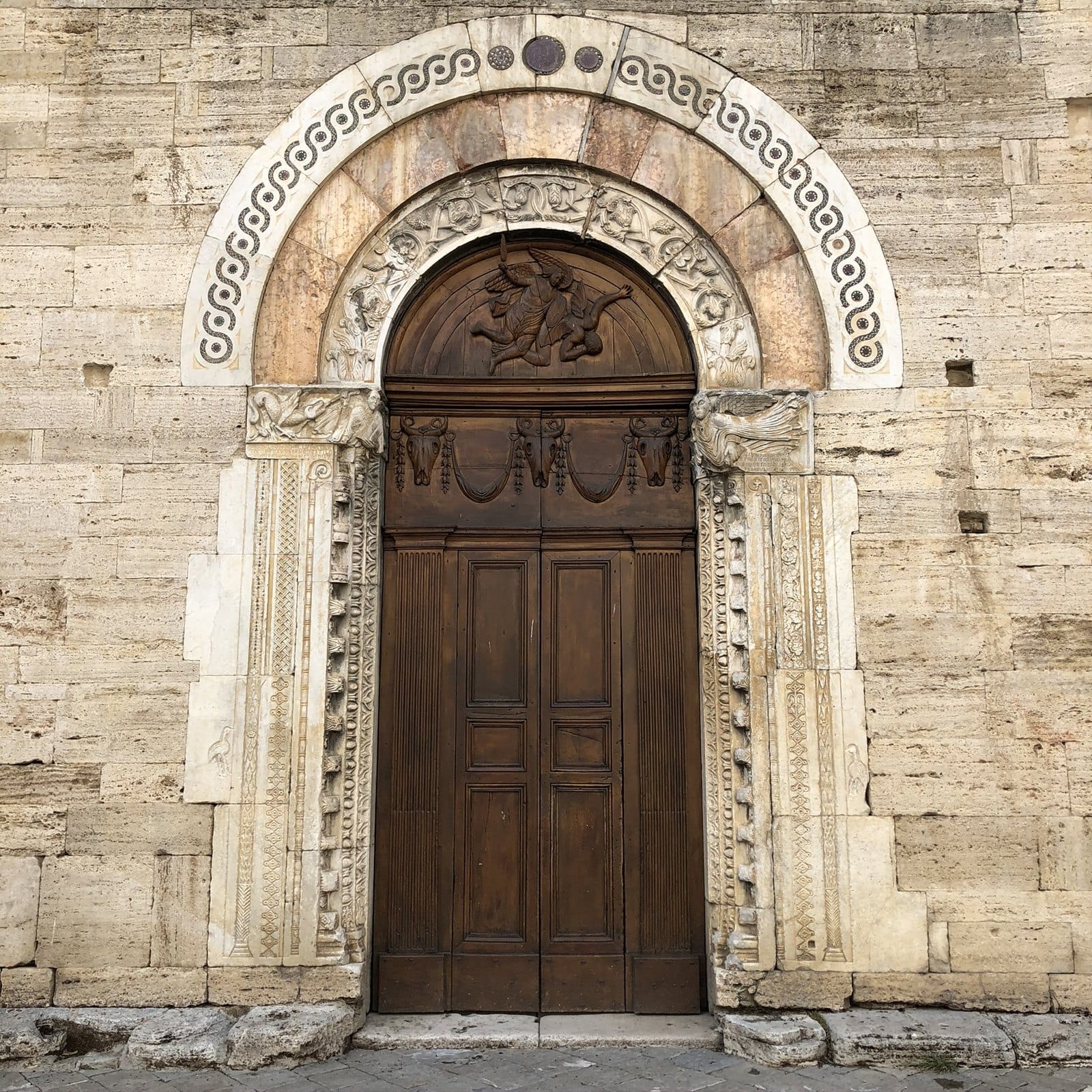
A few kilometres from Montefalco, Bevagna takes the opposite road to almost every town in Umbria: instead of climbing a hill, it stays down in the plain. It was the Roman Mevania, and today you walk round it on the flat. I have been there, and the photo of San Michele's doorway is mine.
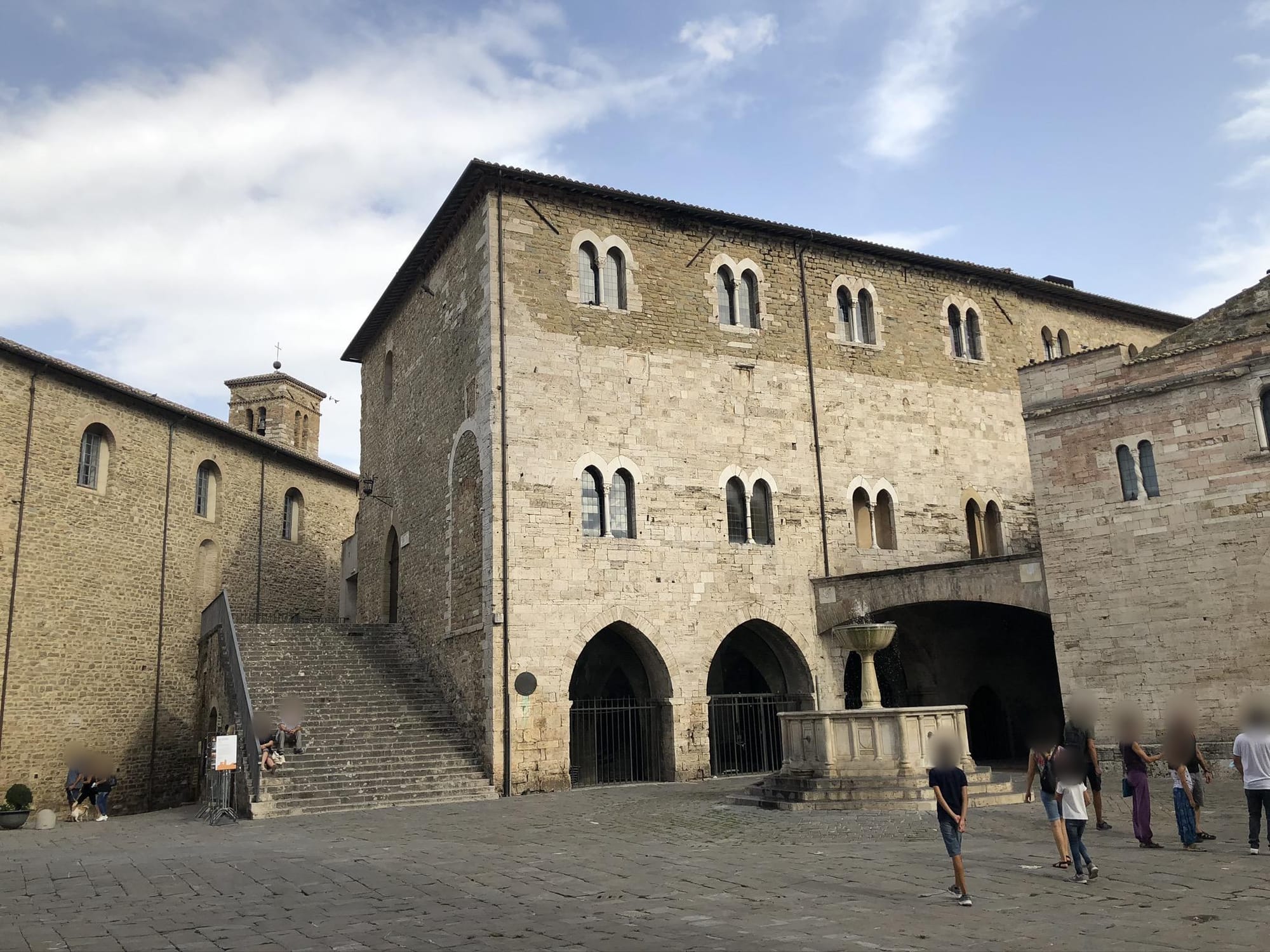
The reason to come is Piazza Silvestri. It is medieval, and it has no symmetry: the buildings don't line up, and the two Romanesque churches, San Silvestro and San Michele, face each other without ever quite looking each other in the eye. In the middle there is a nineteenth-century fountain, and towards Corso Matteotti a Roman column rises. There is no single spot from which to take it all in: you discover the square by walking about inside it, one step at a time.
Of the Roman baths, the floor of the pool is left: a mosaic peopled with octopuses, dolphins and mythological figures. You go in from Via delle Terme Romane, asking first at Palazzo Lepri; and when it is closed, you can see it through the windows. In June the town goes back to the Middle Ages with the Mercato delle Gaite, which recreates life in Bevagna between 1250 and 1350 in its four quarters; in 2026 it ran from 17 to 28 June. The craft workshops, where paper, silk and wax are made, also open outside the festival, with the Circuito dei Mestieri Medievali.
The Carapace is in the comune of Bevagna, a few kilometres from the town.
Spello and Foligno
Spello leans against the side of Monte Subasio, between Assisi and Foligno. What brings you in is inside Santa Maria Maggiore: the Baglioni Chapel, which Pinturicchio frescoed between 1500 and 1501. For Corpus Domini the town covers itself in flowers: the carpets are laid during the night, and the next morning the procession walks over them. Between forty and fifty thousand people come, and parking has to be booked: if you are after the quiet valley, you would do well to choose another weekend.
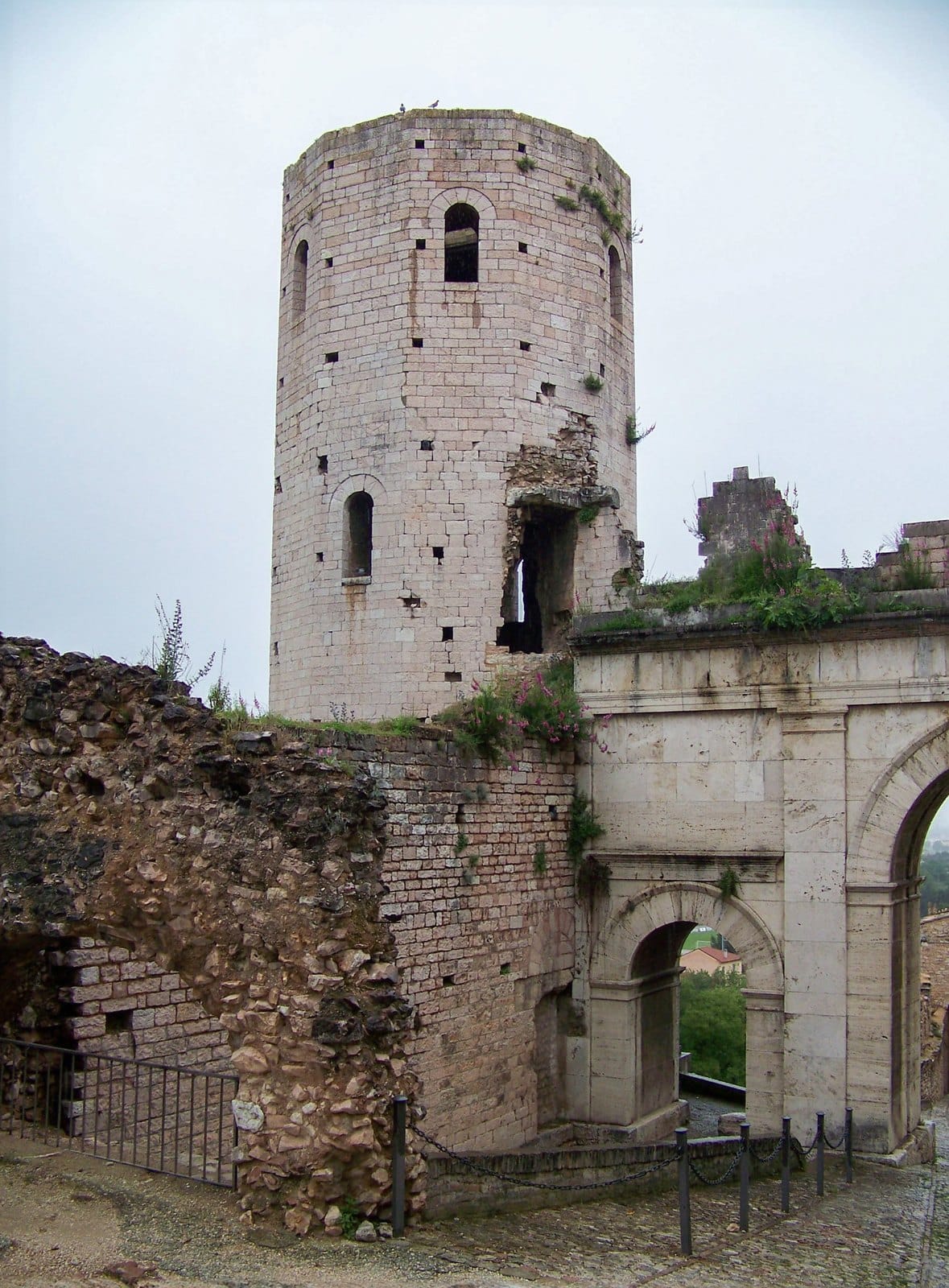
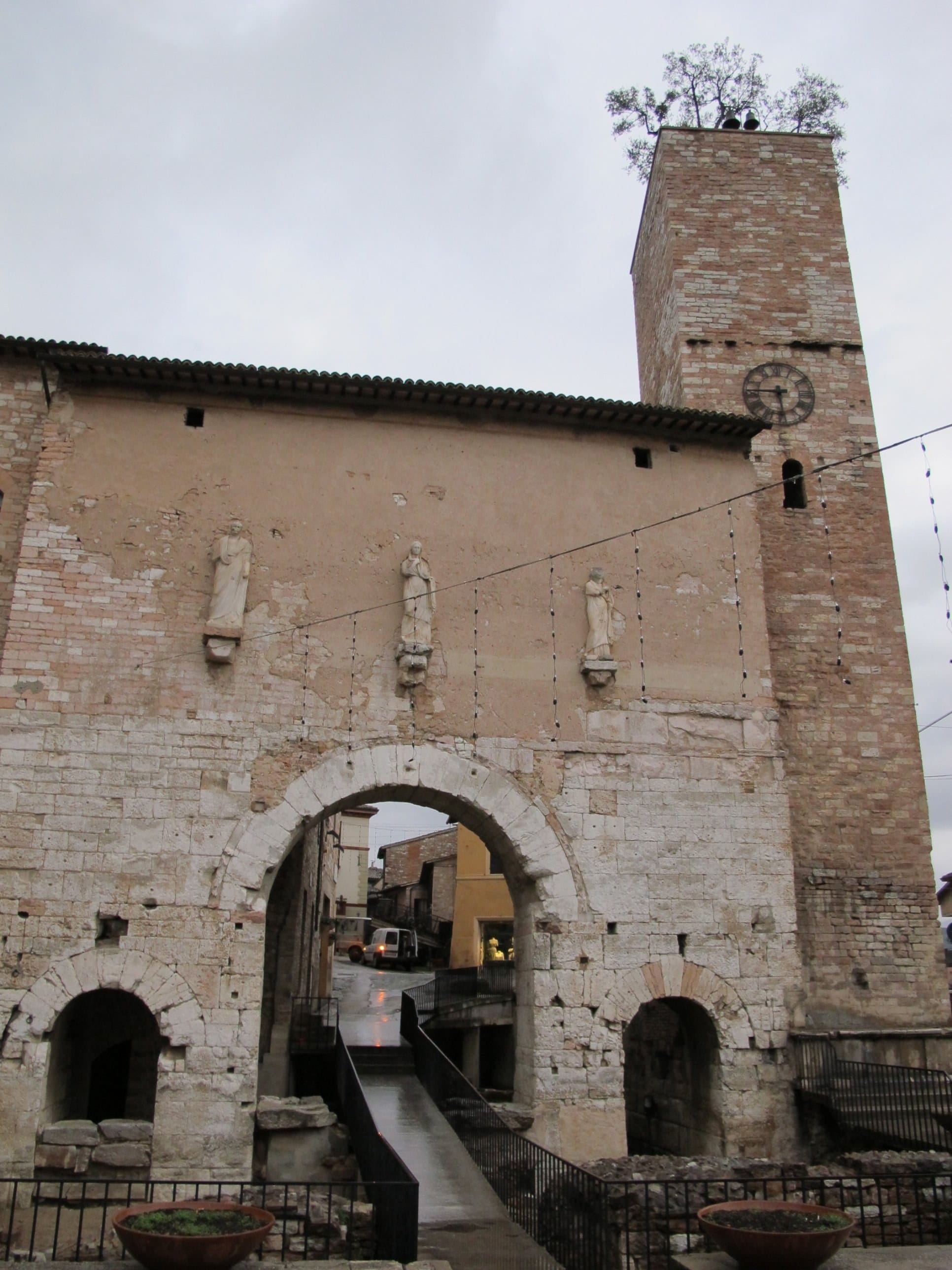
Foligno is the town of the valley, and if you are coming by train it is the way in: the buses for Montefalco and Bevagna leave from here. If you have an hour before your train, Palazzo Trinci is on Piazza della Repubblica, built between the end of the fourteenth century and 1407 by the Trinci, lords of the city from 1305 to 1439, with frescoes by Gentile da Fabriano. And in the former church of the Santissima Trinità in Annunziata, Gino De Dominicis's Calamita Cosmica is waiting for you, a gigantic skeleton lying in the middle of the nave.
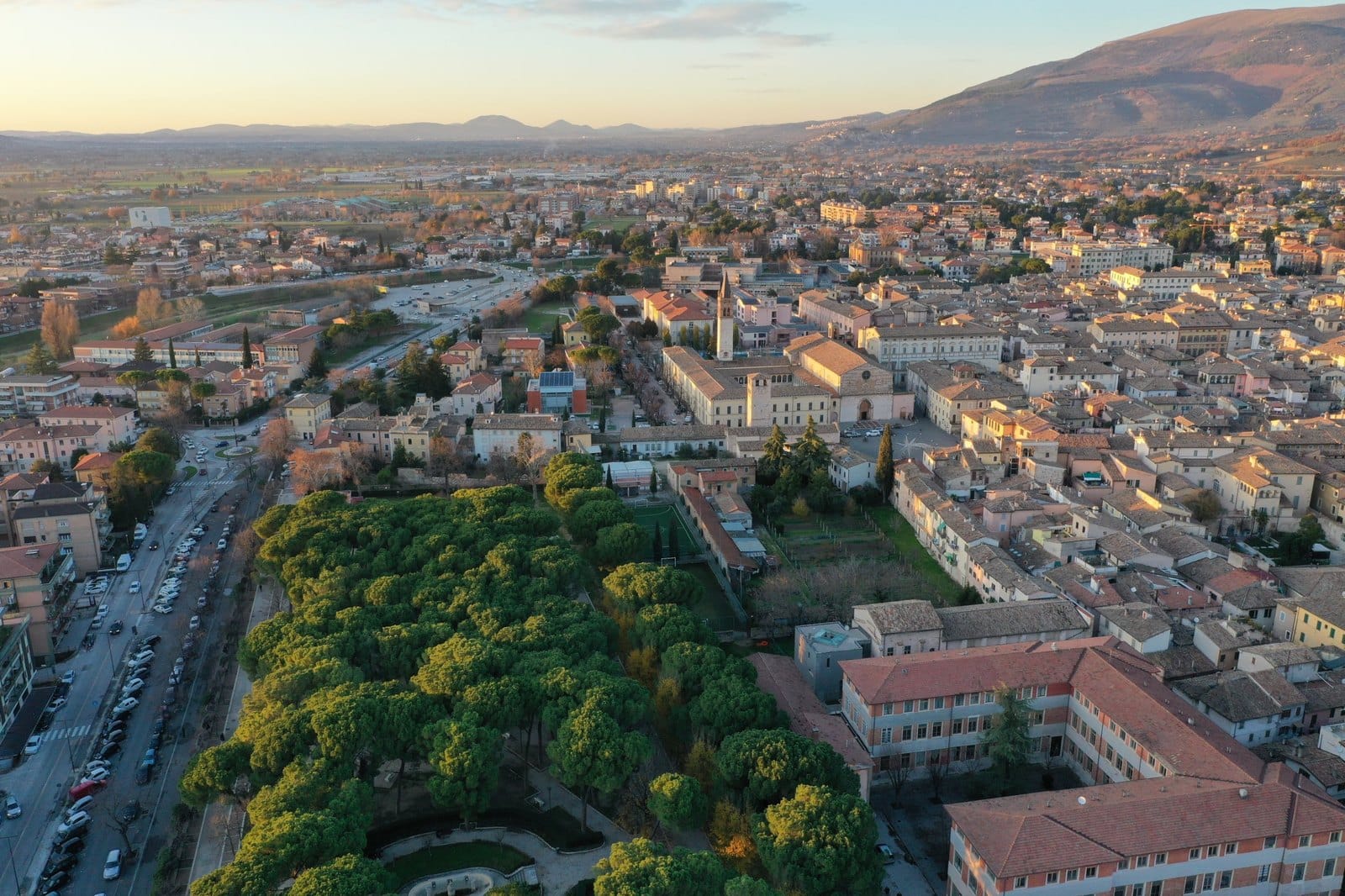
The road back to Rome: the Fonti del Clitunno, the Tempietto and dinner in Spoleto
If you are heading back to Rome, the Via Flaminia runs down from Foligno towards Spoleto following the Clitunno, and along the way there is a stop worth making.
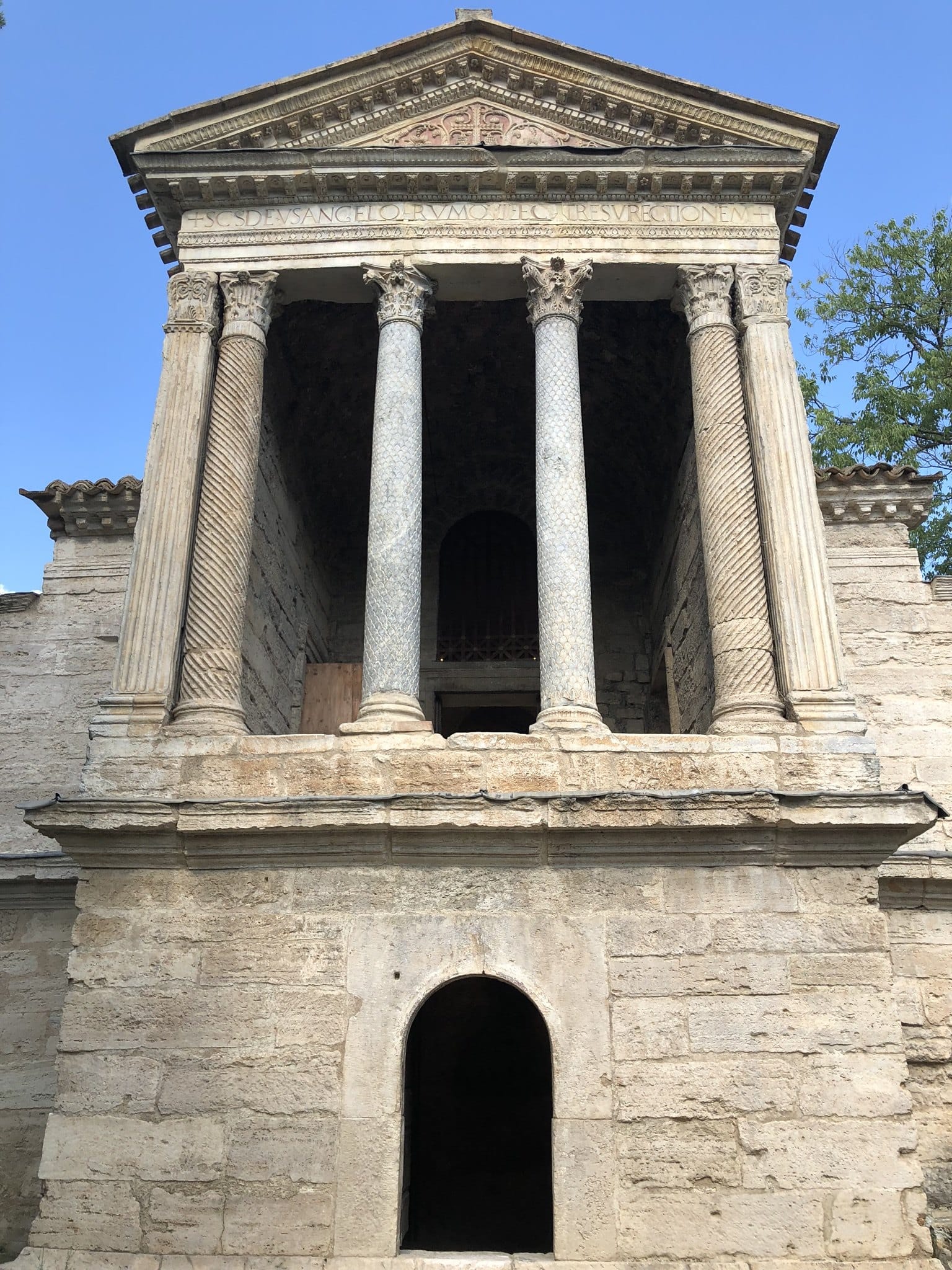
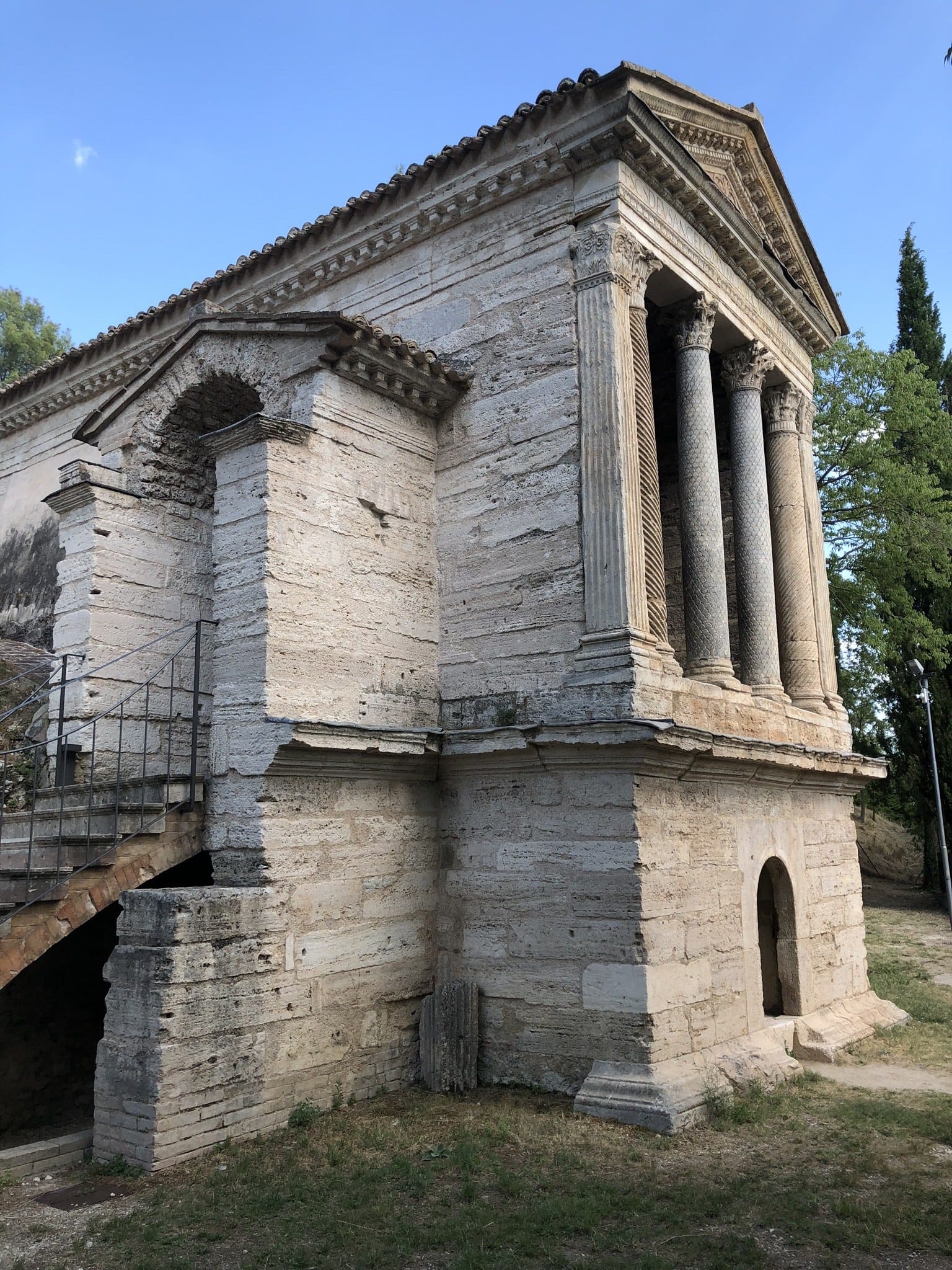
At first sight the Tempietto del Clitunno looks like a Roman temple in miniature: a pediment, Corinthian columns, all of it no more than eleven metres long. In fact it is a small church, built largely from pieces of Roman buildings nearby and from other pieces carved specially to look ancient; whether it is early Christian or early medieval, scholars still don't agree. In the Renaissance it was thought to be a Roman temple turned into a church, and it is easy to see why: whoever built it wanted it to look ancient. Since 2011 it has been a UNESCO World Heritage Site, as part of the Longobards in Italy. The opening hours change with the seasons: check them on the website of the Musei nazionali dell'Umbria.
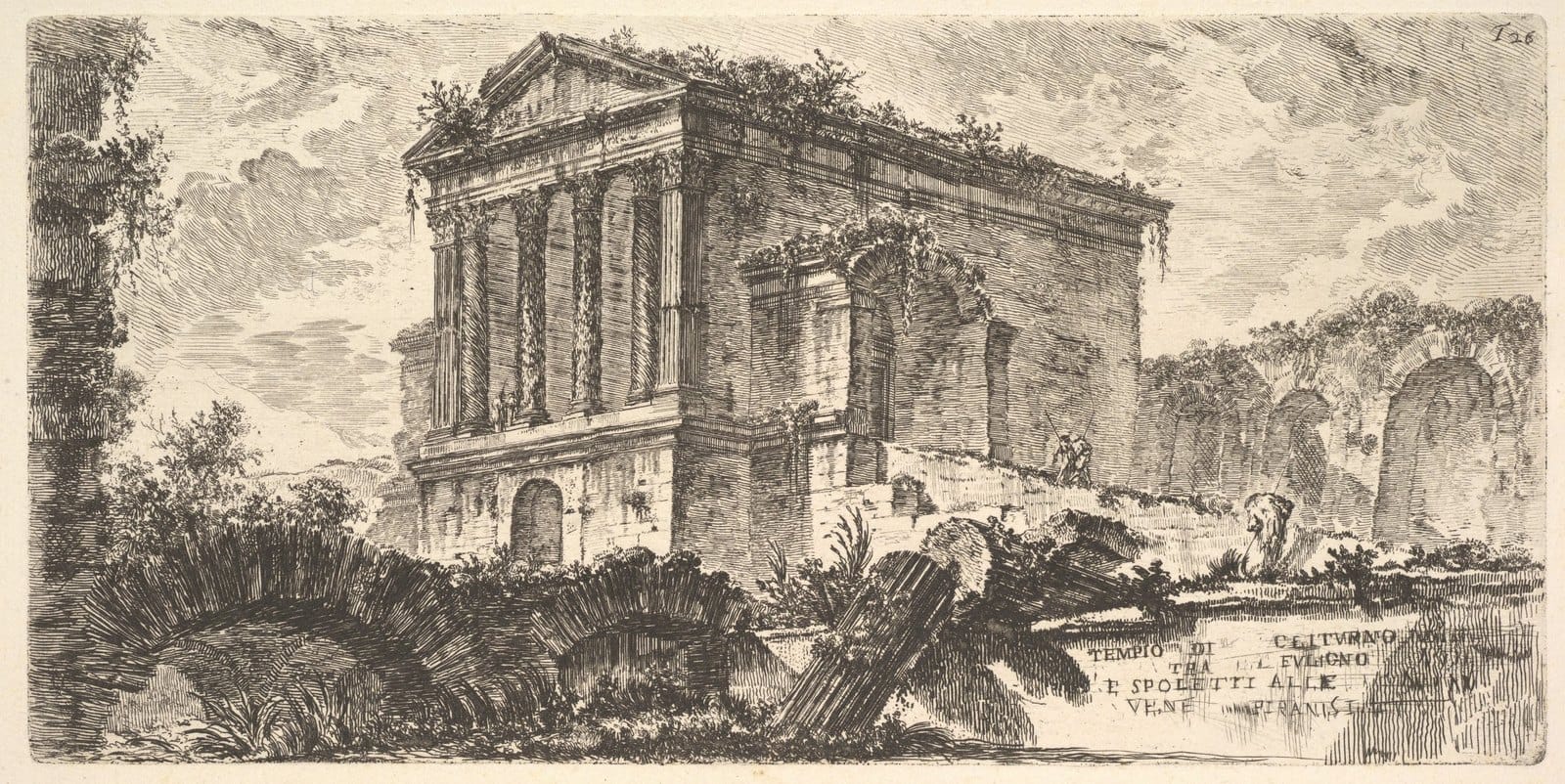
It has to be said, though, that the site is really small. It is not half a day: it is an hour, two at most, and it is something for enthusiasts; if you are expecting something spectacular, you may be disappointed. I came past one year on my motorbike, riding from Rome to Ancona on my way to Croatia: it was on the road, and I stopped specially to see it. It was a quick break, in a place that was beautiful and at the same time tiny.
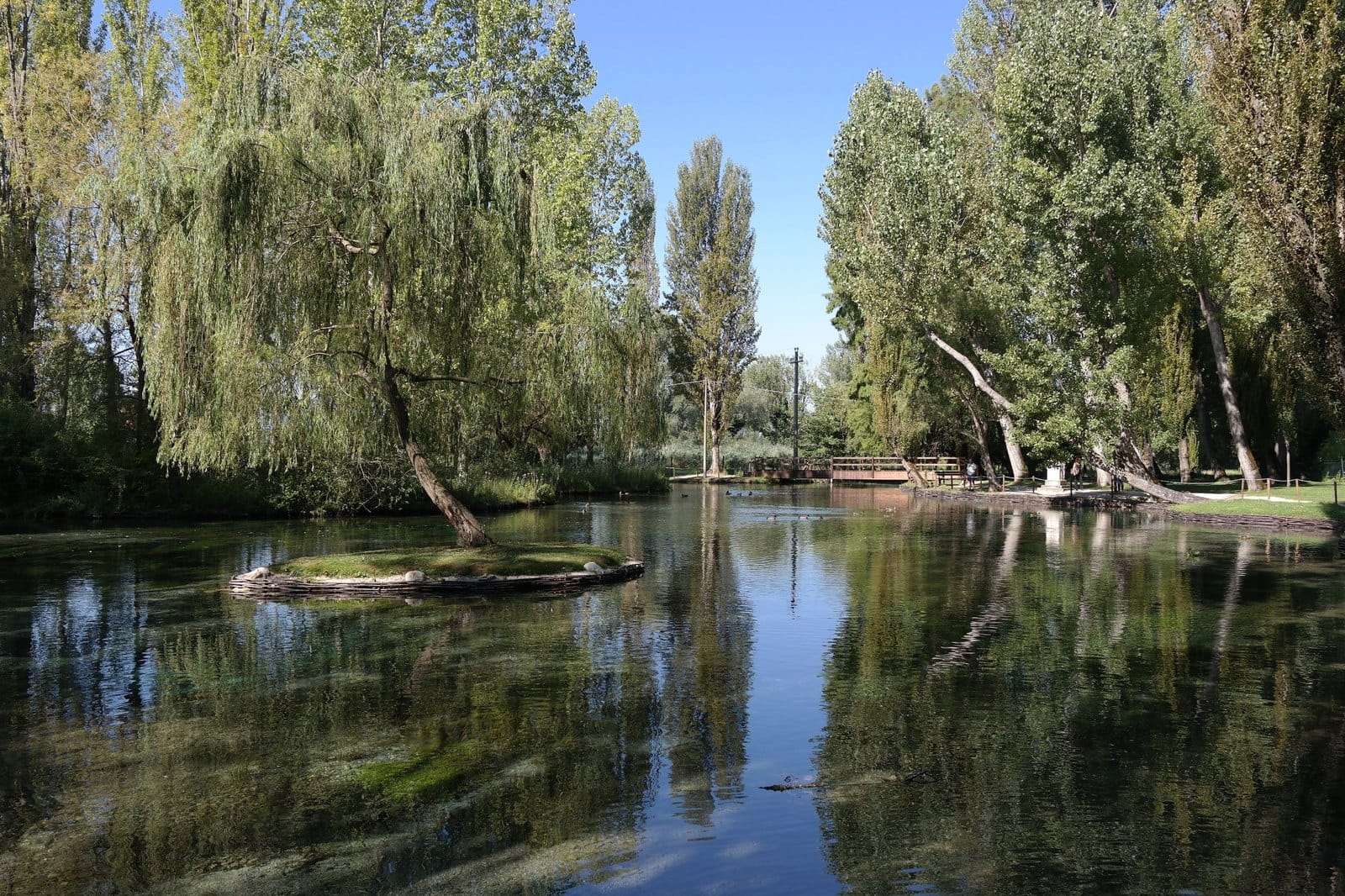
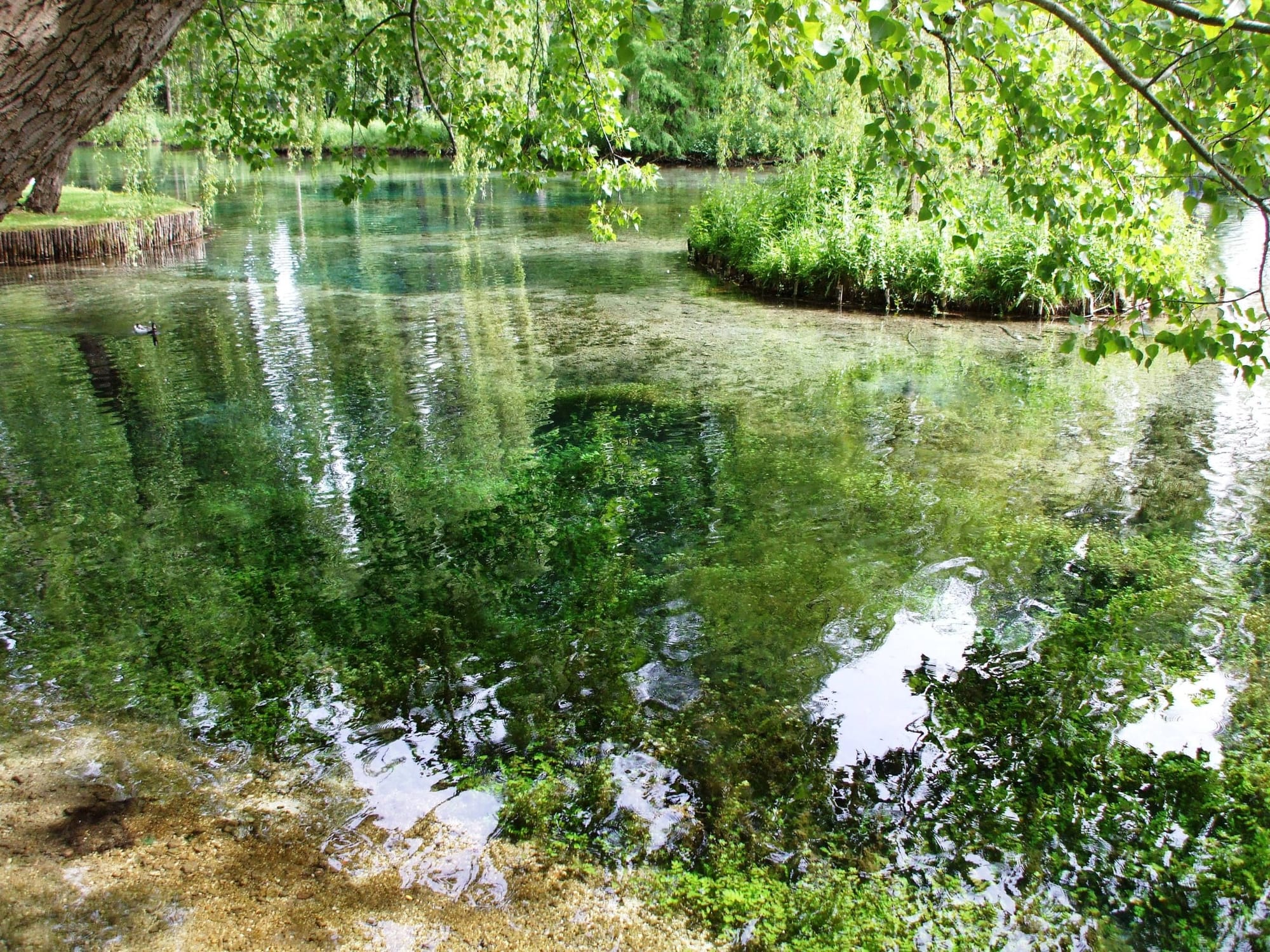
A kilometre further on are the Fonti del Clitunno, a small lake of very clear water among willows and poplars, laid out as a park in the nineteenth century, to which Carducci dedicated an ode. Entry costs little. I didn't stop there: I was on the motorbike, and I had a ferry to catch.
From Campello to Spoleto is about thirteen kilometres. It is worth arriving in time for dinner, because Spoleto is truffle country. Then, with a full stomach, you take the road back to Rome, or stop for a last night in Umbria before heading home.
Getting to Montefalco from Rome, by train or car
By car, Montefalco is about 160 kilometres from Rome and about 225 from Florence, and the car is the easiest way to get around, because the wineries are scattered through the countryside. But a day of tastings and a car don't go together: whoever is driving doesn't drink.
By train you arrive at Foligno: from Rome the direct trains take from just under two hours to two and a half. The Montefalco-Bevagna Link buses leave from the station forecourt, about twenty minutes to Bevagna and thirty-five to Montefalco, €2.50 a journey. Services are infrequent: check the timetable before you set off. Spello is a few kilometres from Foligno.
Where to stay in Montefalco or Bevagna
Montefalco is the base if you want evenings in the square and the view over the valley; Bevagna if you are after a quiet town on the flat, with the Carapace a few kilometres away. We had rented a flat, and in wine country it is a good choice: in the evening you get home without having to drive too far.
When to go
Autumn is the season of wine: there is the harvest, and in September Enologica Montefalco, the festival of food and wine pairings, which in 2026 was held from 18 to 20 September. Between the end of May and June come the festivals, the Infiorate in Spello and the Gaite in Bevagna, and the crowds with them. Winter is black truffle season; in those months the museum of San Francesco opens on fewer days, so check before you go. I was there at the end of August.