Perugia from Below: The Underground City in the Rocca Paolina, the Great Square and the Chocolate
Is Perugia worth visiting? Park at the bottom and ride the escalators up through what is left of the Rocca Paolina, a papal fortress built over a buried medieval street. Then the great square, the star-shaped city, and the chocolate.
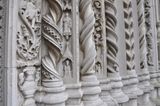
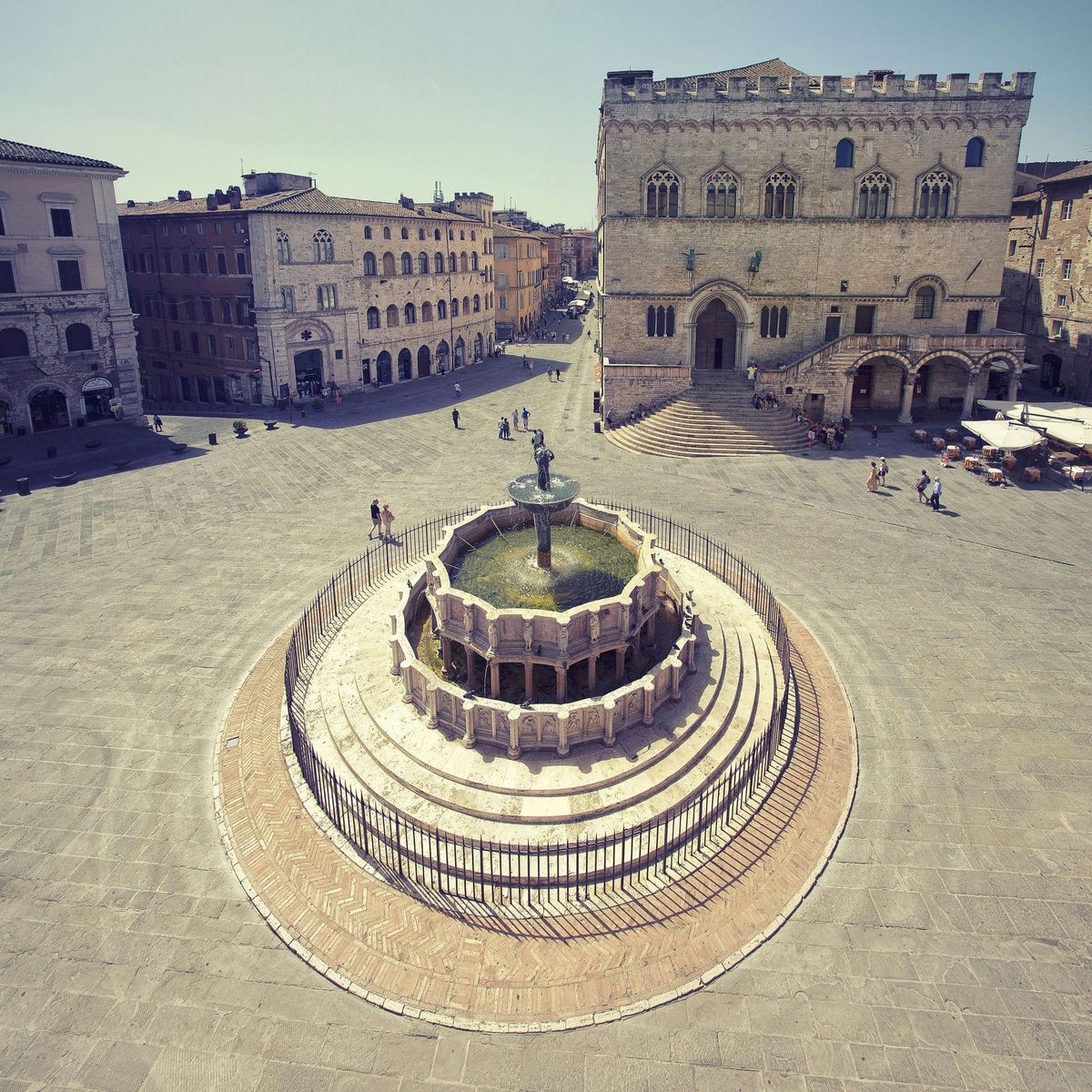
In Perugia you arrive at the bottom and climb up through a fortress that no longer exists, along the streets of a buried neighbourhood. At the top is a square that shows you how the whole city is put together.
Is Perugia worth visiting? The short answers
Is it worth it? Yes. It is a university city, full of young people, with a good feel to it, and it has always struck me as a lively place, a pleasant place to live. People live and study there, and you can tell.
One day or more? One day is enough for the climb, the square and the old town. If you also want the chocolate factory, which is outside the city, add half a day.
From where? By car, about two hours from Rome or Florence. By train, about two hours from Florence, two and a half or more from Rome. From Assisi, a regional train is all it takes.
When? If you like crowds, in November for Eurochocolate (held in November since 2024) or in July for Umbria Jazz, when the city fills up. If not, any other time.
My times in Perugia
The first time I came was at least twenty years ago. I saw the Perugina factory and did the tour, which was wonderful, and we ate a lot of chocolate. Later I came back for Eurochocolate, when the city fills up with people and chocolate.
I remember the climb underground very clearly, and the way the spaces beneath the city had been brought back into use. That is where this guide starts. My memories are distant, so the practical information below comes from today's sources, not from my memory.
Getting to Perugia from Rome and Florence, by train or car
By car from Rome. About 170 to 176 kilometres, two hours: the A1 motorway as far as Orte, then the E45 to Perugia.
By car from Florence. About 150 to 160 kilometres, a little under two hours: the A1 to the Valdichiana exit, then the link road to Perugia.
By train from Rome. The direct fast regional trains from Termini take about two and a half hours; with a change at Foligno it takes longer. At times some stretches of the line are run by replacement buses: check the Trenitalia timetable for the day you travel.
By train from Florence. The direct fast regional trains from Santa Maria Novella take about two hours and ten minutes, the Intercity about an hour and a half. Other trains change at Terontola.
By train from Assisi. Twenty to thirty minutes on a regional train. If you are staying in Assisi, Perugia makes an easy half day.
The main station is Fontivegge, at the bottom. The old town is about two kilometres away, uphill: you can walk it, but the Minimetrò is easier. Its stop is two or three hundred metres from the platforms, with a footpath from platform 1.
Parking in Perugia
The old town is a limited traffic zone (ZTL). There are really two choices.
The free one. The Pian di Massiano car park, by the stadium, has about 3,000 spaces and costs nothing. The Minimetrò terminus is next to it: you leave the car and ride up.
The one I'd recommend, if you don't mind paying. The Piazza Partigiani car park, below the city, where the escalators up through the Rocca Paolina start. It is a paid car park, open day and night, and it is the right way into Perugia. On the other side of town there is the Pellini car park, with the escalators of Via dei Priori.
The old-town car parks are run by Saba: prices and hours are on its website.
A map of Perugia
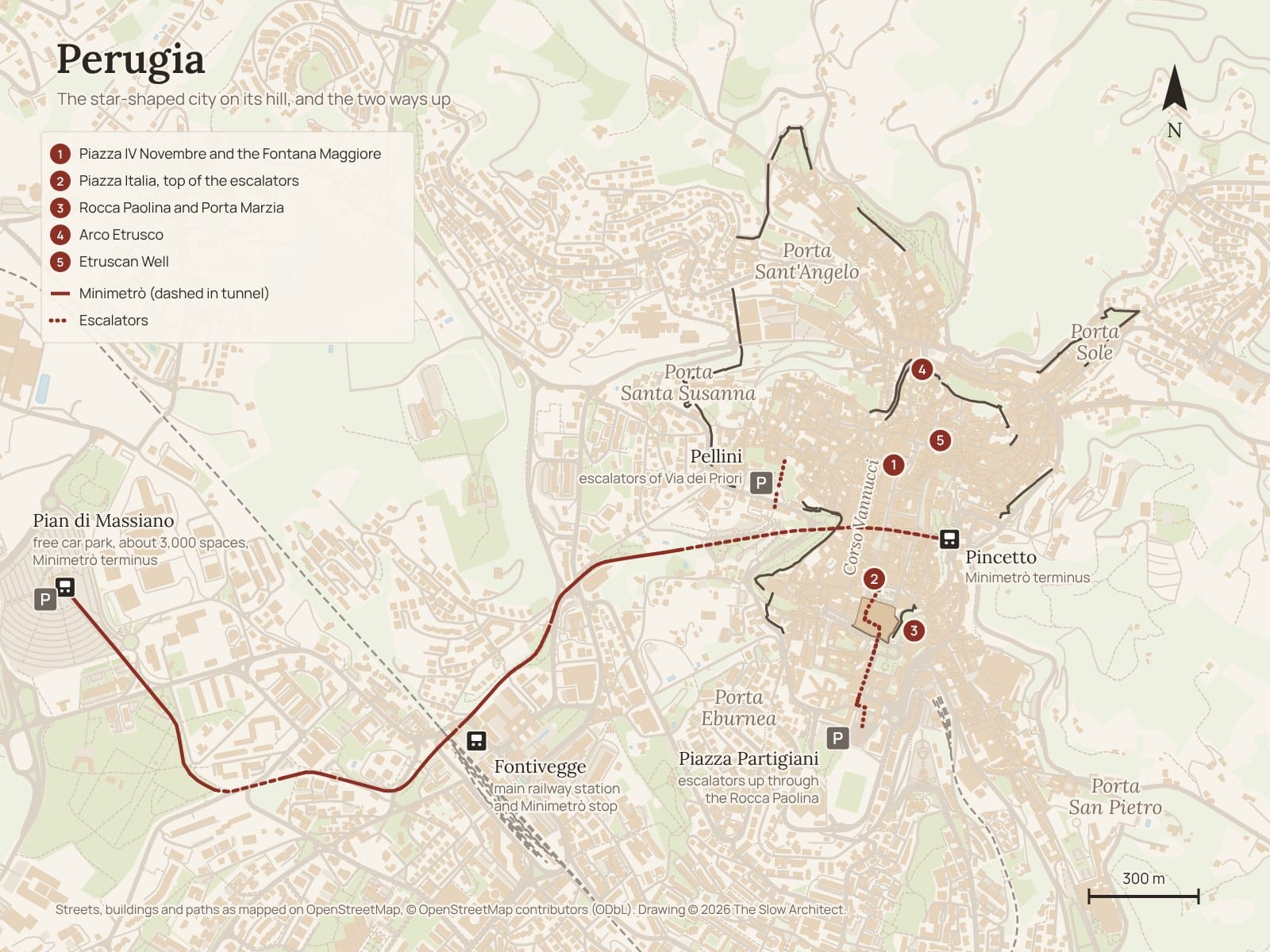
The map below puts Perugia on a single page. At the bottom, the car parks and the two ways up, the Minimetrò and the escalators; at the top, the acropolis with the great square; around it, the five districts that make the star. Keep it open on the way up: the walk I suggest further on follows it.
How to get up: the Minimetrò and the escalators
The Minimetrò is a single line with seven stations, from Pian di Massiano to Pincetto, by way of Fontivegge station. Small driverless cars are pulled along by a cable and climb 161 metres: end to end it takes ten to fifteen minutes. Pincetto is on the edge of the old town, just below it, and from there you finish the climb by escalator. The ticket is the Unico Perugia, which is also valid on city buses. The Minimetrò closes in the evening: the hours are on its website, and they are extended for big events.
The Rocca Paolina escalators start in Piazza Partigiani and come out in Piazza Italia, at the end of Corso Vannucci. They run from a quarter past six in the morning until late at night. If you can, come up this way at least once. The Minimetrò is convenient; the escalators are something else.
One step to the side: the underground city in the Rocca Paolina
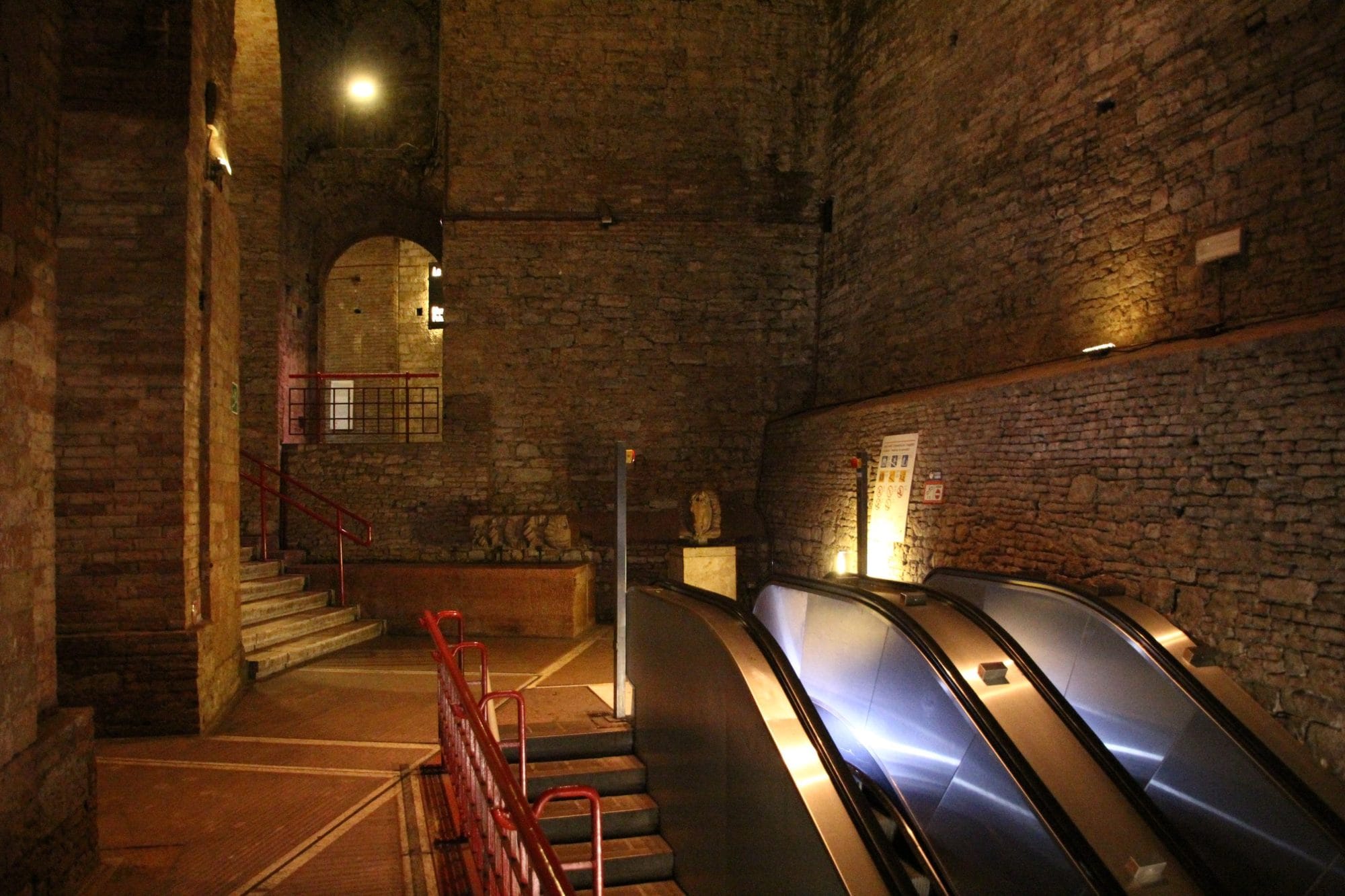
On the way up the escalators you pass through the city that was there before. You can go through it like an underpass, without stopping. Stop.
In 1540 Perugia rebelled against the Pope over a tax on salt. It lost. Pope Paul III Farnese had a fortress built to stamp papal rule on the city, and had it built on top of the houses of the Baglioni, the most powerful family in town. The design was by Antonio da Sangallo the Younger, and the work lasted from 1540 to 1543. To make room for it much of the neighbourhood was pulled down: the sources don't agree on how many houses, but the figures run from two hundred to three hundred, plus about ten churches.
The streets of the neighbourhood, though, did not disappear. The fortress was built over them, and they stayed underneath, in the dark, with their houses, courtyards and workshops. In 1860, when Perugia passed to the new Italian state, the city council took over the Rocca and decided to demolish it. What is left is the great walls on Viale Indipendenza and Via Marzia, and the underground spaces.
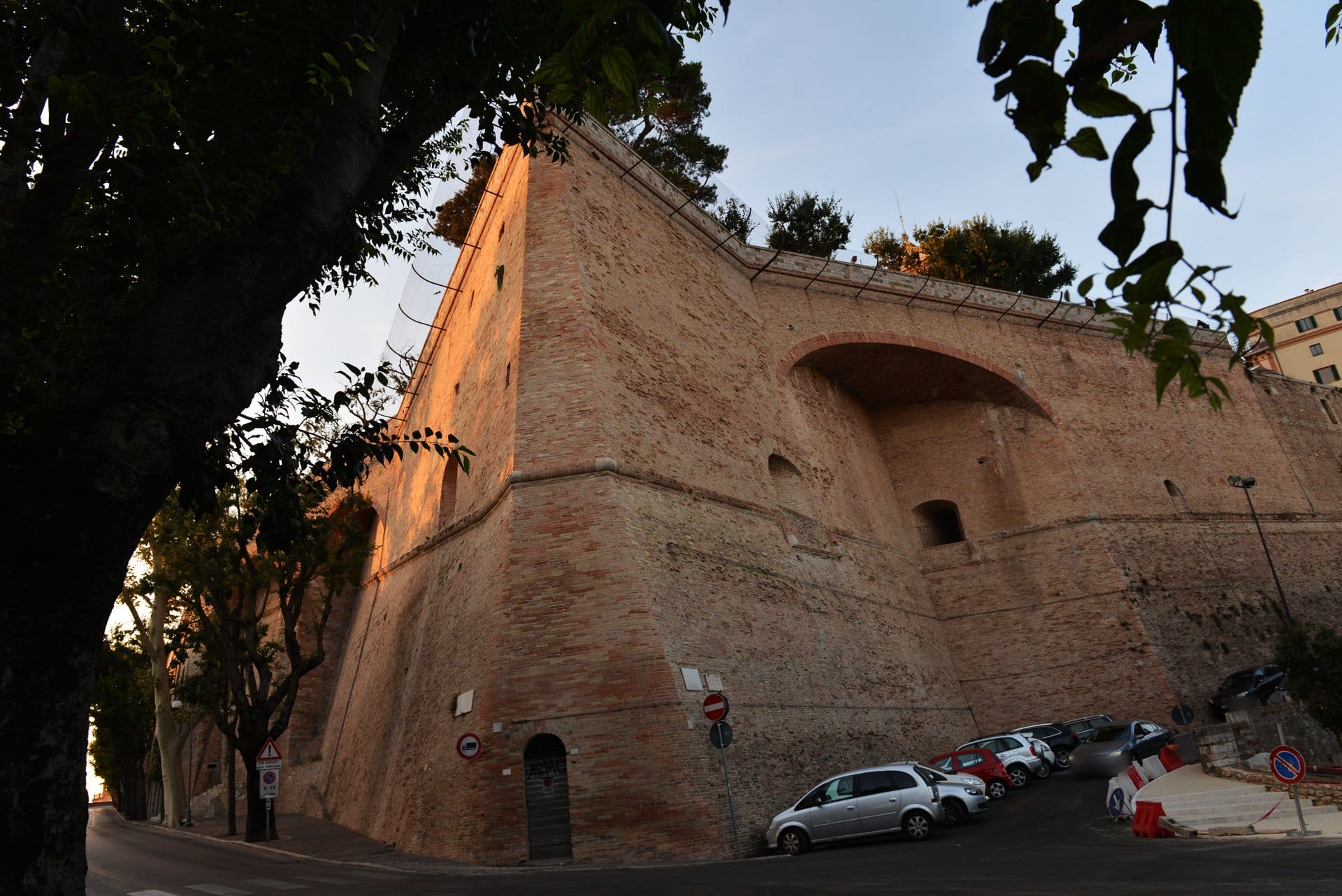
The escalators that run through it opened on 18 June 1983. Until then, writes the daily La Nazione, the Rocca was a cave "unknown to most". Since then it has been the everyday route for anyone coming up from below, and according to the same paper the escalators have in effect cleared the tour coaches out of the old town; they now stop in Piazza Partigiani. I have always felt that many other towns were a little jealous of what Perugia did to connect the city to its car parks.
What to look at. Along Via Bagliona, the buried street, you walk between lanes and little squares, courtyards and houses of the medieval neighbourhood, with the windows of homes, bakeries and workshops that once looked onto open streets and now look onto the dark. Go out towards Via Marzia: the gate set into the wall of the fortress is the Porta Marzia, an Etruscan gate of the third century BC. Sangallo took it apart and rebuilt its upper part in the wall of the Rocca, instead of throwing it away. In the Salone delle Acque stands Alberto Burri's Grande Nero, a sculpture from 1980, seven and a half metres tall. If you have read our essay on Gibellina, it is the same Burri who made the Cretto.
The entrance from Porta Marzia to Via Bagliona is open from 7am to 8pm; the escalators stay open until late at night.
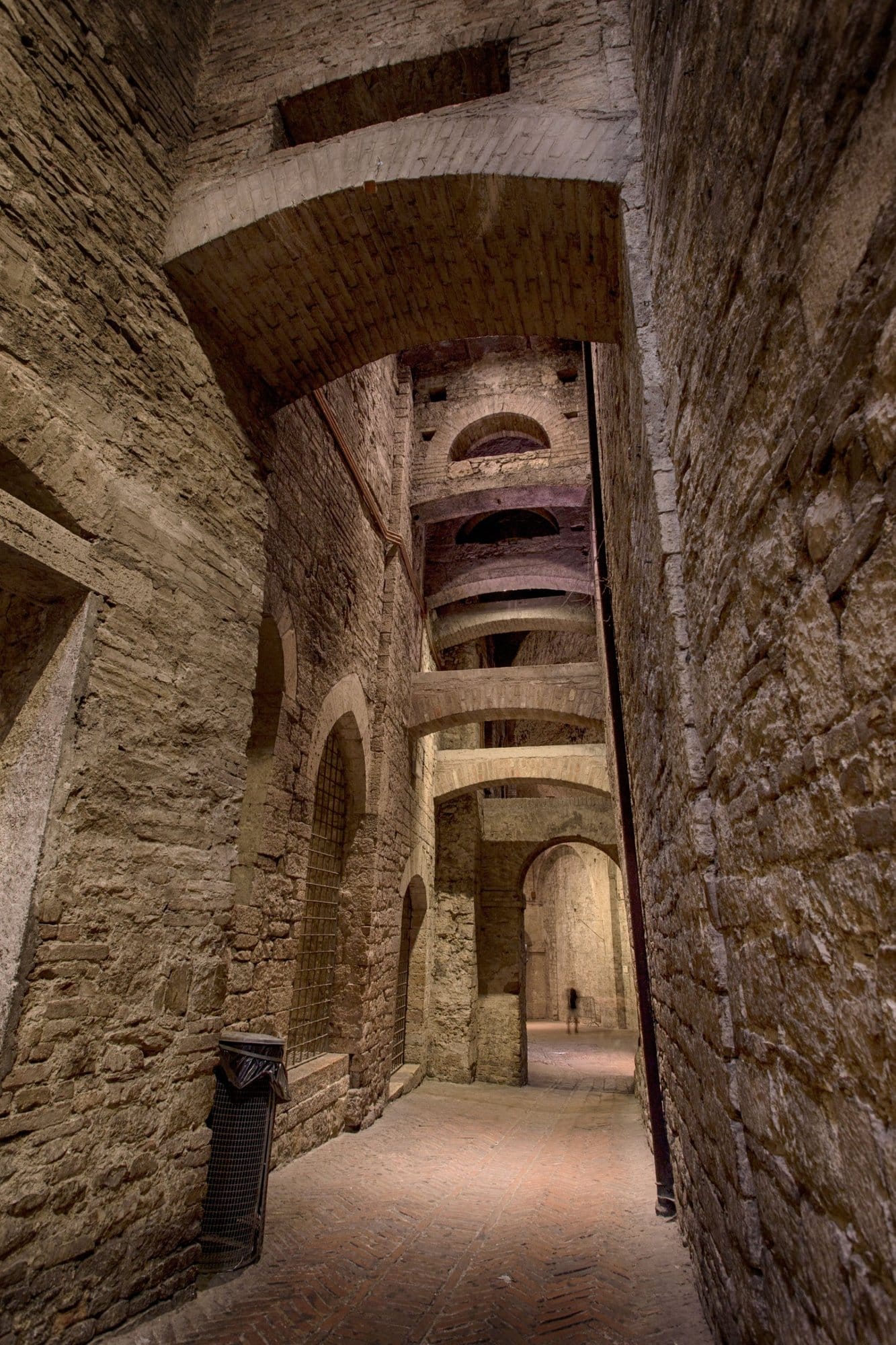
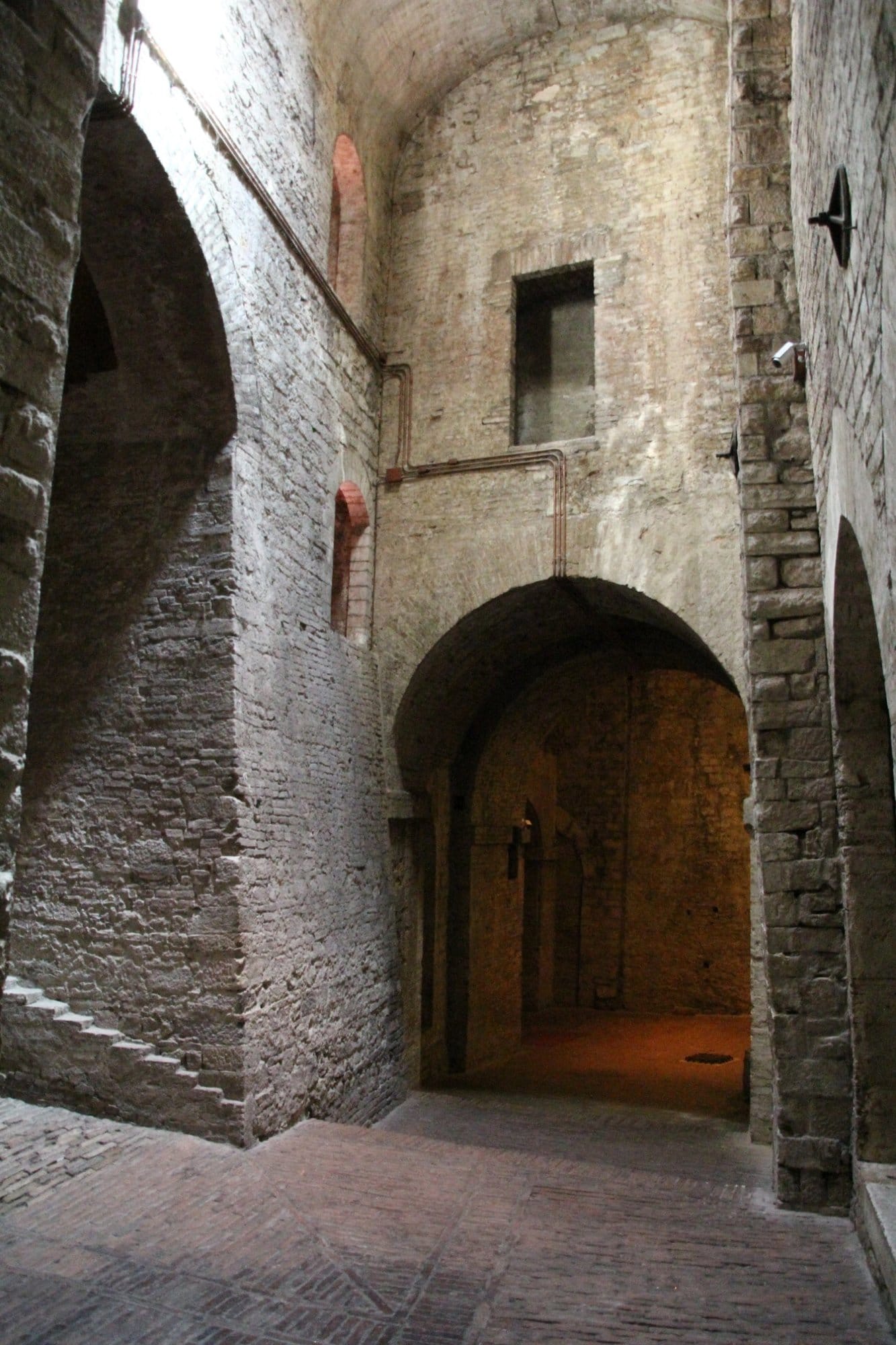
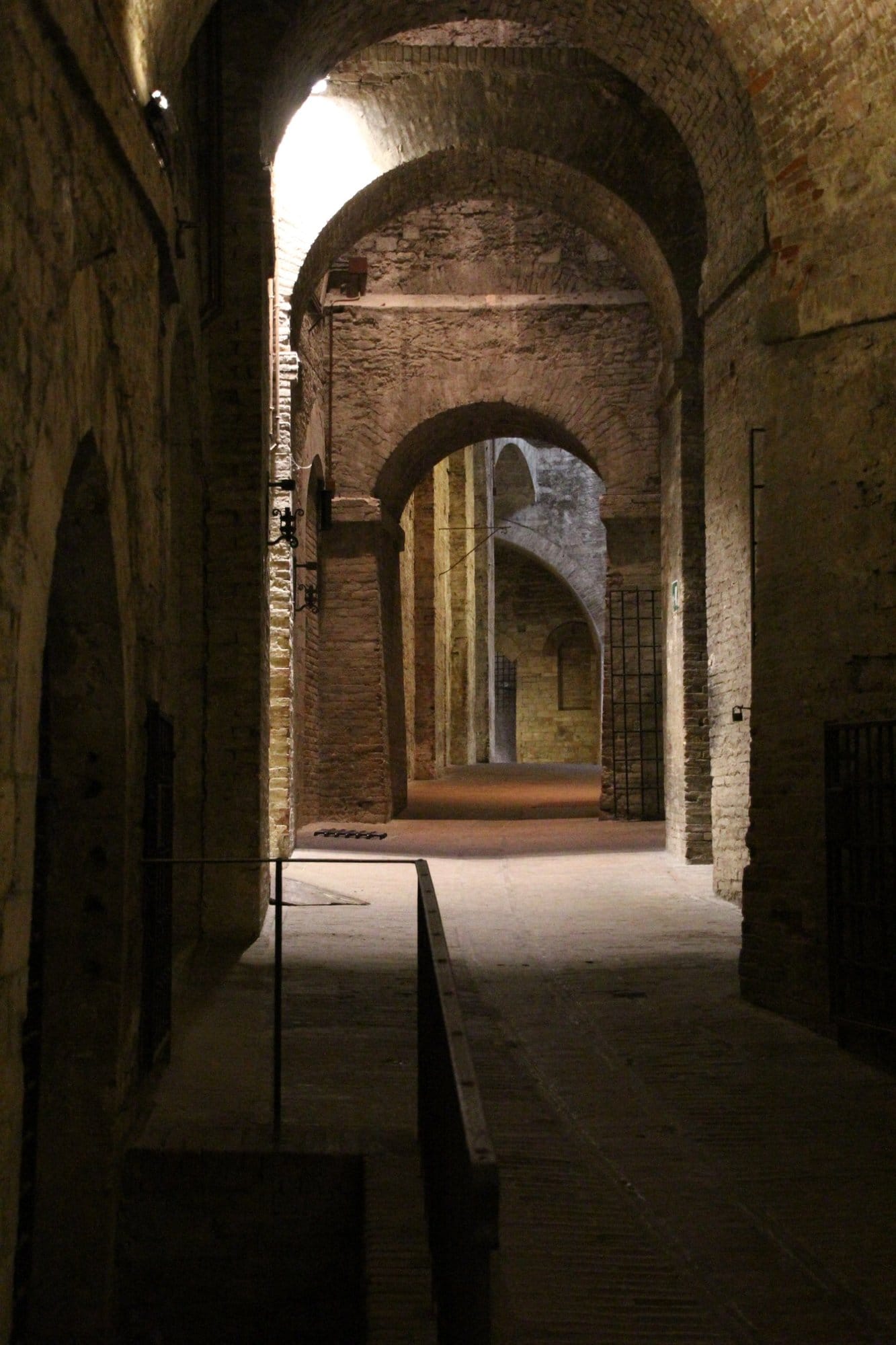
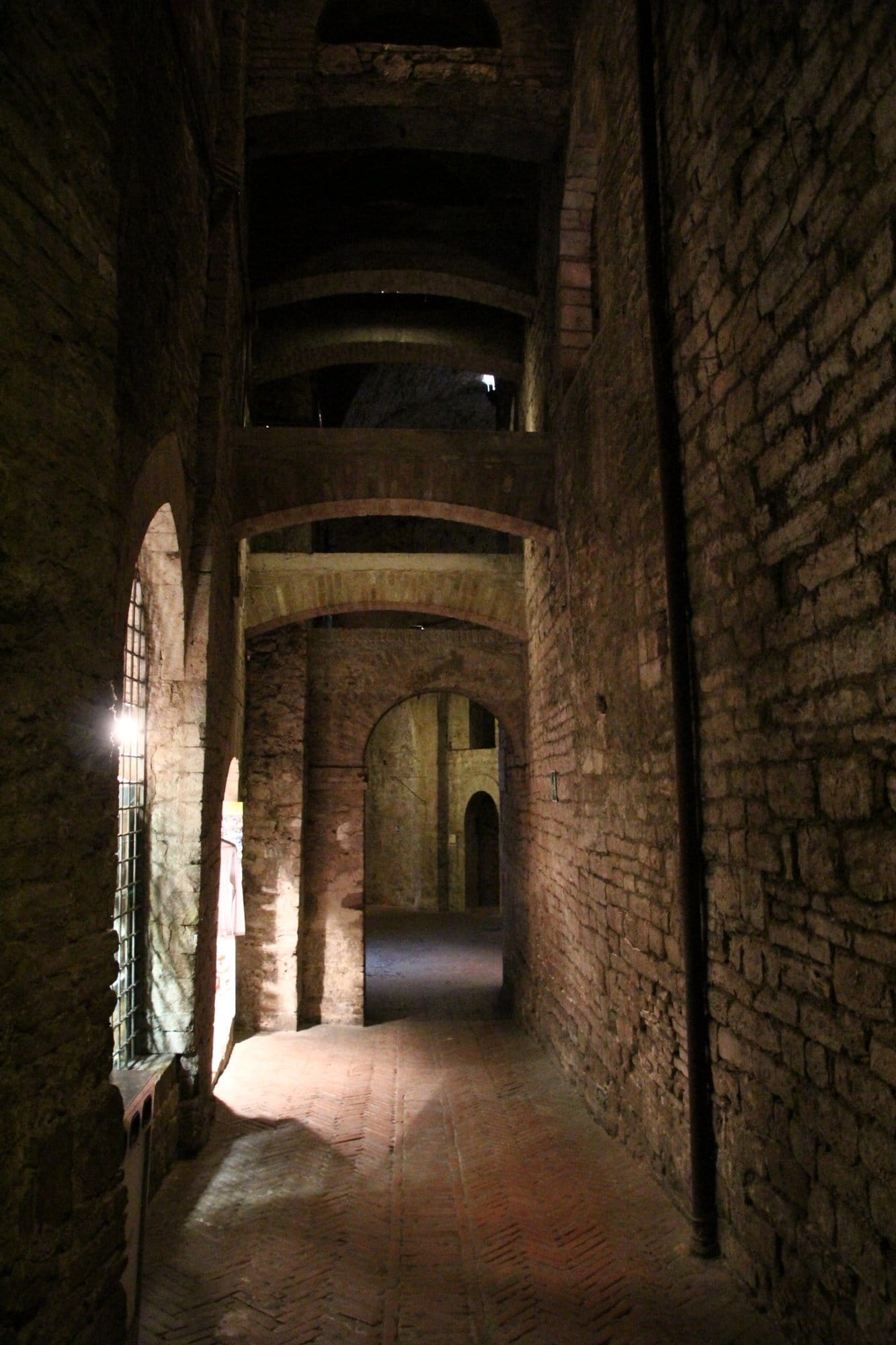
Under the fortress, three views of the buried neighbourhood: a house front with its window, one arch after another, the vaults over the street. Photos: Gianni Careddu, CC BY-SA 4.0, via Wikimedia Commons.
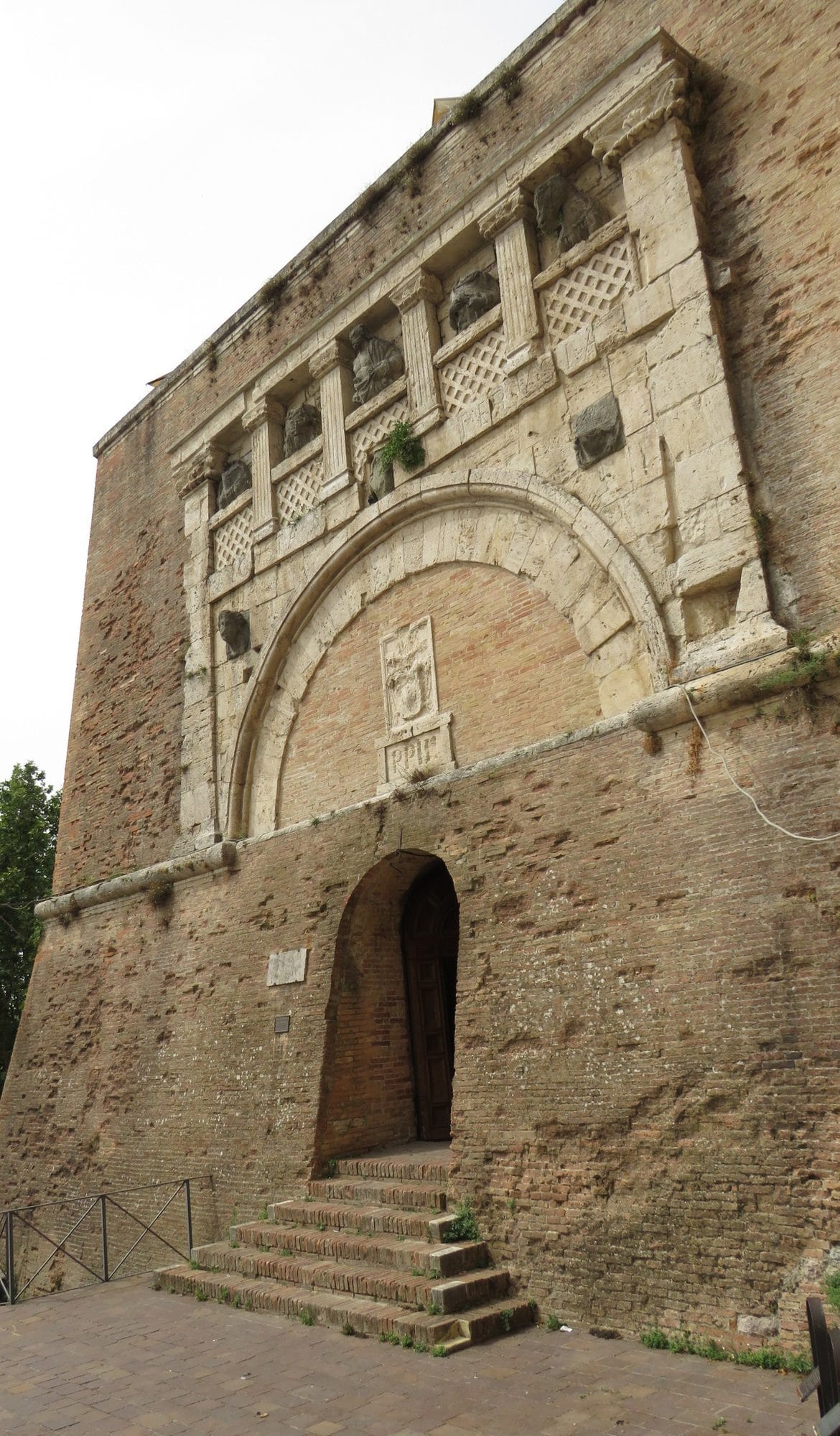
How to read the city: Piazza IV Novembre and the Fontana Maggiore
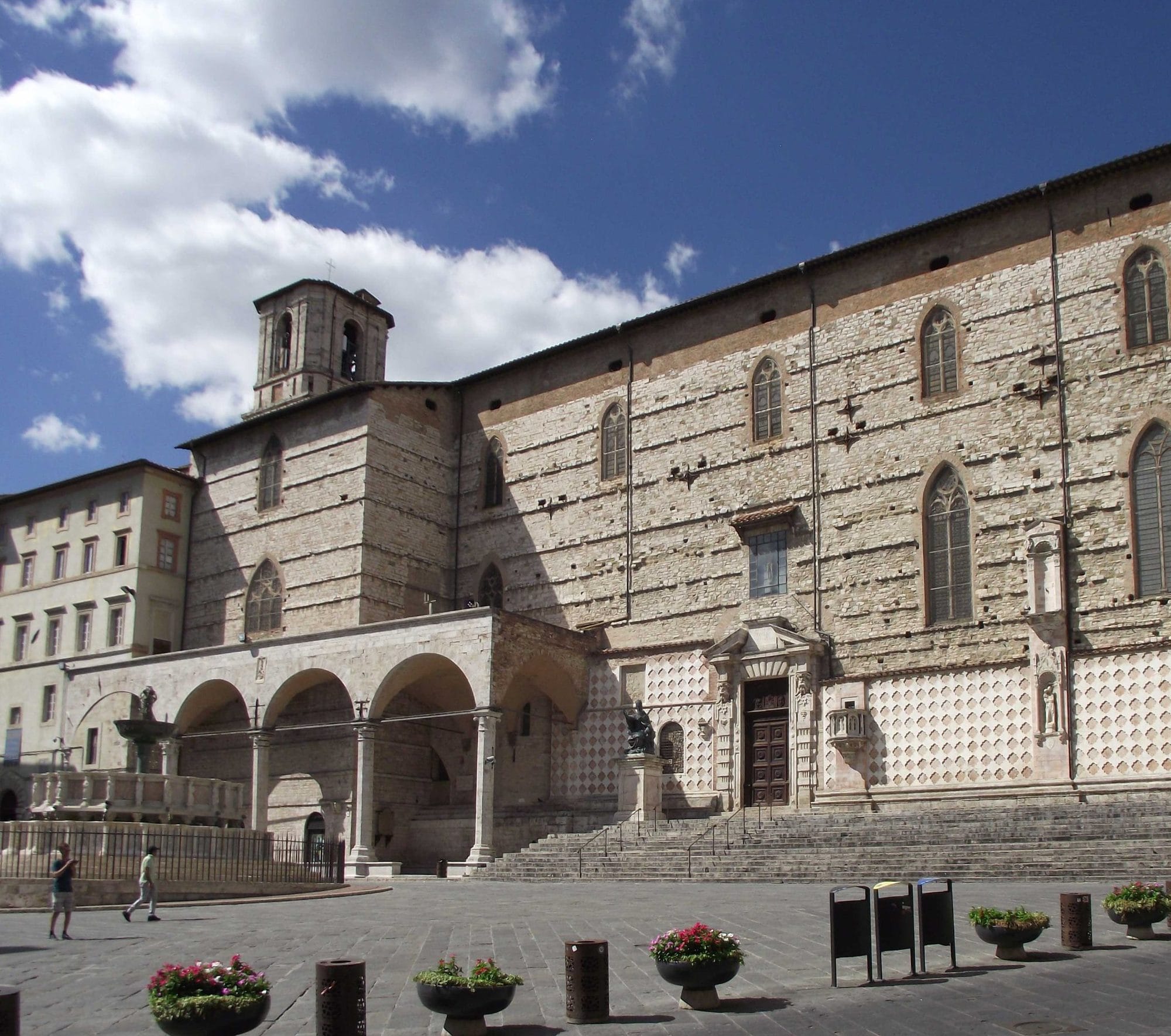
At the top of the climb is the great square. Today it is called Piazza IV Novembre, but it used to be the Piazza Grande, and for me the symbol of the city is the fountain and the great square. On one side is the cathedral, on the other the Palazzo dei Priori. In the middle, the Fontana Maggiore.
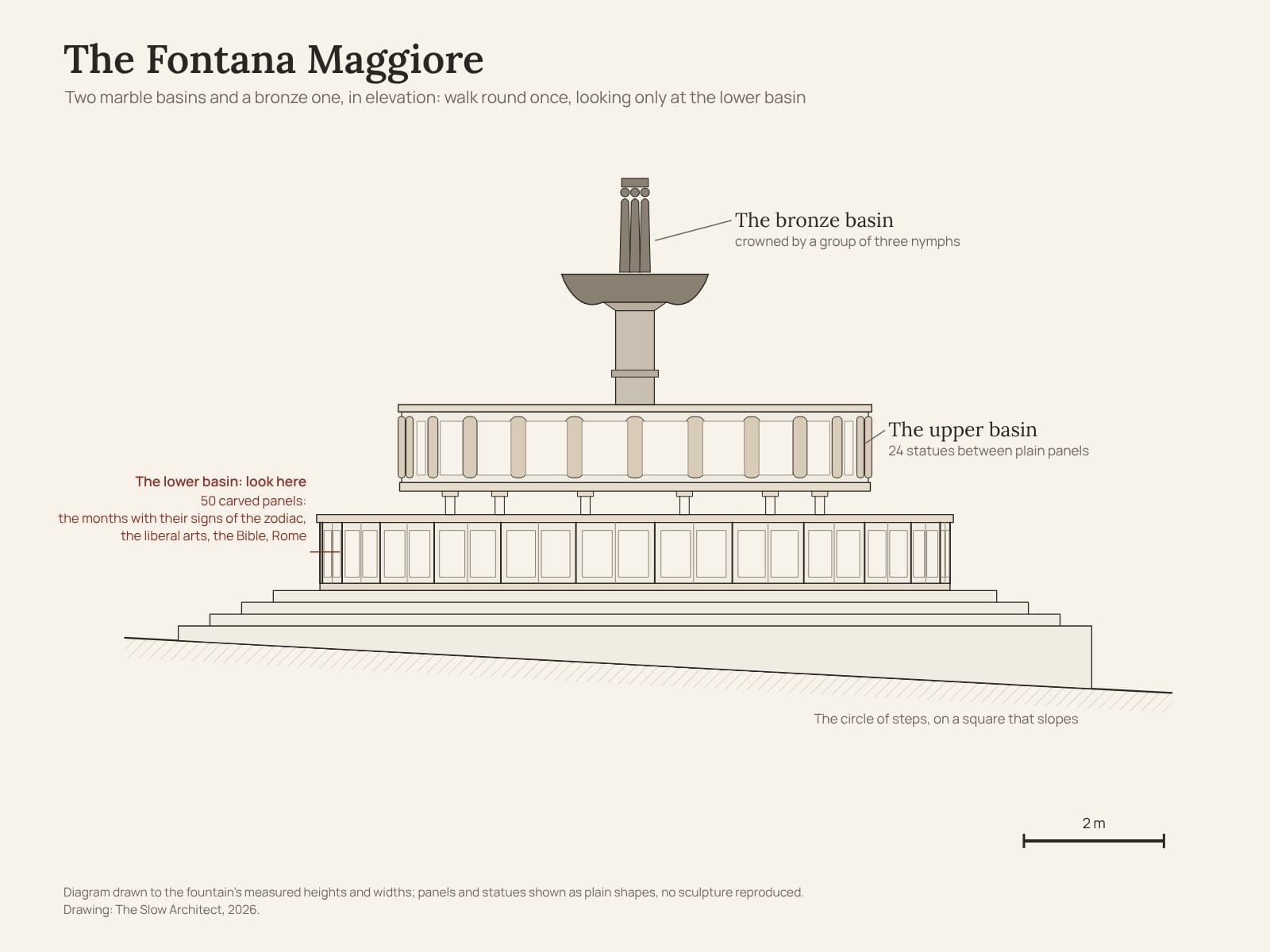
The fountain was finished around 1278, to celebrate the water brought by the new aqueduct. It was designed by Fra Bevignate, with the hydraulics by Boninsegna of Venice and the sculpture by Nicola and Giovanni Pisano, father and son. It has two polygonal marble basins, one above the other, covered in reliefs. Walk round it slowly, once, looking only at the lower basin: there are the months of the year, one after another, each with its sign of the zodiac and a scene of work or everyday life. Then come the liberal arts, stories from the Bible and stories of Rome.
From the square runs Corso Vannucci, named after the painter Perugino, the city's drawing room. It goes down to Piazza Italia, which is to say to where the Rocca stood. Inside the Palazzo dei Priori are the Galleria Nazionale dell'Umbria and, on the ground floor facing the Corso, the Collegio del Cambio, frescoed by Perugino.
Then look up from the square at the shape of the place. Perugia sits on top of a hill, and from there it runs down the ridges in five districts that together make a star. Each one has its own name: Porta Sole, Porta Sant'Angelo, Porta Santa Susanna, Porta Eburnea, Porta San Pietro. They are also the five rioni, the quarters, of the old town, and they are named after the city gates: the sources don't agree on whether that means the Etruscan gates or the medieval ones. The districts grew outside the walls, along the old roads that led out of them. One of the Etruscan gates is still standing, the Arco Etrusco. Near the square there is also the Etruscan Well, about 37 metres deep, which still holds water and can be visited.
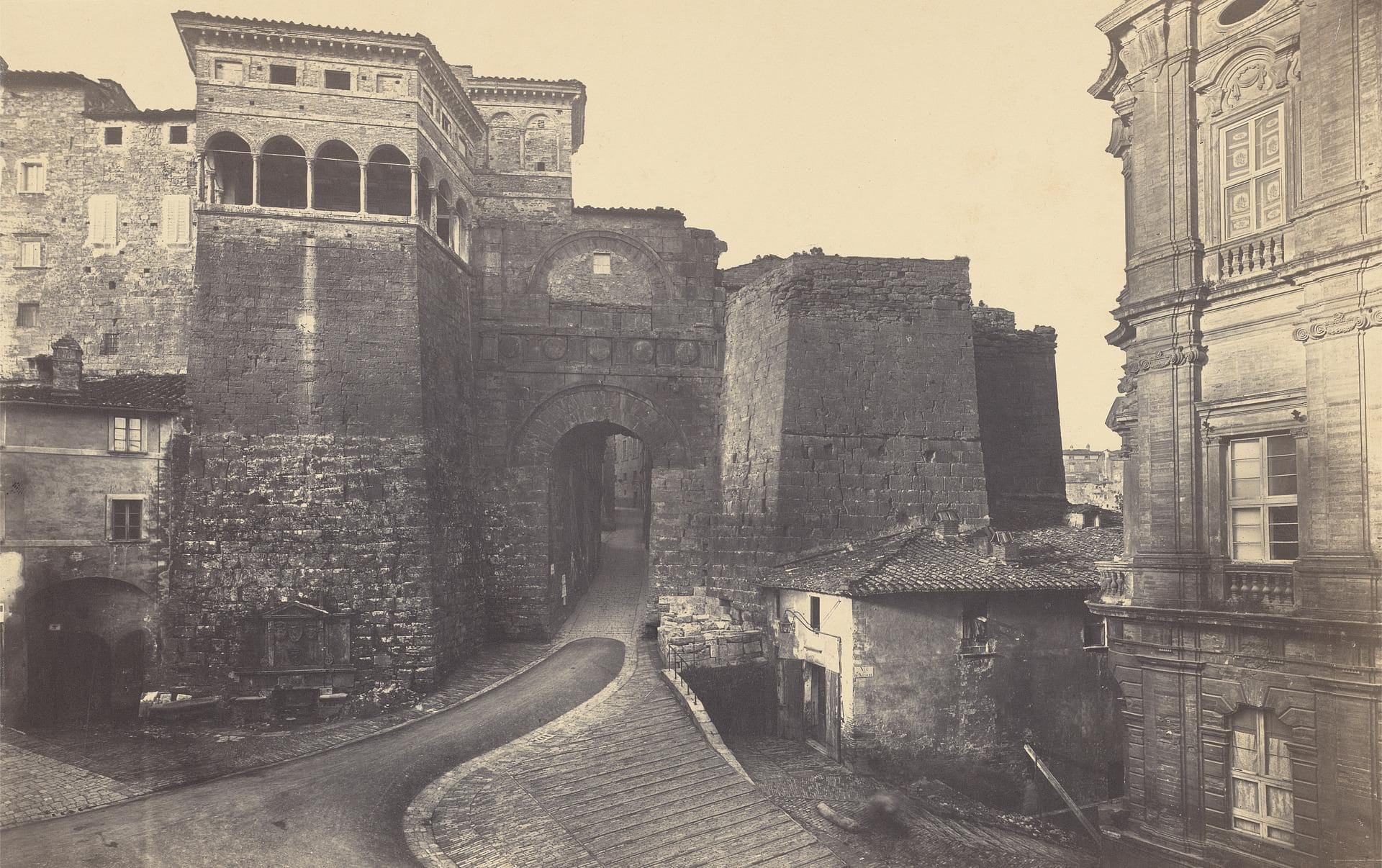
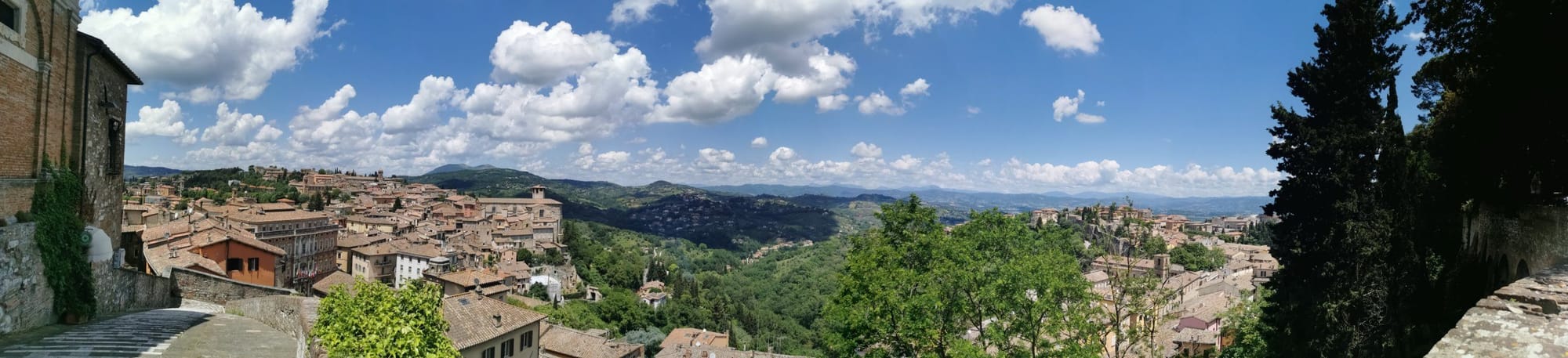
The walk I'd take, map in hand: come up through the Rocca, cross the great square, then walk down one of the districts to its gate. One is enough to understand the star. The others are for next time.
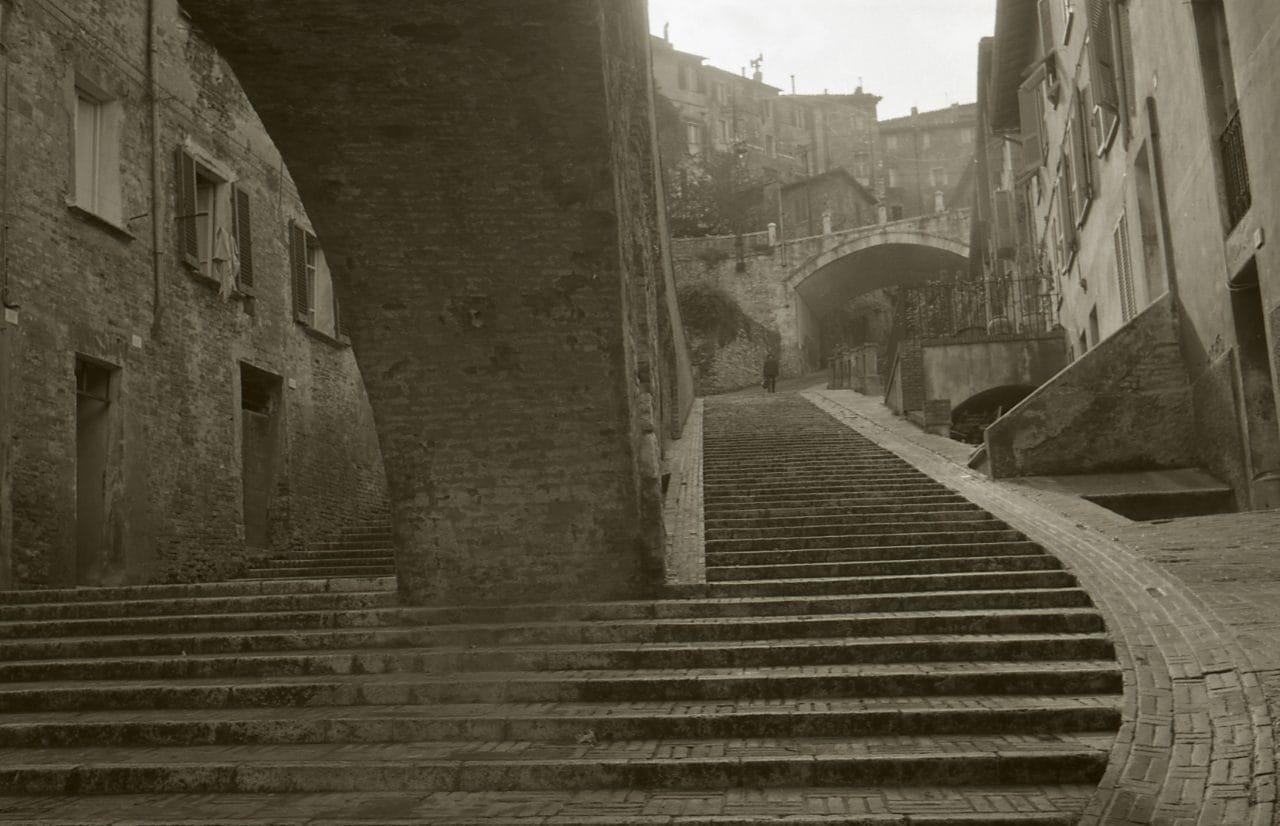
What does a thousand-year-old city need?
As I remember it, Perugia took on the problem of parking and of an old town emptying out before other cities did. Its first public lift dates from 1973. In 1983 the old town became a limited traffic zone and the Rocca escalators opened. Up to 1999 more car parks were added around the old town, linked to it by escalators and lifts. In 2008 came the Minimetrò, which cost 98 million euros.
Not everyone in Perugia has seen it as a success. In 2017, in its comments on the city's mobility plan, the heritage association Italia Nostra spoke of a general worsening of access to the old town over the previous ten years, and pointed out that in 2007, before the Minimetrò, the Piazza Partigiani escalators carried 11,500 people a day, more than the Minimetrò's 7,400. In the same round of comments the Order of Engineers of the province of Perugia, the profession's official body, wrote that the acropolis was no longer the main centre of interest for the people who live in Perugia.
I believe it has paid off, because the old town is not deserted. I am not saying escalators should go everywhere. I am saying we need to work out what Italian cities, founded more than a thousand years ago, need today: somehow they have to change to make room for the world we live in now. Otherwise they are bound to become dormitory towns.
Perugia chocolate: the Perugina chocolate factory and Eurochocolate
The Perugina chocolate house, the Casa del Cioccolato, is outside the centre, in the San Sisto factory. Visits are always guided and must be booked: without a booking you don't get in. They last about an hour and a half: the Perugina museum, the production line seen from a walkway above it, and a tasting at the end. It is closed on Sundays, and on Wednesdays it opens in the morning only. The production lines are not always running: if seeing the machines is what you care about most, ask when you book. Hours and dates are on the Perugina website.
Eurochocolate, on the other hand, happens in town. For ten days the old town fills with stalls, tastings and people, along Corso Vannucci, Piazza Matteotti and the streets around them. Entry to the streets and the stands is free. For some years the festival moved out to Umbriafiere, the exhibition centre at Bastia Umbra; since 2024 it has been back in the old town. In 2026 it runs from 13 to 22 November. If you go, take the Minimetrò or the escalators and leave the car at the bottom.
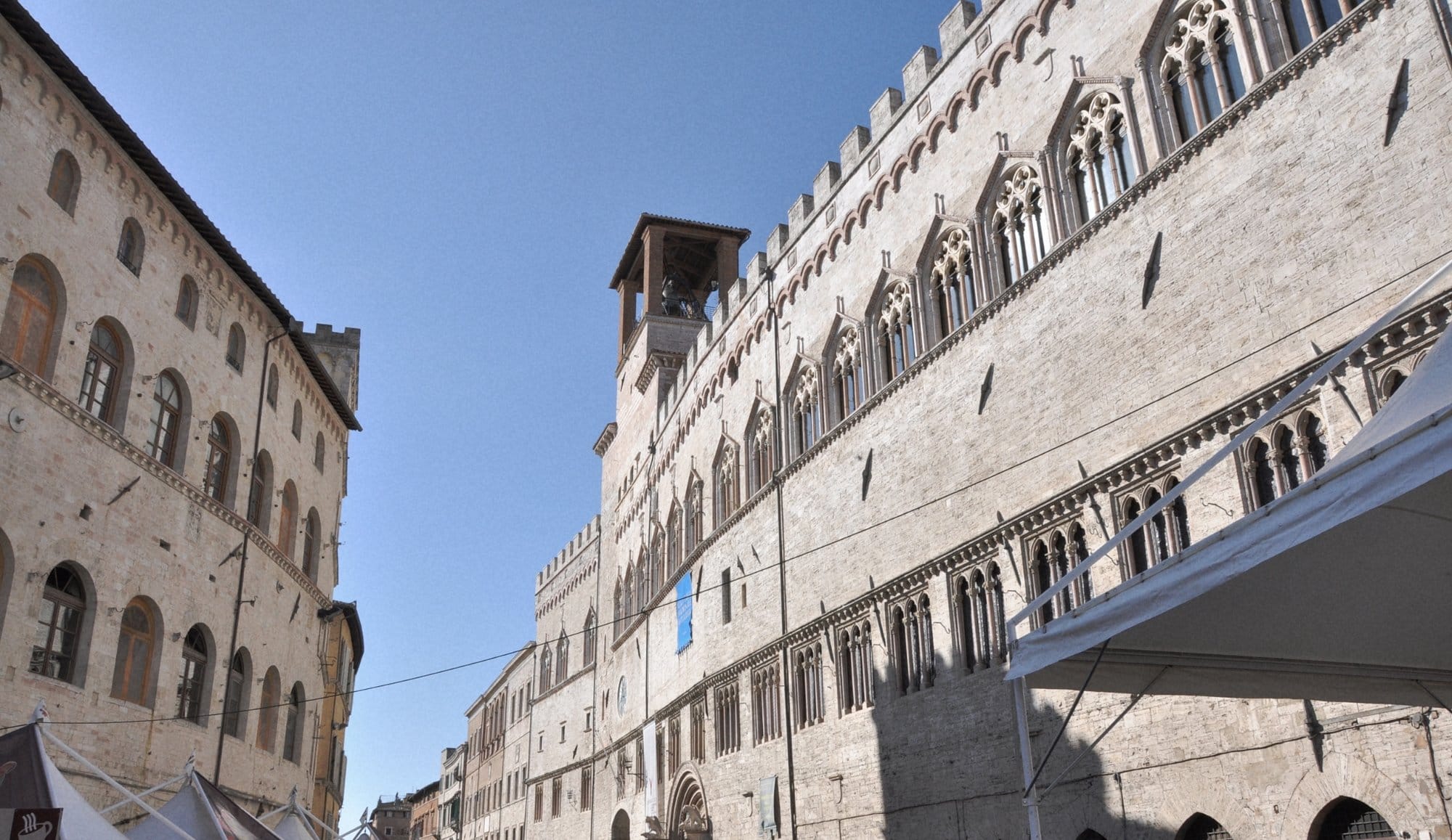
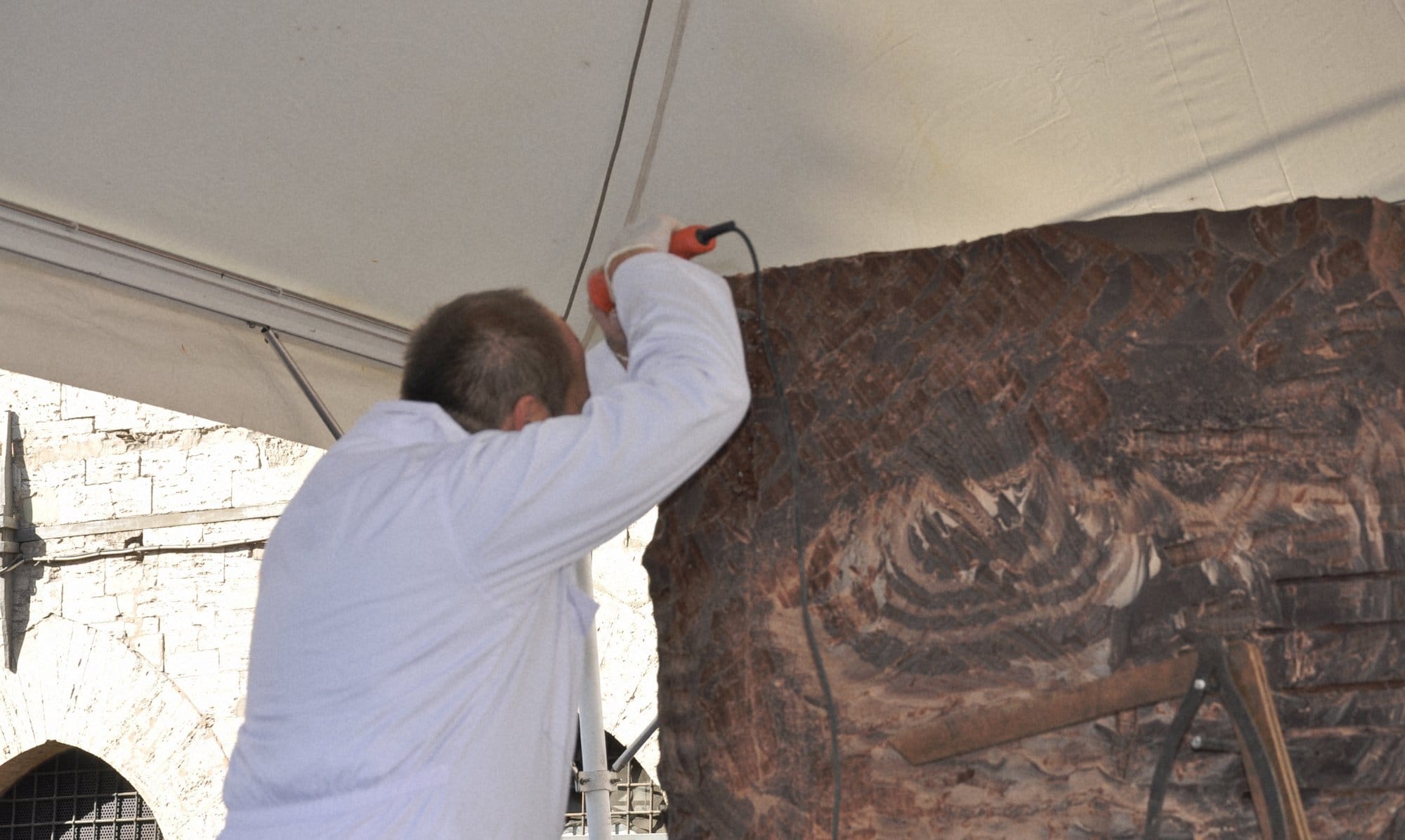
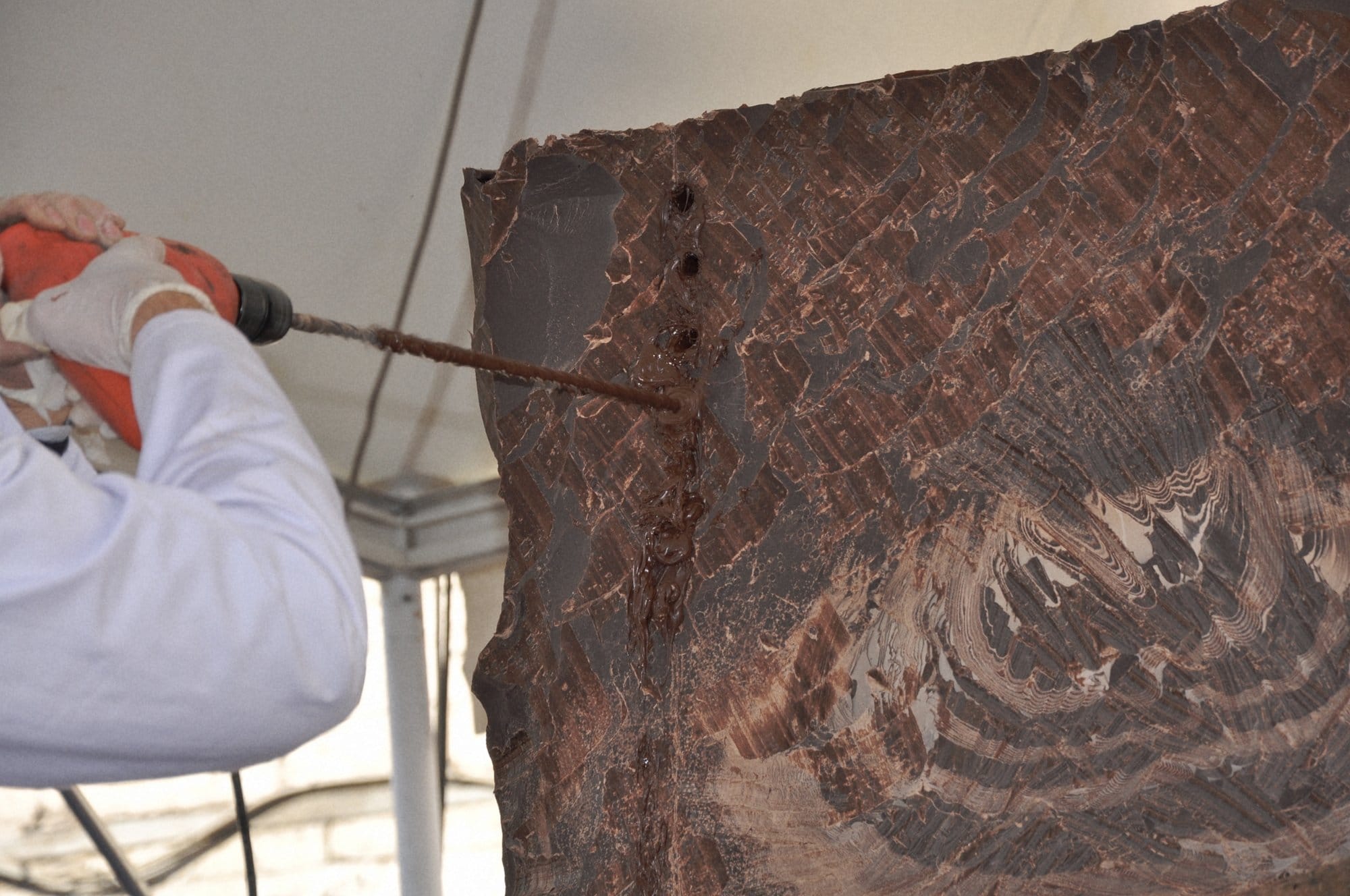
At Eurochocolate, a block of chocolate carved live on a stage in Piazza IV Novembre: drills, picks and callipers, under a tent.
With more time
With a second day. Perugia sits in the middle of Umbria, and a second day is best spent outside it. Assisi is half an hour away by train. Montefalco and Bevagna, for the Sagrantino and two small towns made for walking, are fifty minutes by car. Todi is forty minutes south, on the road to Rome.
People often ask which is the prettiest town in Umbria. I don't do rankings. Umbria is beautiful all over, and every town has something of its own. Italy is a wonderful journey for anyone coming from abroad, and you don't have to pick the most famous places or follow the lists of the ten best. Often the best trip is the one where you let yourself be carried by the moment, by smells and flavours, by the architecture and the landscape around you. I say that from experience. Something that most people would call a detail can become the thing that stays with you for life: a view, a moment, a road. The famous places are famous for good reasons. The quieter ones, that most people still don't know, deserve a look too.
If you are staying in Assisi, Perugia is half an hour away by train: a morning, or an afternoon with the evening in the square. If you are driving between Rome and Florence, Perugia is worth the detour off the A1, like Todi.
When to go
Two moments fill the city. In July, Umbria Jazz, which has been running since 1973: in 2026 more than half of its events were free, spread around the old town. In November, since 2024, Eurochocolate. The rest of the year it is the university city, with its students.