WHO RESTORED THE COLOSSEUM?
Two brick buttresses with two opposite ideas of restoration, a shoe entrepreneur, and an arena floor that isn't there yet. Two centuries of Colosseum restoration, before and after.
Why, exactly? · Two brick buttresses with two opposite ideas of restoration, a shoe entrepreneur, and an arena floor that isn't there yet.
The spire in Paris
In December 2024 Notre-Dame reopened with its spire back in place: ninety-six metres, an exact copy of the one Eugène Viollet-le-Duc had built in 1859 and fire had brought down in April 2019. France had argued about it for more than a year, between those who wanted a contemporary gesture and those who wanted it as it was. In July 2020 Macron chose "as it was".
The Colosseum has been missing more than half of its outer ring for over a thousand years, and nobody has ever rebuilt it. [[ LINK: What Happened to the Colosseum? → /what-happened-to-the-colosseum/, on "more than half of its outer ring" ]] Yet the Colosseum you see today has been restored for more than two centuries, in particular places, and the oldest are at the two ends of the wall that remains.
The short answer
Plenty of people have restored the Colosseum, and almost never to rebuild it: the point was to keep it standing. Two popes, Pius VII and Leo XII, with two architects, Raffaele Stern and Giuseppe Valadier, between 1806 and 1826. Then, in the nineteenth century, Gaspare Salvi and Luigi Canina. The Italian state from 1871, a bank in the 1990s, a shoe entrepreneur, Diego Della Valle, from 2011, and in 2026 money from Rome's new metro line. Nobody has rebuilt the missing part. But the question restoration has been asking for two centuries, whether to stop the ruin where it is or to rebuild what isn't there, can be seen at the Colosseum in two brick buttresses, one at each end of the wall.
The Colosseum falling down on its own
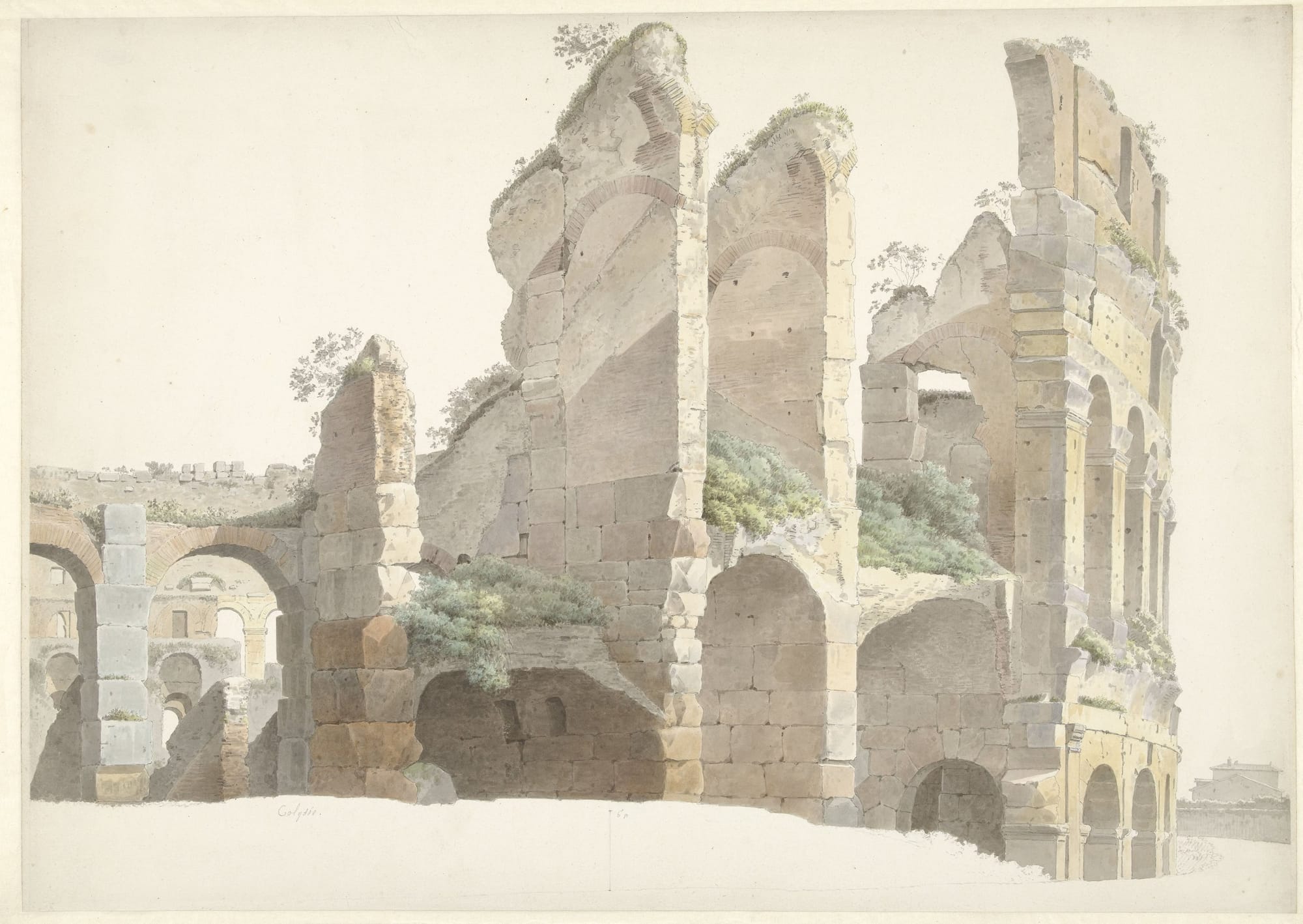
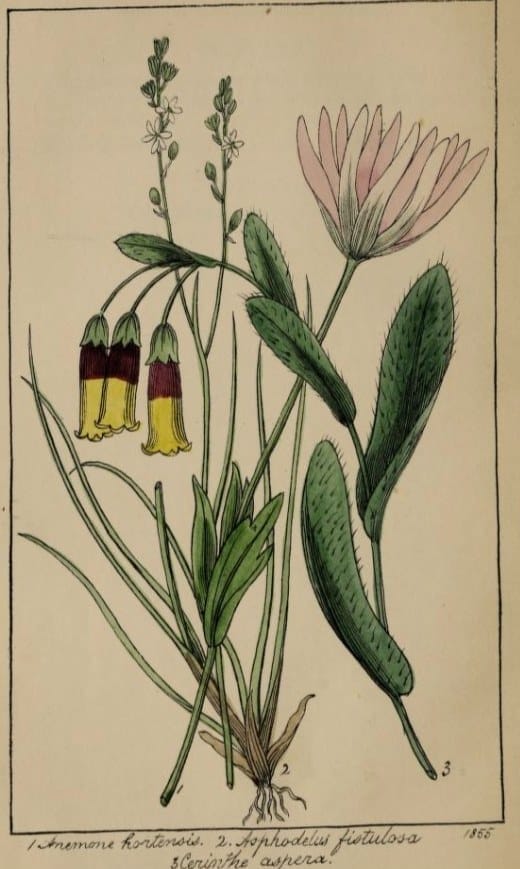
By the beginning of the nineteenth century the Colosseum was no longer a quarry. The stones had stopped leaving half a century earlier, but nobody was holding them up. Plants grew on every ledge: in 1855 an English botanist, Richard Deakin, counted 420 species and wrote a book about them.
Stern: stop the ruin as it is
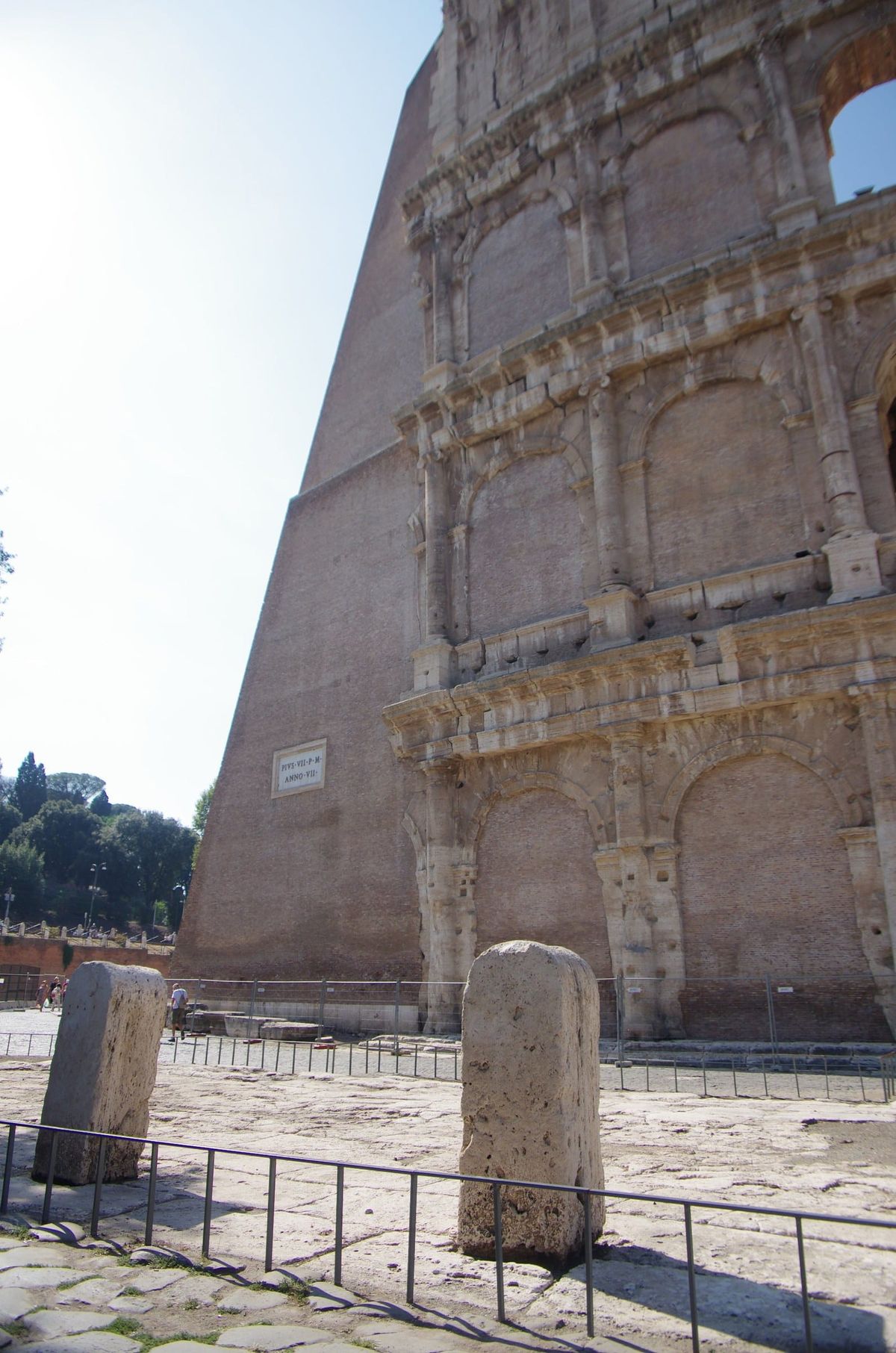
Stern's buttress was born under a pope who had written the rules not long before. In 1802 Pius VII signed a chirografo, a papal decree, which for the first time in the Papal States brought the protection of antiquities together in a single law: no exports, and excavations only with permission. Four years later, in 1806, an earthquake in the Alban Hills, the dormant volcano south-east of Rome, shook the last arches on the east side, where the wall breaks off. The wall threatened to collapse, and the voussoirs of the arches had slipped out of place.
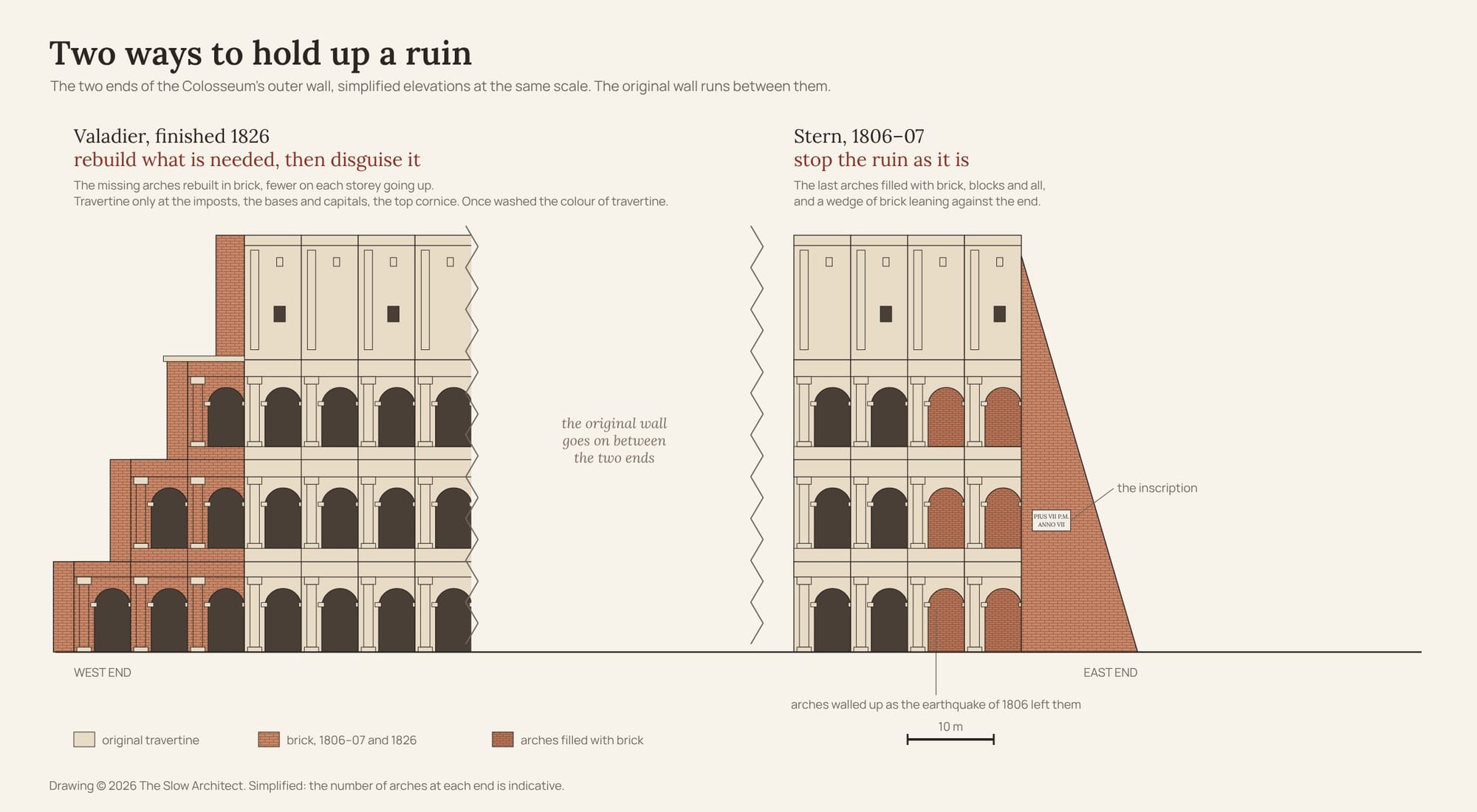
The job went to Raffaele Stern, architect of the papal palaces, who worked with Giuseppe Palazzi and Giuseppe Camporese. The obvious solution would have been to take the unsafe arches down and put them back up in order. Stern filled them with brick just as they were, with the travertine blocks slipped and teetering, and locked them in the position the earthquake had left them in. Then he leaned a huge sloping wedge of brick against the end, with an inscription, "Pius VII P.M. Anno VII", the pope's seventh year, that is 1806–1807. Those walls still hold the displaced blocks today.
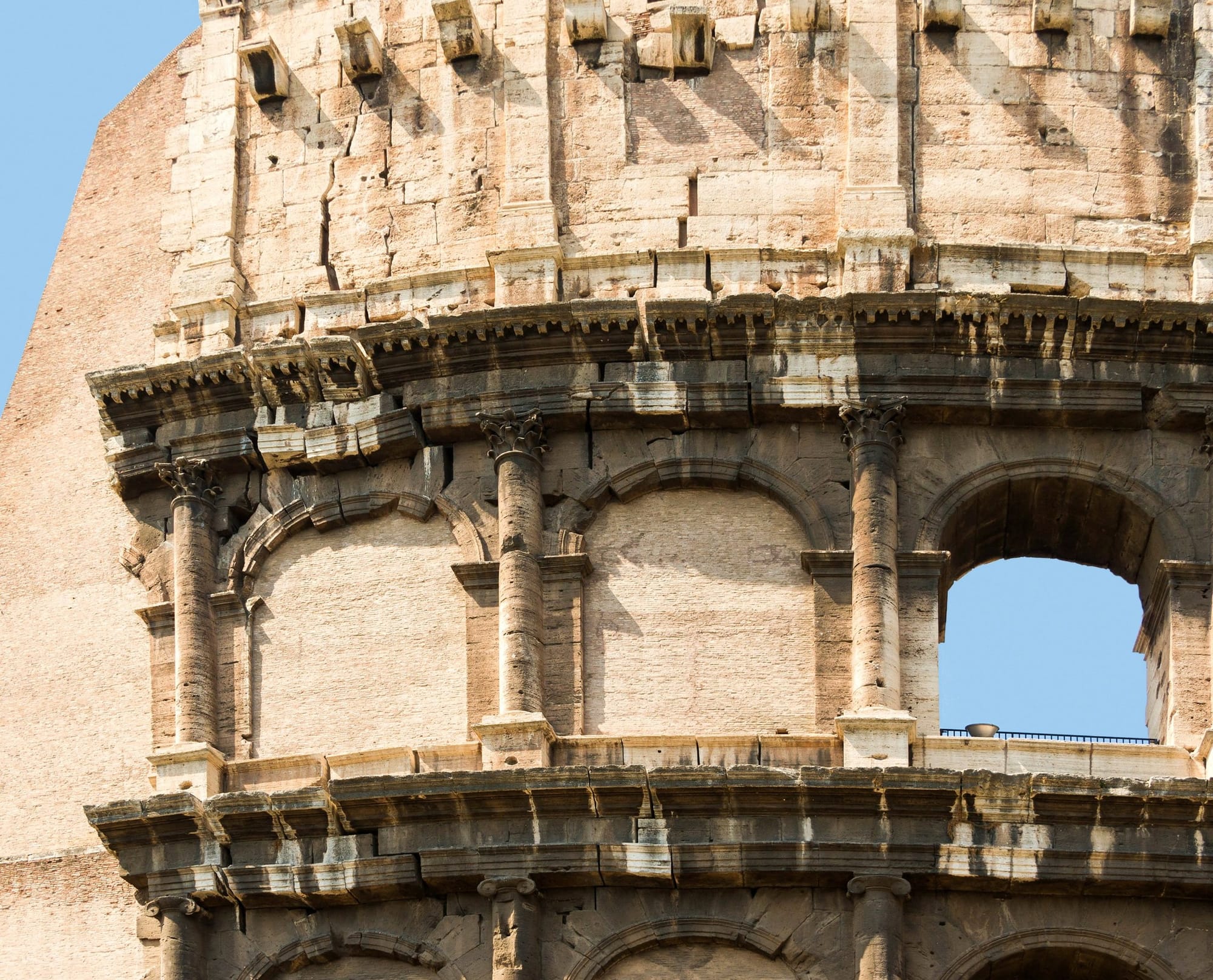
At the time the buttress was criticised. The Archaeological Park, on the sign it has put up beside it, calls it "the first and fundamental restoration of the Colosseum". Whether Stern did it out of respect for the ruin, or out of haste and a shortage of money, is a question that a set of lecture notes on the history of restoration from the University of Genoa asks, and leaves open. Either way, the result is an idea others would put into words later. Forty-two years on, in 1849, John Ruskin asked for exactly this: "Take proper care of your monuments, and you will not need to restore them." Bind them with iron where they loosen, prop them where they sag, and never mind how ugly the support looks: "better a crutch than a lost limb". Stern had already put the crutch in, in brick, and without pretending it was anything else.
Valadier: rebuild what's needed, in disguise
At the other end of the wall worked Giuseppe Valadier, architect to the papal administration, who had already redesigned Piazza del Popolo. First, in 1814 and 1815, he had the monument cut off from the groundwater that was making the soil unstable, and closed its entrances with gates. Then he built the west buttress, towards the Arch of Constantine, finished in 1826 under Leo XII.
Valadier rebuilt some of the collapsed arches "by analogy", copying the shapes and mouldings of the ancient ones, fewer and fewer going up, so that the end steps down in tiers. He used travertine only in a few places: the first piers, the imposts of the arches, the bases and capitals of the columns, the top cornice. The rest he built in brick, and covered the lot with a travertine-coloured wash, applied while the plaster was fresh, so that the new would blend with the old. By his own admission, in the book on his works he published in 1833, it was also a way of spending less.
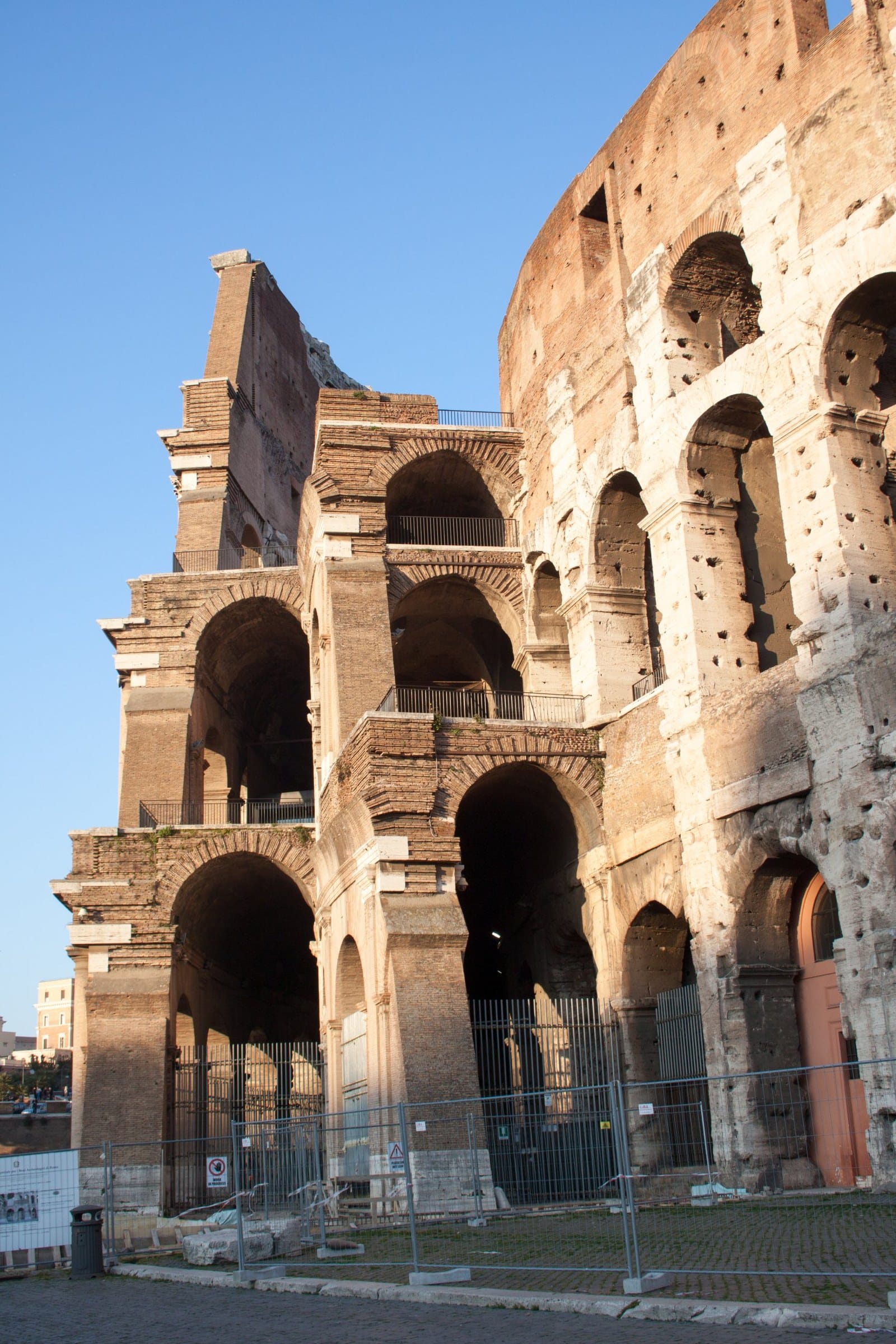
The wash has gone. Today you see the brick, and the buttress that was meant to blend in with the ancient work stands out from a long way off. In 2026 it turned two hundred, and the Archaeological Park has devoted a conference to it on the birth of modern restoration. Among the proposed themes are the comparison with Stern's buttress, and how much the "Valadier method" shaped Camillo Boito, who more than half a century later would write the rules of Italian restoration.
In the same years, a few minutes' walk away, at the Arch of Titus, Valadier did the opposite: the new parts are in travertine, so that they stand apart from the ancient marble. We told that story in our piece on the Appian Way. But that was also what the commissioner of antiquities, Carlo Fea, wanted: he had ordered Valadier not to copy the capitals and cornices identically. And the Genoa lecture notes ask the same question here as for Stern: travertine so that the difference would show, or because it cost less than marble?
Forty years later, in 1866, Eugène Viollet-le-Duc gave restoration the opposite definition to Ruskin's. For him, restoring a building did not mean maintaining it, repairing it or remaking it, but putting it back into a complete state that might never have existed at any one time. Valadier only rebuilt the arches needed to hold up the others. By the rules of Boito and of those who came after him, though, his travertine-coloured wash would be a mistake, because the new part has to declare itself. We wrote about that in connection with the bell tower of St Mark's.
After the popes
Then came the others. In the 1830s and 1840s Gaspare Salvi rebuilt some arches in brick on the side of the Caelian Hill, and around 1850 Luigi Canina, the same man who in those years was putting the Appian Way back in order, tied the façade to the walls behind it with iron chains. From 1871, with Rome now the capital of Italy, the state had the plants pulled out, for decorum and for hygiene, and in 1874 it removed the shrines of the Stations of the Cross: the Colosseum was to be Roman again. The plants grew back, and a count in the early 2000s found 242 species.
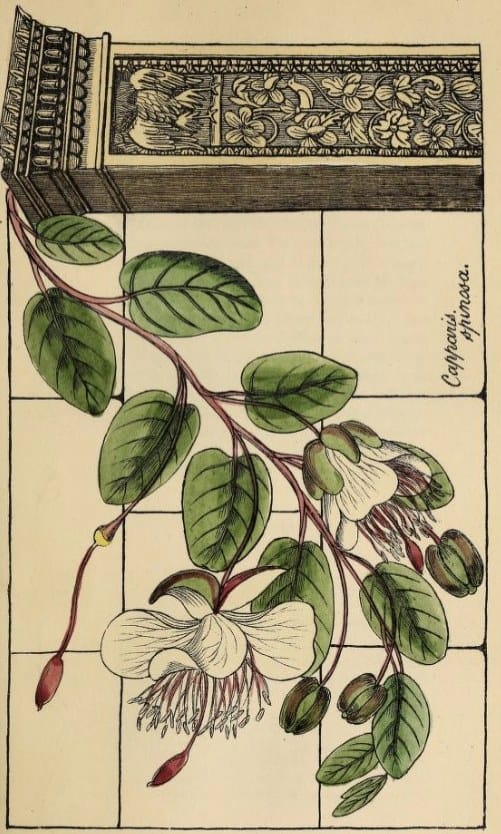
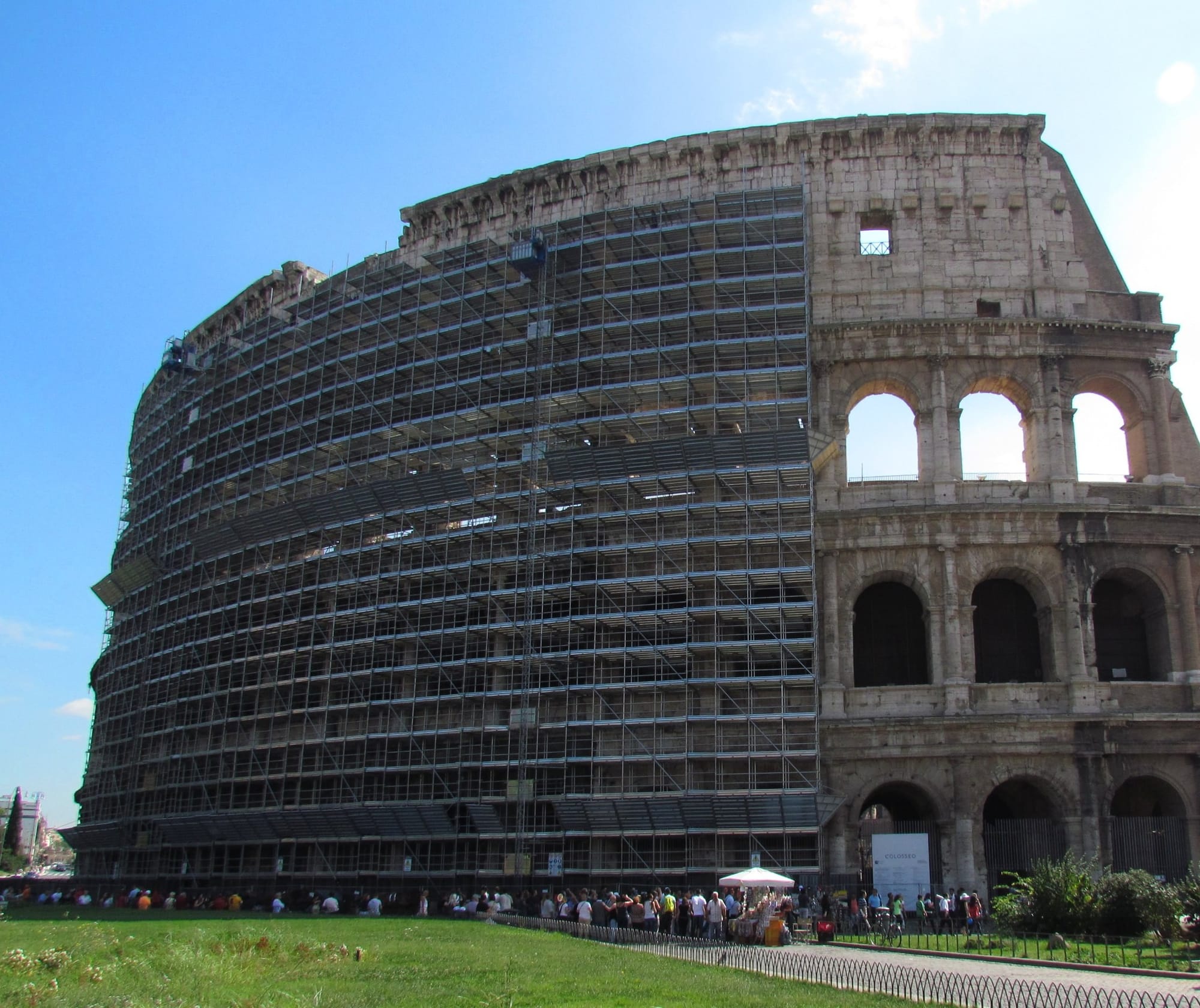
In 1992 a private sponsor arrived: the Banca di Roma signed an agreement with the Ministry worth forty billion lire over four years, for scaffolding, for cleaning off the smog and the weeds, and for drainage. The work went on until 2000, on one section of the monument only.
Who pays for an icon
In January 2011 the Ministry signed an agreement with Diego Della Valle, at the head of Tod's, worth 25 million euros, paid directly to the contractors as the work went ahead. In return, according to the Ministry's press release, he got the exclusive right to present himself as the sole sponsor of the works, for as long as they lasted and for two years after. The consumer association Codacons appealed, and in 2013 the Council of State declared the appeal inadmissible, because the association had no standing to bring it, without ruling on the merits.
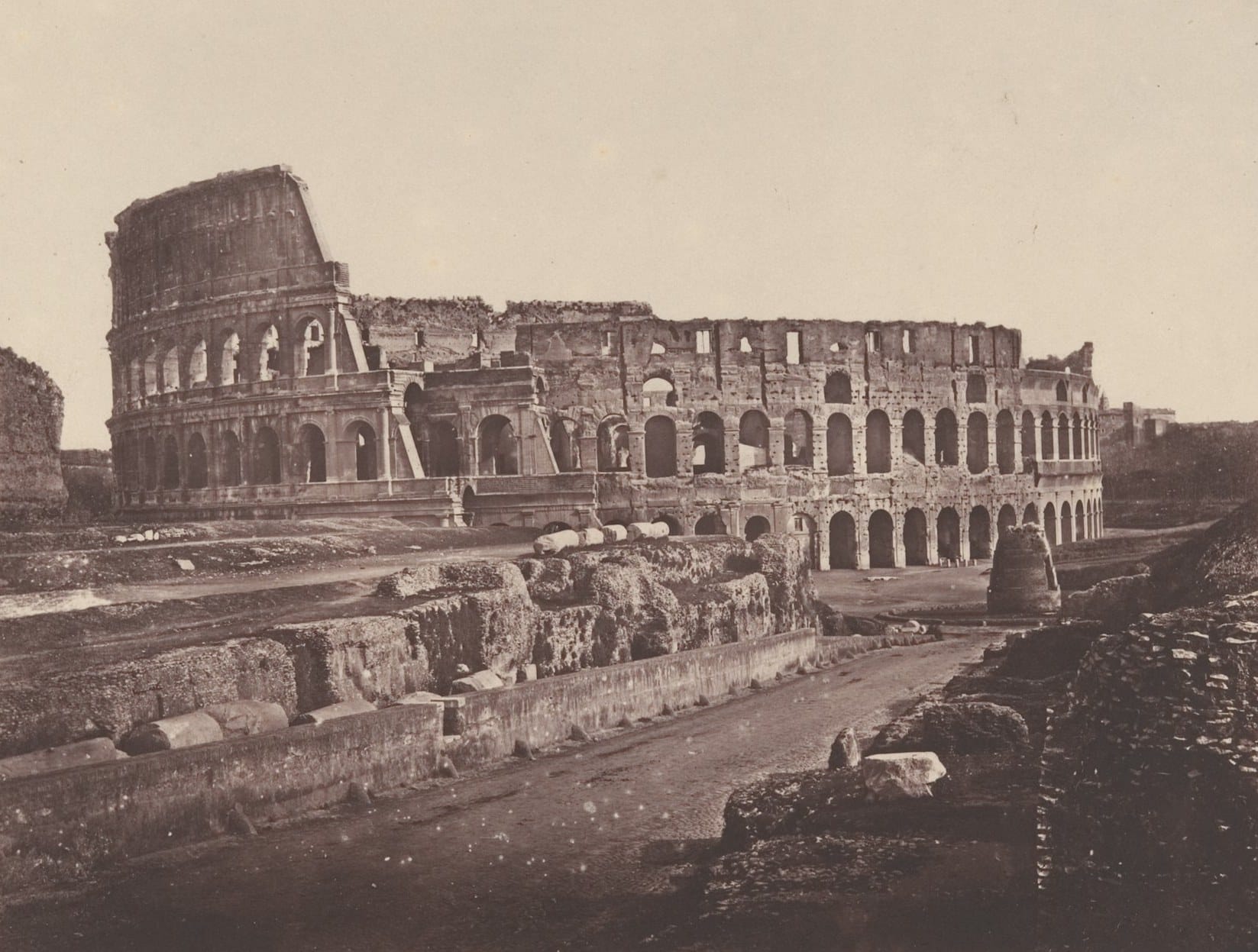
Work on the façade began at the end of 2013: misted water and brushes, the cement of earlier restorations taken off, the gates in the arches replaced. In 2016 the scaffolding came down, and the travertine was pale again. If you have a photo of the Colosseum from before, like ours from 2010, you already have your own before and after.
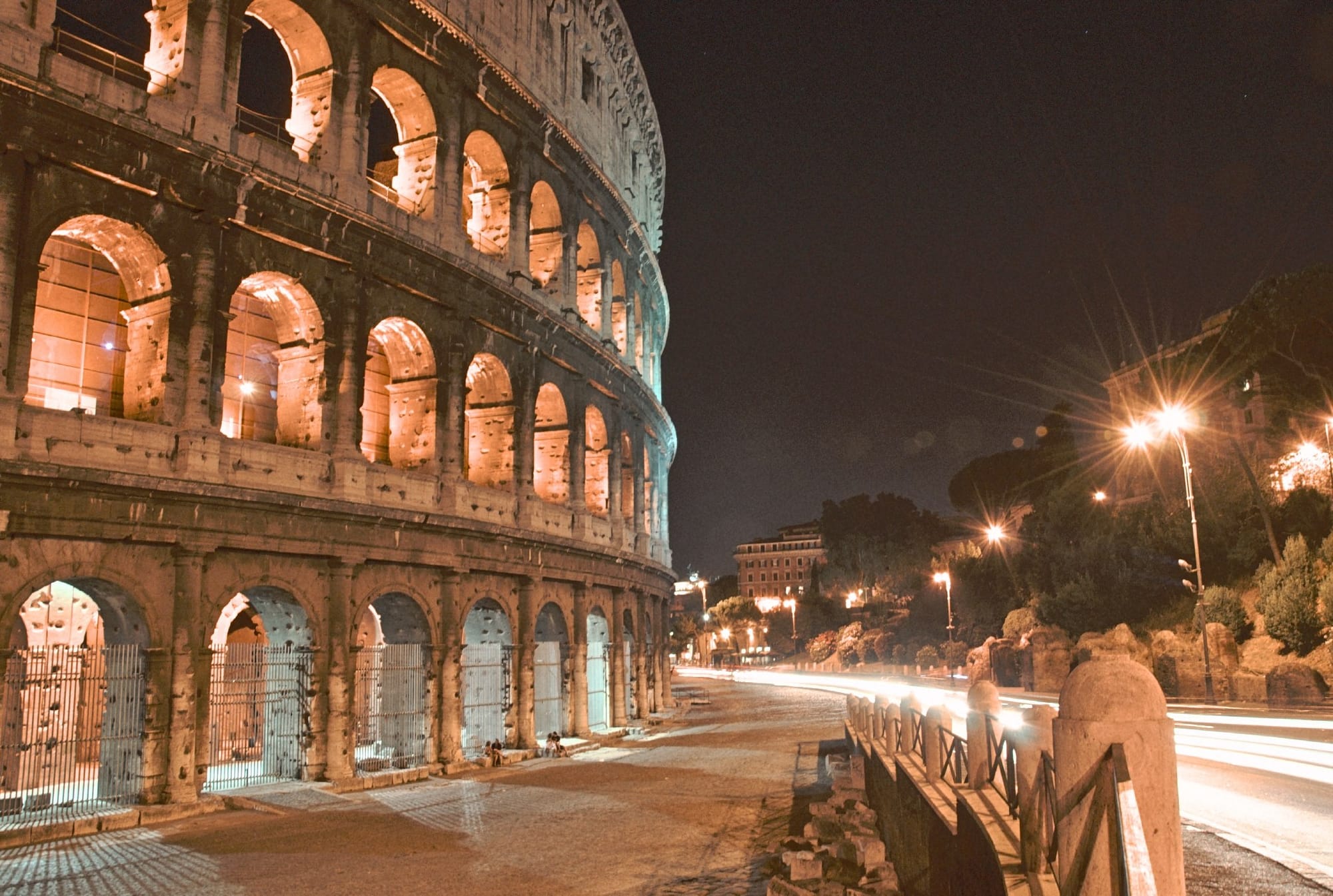
Della Valle isn't the only one. Fendi paid for the restoration of the Trevi Fountain, finished in 2015, and Bulgari for the Spanish Steps, between 2015 and 2016. The name on the hoarding stays for a few years. The restoration, if it's done well, for a few centuries.
Under the arena
The second phase of the work paid for by Tod's went underground. The hypogeum, the Colosseum underground, is a set of corridors and service rooms from which men, animals and scenery came up into the arena through trapdoors in the floor: in the Flavian period twenty-eight lifts, each worked by eight men, raised the beasts in their cages. From December 2018 the work consolidated and cleaned fifteen thousand square metres of surfaces, and in June 2021 the whole of the underground opened to the public, along a walkway 160 metres long. One of the lifts, rebuilt, had been there since 2015: it was paid for by a production company, for a documentary made for the American public broadcaster PBS.
The arena floor
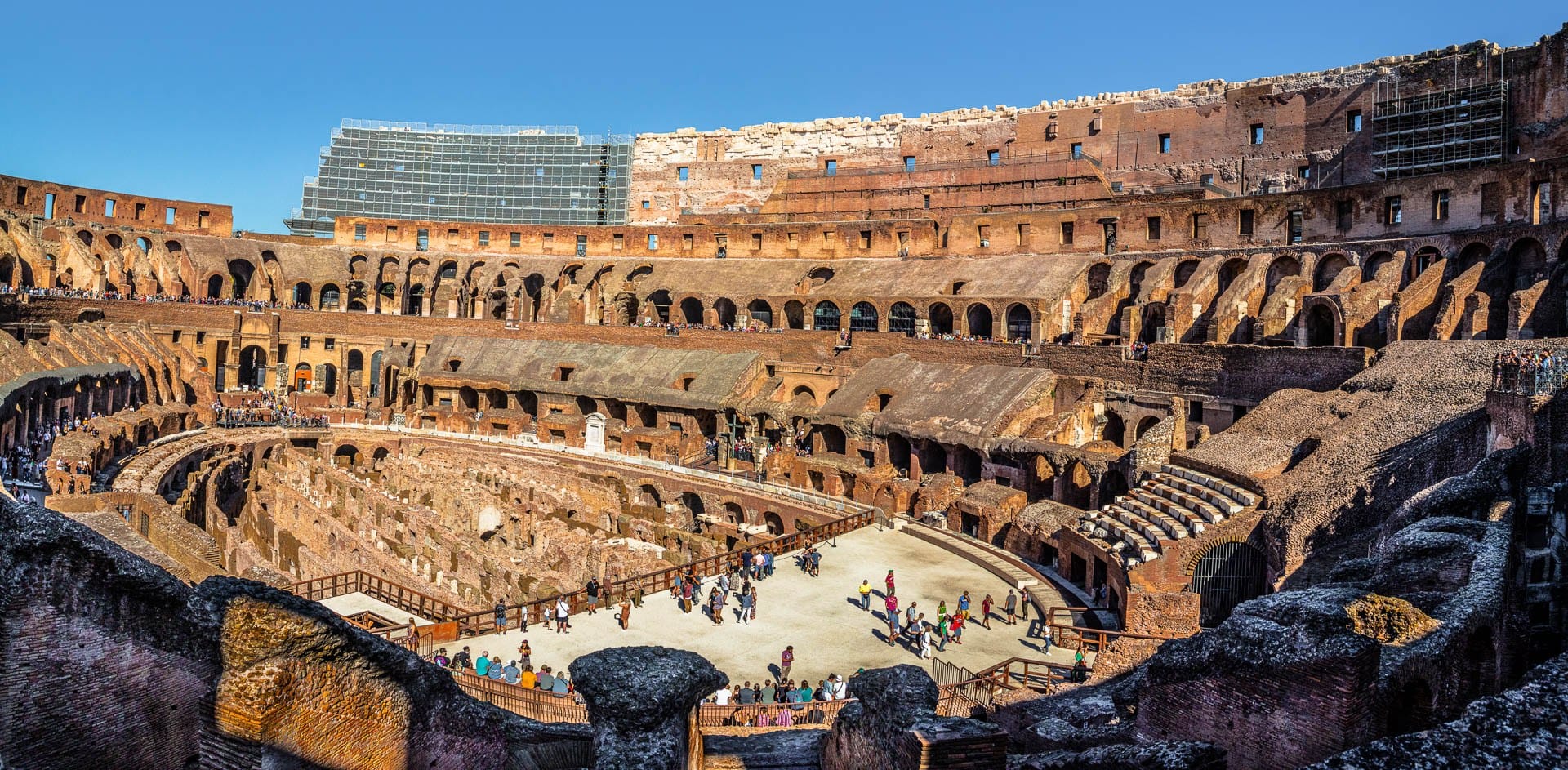
Above, the arena has had no floor since the excavations of the nineteenth century uncovered the underground. One stretch, about 650 square metres on the east side, was rebuilt in wood between 1998 and 2000, and it is the one you walk on today. For the rest, in 2021 a project costing 18.5 million euros was chosen: three thousand square metres of wooden slats on panels that turn and slide, to let light and air into the underground and to close it when it rains, without deep anchors in the ancient masonry, so that it can be taken away again. It was meant to be ready in 2023. In May 2026 the director of the Archaeological Park, Simone Quilici, said it would have to be partly rethought because of the risk from rain: work is still going on to understand how the Romans' drainage system worked.
The south side, again
Two hundred years on, the same question has reopened between the two buttresses. On 17 March 2026 the Park opened new paving on the side where the outer ring is gone, designed by the studio Stefano Boeri Interiors. It runs from one buttress to the other: from the western entrance, the one Valadier completed in 1826, to Stern's buttress, at arch XVIII.
First they dug. Under the cobbles, down to a metre, the ancient level came to light: the imprints left by the blocks of the piers that had been carted off, up to ten centimetres deep, and platforms of lime and red pozzolana, about forty centimetres thick, which filled the gaps between the foundations and carried the ancient floor. On top, at the ancient level, there is now travertine from Tivoli, laid on a lime with no cement in it so as not to damage what lies beneath. Where the piers stood, the paving stops; slightly raised blocks, which double as seats, redraw the ambulatories, and the Roman numerals of the lost arches are cut into the ground. The metro paid for it: 2.2 million euros from the compensation funds of Line C, with a building materials company, Mapei, as technical sponsor.
Not everyone applauded. Michele Zampilli, who teaches architectural restoration at Roma Tre University, called it pointless; others worry that the white travertine will soon get dirty, and on social media someone compared it to a cemetery. Andrea Carandini, who sits on the Colosseum's scientific committee, defended it like this: "it is precisely what isn't there that lets us complete what is". A drawing on the ground of what is no longer there: the closest thing to it in Italy is Burri's concrete cast of Gibellina, which keeps the streets of a town that no longer exists.
Where to see it
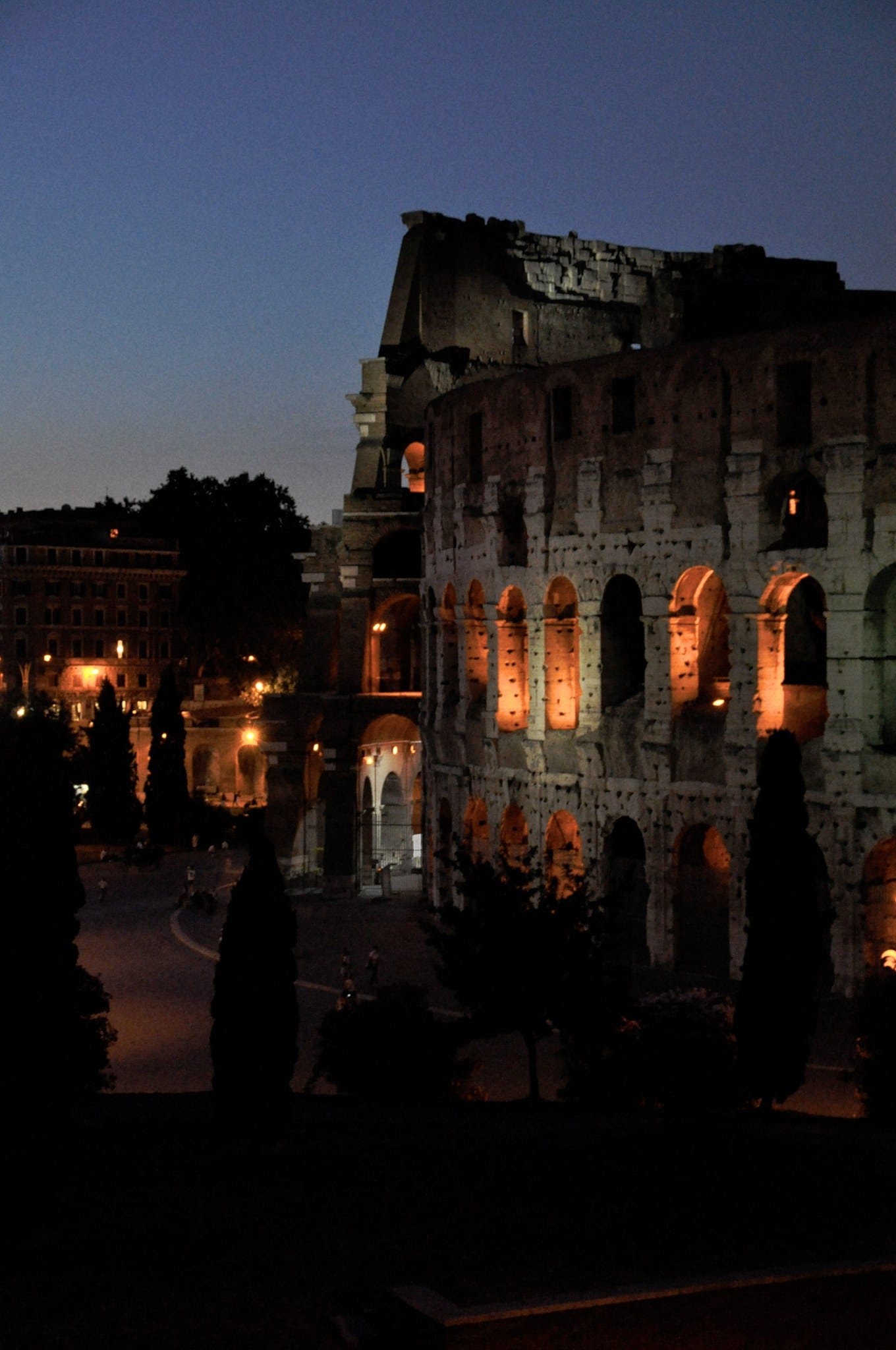
Walk around the Colosseum and stop at the two ends of the wall. To the east, where Piazza del Colosseo meets Via dei Santi Quattro, is Stern's buttress: the sloping wedge of brick, the inscription of Pius VII, and next to it the walled-up arches with the blocks still askew inside. To the west, towards the Arch of Constantine, is Valadier's: arches rebuilt in tiers, brick and travertine, the cornices copied from the ancient ones. We looked at it from Via Celio Vibenna, on the edge of the Celio park, one evening in July: the photograph below is from that evening. Between the two, walk on the new paving and sit down where a pier used to be.
With a Park ticket, go into the Forum, walk up the Via Sacra to the Arch of Titus, and look at where the marble ends and the travertine begins. The underground and the rebuilt stretch of arena can be visited with the tickets that include them. Metro line B, Colosseo station. And if you have a day to spare, five day trips from Rome are in our free guide.
…, Exactly? answers one question about a building, properly. If there is one you have always wondered about, reply to any Slow Letter and ask.
Sources: Rebâtir Notre-Dame de Paris, "The spire of Notre-Dame de Paris is reborn" (December 2024); The Architect's Newspaper (July 2020) and Smithsonian Magazine (2019) on the spire; M. Como, "Il Colosseo: sulle ragioni del suo stato di danneggiamento" (2018; Gli Speciali de Il Giornale dell'Ingegnere 1/2021); Colosseo. Un'icona, exhibition press kit and chronology (Electa, 2017); M. Saracco, teaching materials on Stern and Valadier, University of Macerata (2024); Colosseum Archaeological Park, sign "Lo Sperone Stern" (Historical Marker Database); INGV, Catalogue of Strong Earthquakes in Italy (CFTI5Med), the earthquake of 26 August 1806; University of Genoa, lecture notes on the theory and history of restoration, on the Colosseum and the Arch of Titus; Colosseum Archaeological Park, call for papers for the conference "Il Colosseo e la nascita del restauro moderno. Bicentenario dello Sperone Valadier (1826–2026)" (2026); G. Abbatiello, "Stern e Valadier. I restauri sul Colosseo" (2023); G. Valadier, Opere di architettura e di ornamento (1833), as quoted by M. Saracco; R. Deakin, Flora of the Colosseum of Rome (1855); J. Ruskin, The Seven Lamps of Architecture (1849), "The Lamp of Memory", §§ 18–19; E. Viollet-le-Duc, Dictionnaire raisonné de l'architecture française, vol. VIII (1866), "Restauration"; Encyclopaedia Britannica and the Primo Levi Center on the restoration of the Arch of Titus; the-colosseum.net, "Modern times"; l'Unità, 8 July 1992; Italian Ministry for Cultural Heritage, press release of January 2011 on the agreement with Diego Della Valle; Il Fatto Quotidiano, 31 July 2013; ANSA (2014) and The Art Newspaper (2016) on the façade; Wanted in Rome, MF and Finestre sull'Arte (June 2021) on the underground; Colosseum Archaeological Park, "Montacarichi e piattaforme"; Il Post, 6 June 2015; Finestre sull'Arte, Romeing (May 2021) and artnet on the arena project; AgenziaCult, 27 May 2026; Colosseum Archaeological Park, press release of 17 March 2026 and "The Lost Ambulatories from Arch 18 to 60"; Il Post, 18 March 2026; Wanted in Rome, 17 February 2026; Turismo Roma on the conference for the buttress's bicentenary; Artribune (2019) and ANSA (2015) on the Fendi and Bulgari restorations; The Metropolitan Museum of Art, collection record 2005.100.799 (29); Colosseum Archaeological Park, "Arch of Constantine and Meta Sudans", and Wikipedia, "Meta Sudans", on the demolition of 1936. Translations are my own.