MATERA — THE CAVE CITY THAT WAS A DISGRACE, THEN A WONDER
In 1952 Italy emptied the caves of Matera as a national disgrace. Today they are hotels, film sets and a World Heritage Site. How the Sassi work, and who paid for the change.
Basilicata, southern Italy. A place most people still haven't been to.
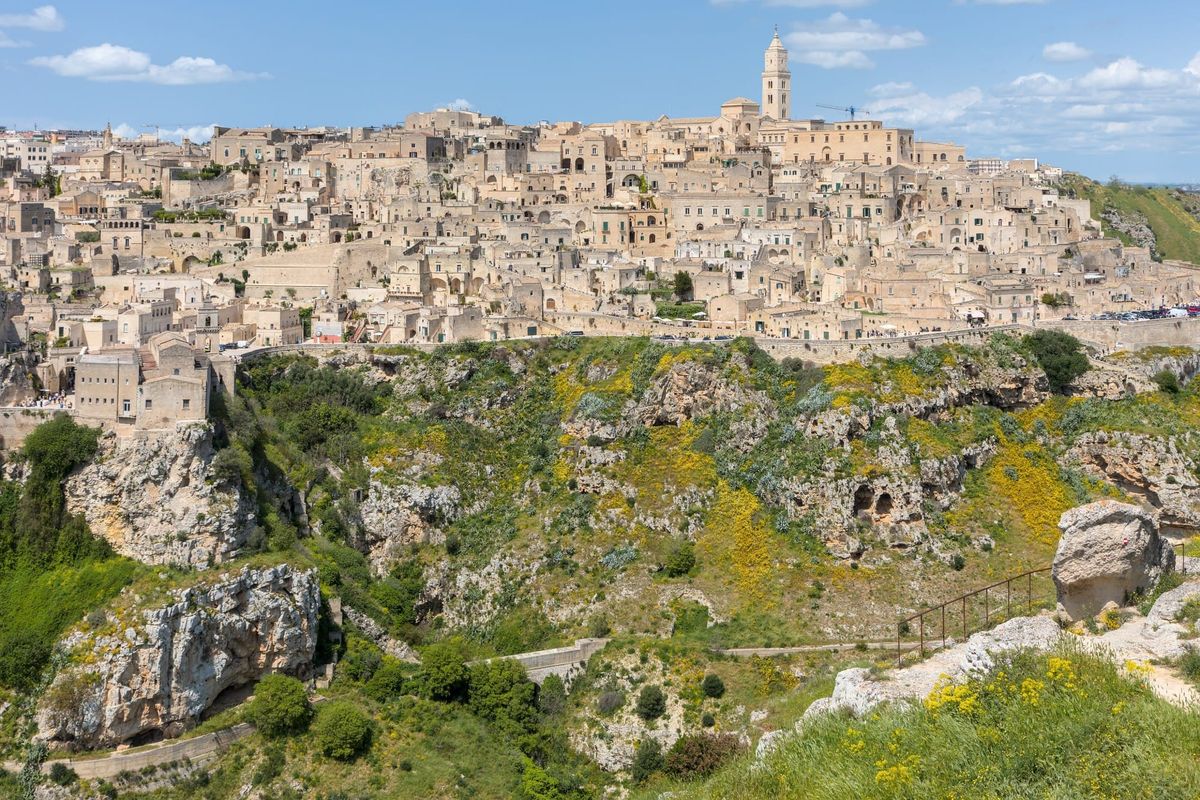
Luisa Levi arrived in Matera at about eleven in the morning. She was a doctor, on her way to visit her brother Carlo, whom the regime had sent into internal exile in a village in Lucania. Her guidebook said Matera was picturesque and worth a visit, with a museum of ancient art and some curious dwellings cut into the rock. A short walk from the station she came to a road with houses on one side and a sheer drop on the other. "In that precipice is Matera," she told her brother. Below her opened two half-funnels side by side, split by a spur and joined at the bottom, where a white church, Santa Maria de Idris, seemed to have been driven into the ground. Those funnels are called the Sassi.
Carlo Levi put his sister's account into Christ Stopped at Eboli, the book about his exile in Lucania in 1935 and 1936, published in 1945. It made Matera famous and, at the same time, infamous. Famous because the pages are extraordinary. Infamous because they described families sharing their homes with animals, children sick with malaria, a whole town living underground. Togliatti came to see for himself in 1948, De Gasperi in 1950, and the Sassi became "the national disgrace": who said it first is still argued over. On 17 May 1952 the special law no. 619 ordered the Sassi cleared. Around seventeen thousand people, two thirds of the town, left the caves for the new districts built on the plateau.
The caves emptied. The town fell silent.
Ten thousand years of history in a cubic metre of rock
Before it was a national disgrace. Before it was a UNESCO World Heritage Site. Before Carlo Levi wrote it into history. Matera was already something.
The first traces of people on the Murgia plateau go back to the Palaeolithic: hunters sheltering in the natural caves of the ravine. In the Neolithic the settlements became permanent, villages ringed by ditches, with cisterns for rainwater and pits for grain and for the dead. Domenico Ridola identified thirteen of them around the town, at Murgecchia, Murgia Timone, Trasano, Trasanello and Tirlecchia. Matera is often counted among the oldest continuously inhabited towns in the world.
Ridola was a doctor, later mayor and senator, and a devoted archaeologist. In 1906 he supervised the digging for the new rooms of the Seminary, next to the cathedral, and the history of the town came out layer by layer. Six metres down, the town rebuilt after the barbarian and Saracen raids, with Christian graves cut into the tufa. Deeper, fragments of statues, capitals and columns, and Byzantine coins. Deeper still, the ancient settlement cut into the rock, with sherds of Greek and Roman pottery. At the bottom, ten metres down, fragments from the early Iron Age.
Ten metres of digging, thousands of years, and the same caves all the way down. What Ridola found, and gave to the State, is in the museum that bears his name.
Why here: the rock as an ally
But there is a question that comes before everything else: why here?
The answer is the same one that explains Orvieto, Civita di Bagnoregio, Pitigliano, Sorano, Vitorchiano, every Italian town that grew on a spur of rock or on the lip of a ravine. Defence. Not the abstract defence of military strategy, but the plain, immediate need to survive in country where trouble came from every side: the neighbours, the Saracens, the Lombards, the bands that moved along the drove roads of the transhumance. Rock was the only building material to hand, and it was free. Above all it was an ally: a moat that cost nothing and was hard to climb.
The ravines were lived in from the Palaeolithic, when people hunted, gathered and sheltered in caves. Only in the Neolithic did they settle, start farming and found the first villages near water and good soil. With metals, people moved on again, following their flocks, before coming back to the sides of the ravines, to places that were easy to defend and close to springs.
The canyon of the Gravina offered everything that was needed. On one side the sheer wall protected: no cavalry could ride down into that gorge. On the other there was water, scarce but collectable, and rock soft enough to dig with the tools of the time. The first people on the Civita, the central spur where the cathedral stands today, had the ravine at their backs and a high point from which to watch the horizon.
This logic is not Matera's alone. It built the whole urban landscape of central and southern Italy, that scatter of towns on tufa spurs, cut off from the plateau by natural or dug ditches, with a single gate to watch. At Matera the logic was pushed all the way. The town went into the rock. It dug down instead of building up, and made the canyon itself a place to live.
Not a castrum on a hill. A town inside the wall of a ravine.
That is why the Sassi are unique: they are the most radical answer anyone has given to the problem of defence, which was to disappear into the rock.
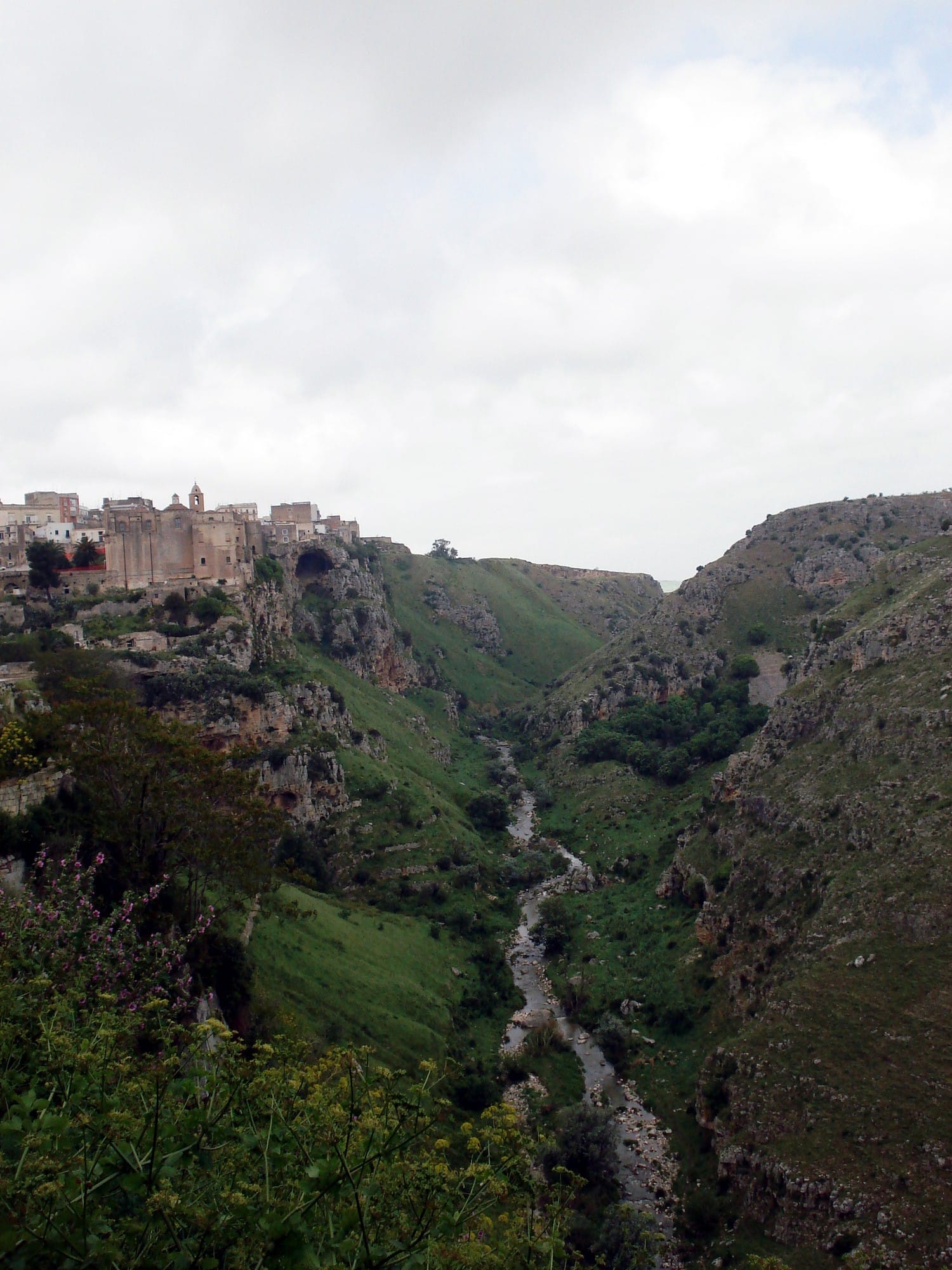
The caves of Matera: what the Sassi really are
Sassi just means stones, but as a place name it means two districts dug into the walls of a double ravine: the Sasso Caveoso to the south and the Sasso Barisano to the north, split by the spur the cathedral stands on. The ravine cuts through the tufa plateau like a wound, with the wild Murgia on the far bank.
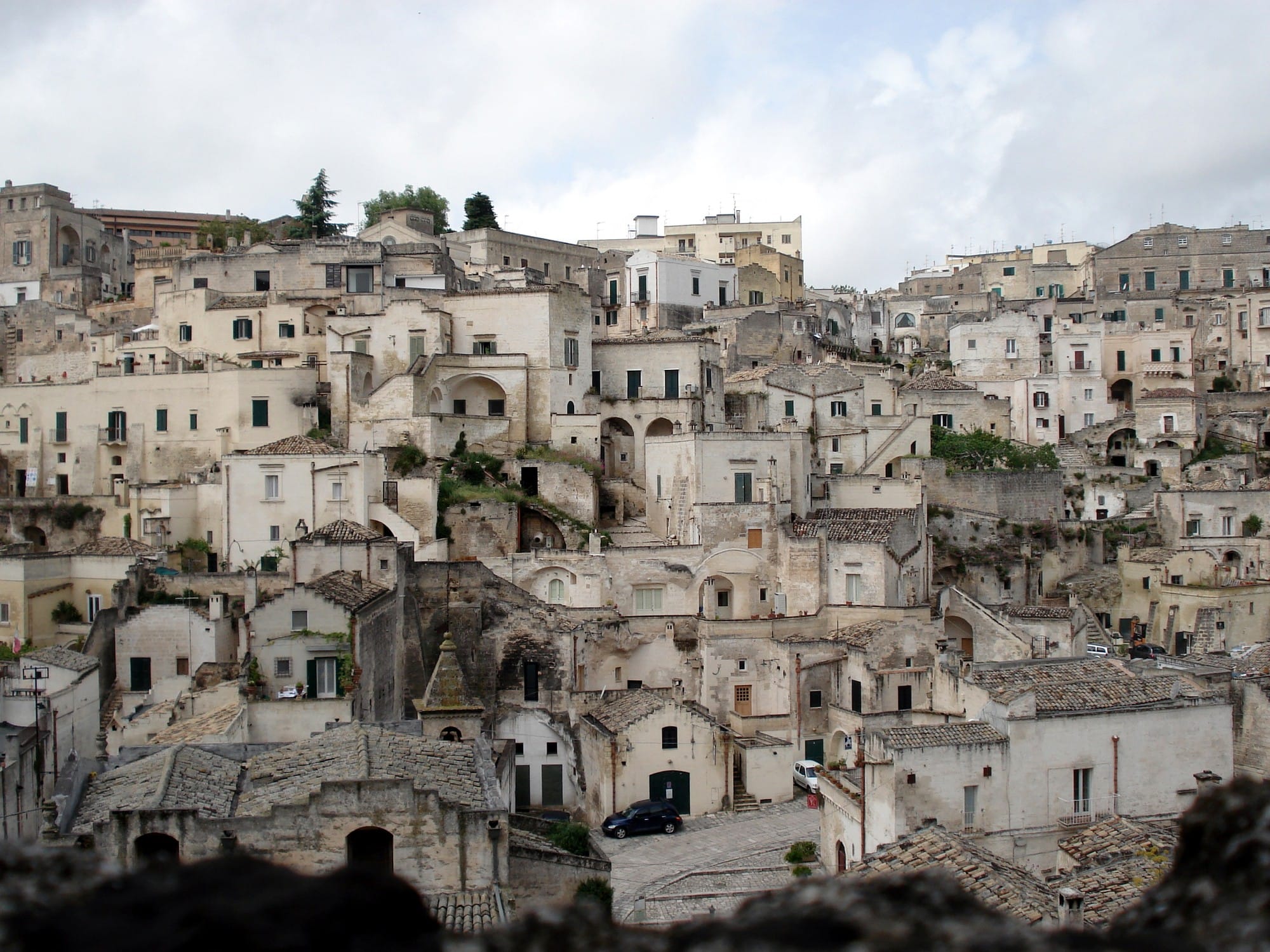
What makes Matera remarkable as architecture is the vertical order of the town. The Sassi are not a slum that ended up in a gorge by accident. They are a refined way of living that grew over millennia, layer on layer, each generation digging deeper into the rock or building on top of what was already there. Streets are also roofs. Doorsteps open onto the terraces of the houses below. Water was gathered in a tangle of cisterns, channels and underground tanks.
What looks like chaos from the plateau is a town with a precise inner logic, and you can only read it once you go down into it.
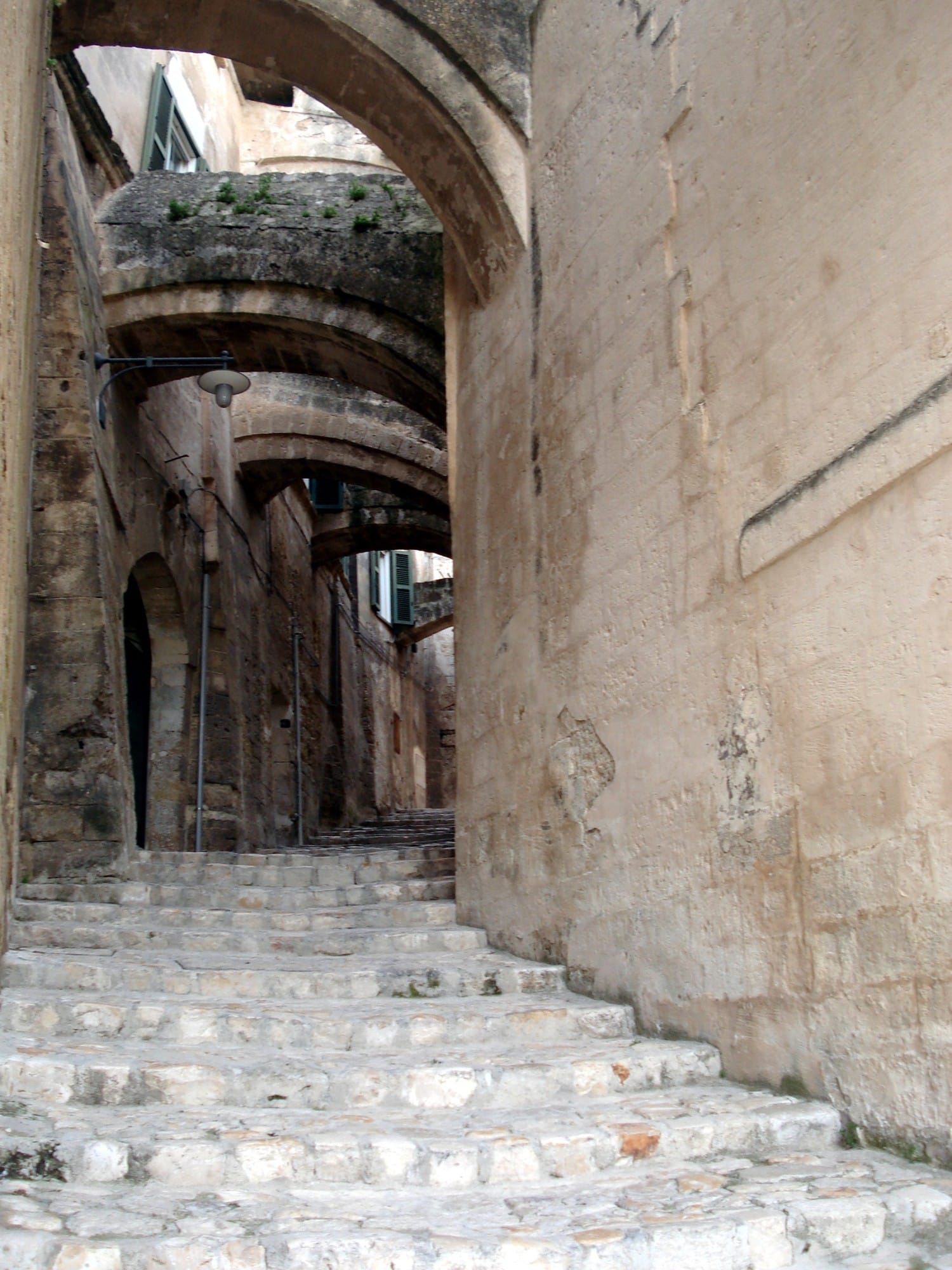
The architecture of the Sassi: how to read the town
To understand the Sassi, looking down on them is not enough. You need to know what you are looking at.
The first thing a careful eye notices is that there is no clear line between building and rock. The houses do not stand on the hill; they come out of it. Outer walls are often the rock itself, rendered or left bare. Roofs are often the floor of the lane above. Nothing separates architecture from geology: the Sassi are the point where the two become the same thing.
There are three kinds of building. True caves, dug entirely into the rock, a single room for sleeping, cooking, keeping animals and storing food. Mixed houses, part dug and part built, with a tufa wall in front of the opening that adds room and light. And masonry buildings set against the walls of the ravine, on platforms of rock already shaped by earlier generations.
The result is a town where nothing is left to chance. The cisterns are linked by channels cut in the rock, so rainwater was caught, filtered and sent down to the lowest houses. The vicinati, courtyards closed on three sides that are the basic unit of living in the Sassi, were made for sharing resources and keeping an eye on one another: a form of community we would now call cohousing. The density was extreme and life was very hard, but the system had a logic of its own, and it held a town together for millennia.
Seen this way, the Sassi stop being a picturesque oddity. They are a clever answer to a hard problem, built with the materials there were, in country that did not forgive mistakes.
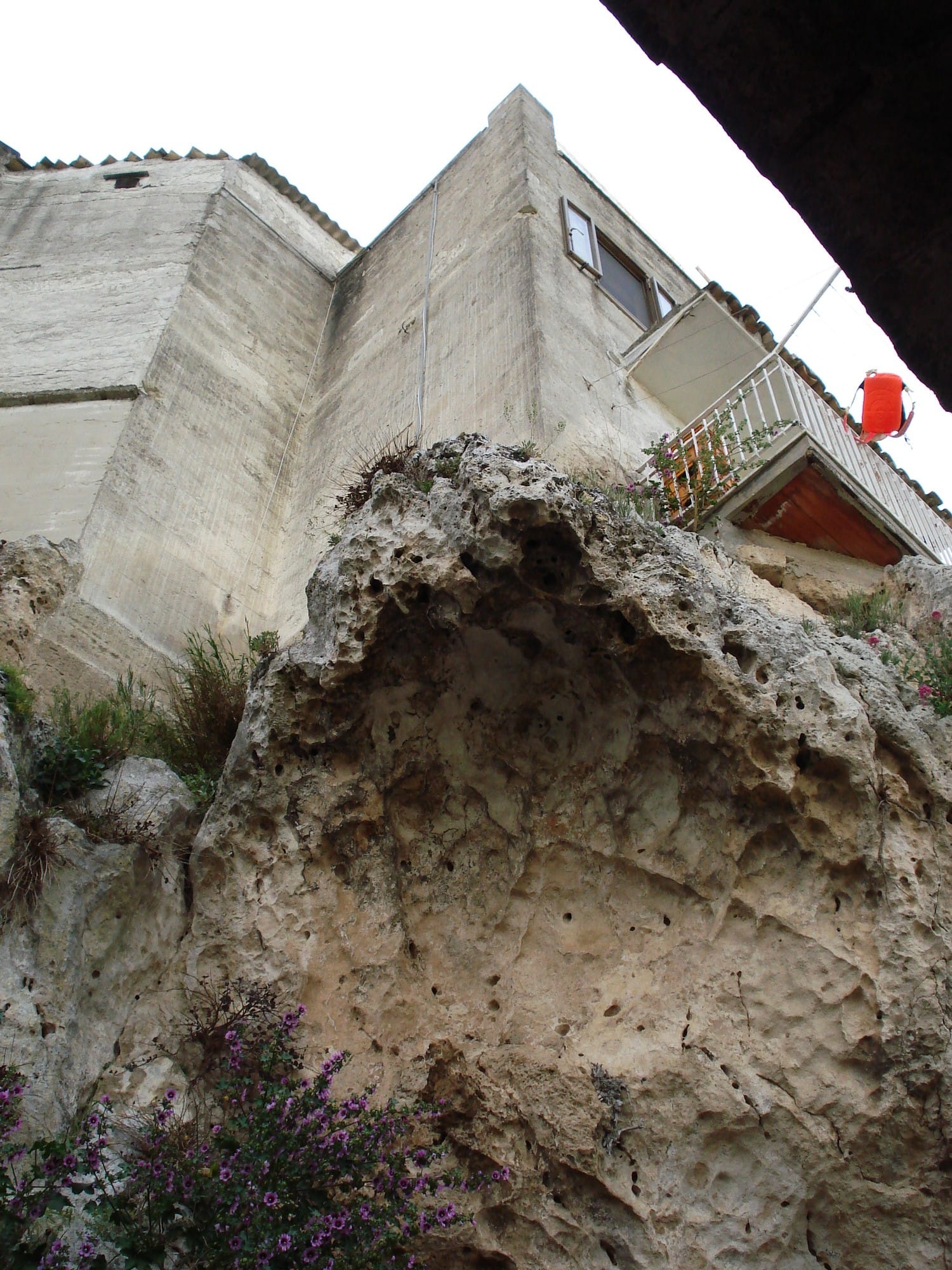
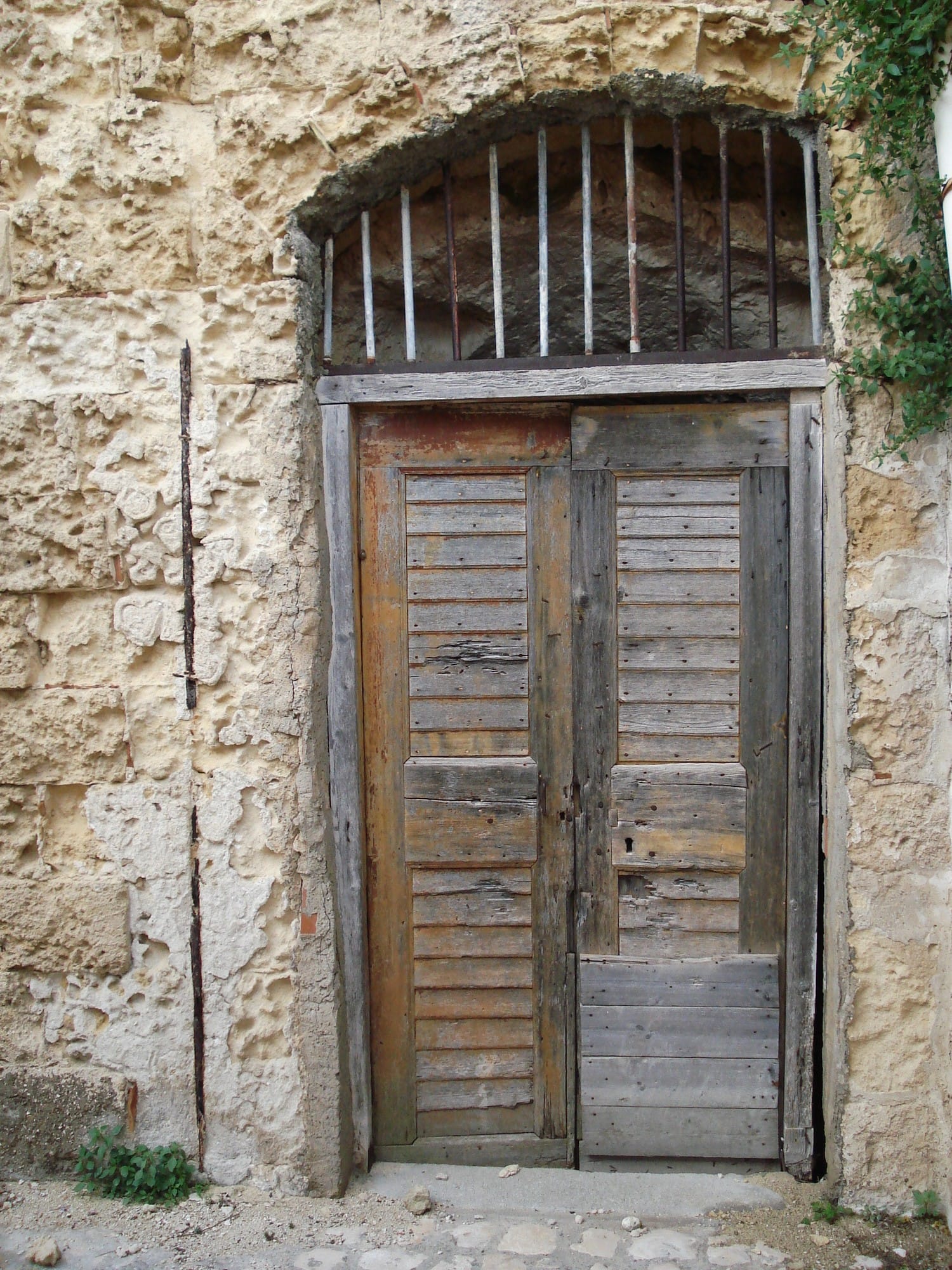
Going down: what to see in the Sassi
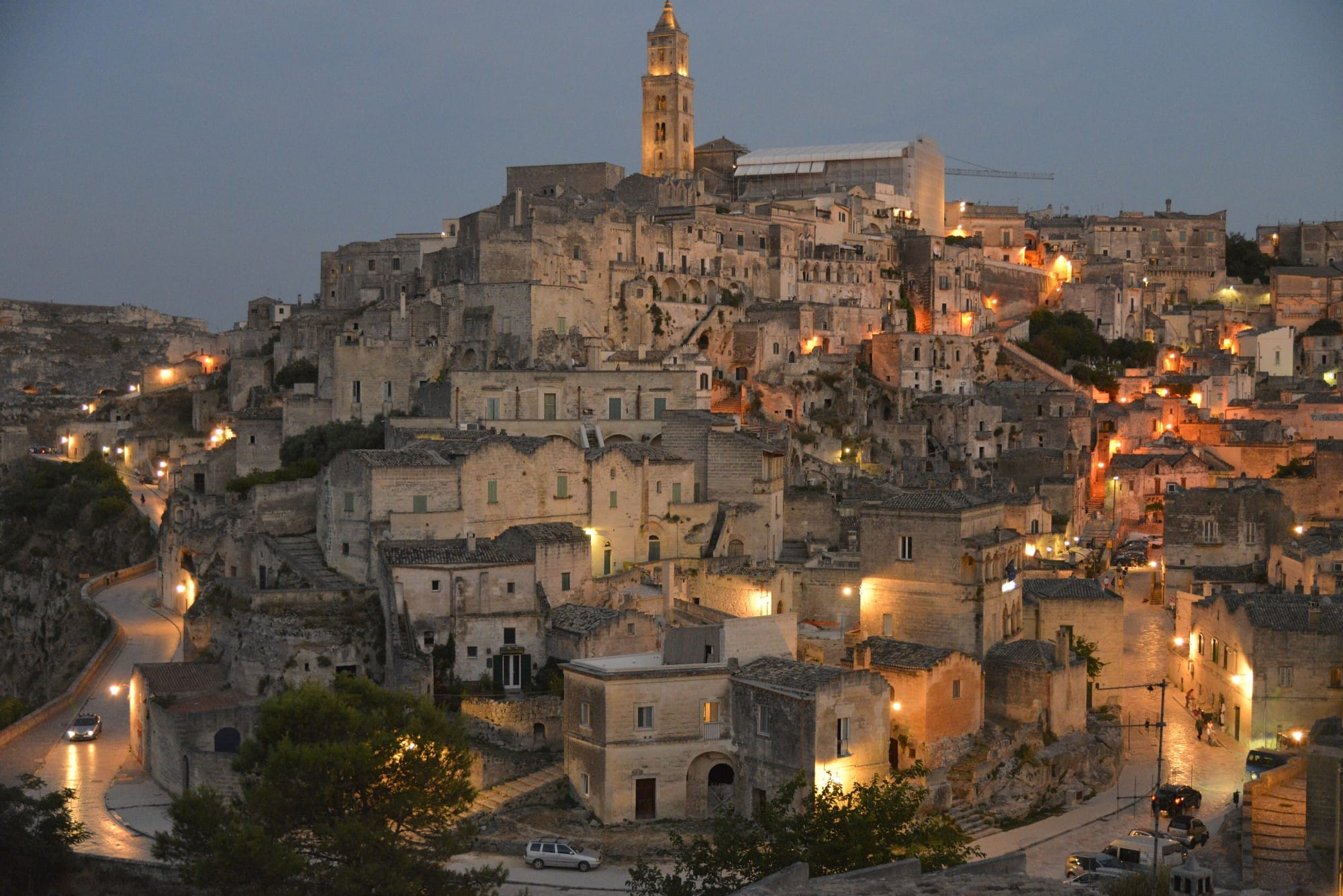
The right way to arrive in Matera is on foot, from the belvedere above the Sasso Caveoso. Don't park in the Sassi. Don't arrive by taxi at your hotel door. Walk to the edge of the plateau and look down.
From up there the scale of the thing hits you: the whole town pouring down the walls of the ravine, bell towers and rock churches lodged in the stone, the gorge dropping to the torrent, and on the other bank the bare, ancient emptiness of the Murgia, with rock churches dug into its face by the religious communities that settled between the Gravina and the Murgia in the Middle Ages, from Benedictines to monks of the Greek rite.
Then you go down. The streets narrow. The light changes. The stone, a cream tufa that soaks up heat by day and gives it back at night, changes colour with the hours. At noon it is nearly white. At sunset it turns amber, then ochre, then the colour of old honey.
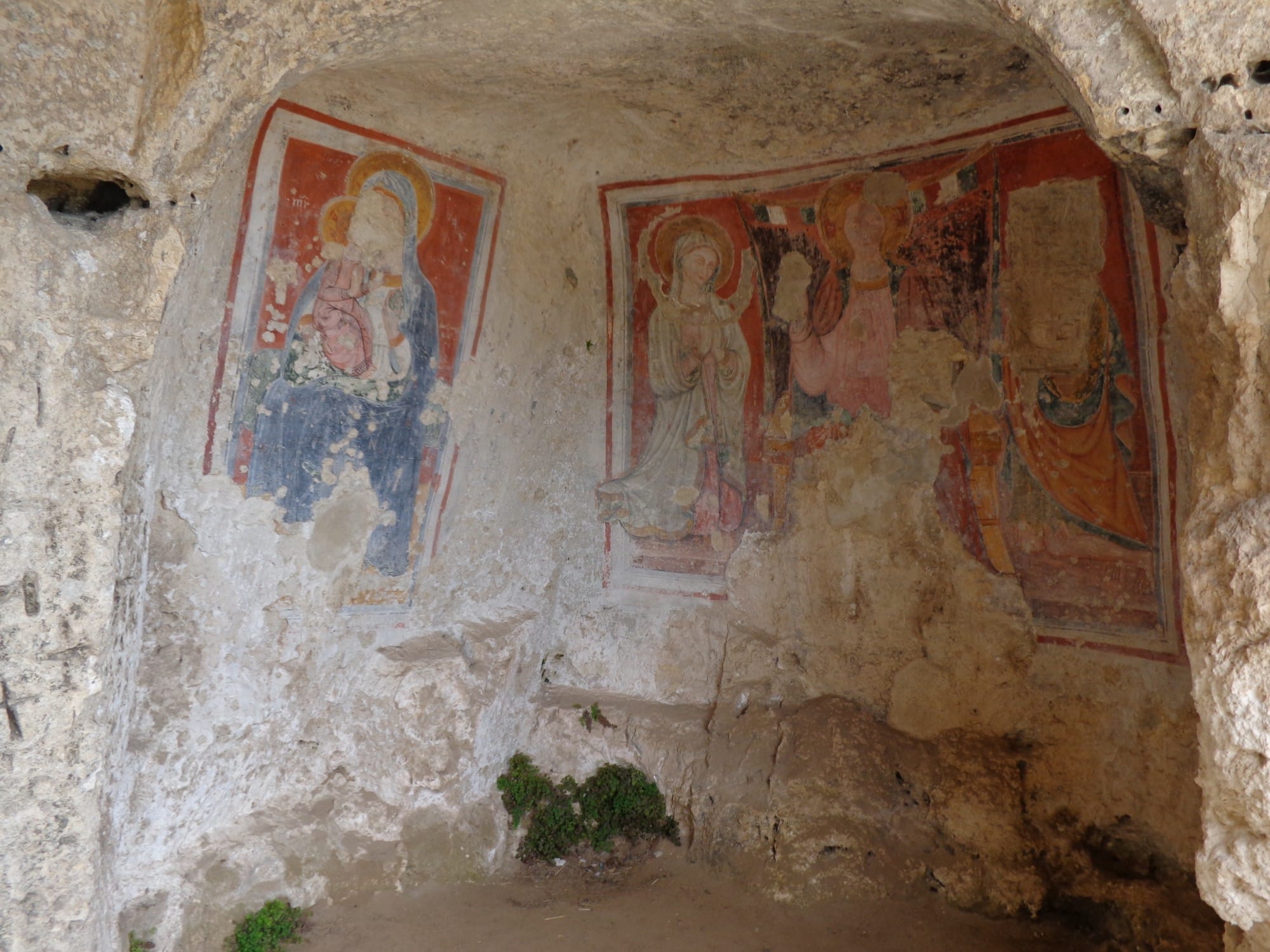
Santa Maria de Idris clings to the Monterrone, the rock in the middle of the Sasso Caveoso, and it is one of the strongest images in Matera: a building that looks extracted from the rock rather than built. A tunnel joins it to the crypt of San Giovanni in Monterrone, where frescoes from the twelfth to the seventeenth century survive on the walls, faded but still legible, still surprising. Matera's rock churches are not ruins. Many were used for centuries, and abandoned only when the cave dwellers were moved out.
A little lower down, along Via Madonna delle Virtù, San Pietro Barisano is the largest rock church in town: three naves dug into the tufa, burial niches open in the walls, and a light that changes completely through the day.
The cathedral, on the edge of the spur between the two Sassi, is Apulian Romanesque, built between 1230 and 1270. It stands where it always stood: the highest point, visible from every corner of the Sassi, made to look out and to be looked at.
If you want to understand how people actually lived here, go to the Casa Grotta di Vico Solitario: a lived-in cave faithfully put back together, with furniture, tools and terracotta animals that remind you that people, goats and hens shared the same room. It is not folklore. It is history lived two generations ago.
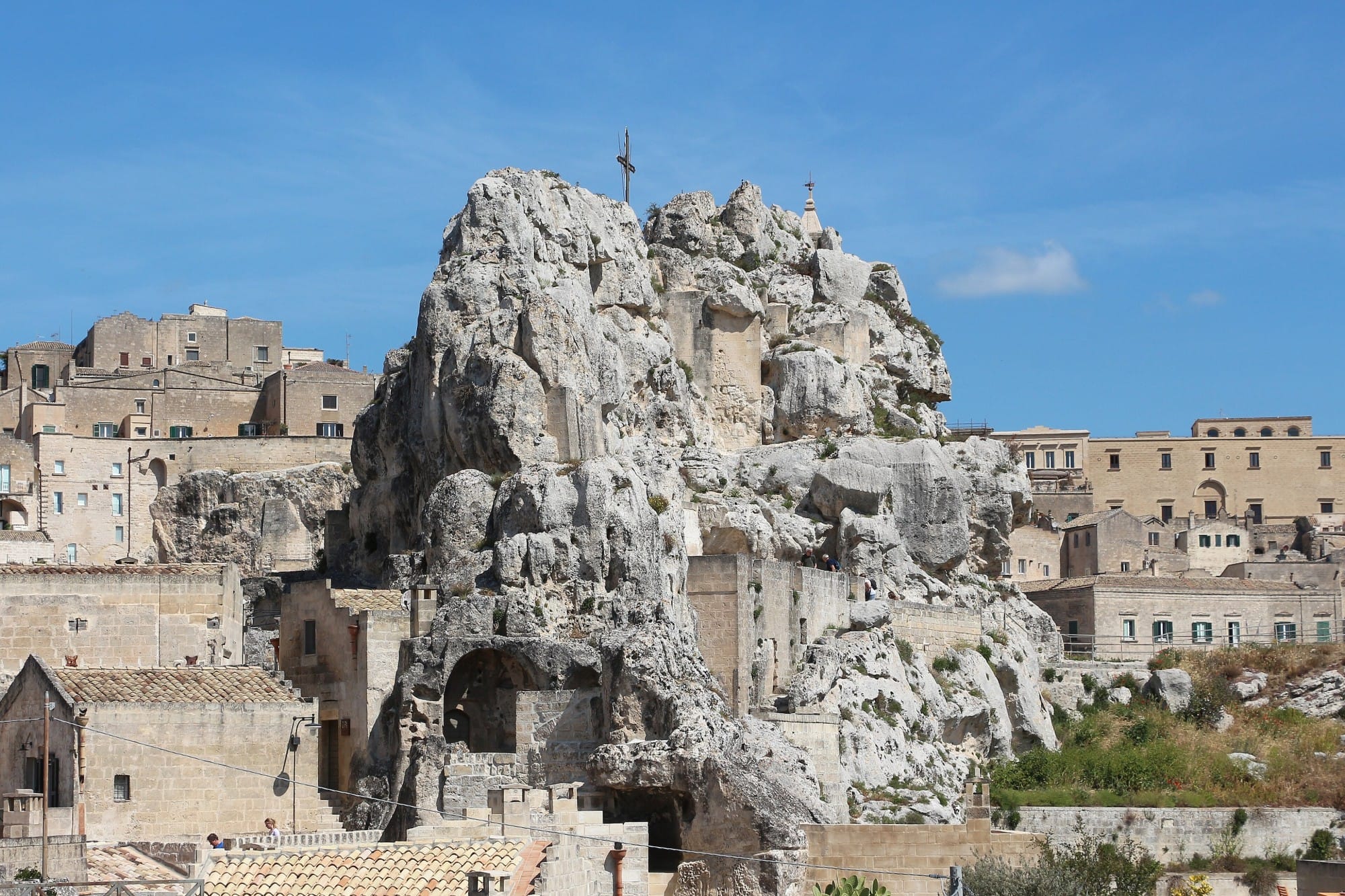
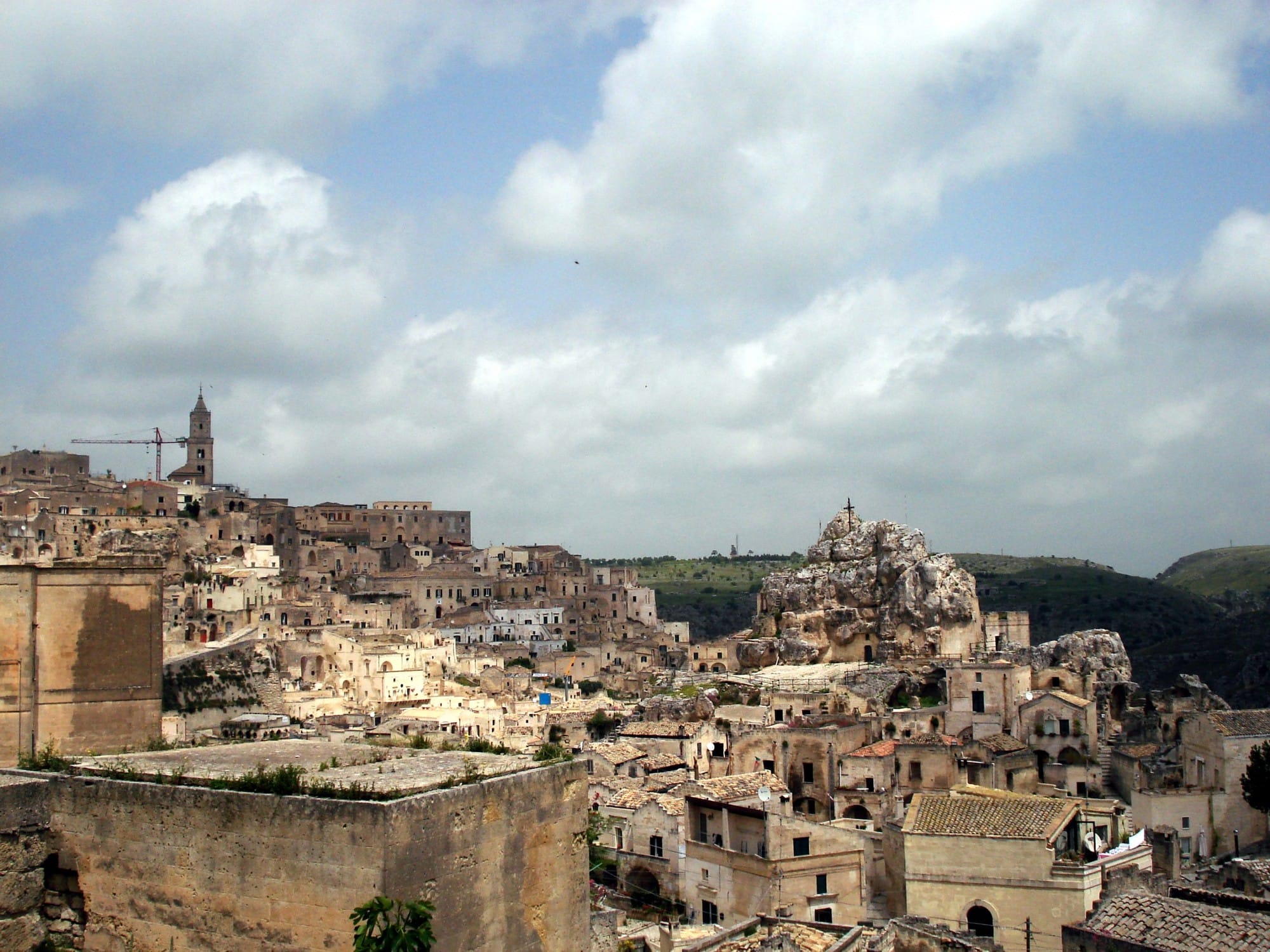
Into the Gravina: the other side of the canyon
What many visitors skip is crossing to the other side.
From the Sasso Caveoso, at Porta Pistola, Trail 406 of the Parco della Murgia Materana drops to a suspension bridge over the Gravina torrent, a walkway slung between the two walls of the canyon, from which the Sassi look like they do from nowhere else. On the far side the trail climbs onto the Murgia Timone plateau, to the rock church of the Madonna delle Tre Porte, with paintings from the thirteenth to the fifteenth century, and a view straight back across the canyon to the Sassi.
There is an older path too, from 1632, that the people of the Sassi used to fetch water in dry spells until the 1920s and 1930s. It goes down to the bottom of the gorge, crosses the torrent between old olive trees and dry-stone walls, and climbs towards the Murgia Timone past what is left of the Madonna di Monteverde, a little church from 1583 with a bell gable that seems to have grown out of the rock.
Seen from the other bank, Matera is a different thing. It is no longer the town you look down on; it is the town that looks at you. The pale fronts of the Sassi throw the light back across the canyon, the cathedral holds the central spur, and the lesser kestrel, the small falcon that is the park's emblem, turns slow circles over the plateau.
The park runs walks with licensed guides from the Jazzo Gattini visitor centre. The trails are steep: walking boots, at least two and a half hours for the basic route, and a start early enough to be back before dark.
Matera bread: the ovens and the stamps
There is a story of Matera that has nothing to do with rock churches or design hotels, and everything to do with bread.
The old town baked in shared ovens, many of them dug wholly or partly into the rock. Families made their dough at home and carried it to the oven on long wooden boards wrapped in cloth. The baker's boy made the rounds of the lanes, collecting the loaves and balancing them on his shoulder.
Because the ovens were shared, every family needed a way to tell its bread from all the others baked alongside it. The answer was the stamp: a wooden seal pressed into the raw dough before it went in. Each family had its own, carved by shepherds, or by farmers who kept a few sheep and goats and lived half a shepherd's life.
The stamps were also a mirror of standing. Simple families had a simply carved piece of wood; better-off ones ordered more elaborate designs from craftsmen. The commonest figure was the cockerel, an old sign of vitality and fertility found all through popular art.
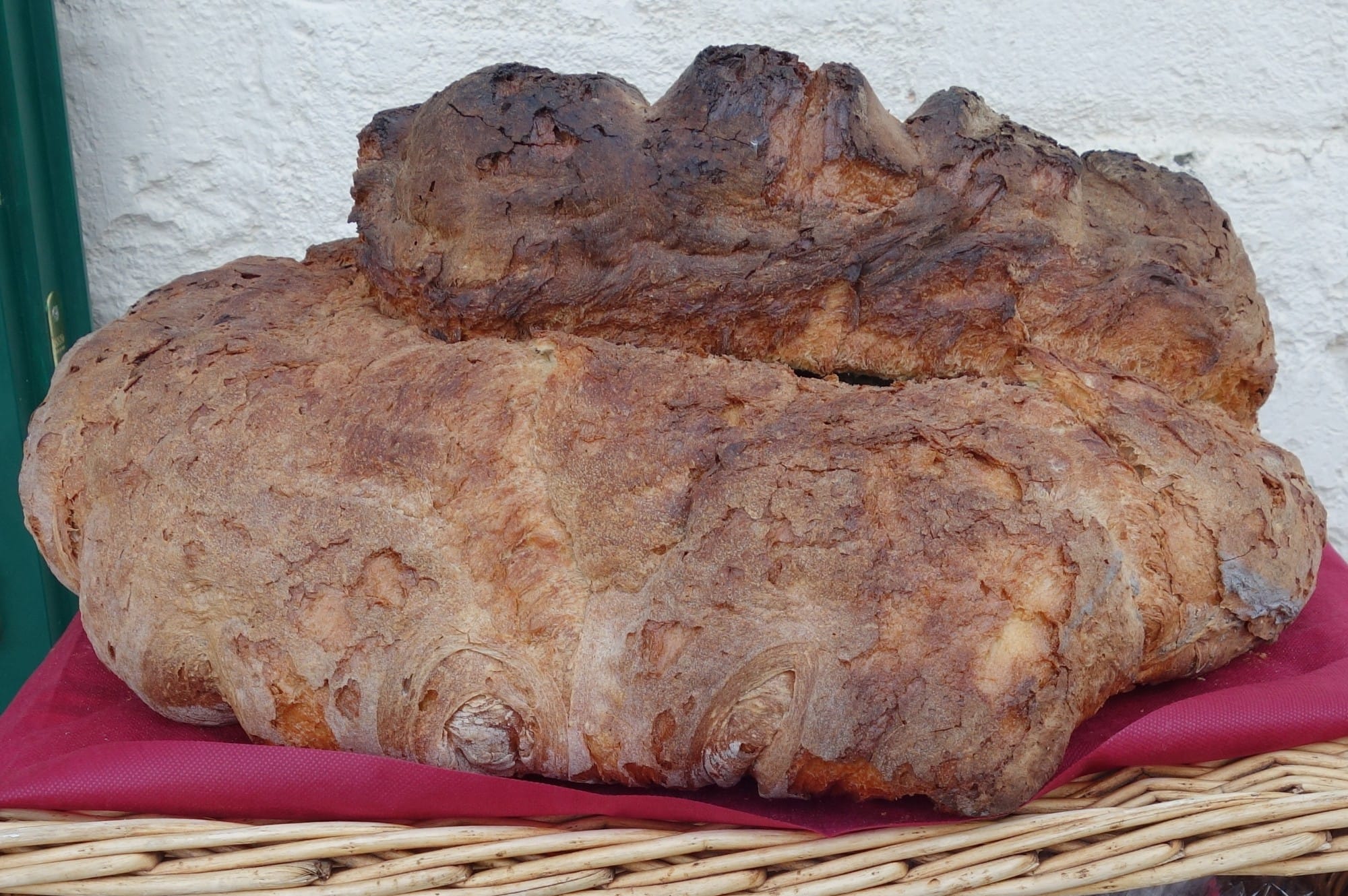
The Museo Ridola holds a collection of more than four hundred of them, most in storage, a few on show. Since 2008 Matera bread has had protected IGP status, and the loaves are marked on top with a pressure stamp bearing the letters MT.
Before you leave, find a bakery in the Sassi and buy a loaf. Pane di Matera comes in a cornetto or a tall shape, at one or two kilos, made with twice-milled durum wheat semolina, and it keeps for a long time; approach the crust with respect. It is not a souvenir. It is the one thing from that world that is still made much as it was.
Jerusalem, Basilicata: the town cinema chose
At the heart of Matera's story there is a paradox worth telling.
On 4 October 1962 Pier Paolo Pasolini was stuck in a guest room in Assisi, during the visit of Pope John XXIII. To pass the time he picked up the Gospels and read Matthew straight through, like a novel. By the end, the idea of making a film of it had pushed every other project out of his head. He went to the Holy Land to look for locations and found them no use: too modern, too changed to play the time of Christ. He came back to Italy and chose the Sassi of Matera.
The film was The Gospel According to St Matthew, 1964. Pasolini followed Matthew's text almost word for word, with non-professional actors: peasants, labourers, shopkeepers, and a few writer friends. To play Mary in old age he cast his own mother. For the homes of Mary and Joseph he used the real dwellings of the Sassi. The film won the Special Jury Prize at Venice.
A Marxist atheist had made what many still think the most convincing film ever made about Christ, using as Jerusalem a town in the south that Italy had branded a national disgrace not long before.
Forty years later Mel Gibson shot The Passion of the Christ in the same places: the same canyon, the same stone.
The point is not the film trivia. The point is why. Why did two such different directors, a Marxist atheist and a traditionalist Catholic, choose the same place to tell the same story? Because Matera looks more like Jerusalem than Jerusalem now looks like itself. The cream limestone. The light that changes the colour of the rock through the day. The town dug into the walls of a canyon. The absence of anything modern in the Sassi, which in Pasolini's day was not an aesthetic choice but a fact of life.
After Pasolini and Gibson, Matera appeared in the 2006 remake of The Omen, was Jerusalem again in the 2016 Ben-Hur, a location in Wonder Woman in 2017, and a stop for James Bond in No Time to Die in 2021. Pasolini had found, in the place the State had emptied, the Jerusalem he was looking for.
The irony is perfect: the disgrace was the truth.
Who lived here, and who sleeps here now
In 1993 the Sassi and the Park of the Rupestrian Churches became a UNESCO World Heritage Site. In 2019 Matera was European Capital of Culture. Today the caves are cave hotels, a Michelin-starred restaurant, art galleries.
It is worth stopping on this change, because it is uncomfortable and deserves to be looked at straight.
The families who lived in those same caves in 1952 had one room for sleeping, eating, keeping animals and storing grain. Water came from the rain. Bread was kneaded at home and carried to the neighbourhood oven on a wooden board. It was not picturesque. It was very hard.
Today the same caves offer four-poster beds, baths cut into the rock and breakfasts with a view over the Sassi. The experience is real and often beautiful. But it is the reverse of what the people before lived: theirs was necessity.
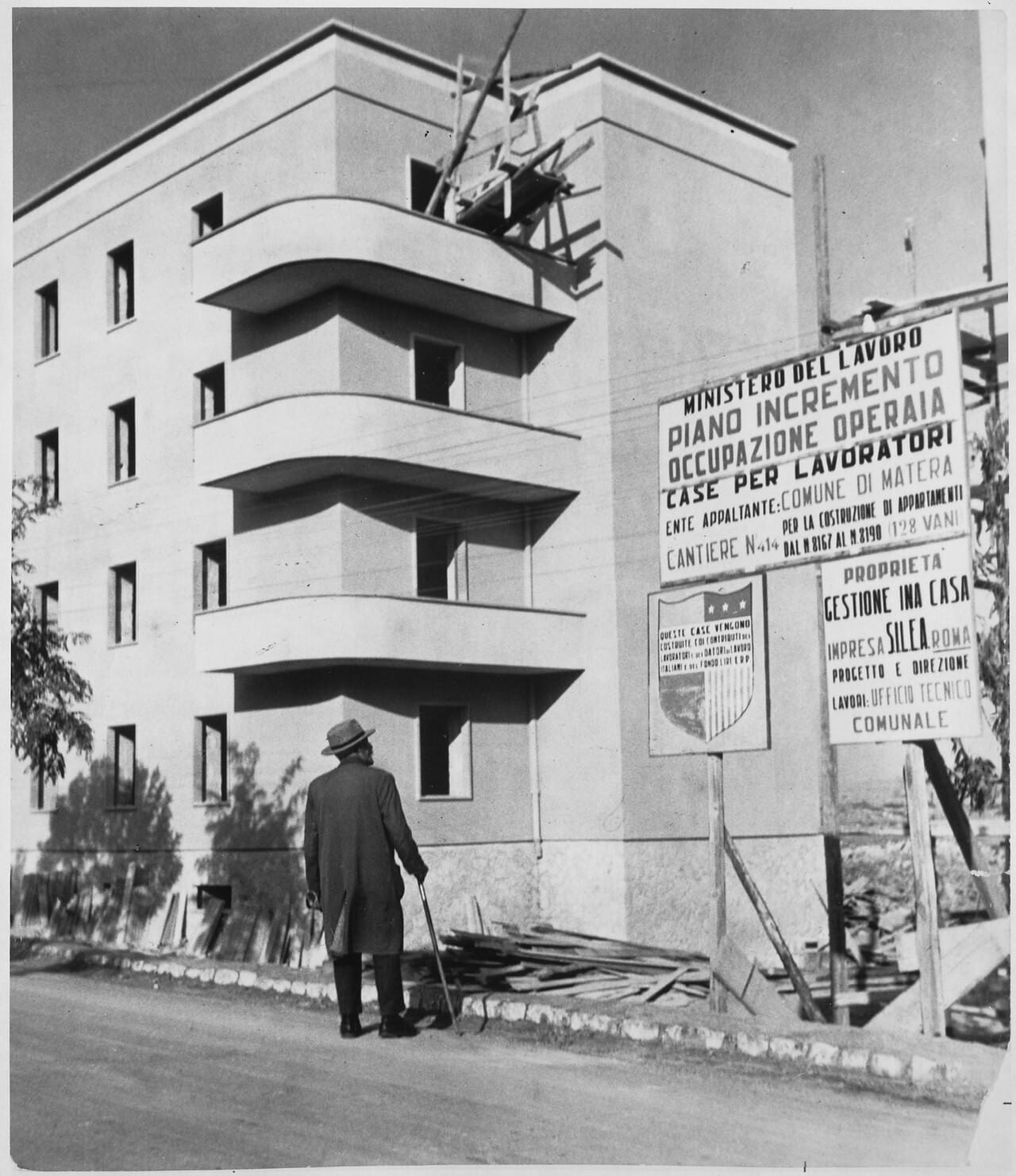
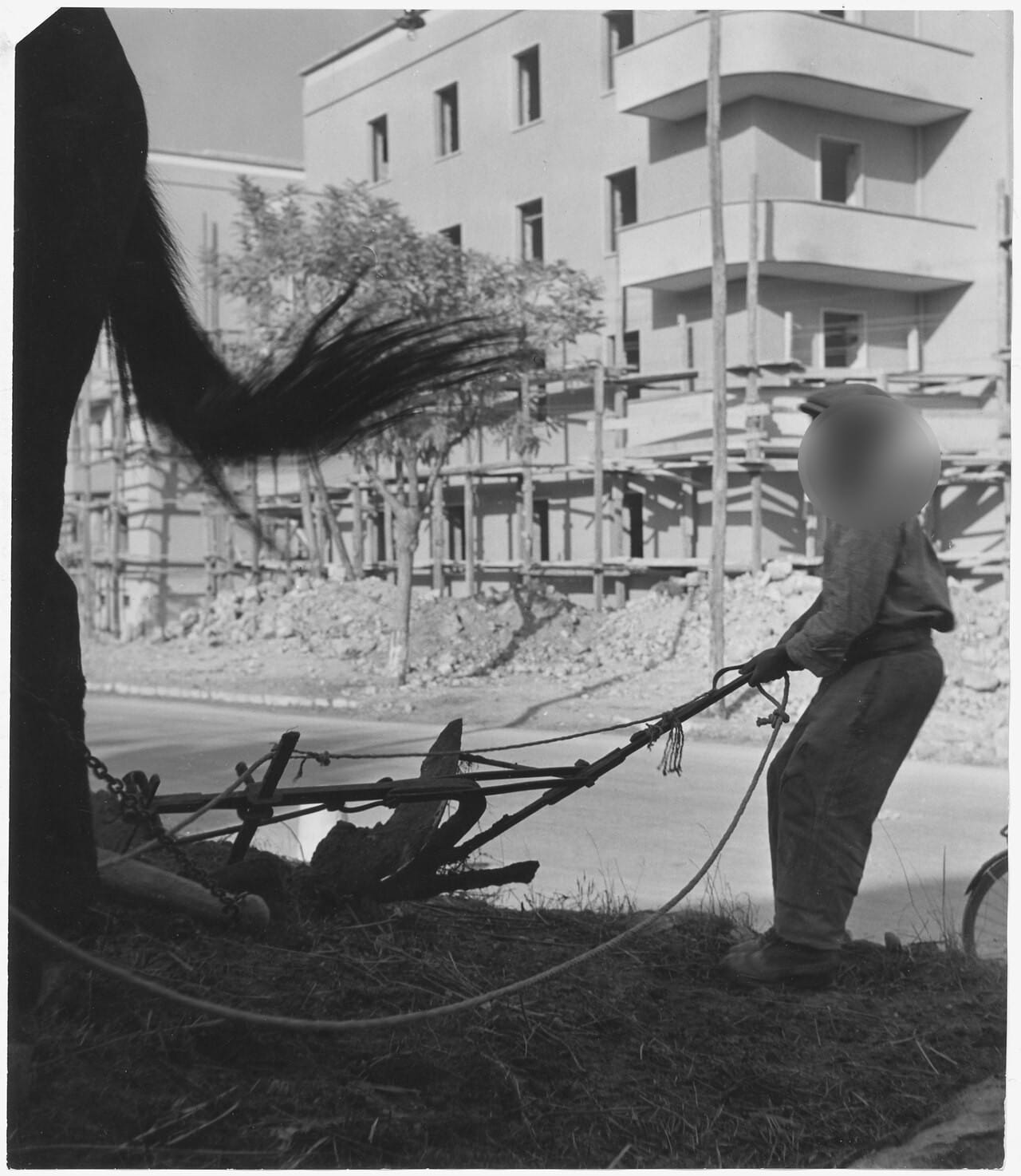
Even then the new houses were not for everyone. An American caption of the time, under a photograph of the first blocks going up, says they were for working people, and too dear for the cave dwellers. Most of the families moved out in the 1950s never came back. Their children and grandchildren live on the plateau, in the new town, and every morning they watch the tourists go down into the neighbourhood their grandparents called home.
The history of what we call beauty in buildings is often the history of who gets to decide, and of who pays for the decision.
Before you leave
From the belvedere above the Sasso Caveoso you can see the rock churches dug into the face of the Murgia on the far bank. If you have half a day more, spend it over there: the Parco della Murgia Materana runs walks across the gorge and into the bare, wild country opposite. Wear walking boots.
If you have a spare day, drive about fifty kilometres to Craco, a medieval village abandoned after the 1963 landslide, where Mel Gibson filmed Judas hanging himself for The Passion of the Christ. It is one of the most unsettling and most beautiful places in Basilicata.
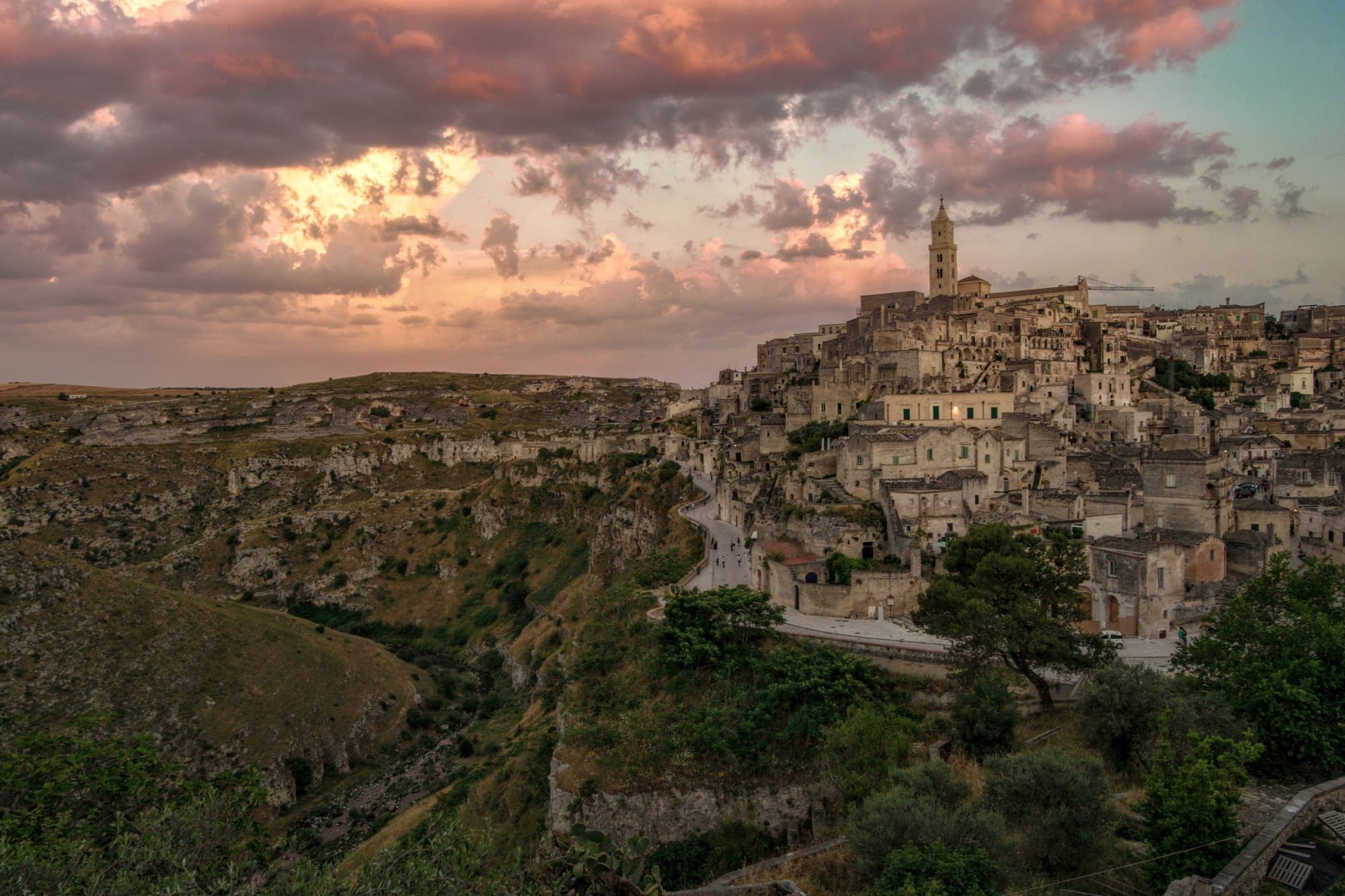


Four more views. From the top left: the cathedral seen through an arch on a terrace in the Sassi; San Pietro Caveoso, one of the few churches in the Sassi built rather than dug, with its seventeenth-century front, above the Gravina; its bell tower below the Idris rock at sunset; the Sassi at dusk, framed by the mouth of a cave. Photos: Piermario Eva, Kamil Klyta, Valerio Giannattasio and Luca Micheli, via Unsplash.
How to visit
Matera is walked, not driven: leave the car on the plateau above the Sassi and go down on foot. Santa Maria de Idris, San Pietro Barisano and the Casa Grotta di Vico Solitario charge for entry; check the combined tickets before you go. The cathedral is free, and the Museo Ridola is a real surprise. Since 2026 access to the Murgia Timone and Trail 406 has been regulated, with a ticket office: check the park's website before you set off, and wear walking boots. Avoid July and August, when the stone multiplies the heat and the town multiplies the crowds. Spring and October are the time: the light is extraordinary and the Sassi breathe.