HOW WERE ROMAN ROADS BUILT?
Every book answers with four layers and four Latin names. The names come from a recipe for floors. What the Romans actually did was simpler, and smarter.

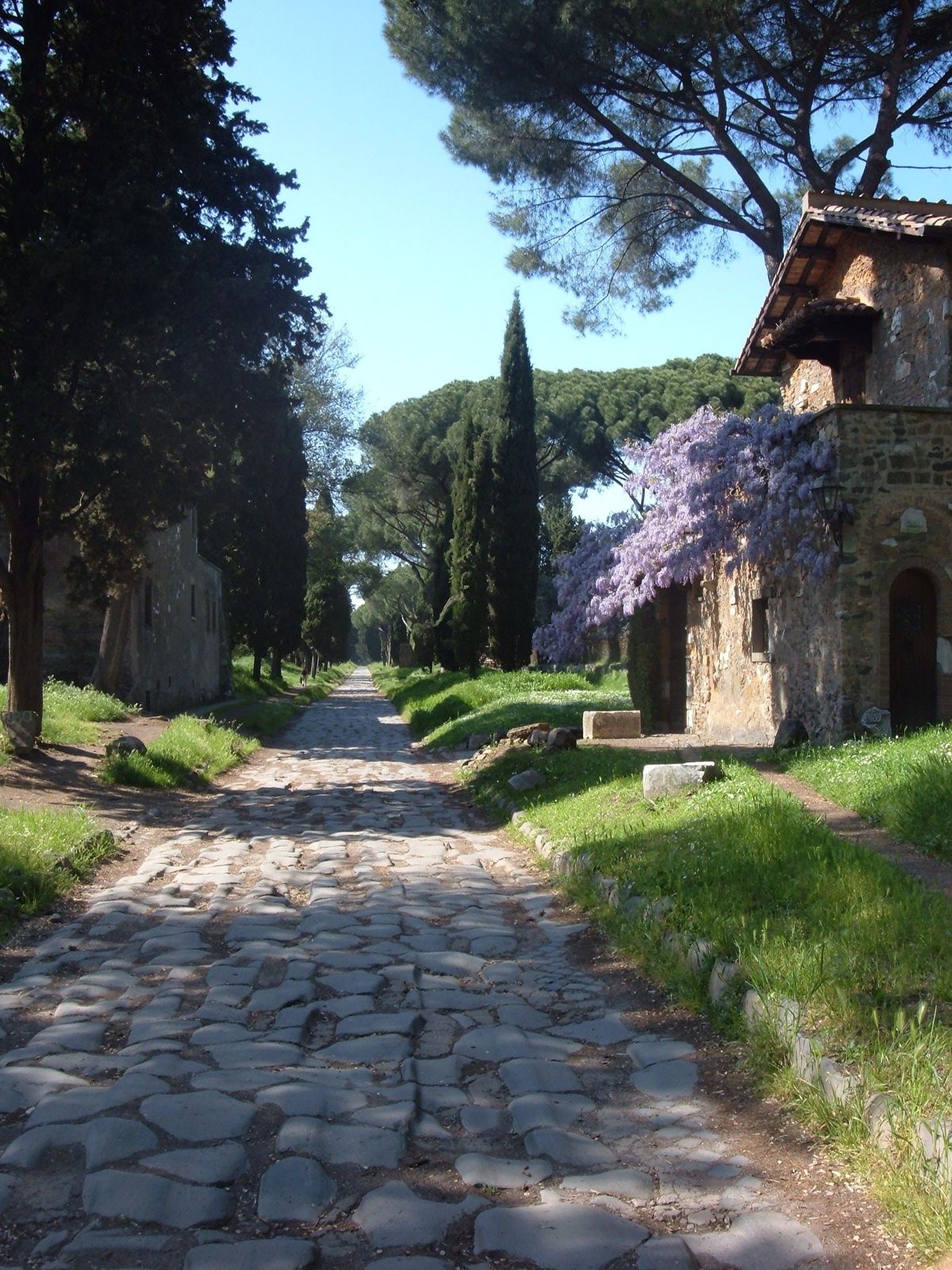
The short answer. Roman roads were built from the ground up, and from the water out. Surveyors laid out the line; workers dug a trench down to firm ground, filled it with compacted stone, gravel or earth, and finished it with a crowned surface that shed the rain into ditches on either side. Most roads were surfaced with gravel. The important ones, near cities, got fitted polygonal blocks of the hardest local stone. What made them last was not a secret recipe. It was a firm bed, good drainage and constant repair.
That is the honest short answer. The one you find in most books is tidier, and partly wrong.
The textbook answer
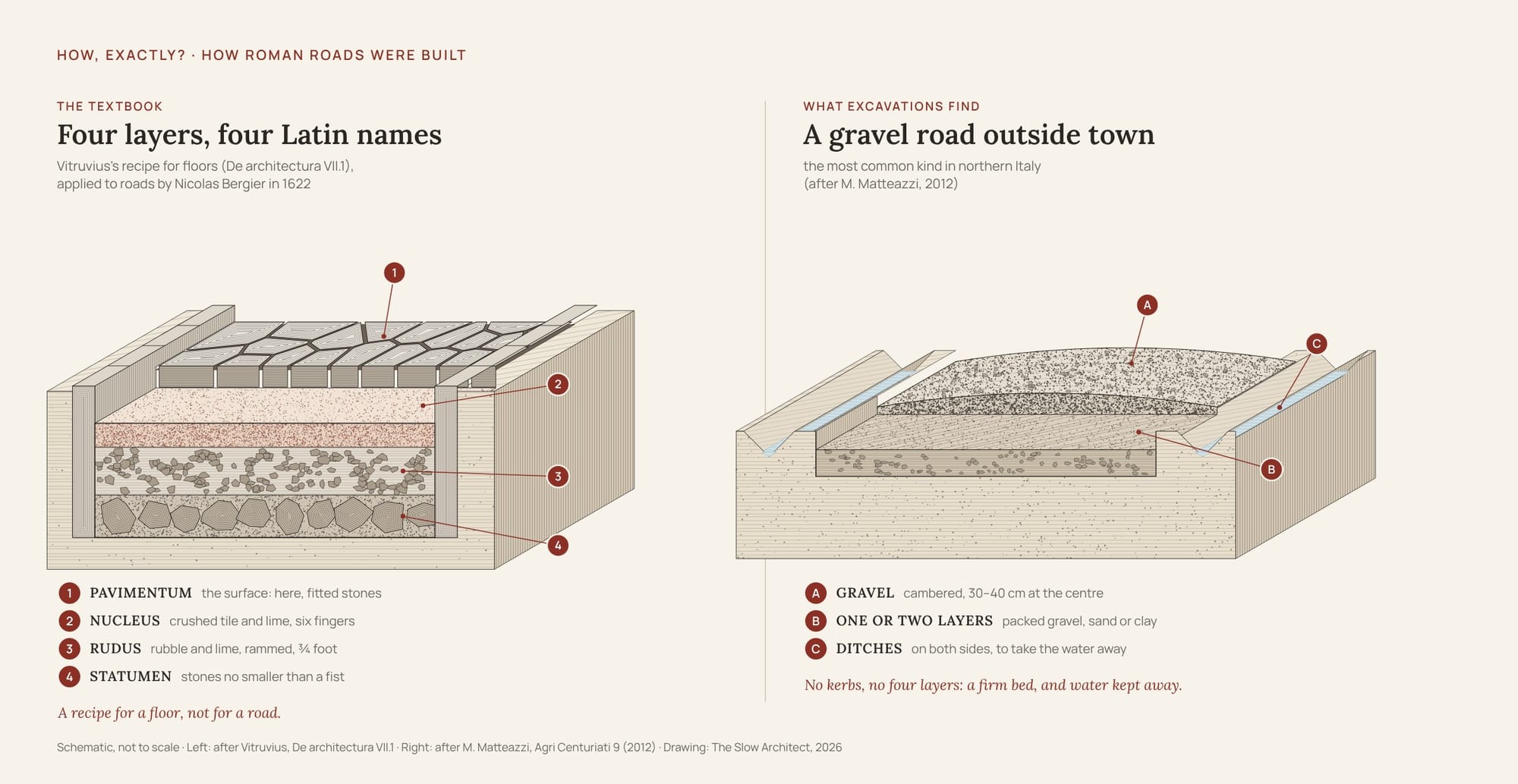
Open almost any book on Roman engineering and you will find the same cross-section: four layers with four Latin names. At the bottom the statumen, a bed of large stones. Above it the rudus, rubble bound with lime. Then the nucleus, a finer layer. On top the pavimentum, the paving. It is clear, it is easy to draw, and it is everywhere.
Where the four layers come from
The names are real, and they are Roman. They come from Vitruvius, the only Roman architect whose treatise has survived. But they do not come from a chapter on roads.
In the seventh book of De architectura, Vitruvius explains how to lay a floor. First a bed of stones, none smaller than a fist. Then rubble mixed with lime, rammed down until it is at least three quarters of a foot thick. Then a layer of crushed tile and lime, six fingers deep. Finally the floor itself, slabs or mosaic, laid true and level. It is a recipe for a room.
In 1622 Nicolas Bergier, a lawyer from Reims, published a monumental history of the great roads of the Roman Empire, and read that passage as if it described a road. The idea stuck, partly because ancient texts on road-building are almost non-existent, and partly because for a long time nobody dug carefully through a Roman road to check.

What a Roman actually wrote
The only ancient text that describes the building of a road step by step is a poem. Around AD 95 Statius celebrated the Via Domitiana, the new road the emperor Domitian had built along the coast north of Naples, from the Appian Way at Sinuessa down to Pozzuoli. He lists the work in order. First, mark out the line with furrows and dig the earth out deep. Then fill the trench with other material and build up a bed for the crown of the road, ne nutent sola: so that the ground does not give way, and the stones do not sit on an uncertain bed. Then lock the road with kerbs on either side and wedges driven in close.
He also describes the crowd at work: felling trees, squaring beams, binding stones with lime and tufa, draining marshes, turning streams aside. And he gives the reason for all that effort. A journey that used to take a whole day now took barely two hours.
There are no four layers in Statius. There is a trench, a fill, a crown, kerbs and wedges. Not a recipe: a method.
What the excavations find
Archaeologists who have dug through Roman roads find something less tidy and more intelligent. In northern Italy, the archaeologist Michele Matteazzi brought the excavations together and found that roads outside towns were mostly gravel roads: one or two well-packed layers of gravel, sand or clay in a shallow trench, a gravel surface thirty or forty centimetres thick at the centre, a cambered profile, ditches on both sides and, often, no kerbs at all. Where the ground was wet, the builders improvised: packed amphorae at Parma, clay drains at Rimini, timber foundations near Ferrara. Elsewhere they raised the road on an embankment or cut it into the rock. In the north, paving stones are mostly an urban thing, and mostly from the age of Augustus onwards.
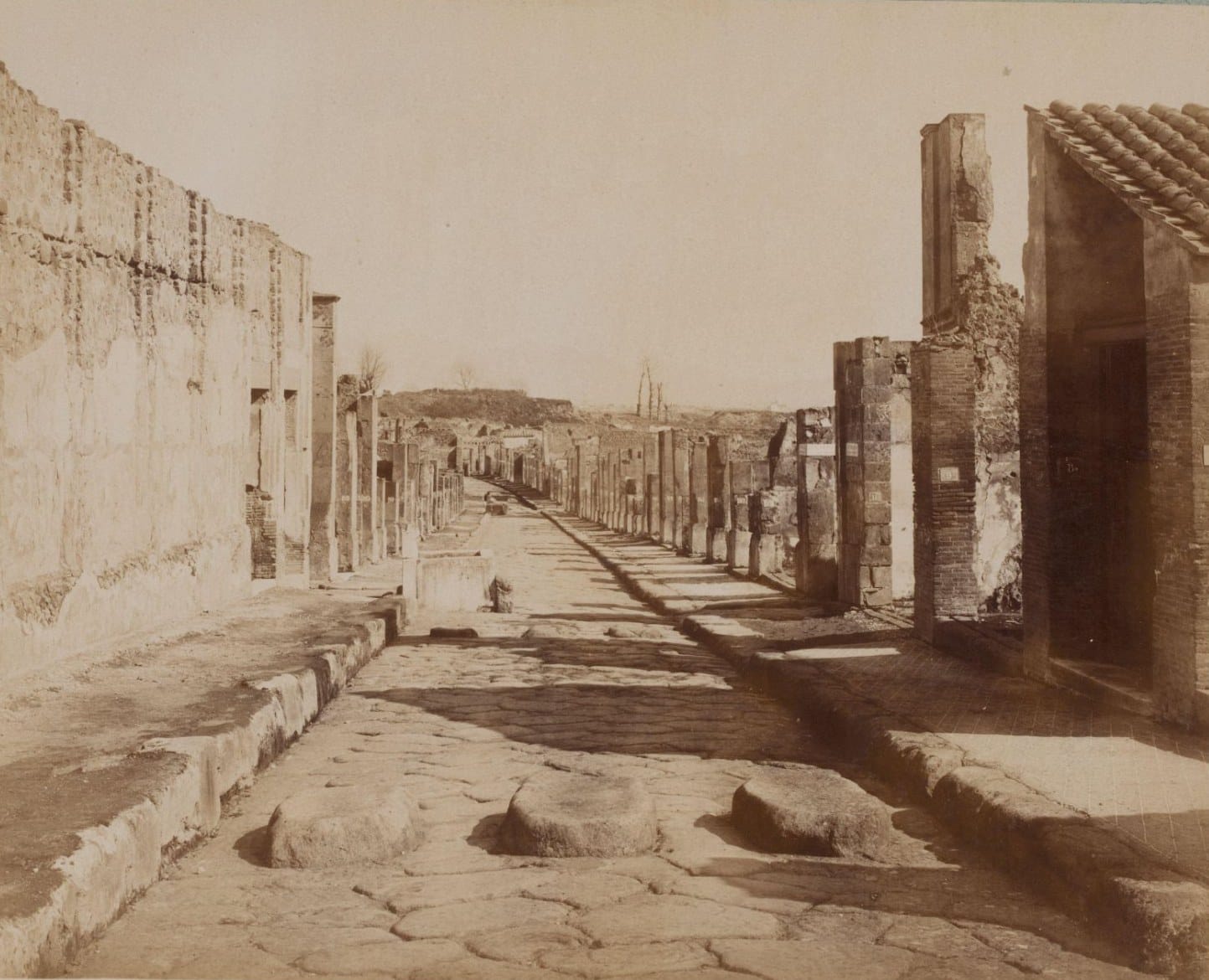
The Romans themselves distinguished between earth roads, gravel roads and roads paved with stone, and the paved ones were the minority. Of the more than 400,000 kilometres of roads usually credited to the Empire, about 80,000 are reckoned to have been paved.
The road built on its own stone
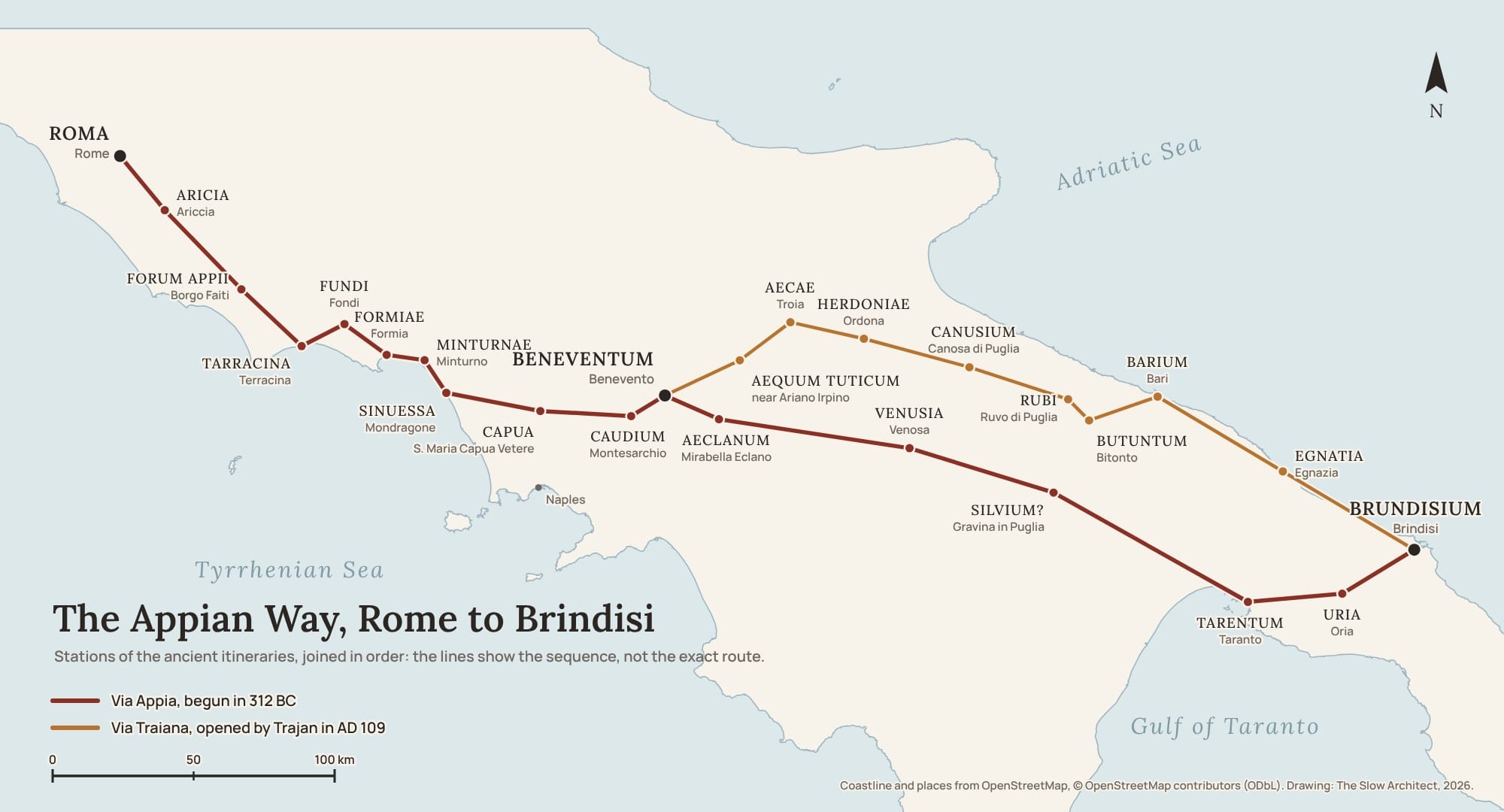
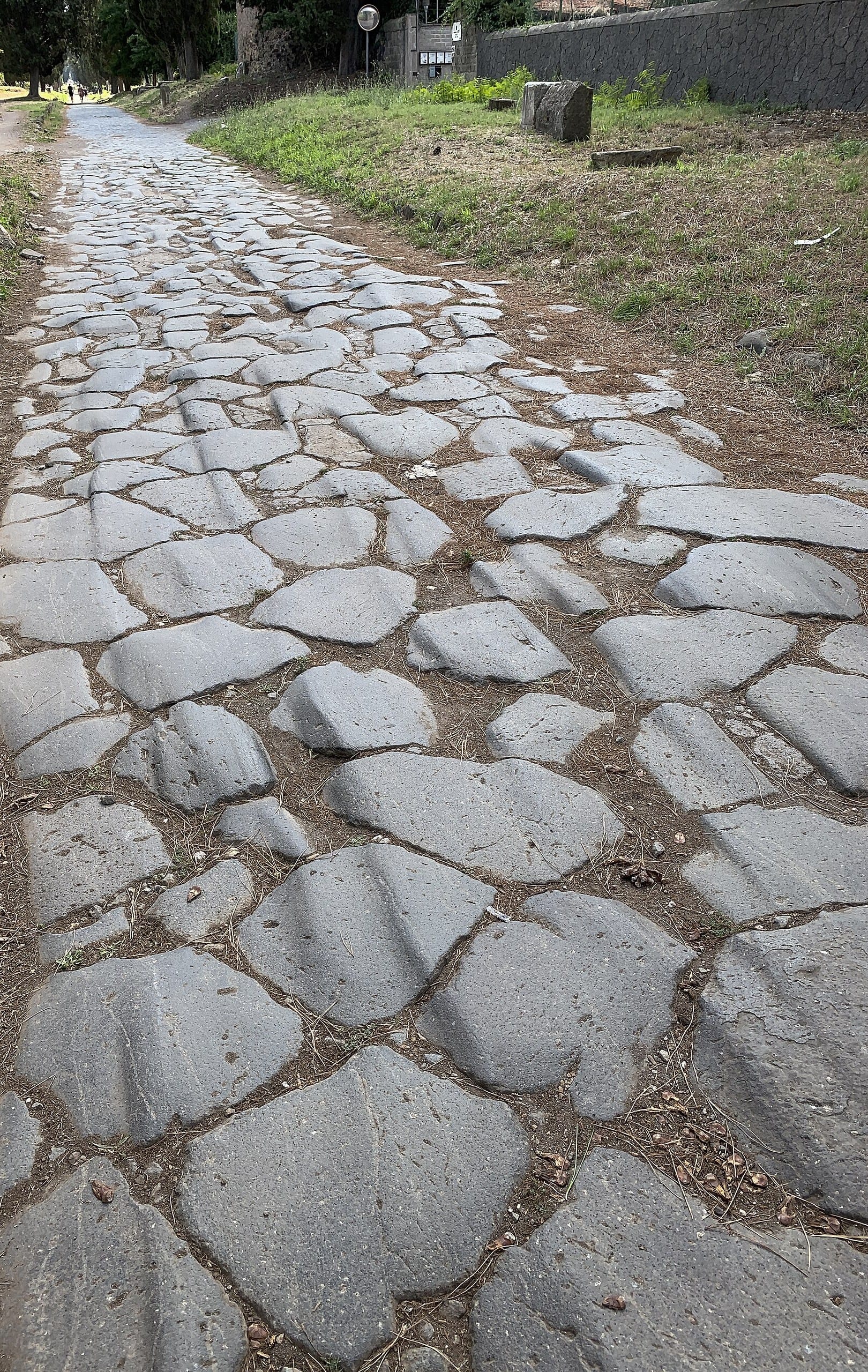
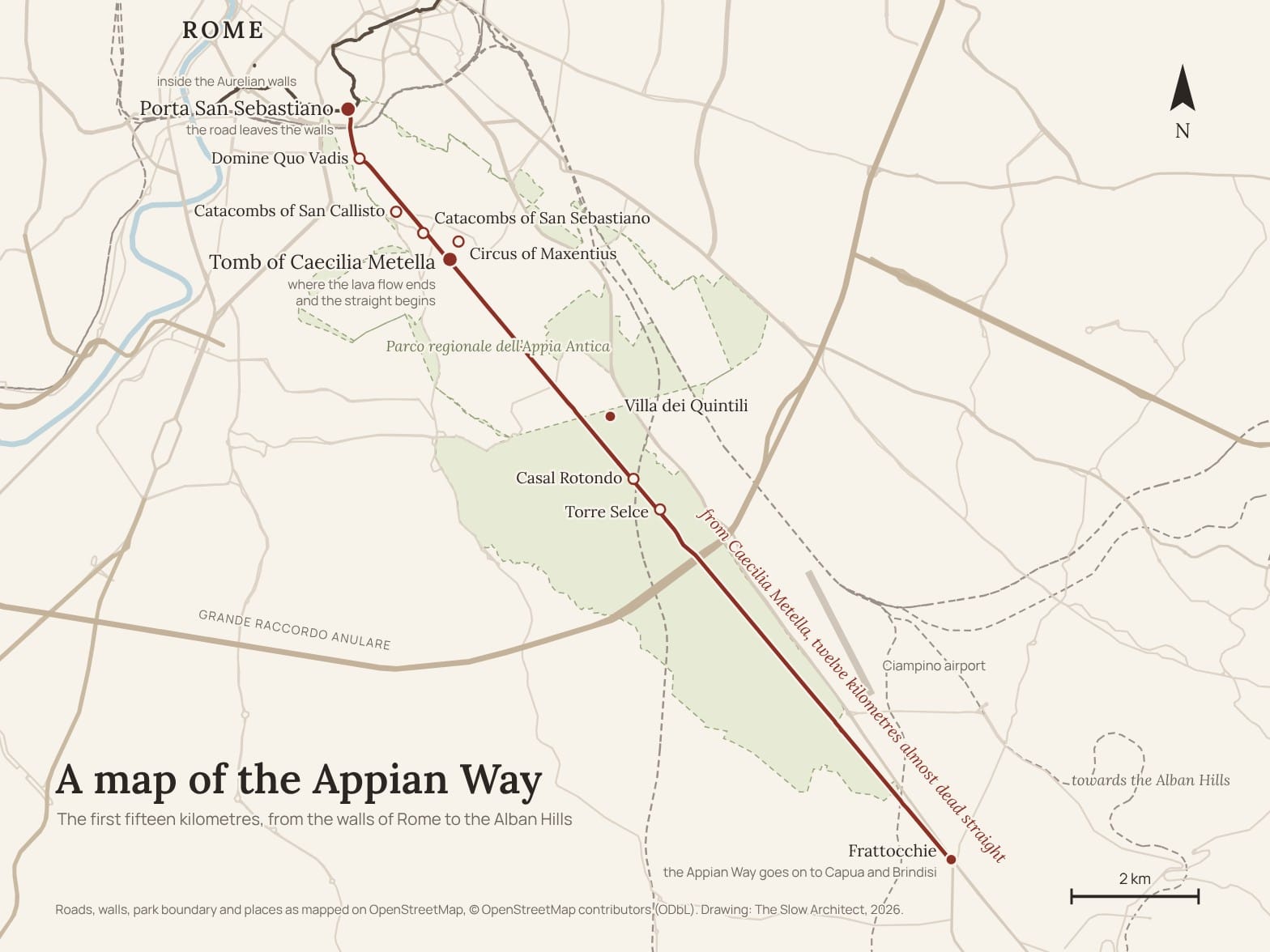
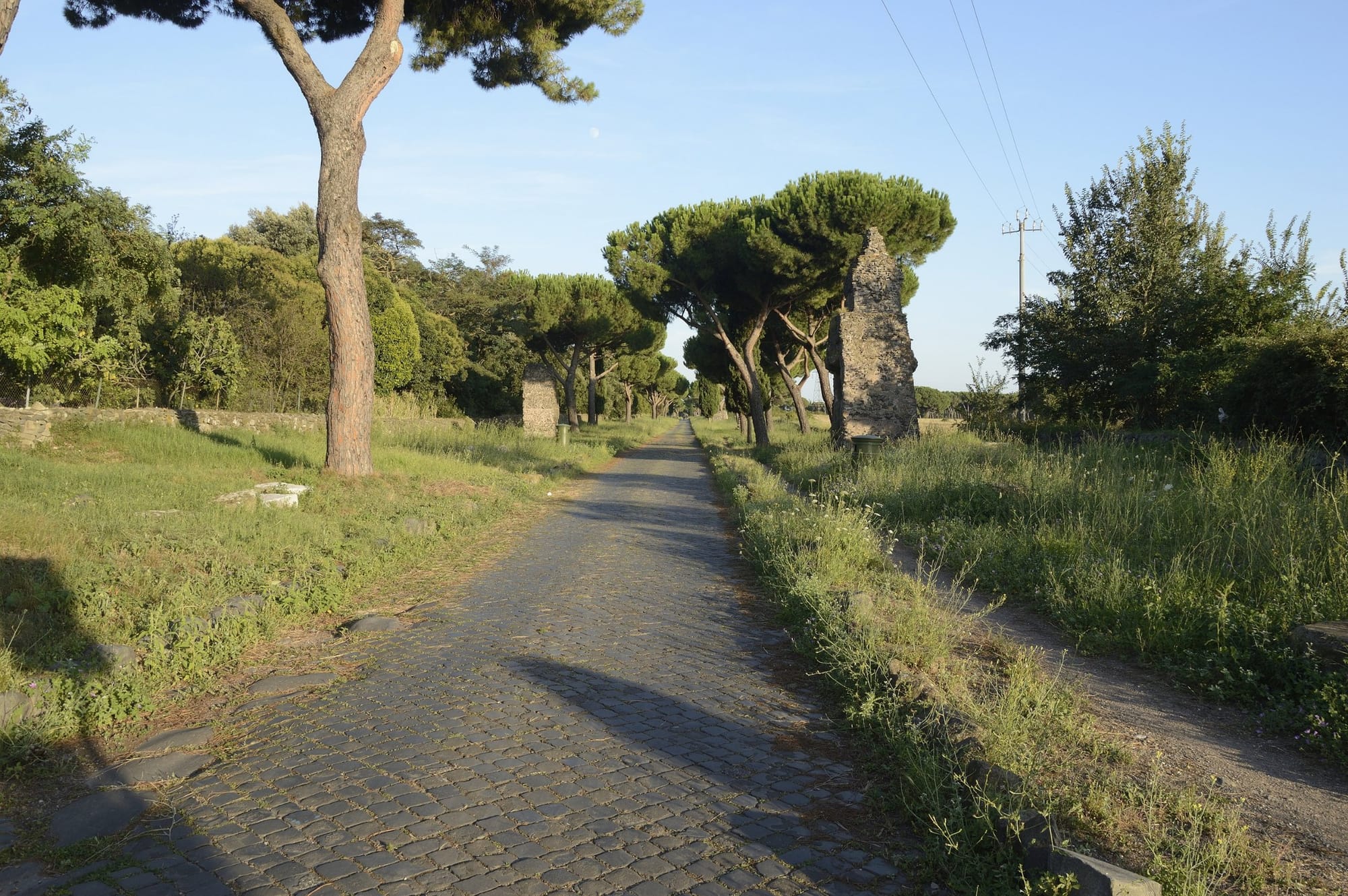
The road I know best is the clearest example. The Appian Way, begun in 312 BC by the censor Appius Claudius, was not paved at first: it was a gravel road. The paving stones came later, stretch by stretch. And on the first stretch out of Rome the builders hardly had to make a foundation at all. The road runs along the back of an ancient lava flow from the Alban Hills, hard, raised and straight, and its paving stones were cut from that same lava.
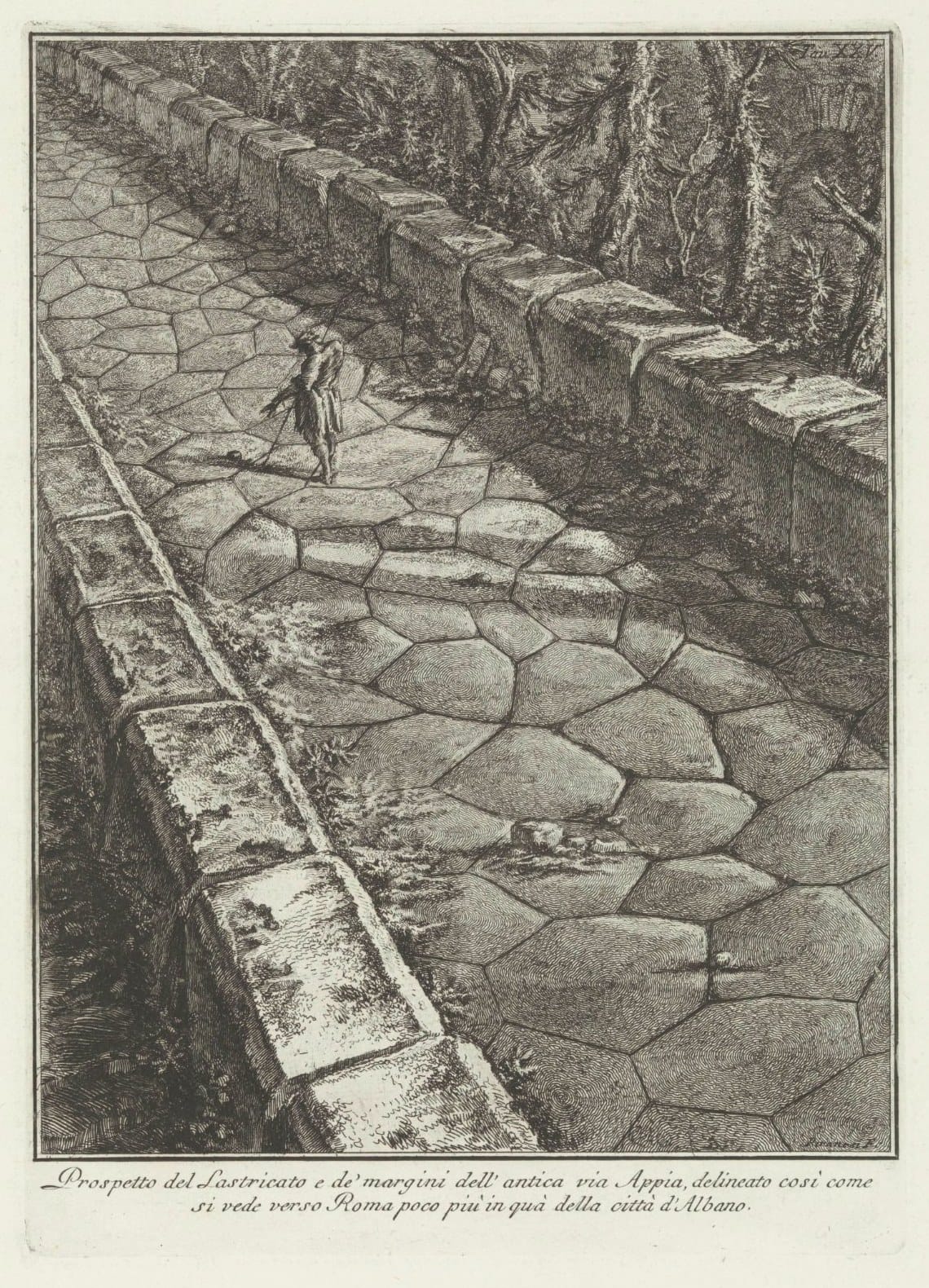
In 1756 Giovanni Battista Piranesi drew a section of it: ground rammed with stakes, a bed of lime, pozzolana and stone chips, and polygonal stones cut to a point underneath, driven into the bed like teeth into a gum. Even Piranesi hedged. About what some of the stones were for, he wrote "perhaps".
Why are Roman roads so straight?
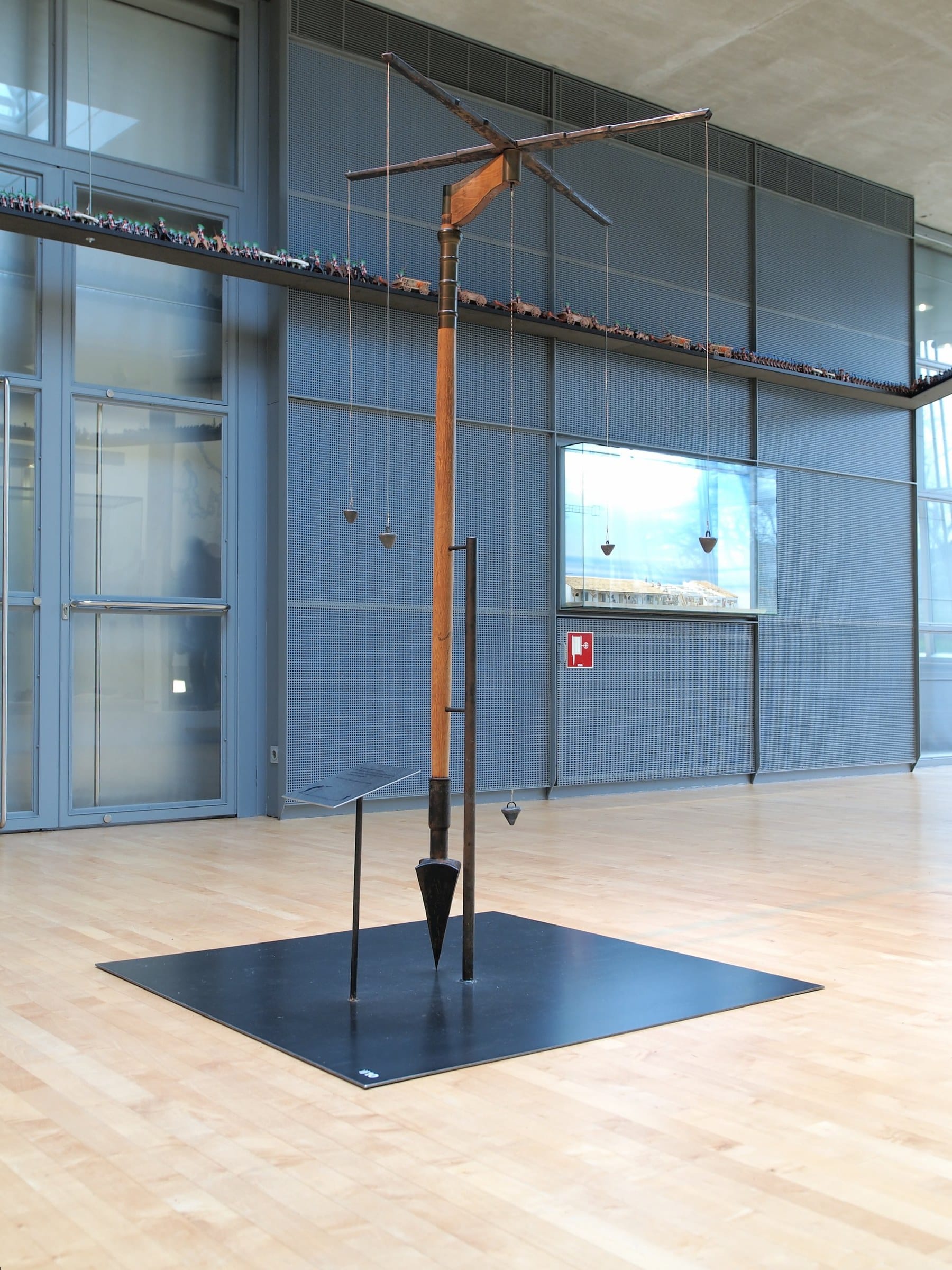
Because they were laid out by surveyors with sighting poles and a groma, a cross on a staff for setting out straight lines and right angles, often from one high point to the next. And because the shortest line is the quickest way to move an army and its supplies. But they were not straight at any cost. They bent around hills, marshes and rivers whenever the ground said so, which is what good engineers still do.
So why did they last?
Ask anyone who has supervised roadworks what makes a road last, and you will hear two words: bed and water. A bed that does not settle, and water that never stays on the surface or soaks into the foundation. The Romans had both: the deep trench and compacted fill that Statius describes, a crown that sheds the rain, ditches that carry it away.
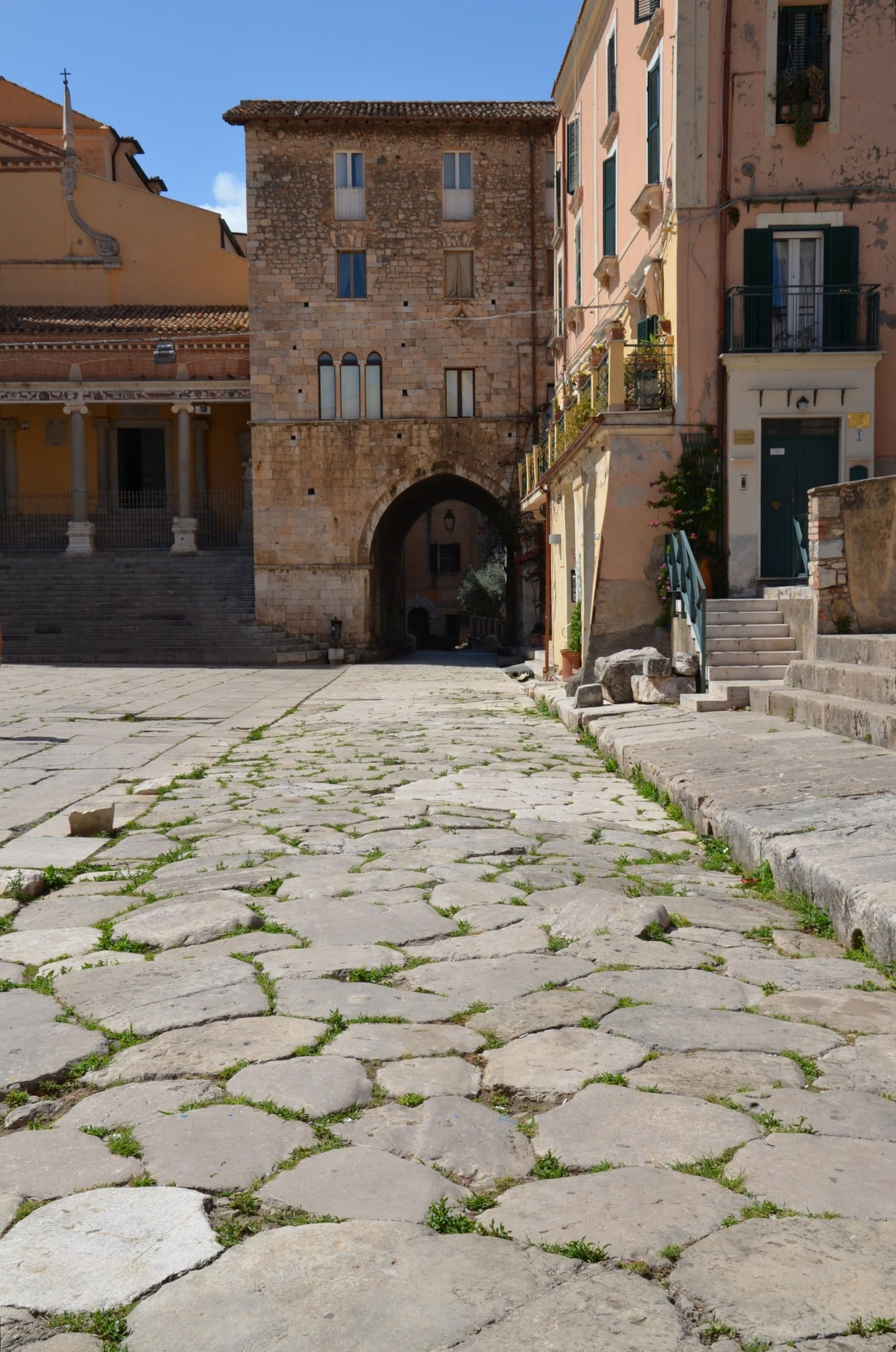
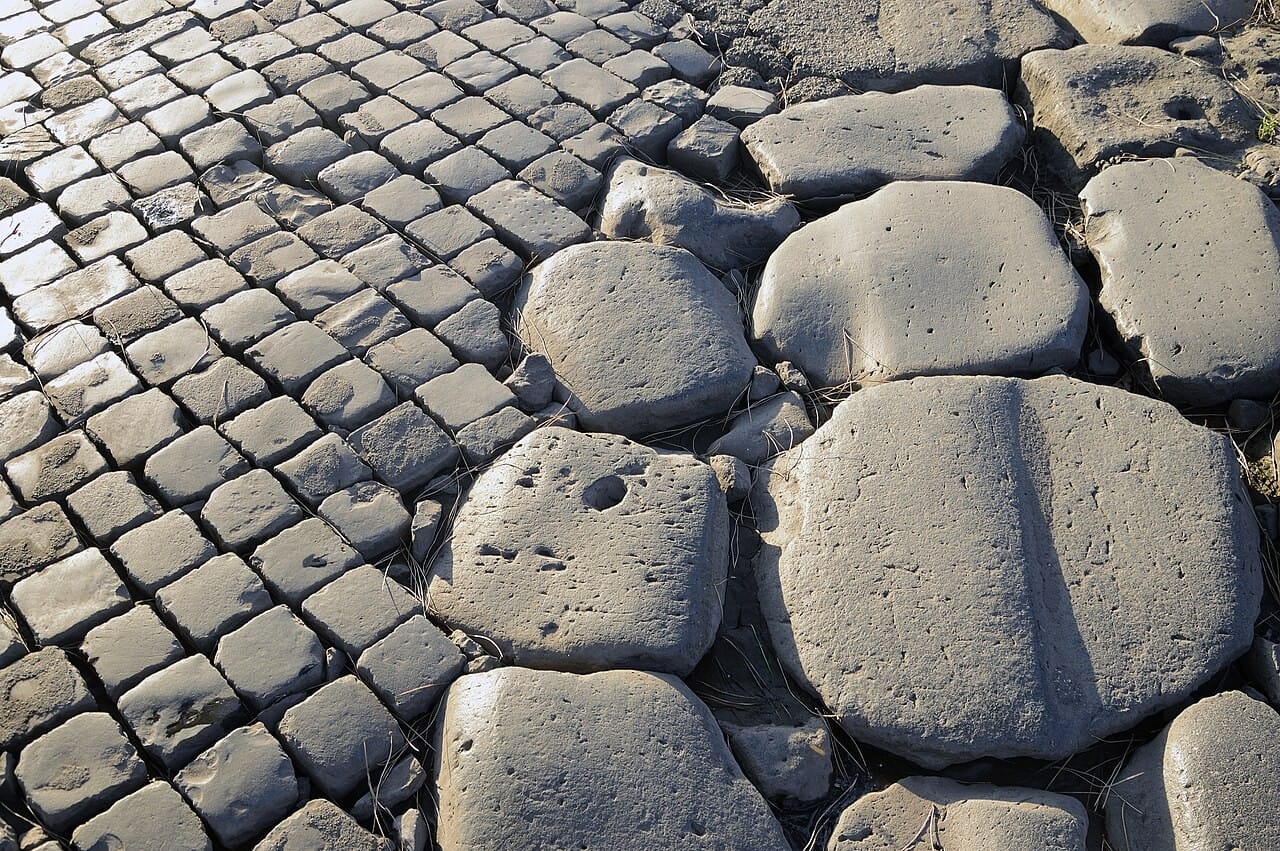
And they had a third thing we tend to forget. Rome had officials, the curatores viarum, whose job was to let out contracts for repairs. The Roman roads we walk on today are not proof of perfect construction. They are what is left of centuries of maintenance, on ground hard enough to keep them. Where the maintenance stops, you can see what happens in the photo at the top: the stones are still there, but the joints have opened and the water has got in.
Where to see one
Near Rome, the Appian Way beyond the tomb of Caecilia Metella keeps long stretches of its polygonal paving. Go on foot or by bike, and slow down on the stones: thin tyres slip into the joints. Since 19 September 2026 the first stretch, from Porta San Sebastiano, has been a limited traffic zone at weekends, and bicycles are exempt.
…, Exactly? answers one question about a building, properly. If there is one you have always wondered about, reply to any Slow Letter and ask.
Sources: Vitruvius, De architectura VII.1; Statius, Silvae IV.3; Michele Matteazzi, "Ne nutent sola. Strade e tecniche costruttive in Cisalpina", Agri Centuriati 9 (2012); Nicolas Bergier, Histoire des grands chemins de l'Empire romain (1622); Giovanni Battista Piranesi, Le Antichità Romane, vol. III (1756). Translations are my own.