WHO MADE THE APPIAN WAY
Almost nothing of the Appian Way we carry in our heads is ancient. The fragments on the walls, the road dug out and given back, the enclosure, the pines: someone decided all of it, between 1808 and the twentieth century.
A sculptor, an architect who painted brick to look like travertine, an archaeologist who shut the road behind two gates, an inspector who planted the pines, a journalist, a film director and an insect. The Appian Way we carry in our heads is not ancient: it was built between the nineteenth century and today. Second part.
Strata is a series about a very Italian habit: not demolishing, but building on top, inside, beside. The first part of the Appian Way was about the matter: the volcano, the road, the tomb, the tower. This one is about the image.
Think of the Appian Way. What probably comes to mind is a straight road of paving stones, two rows of umbrella pines, tombs and fragments of marble lined up along the sides, the countryside behind. An image so strong it seems eternal, as if the road had stayed there, intact, since the day it was built.
Almost nothing in that image is ancient. The tombs are, and some of the paving. But the way we see them, the fragments set into walls along the edges, the road dug out and given back, the enclosure, the trees, the very idea that the Appian Way is a monument to walk along: all of it was decided by someone, between 1808 and the twentieth century, for different reasons that often pulled against each other.
The first part ended in front of the tomb of Caecilia Metella, in 1789, with the Roman road far below the monument and a steep climb under the tower. I'll pick it up from there. And from a question that anyone who works on monuments asks every day: when every century has put its hands on the same thing for a different need, what is left that is authentic?
A sculptor and a wall
The first person to build a wall in order to show a ruin was not an architect. He was a sculptor.
In 1808 Antonio Canova designed the restoration of the tomb of Marcus Servilius Quartus, on the Appian Way. Of the funerary monuments only scattered pieces remained: reliefs, inscriptions, cornices. Canova did not try to rebuild the tomb. He built a brick screen in the shape of a funerary stele and fixed the original pieces onto it, like pictures on a wall. The same method was later used for the tombs known as Seneca's and that of the sons of Sextus Pompeius.
It is a more important gesture than it looks. For the first time on the Appian Way something new is built not to be used, as the Caetani had used the tower, but to show something old. An architecture of display is born. And it is born with an ambiguity that will never leave us: the wall is modern, the pieces are ancient, and whoever passes by sees one single thing.
Valadier, or the director
Sixteen years later it is Caecilia Metella's turn.
Between the end of 1823 and 1824 the road in front of the tomb is lowered, to get rid of the climb, under the supervision of Giuseppe Valadier, architect and adviser to the Commissione Generale Consultiva di Belle Arti, the papal fine arts commission. As they dig, the works turn up fragments, which the president of the Direzione Centrale delle Strade, the roads authority, Luigi Lancellotti, reports to the cardinal chamberlain Pacca: sculptures, inscriptions, architectural pieces, a statue of a warrior that came to light at Capo di Bove in January 1824. On 29 January Valadier presents a design to display them; Pacca approves it on 13 February, with a spending cap of 186 scudi. The original gate of the castle is walled up and becomes the support for a small open-air museum: the pieces, which were meant to be eighty and in the end number 116, are fixed to the facade of the Caetani palace, "in full view". Pacca writes that they will serve "erudition" and "delight the lovers of antiquity". The final bill comes to more than 340 scudi.
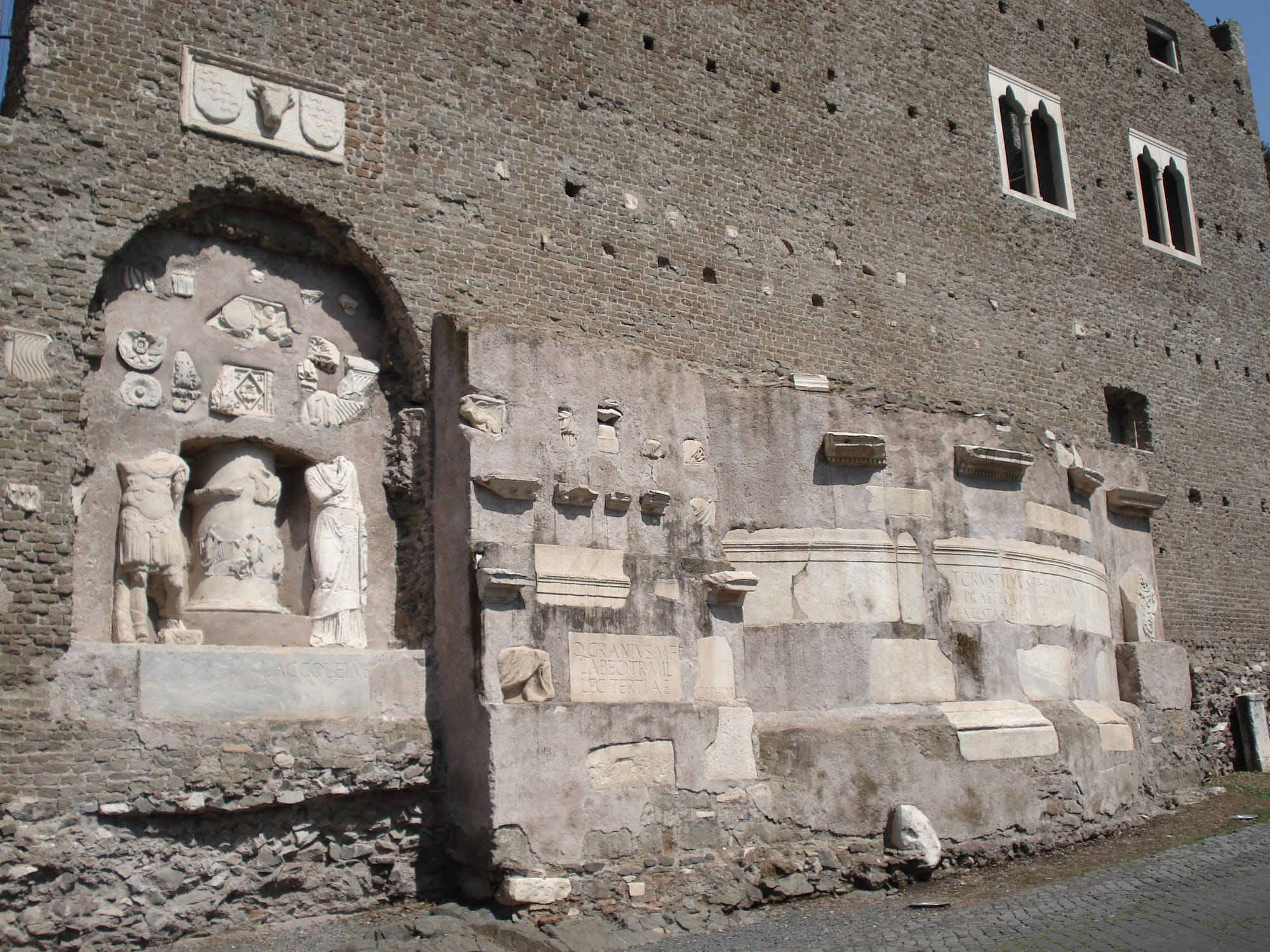
That wall, with its Gothic double windows and the headless statues in the niche, looks like the Middle Ages building with the pieces of antiquity. It isn't. It is a display from 1824: a roadwork, lowering a gradient to remove a climb, turned into an exhibition. For anyone who works as a site supervisor it is a textbook case, a job that changes its nature as it goes along.
Who was Valadier? The man who, in those same years, was deciding what face Rome should have. The son of a goldsmith, a goldsmith himself, he became the architect of neoclassical Rome. Piazza del Popolo as we see it is his, with its ellipse, completed in 1824; his are the ramps and terraces that tie it to the Pincio, his the Casina on the Pincio. He is, quite literally, the director of the modern urban stage.
And in those same years he gets his hands on two symbolic monuments, with two opposite choices.
At the Arch of Titus, a job begun by Raffaele Stern in 1818 and continued by Valadier from 1820, the arch is freed from the medieval buildings that had swallowed it, the marble blocks are taken down, numbered and put back, and the missing parts are made good in travertine, with capitals and cornices simplified at the request of the commissioner Carlo Fea, so that they remain recognisable. It is, sixty years early, the principle Camillo Boito will set down in 1883: an addition must declare itself as an addition. Quatremère de Quincy praises it for exactly that reason. Stendhal, on the other hand, writes that little remains of the original arch, and that it is only a copy.
And there is a detail you only see by looking up at the attic on the side facing the Forum; the side facing the Colosseum still carries the ancient dedication to Titus. Above the new parts an inscription was carved that declares the restoration: INSIGNE RELIGIONIS ATQUE ARTIS MONUMENTUM VETUSTATE FATISCENS PIUS SEPTIMUS PONTIFEX MAX. NOVIS OPERIBUS PRISCUM EXEMPLAR IMITANTIBUS FULCIRI SERVARIQUE IUSSIT. This outstanding monument of religion and art, which was falling apart with age, Pius VII, Supreme Pontiff, ordered to be propped up and preserved with new works imitating the ancient model. Novis operibus priscum exemplar imitantibus. The whole dilemma of restoration is there in a single phrase: new works, that imitate, the ancient model. The arch says it of itself, in Latin, to anyone who looks up.
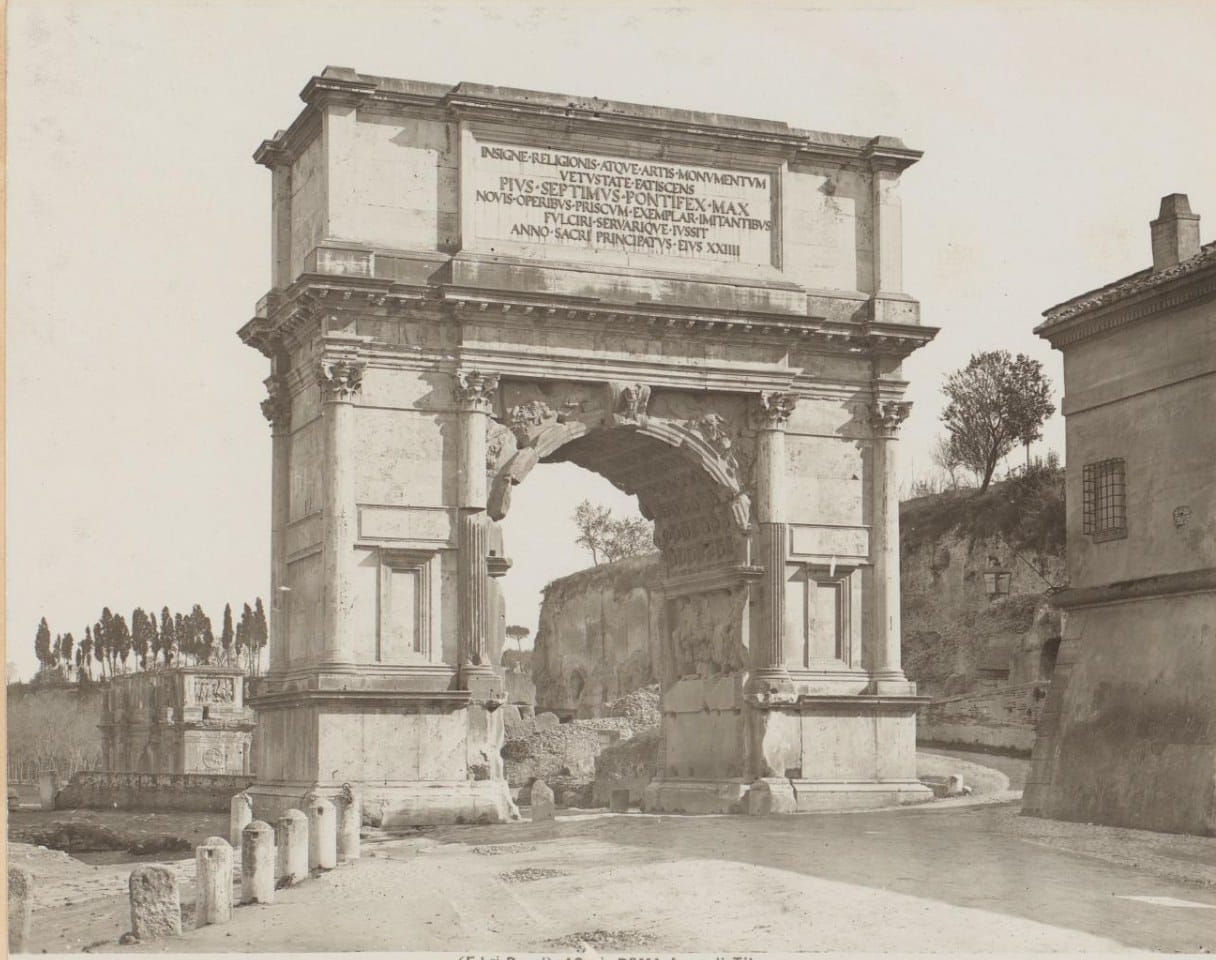
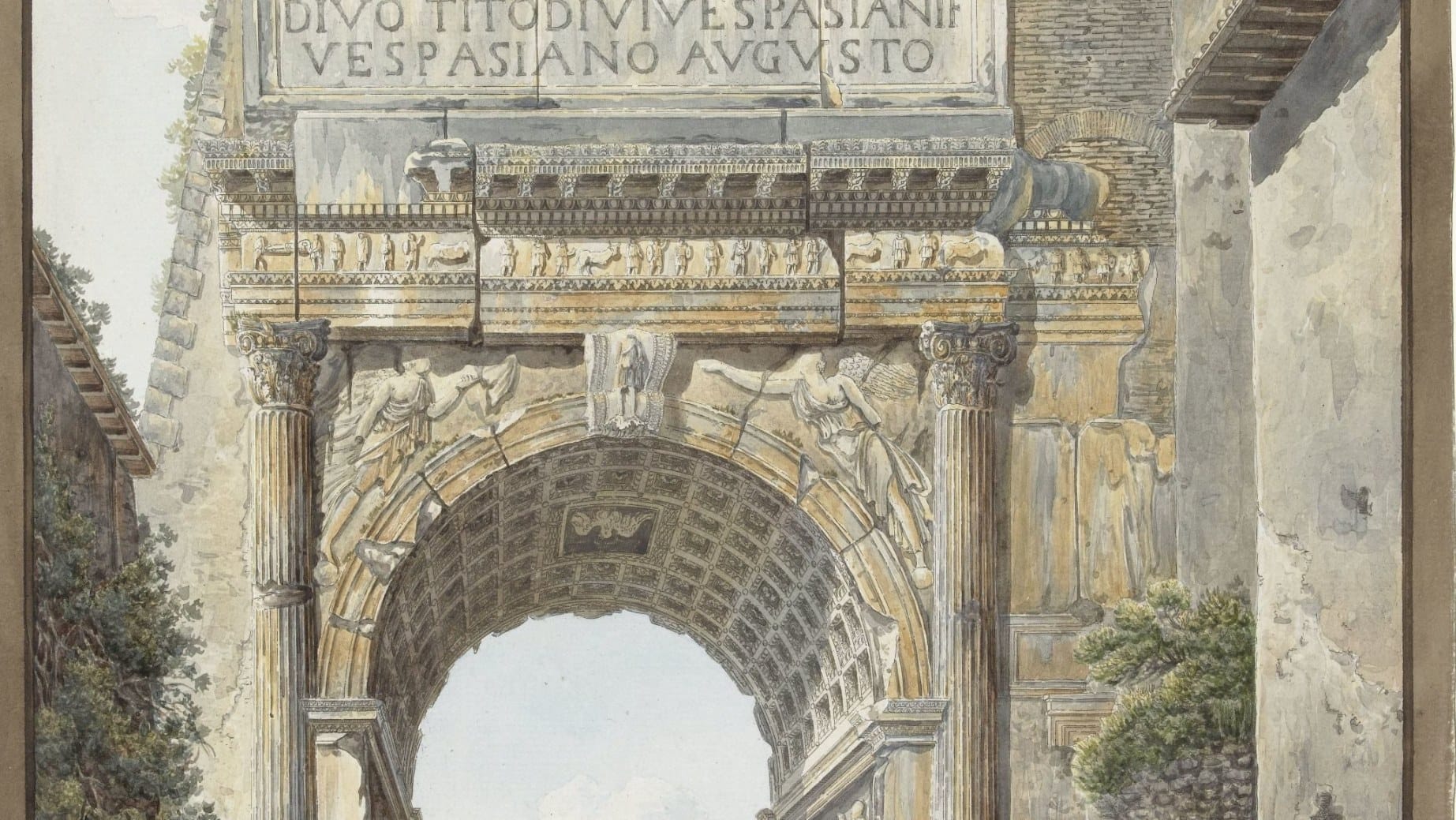
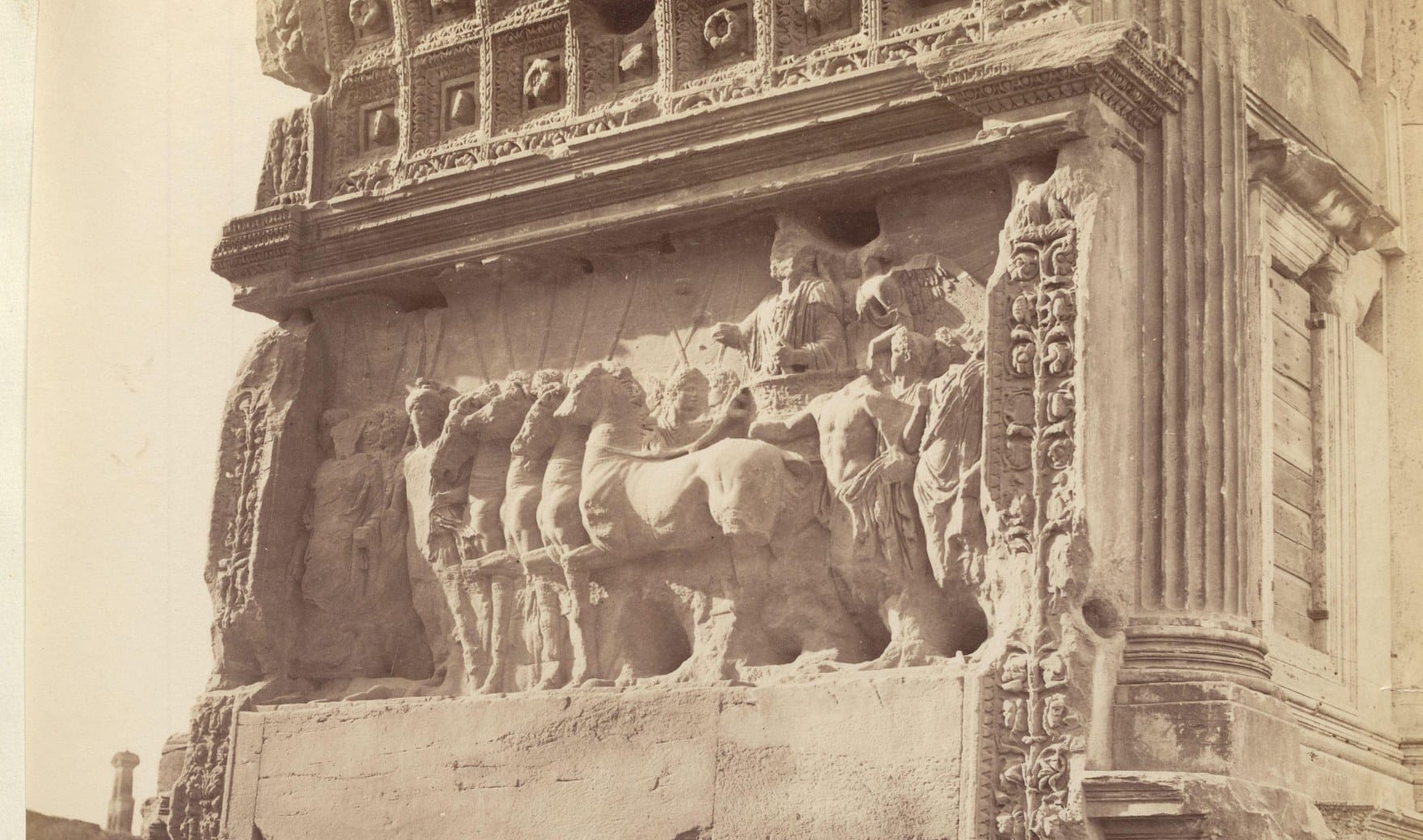
The Arch of Titus before and after Stern and Valadier, and a piece of the original marble. All Rijksmuseum, Amsterdam, public domain. g1: Daniël Dupré, The Arch of Titus on the Forum Romanum, 1786–1817, before the restoration, with brick walls built up against it. g2: after Stern and Valadier, with the plain travertine piers and Pius VII's inscription on the attic. g3: Anonymous, relief of Titus's triumph on the arch, c. 1880–1900: the original marble, left as it was.
At the Colosseum, between 1823 and 1826, Valadier builds the great buttress that holds up the western side. He rebuilds some of the collapsed arches by analogy and, to save money, uses travertine only where it shows most: the rest is brick, covered with plaster painted to look like travertine. That skin has gone now, but the intention was clear: an addition that camouflages itself.
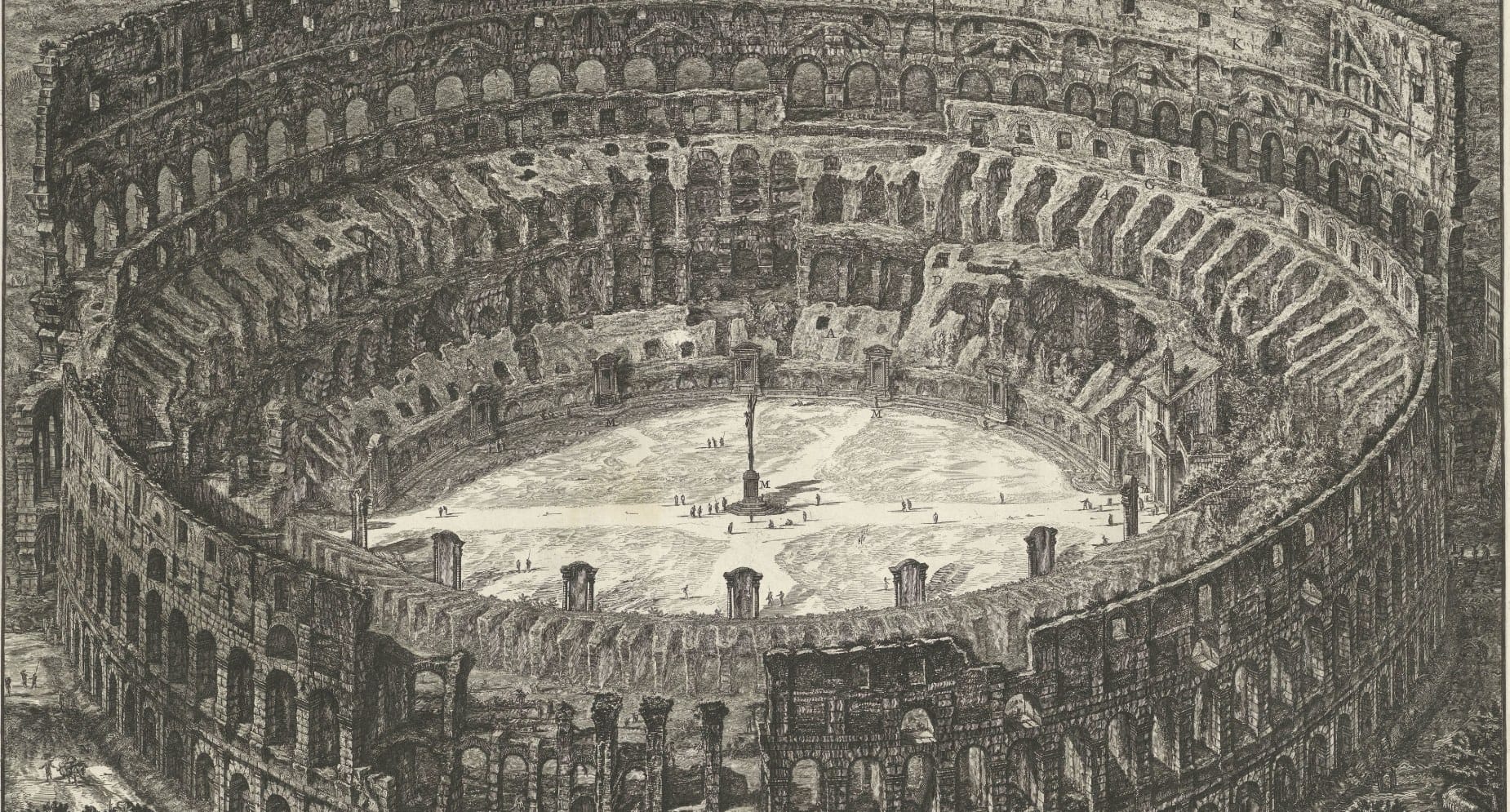
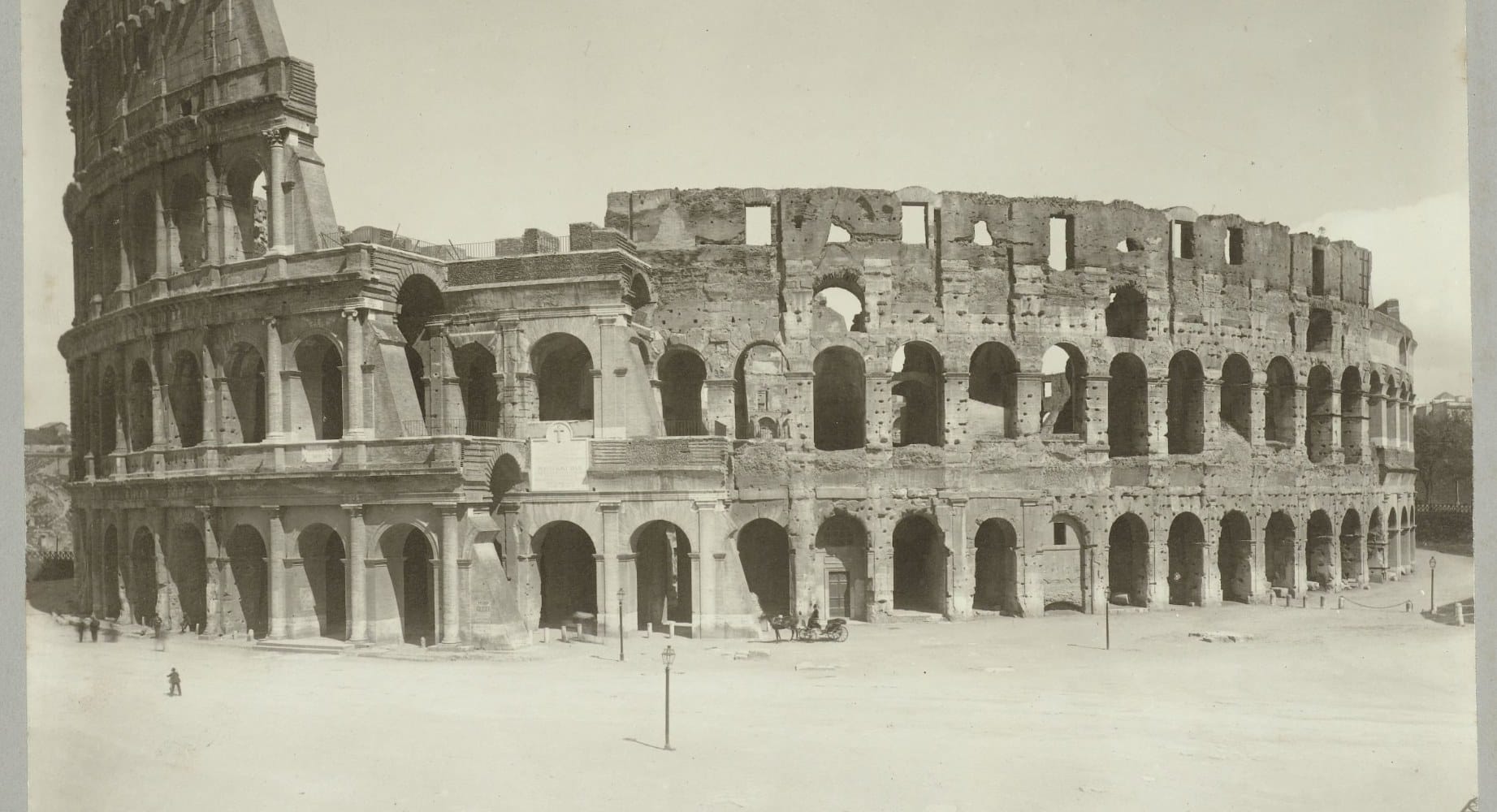
g1: Giovanni Battista Piranesi, Bird's-eye view of the Flavian Amphitheatre, 1748–1778. g2: Fratelli Alinari, Colosseum, c. 1893–1903. The Colosseum at the end of the nineteenth century. On the left, Valadier's buttress: the arches rebuilt by analogy, fewer on each storey, until they close off the end of the outer ring. Both Rijksmuseum, Amsterdam, public domain.
Distinguish at the Arch of Titus, camouflage at the Colosseum, display at Caecilia Metella. Three restorations in six years, three different philosophies, the same man. You can read it as inconsistency. I read it as the normal condition of anyone who worked on monuments before the discipline had rules: every job is a decision taken with the budget, the materials and the client you have. Questionable, certainly. And modern restoration was born out of arguments exactly like this one.
Canina, or the road as museum
A quarter of a century later, the Appian Way outside the walls had almost disappeared as a road. Dry-stone walls cut across it, landowners used it to reach their fields, and the route could be made out mostly from the sequence of tombs.
Between 1850 and 1853, under Pius IX, the Piedmontese architect and archaeologist Luigi Canina restores the road from Caecilia Metella all the way to Bovillae. He digs out the paving, expropriates a strip of about ten metres on each side, consolidates the monuments and partly rebuilds some of them. Next to the most fragmentary ones, following Canova's example, he puts up masonry screens and fixes inscriptions and architectural pieces onto them, so that passers-by can understand what shape the tombs had. Among the items in the accounts, which come to 24,999 scudi in all, there is also "planting of trees". And then there is the enclosure: the archaeological area is cut off from the fields by dry-stone walls, the macère, and closed with two gates.
The idea is new. No longer the single monument, but the whole road as a monument: an open-air museum kilometres long, with a way in and a way out. It is the first time the Appian Way becomes a space to visit rather than to travel along. And it is also the first time it is closed.
The verdict on Canina is still open. Part of the criticism dismissed his work as stage flats, mere backdrops for Romantic picturesque. More recent studies scale the charge down, since it partly comes from wrong attributions, and distinguish two attitudes: an antiquarian one, for tombs too fragmentary to interpret, and an architectural, historicist one, for those that could be recognised. But one thing is certain. The solemn Appian Way, lined with memories, is largely an image built in the middle of the nineteenth century.
An image Europe already knew. For centuries painters and engravers had been drawing the tomb of Caecilia Metella, and not always as it was. In an etching of 1797 Jean-Jacques de Boissieu sets it on the bank of a river, with a group of figures pulling a drowned man out of the water. No river flows in front of the tomb. The Appian Way was already a place of the imagination before Canina turned it into a place to visit.
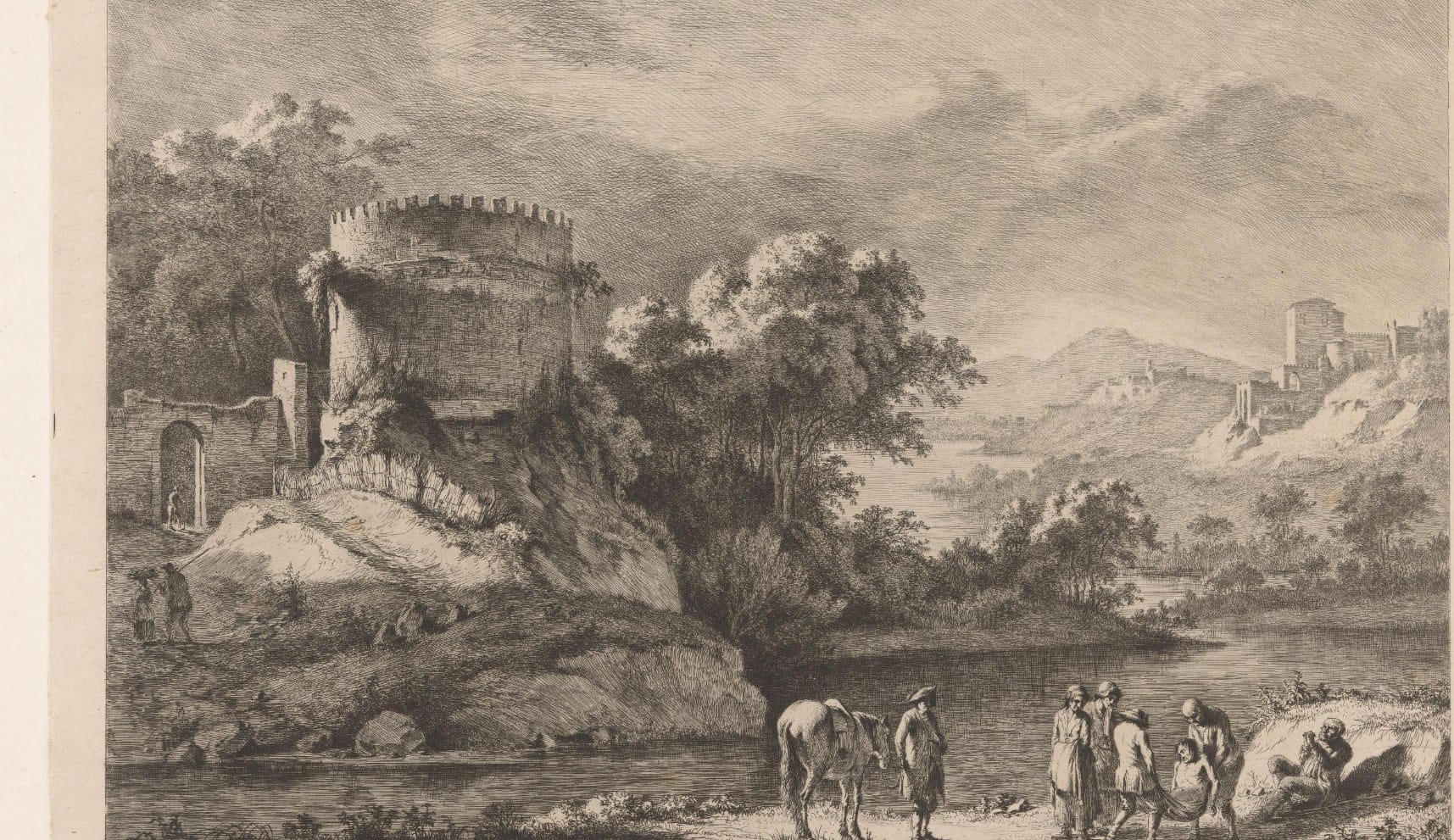
And the open-air museum did not last long. As early as 1882 Rodolfo Lanciani, then the engineer in charge of excavations, wrote that in recent years requests for rights of way had "increased a hundredfold", that the walls had collapsed for more than a kilometre, and that the road was almost impassable.
Muñoz, or fixing
The early twentieth century adds a layer that is less visible and just as decisive.
Between 1909 and 1913 Antonio Muñoz, an inspector of the Regia Soprintendenza ai Monumenti, the royal monuments authority, carries out a campaign of restorations along the road. Among other things he fixes small inscriptions and fragments to the walls, mortaring them in or anchoring them with iron cramps, pieces that would otherwise have been lost. At Caecilia Metella he reworks the entrance to the burial chamber and builds the stair that goes down to the lower corridor, changing the look of the tomb's south side. In that same year, 1909, the heritage law makes possible the first two archaeological protection orders in the area, on the Fountain of Egeria and on the Villa of the Quintilii. Fifteen years later the same Muñoz, by then superintendent, will direct the opening of the Via del Mare, with the demolitions around the Theatre of Marcellus: the "liberation" that took the houses out of the arches and left the palace on top.
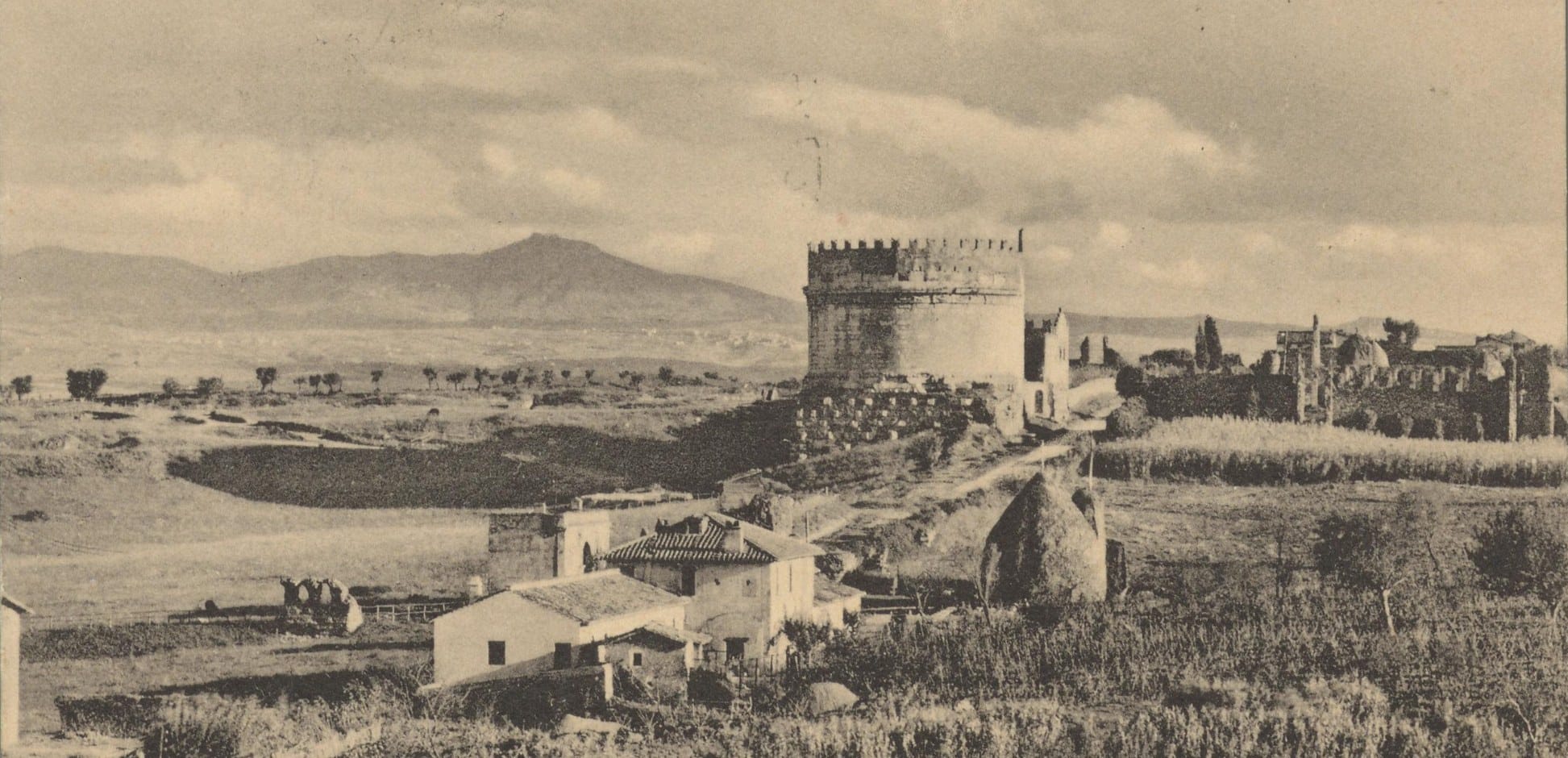
A postcard from those years shows the tomb as Muñoz's tourists saw it: the battlemented tower on the tip of the lava flow, the castle to the right, a few farmhouses, a haystack, and all around it the bare countryside running to the Alban Hills on the horizon. Not a single row of trees.
At this point the fragments we see set into the walls along the Appian Way have at least four authors: Canova, Valadier, Canina, Muñoz. Telling who put what, and where, is a job for specialists, and it isn't always possible. For anyone passing by it is simply "the Appian Way". And this is where the question of authenticity gets serious: what we are looking at, is it a Roman road or a nineteenth-century installation of Roman pieces? The honest answer is both, and the two cannot be pulled apart.
Cederna, or the road to defend
The twentieth century also adds the most fragile layer of all: protection.
The 1931 city master plan imagines the Appian Way as a great park reaching the Alban Hills, but classifies it as a "zone of respect", and the formula lets through villas and low buildings "immersed in greenery". Along the road a scatter of private villas starts to grow, pressed up against the monuments. During the war the road is used by troops, the bombing of Ciampino airport damages the tombs, and after the war maintenance stops.
In the early 1950s an archaeologist and journalist, Antonio Cederna, exposes a plan by the Società Generale Immobiliare, the big property developer, for a luxury district among the ruins of the Villa of the Quintilii. It is the start of a battle that will last forty years and more than a hundred and fifty articles in the weekly Il Mondo. In 1953 he writes that the Appian Way has value in itself, and must be saved "religiously intact". In 1965 a decree designates 2,500 hectares of countryside as a public park; the Council of State will later rule the park designation of the whole area unlawful. Meanwhile building goes on, often without permits, and much of it will be legalised by amnesties, starting with the one of 1985. In that same year the Soprintendenza buys twenty-two hectares around the Villa of the Quintilii. In 1988 the Lazio Region establishes the Appian Way park, about 3,300 hectares from Porta San Sebastiano to Santa Maria delle Mole, and in 1993 Cederna becomes its president. He dies in 1996. His archive is now at Capo di Bove, in the Roman bath complex the state bought in 2002, a few hundred metres from Caecilia Metella.
The villas, here, are two layers looking at each other. On one side, the Villa of the Quintilii, the largest residence in the Roman suburbs, built by the Quintilii brothers, consuls in AD 151: Commodus had them killed in 182 or 183 on a charge of conspiracy and took the villa for himself. Opposite the archaeological park, at number 290 on the Appia Antica, there is today a private villa that carries the same name, Villa dei Quintili, and is rented out for weddings and events. Carlo Verdone chose it in 1988 for the dinner in Compagni di scuola, "schoolmates", the reunion in which fifteen years of disappointments come to the surface in a single night. And in the film the villa changes its name once again: it becomes Villa Scialoja. Er Patata, Verdone's character, goes looking for it, walks into the wrong party and only realises once he is inside, because from the outside "me coincideva tutto: er cancello, er chiosco, er vialetto", everything matched: the gate, the kiosk, the little drive. That makes three villas, one on top of the other: the Quintilii's, buried in the park; the one that took their name, across the road; and the one in the film, which doesn't exist and which Er Patata still manages to get wrong. An emperor confiscating his rivals' villa, and two thousand years later a middle class meeting up in an invented villa to measure its own failures. This is the Appian Way too: a layer can be made of nothing but a name.
The park that isn't there yet
The park exists today, on paper and partly on the ground. In 2000 the Grande Raccordo Anulare, Rome's ring road, which cut across the Appian Way at the seventh mile, was sunk into a tunnel under the road, and the continuity of the way was stitched back together. In 2016 the state Archaeological Park was created. In 2018 the regional park was enlarged by another 1,213 hectares and got its first management plan. In 2024 UNESCO inscribed "Via Appia. Regina Viarum" on the World Heritage List. Since 19 September 2026 the first stretch has been a limited traffic zone at weekends.
But more than 80% of the park's territory is privately owned. The Park says so itself, in its management document: public ownership is a "negligible" percentage. The tomb of Geta stands on private land and cannot be visited. The columbaria of Vigna Codini can be seen only by arrangement with the owners. And the church of San Nicola, opposite Caecilia Metella, has its entrance shut by a gate. Canina closed the road with two gates to protect it; a hundred and seventy years later the gates have multiplied, and almost none of them is public.
Here I'll allow myself a position, because it is my job. The Appian Way has a monumental and recreational potential that few cities in the world can claim: a Roman road you can walk or cycle from the city walls to the Alban Hills, through open countryside, with two thousand three hundred years of architecture on either side. And it is barely developed. Italia Nostra, the heritage association, has been saying it for years: the protections exist, what is missing is planning shared between the Ministry, the City and the Region, and the will to enforce them. The next layer of the Appian Way, if there is one, will have to be a real project: of access, routes, acquisitions, of things open instead of closed. Cederna spent his life stopping the road from being destroyed. Ours is the harder part, which is making it live.
The pines
What is left is the layer we believe to be eternal.
When we think of the Appian Way we think of the pines. Two rows of dark umbrellas over the paving, the light filtering through, the cypresses among the tombs. In 1924 Ottorino Respighi called the finale of his Pines of Rome "The Pines of the Appian Way": pines in the mist at dawn, a legion marching towards the Capitol. Since then that image has become the Appian Way.
In one of the most quoted scenes of Verdone's film, Walter Finocchiaro, the self-made butcher played by Angelo Bernabucci, drives up to the villa, goes over a pine root sticking out at the entrance, nearly leaves his oil sump on it and snaps: "Ma tajamoli 'sti pini no? C'hanno trecent'anni l'uno, ma quanto li volemo fa' campa'?" Why don't we just cut these pines down? They're three hundred years old apiece, how much longer do we want to keep them alive? It is a perfect line, and a wrong one. Pine roots really do lift tarmac and paving stones. But three hundred years, the pines of the Appian Way do not have.
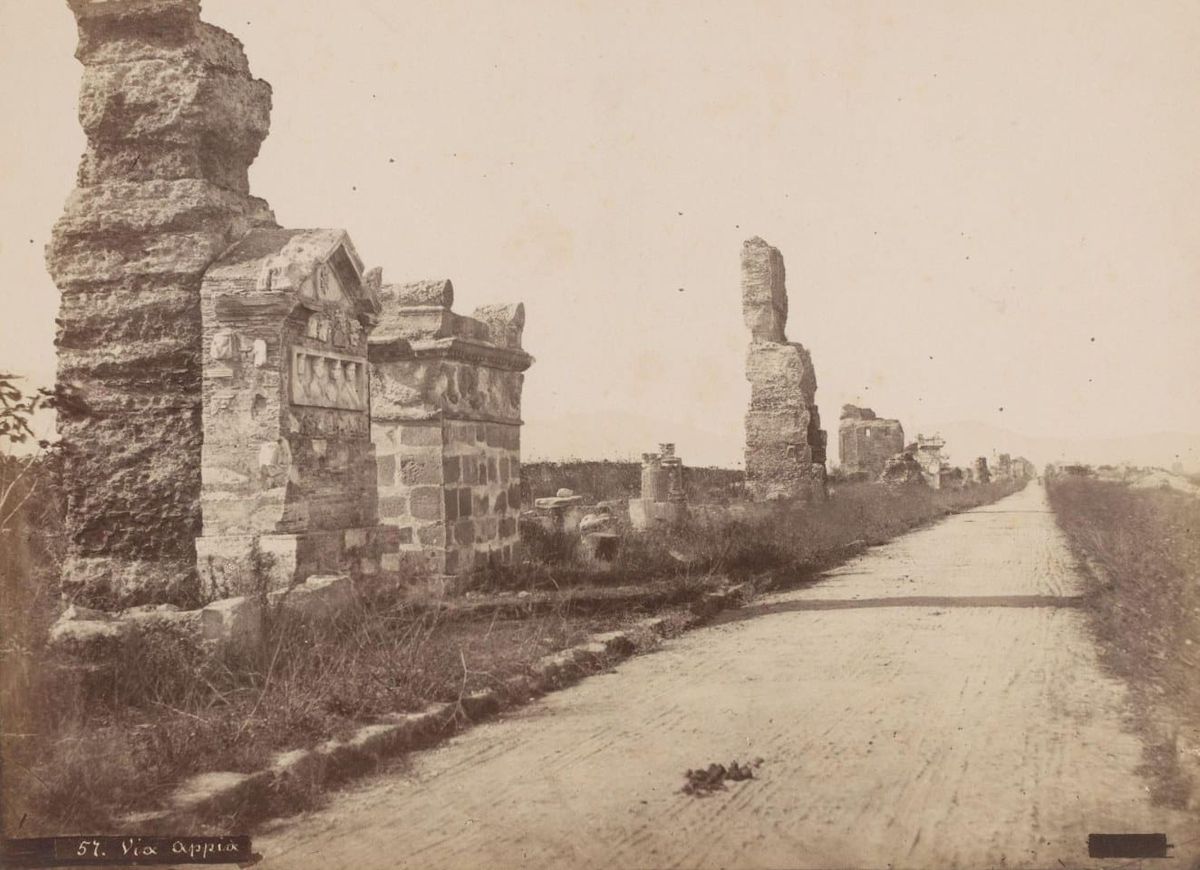
The pictures say it better than the documents. In the eighteenth-century views and the nineteenth-century photographs the Appian Way is open countryside. In the photograph attributed to Altobelli & Molins, from 1857–65, in the Alinari photograph of the tomb, in the Brogi of around 1875, in the Alinari with the tumuli of the Curiatii from the 1880s and 1890s, there are isolated cypresses, the odd solitary pine, fruit trees behind the vineyard walls. In the postcard of 1906–1913 the countryside around the tomb is bare all the way to the Alban Hills. The rows are not there.
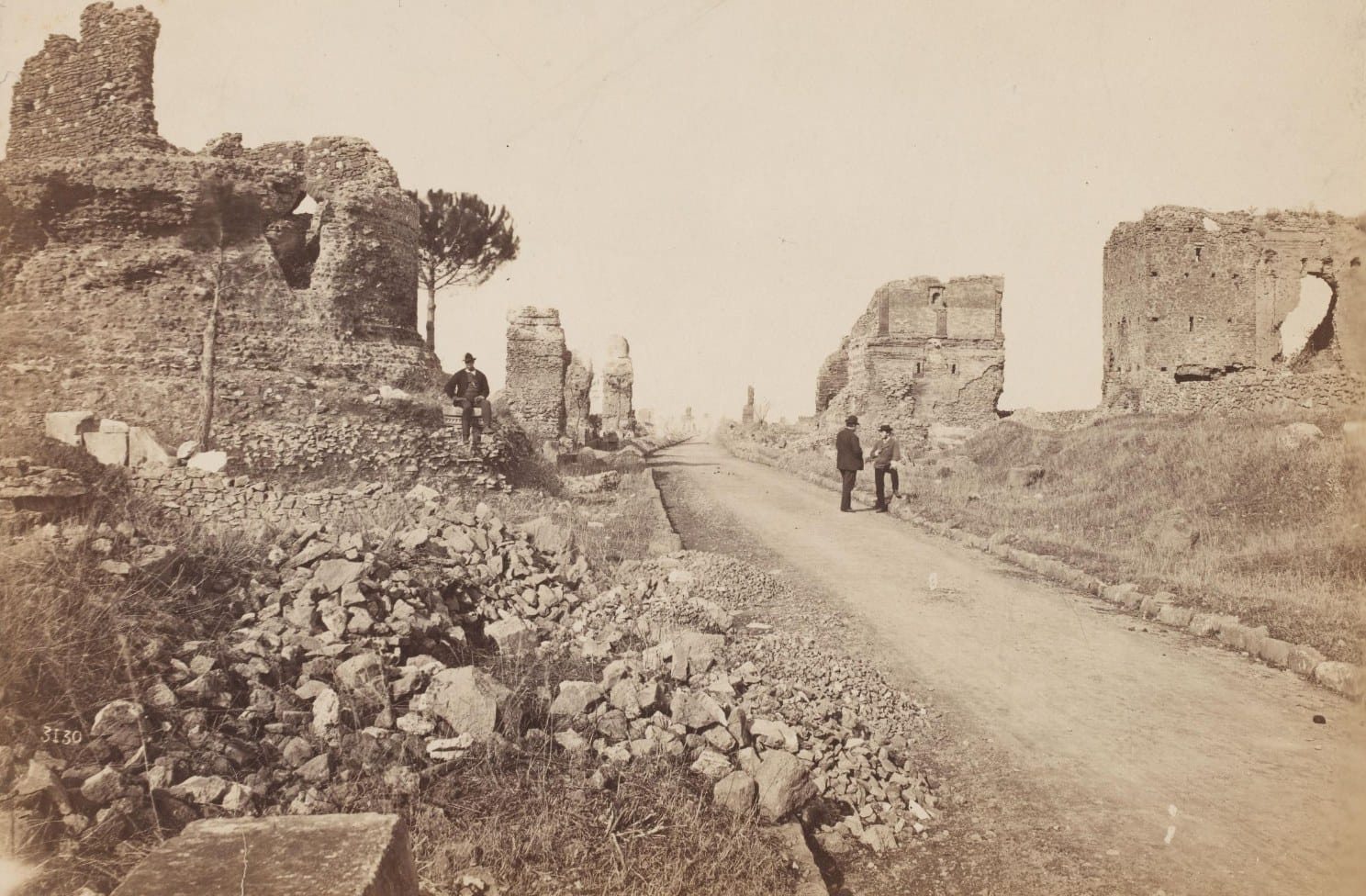
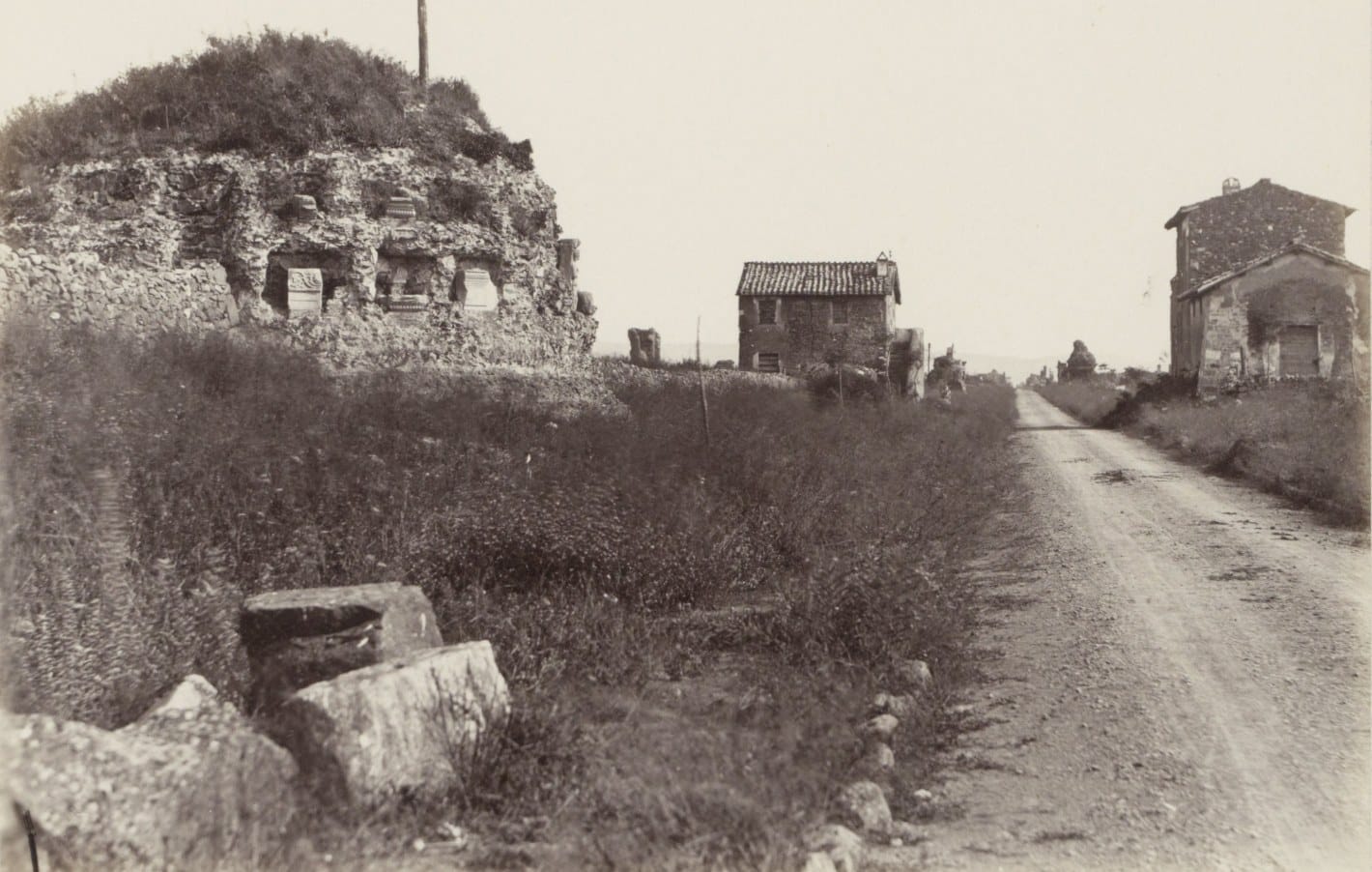
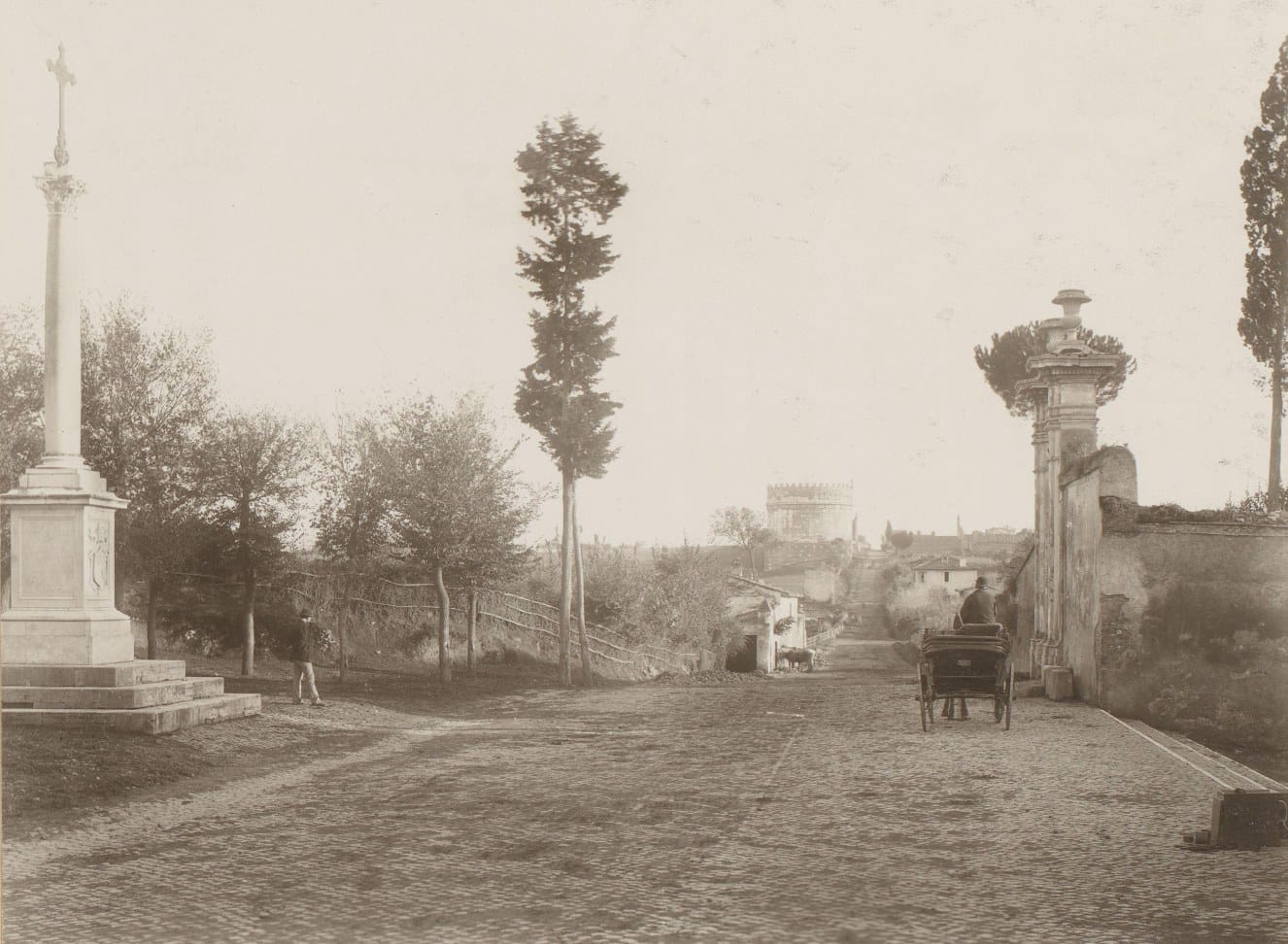
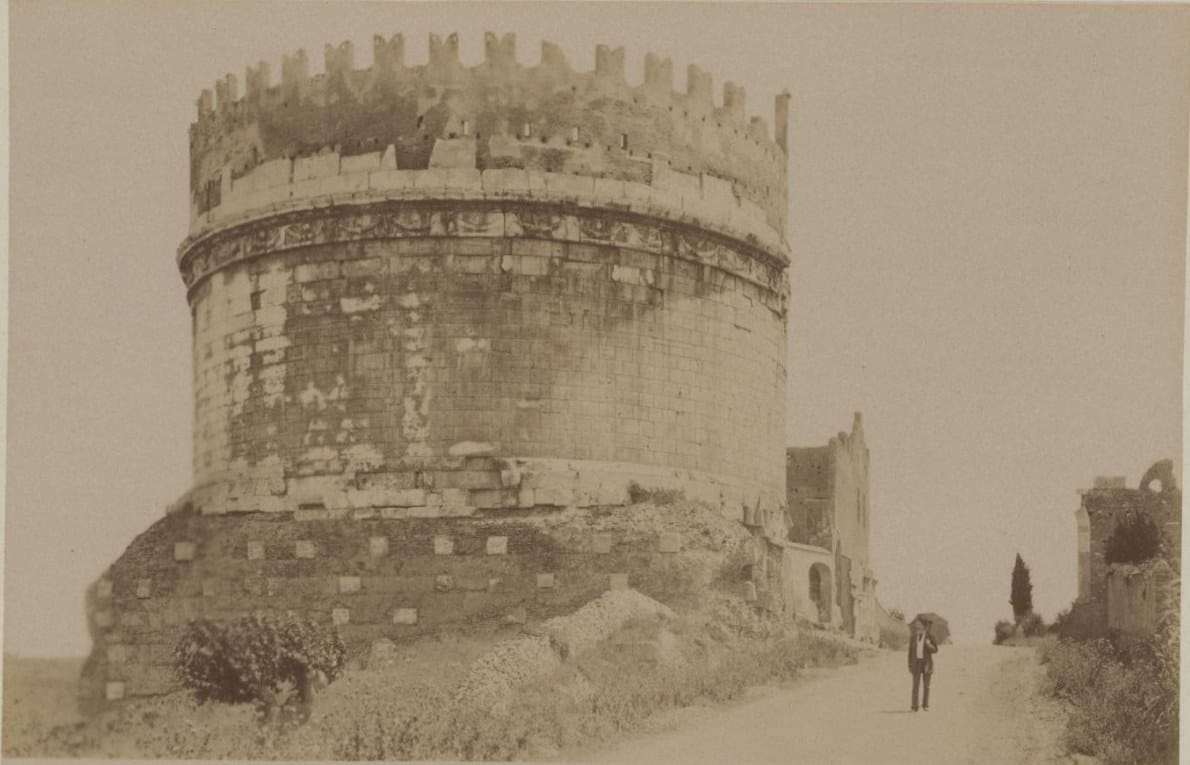
The Appian Way without pines. g1: Attributed to Altobelli & Molins, Via Appia near Rome, 1857–1865. g2: Fratelli Alinari, Via Appia with the tumuli of the Curiatii, c. 1880–1895. g3: Edizioni Brogi, The Via Appia with the tomb of Caecilia Metella, c. 1875. g4: Fratelli Alinari, Tomb of Caecilia Metella on the Via Appia, 1857–1900.
Trees on the Appian Way were planted by someone, like everything else. Canina put them in his accounts, though the documents I have seen don't say which, and some accounts trace the first plantings to Rodolfo Lanciani, at the end of the nineteenth century, and then to Giacomo Boni. But in the photographs of those years the rows can't be seen.
The rows we carry in our heads have an author and almost a date. According to the Archaeological Park, the pines of the Appian Way were planted, together with the cypresses, between 1909 and 1913 by Antonio Muñoz, the same inspector who in those years was mortaring and cramping the fragments, to look after "the picturesque side of the historic road" as well. They don't show in the postcard of those years because they weren't there yet, or were saplings. When Respighi put them into music, in 1924, the pines of the Appian Way were fifteen years old at most. When Verdone shot his dinner, in 1988, the rows were less than eighty. Today they are just over a century. Three hundred, never.
Muñoz is a character who keeps coming back. In the city, in the 1920s and 1930s, as superintendent and then as head of antiquities for the Governatorato, the fascist administration of Rome, he will demolish to isolate monuments: after the Via del Mare, the Capitol and Via dell'Impero. On the Appian Way he makes the opposite gesture: he adds, to frame. Two opposite gestures with the same aim, deciding how a ruin is to be looked at. The picturesque, which for two centuries had been the way travellers looked at the Roman countryside, becomes in his hands a project, and a state project at that.
After him, Rome fills up with pines. On the first mile, inside the walls, in 1929 the architect Raffaele de Vico designs the Park of the Scipios along Via di Porta San Sebastiano, with a monumental avenue "lined with tall pines and cypresses". At Porta Capena, where in 1789 Labruzzi drew vegetable gardens, vineyard walls and an ox cart, an avenue of pines runs today. Then come the pines of Via dei Fori Imperiali, planted around 1931 when the road was opened, already twenty years old; and the one Mussolini planted in Piazza Venezia at Christmas 1937, the first of a row of about two thousand that was meant to reach EUR. Along the Via Appia state road, towards Latina, the pines date from the fascist era: "ninety years have gone by and they are almost at the end of their life cycle", said Mario Tozzi, a former president of the Appian Way regional park, in August 2026.
Now that image is dying. In 2018 the Park counted 120 pines between Caecilia Metella and Via di Fioranello. From the middle of that same year the pine tortoise scale, Toumeyella parvicornis, spread through Rome: an insect from North America that sucks the pines' sap, coats them in sooty mould and, in severe cases, kills them. By 2019 it had already invaded much of the city. Dead pines are felled. Along the provincial road between Velletri and Nettuno, the Metropolitan City began felling 130 pines, and at the beginning of August 2026 the road reopened without a single tree.
Whatever takes the place of the Appian Way's pines will be a choice, and it will be a restoration choice, even if nobody calls it that. Replanting pines will mean rebuilding, as it was, a twentieth-century landscape: a legitimate reinstatement of a recent image that we have elected as the canonical one. Planting other species will mean adding a new layer, a declared one. Leaving the countryside open will mean going back, perhaps, to the Appian Way of Canina and the first photographs. None of the three is wrong in itself. What would be wrong is doing one of them without saying which one we are doing. That was the lesson of the trilogy on com'era, dov'era, as it was, where it was, and it holds for trees too: things should be called by their name.
The last layer
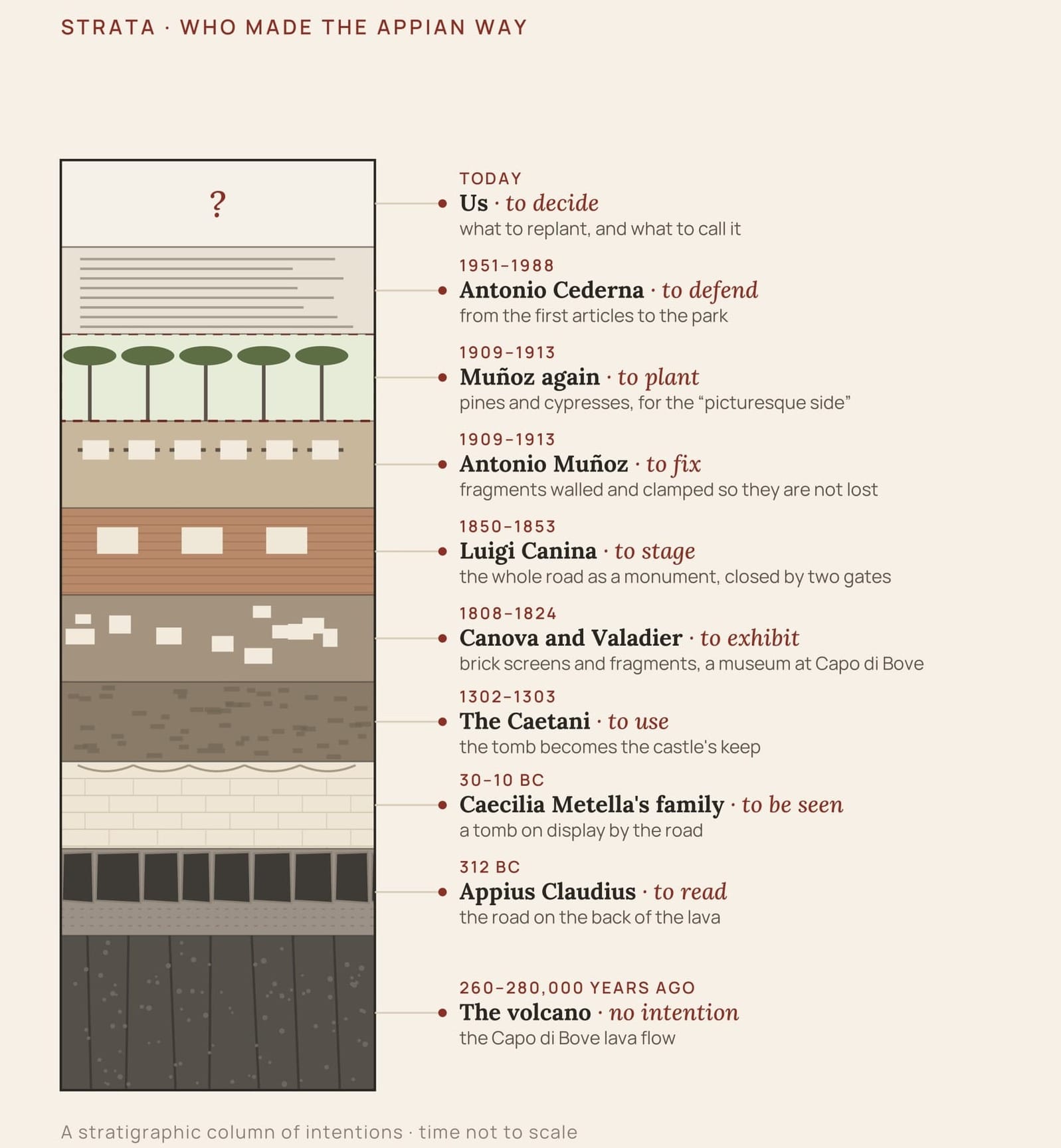
I read back over the list from the two parts. A volcano that designed nothing. A censor who read the ground, and his successors who paved it. A family that put a daughter and a wife on display. Medieval lords who turned a tomb into a tower. A sculptor who built a wall to show some fragments. An architect who turned a roadwork into a museum. Another who turned the whole road into a monument, and shut it behind two gates. An inspector who fixed what was left and, for the picturesque side, planted the pines. A composer who made those young pines into an eternal image. A journalist who defended the road. A film director who, in the shade of those pines, had a butcher say they were three hundred years old. An insect that is taking them away.
Each of them took what was underneath and interpreted it for a need of their own. Each kept something and erased something else. None of them left it as it was.
To ask which is the authentic Appian Way, then, is the wrong question. The authenticity of the Appian Way does not lie in one layer. It lies in being able to read them all, one on top of the other, without the last one wiping out the ones before. That is what restoration theory calls the historical instance, and it is the one rule I feel able to defend all the way.
And underneath, the volcano sleeps, while the ground rises two or three millimetres a year.
The same name, Caetani, will turn up in the next instalment, at the foot of the Lepini mountains: there the same family, in the same years, bought an entire town, which then died and became a garden. And there too there is a closed gate.
Visiting
The practical information on Caecilia Metella and the limited traffic zone is in the first part. The Villa of the Quintilii is part of the Archaeological Park, and the seven-day ticket covers it together with Caecilia Metella and Capo di Bove; the entrance is on the Via Appia Nuova, at number 1092. At Capo di Bove, with the same ticket as the tomb, you can visit the Roman baths and see where the Cederna archive works. Check opening times on the Park's website.
If you ride the Appian Way by bike, look out for the brick screens with fragments set into them, especially after the fourth mile: now you know they have an age, and more than one author.
Further reading
Carla De Stefanis, La Via Appia sotto le mura di Roma. Esperimenti di musealizzazione nell'Ottocento e oltre, Radboud University Press, 2025. Free to read online. The main source on Valadier and the nineteenth-century Appian Way.
Annarena Ambrogi and Rita Paris (eds), Il Museo della Via Appia Antica nel Mausoleo di Cecilia Metella – Castrum Caetani, L'Erma di Bretschneider, 2020. In Italian.
Antonio Cederna, I vandali in casa, Laterza, Bari 1956. In Italian.
Caterina Rossetti, "Sulla via Appia antica con Carlo Labruzzi", Lazio ieri e oggi, 2021. In Italian.
Parco Archeologico dell'Appia Antica, Documento per la gestione e la fruizione (2018): an administrative text that says, with rare frankness, what isn't working. In Italian.
Translations of quotations from Italian and Latin are my own.