Venice Biennale 2027: How to Visit, Giardini or Arsenale, and the Pavilions Worth Seeing
Two venues, one ticket, about thirty pavilions and a city around them. How to do the Venice Biennale in two half-days instead of one, which venue to choose if time is short, and where to go when you come out.
Is the Venice Biennale worth it? The short answers
Until Sunday 22 November 2026 the Giardini and the Arsenale host the Art Biennale, "In Minor Keys". Tickets, the vaporetto and the choice between the Giardini and the Arsenale work as described below. The rest of this guide is for the 2027 Architecture Biennale, from 8 May to 21 November.
Is it worth it? Yes, for the pavilions. I have been to the Architecture Biennale twice, in 2004 and in 2023, and in the end the most beautiful thing is still the pavilions: about thirty buildings put up by different countries over more than a century, in a garden on the water. The exhibition changes every two years; the pavilions stay.
How long? Three hours per venue, on average, says the Biennale itself. Do it in two half-days, on two different days: the single ticket gives you one entry to the Giardini and one to the Arsenale, even on days that aren't consecutive. In 2004 I did it in half a day, off the night train and back on the evening one: don't.
Giardini or Arsenale? The Giardini. They are more varied, and the pavilions are architecture. The Arsenale is less varied, and it feels like a big exhibition in a museum.
How much? In 2026 the single ticket cost €30, €20 for over-65s and residents of the City of Venice, €16 for students and under-26s, free up to the age of 6; the three-day ticket €40, the weekly €50. The 2027 prices come out in spring. The vaporetto costs €9.50 a ride, €25 for a day.
Don't miss: the pavilions as buildings, Fehn's, Aalto's, Rietveld's, Hoffmann's; at the Arsenale, the Gaggiandre; and outside the Biennale, in Dorsoduro, Tadao Ando's Punta della Dogana.
Skip: the Arsenale, if you only have half a day. Bear in mind that you then miss half of the main exhibition, which is usually split between the Central Pavilion at the Giardini and the Corderie.
Avoid: Mondays, when it's closed; suitcases, which aren't allowed in and can't be left; the access-fee days, if you aren't staying in Venice; July at midday.
The next one is the 20th International Architecture Exhibition, "Do Architecture — For the Possibility of Coexistence Facing a Real Reality", curated by Wang Shu and Lu Wenyu: from 8 May to 21 November 2027, with the pre-opening for press and professionals on 6 and 7 May, at the Giardini, the Arsenale and other venues around the city.
This is the practical guide. Why at the Biennale the most beautiful thing is the container, and what Alberto Sordi and a beach in Tel Aviv have to do with it, is in the essay: The Venice Biennale — Do We Really Want to Go In?.
Giardini or Arsenale, if you have to choose
At the Giardini every country has its own house, built by an architect of its own at a moment of its own, and walking from one to the next among the trees, with the water at the end of the avenues, is already the visit. The curator's exhibition is in the Central Pavilion; the rest are the national pavilions, each with its exhibition inside and its architecture outside. In 2023 we went in together, Kat and I, and the walk was beautiful.
At the Arsenale there is only one house. The main exhibition fills the Corderie, the Republic's rope factory, 317 metres of hall, and carries on into the Artiglierie and the Tese with more national pavilions, all the way to the Giardino delle Vergini. I went on my own, in 2023, because I had never been and I was curious, and I didn't like it: it is less varied than the Giardini and feels like a big exhibition in a museum. Along the way, though, there are the Gaggiandre, the two covered docks of the sixteenth century.
So: with half a day, the Giardini. With two, both, on two different days.
Tickets
The 2027 prices come out in spring; these were the 2026 ones, for the Art Biennale.
The single ticket gives you one entry to the Giardini and one to the Arsenale, even on different days that aren't consecutive, but you can't go out and come back in: €30 full price, €20 for over-65s and residents of the City of Venice, €16 for students and under-26s, with ID. Children up to 6 go in free, with a complimentary ticket booked online together with an adult's; from 7 they pay the reduced price. The three-day ticket costs €40 and the weekly €50: they are personal, valid on consecutive days, and allow several entries to each venue.
You buy them online at labiennale.vivaticket.it, with a 50-cent booking fee, or at the Infopoints of the two venues, at the Giardini in Viale Trento. Suitcases and large bags aren't allowed in, and there is no left-luggage: the cloakroom only takes small items. There are restaurants and cafés at both venues, and dogs, small and medium-sized, on a lead, are allowed only in the green area of the Giardini.
Getting there
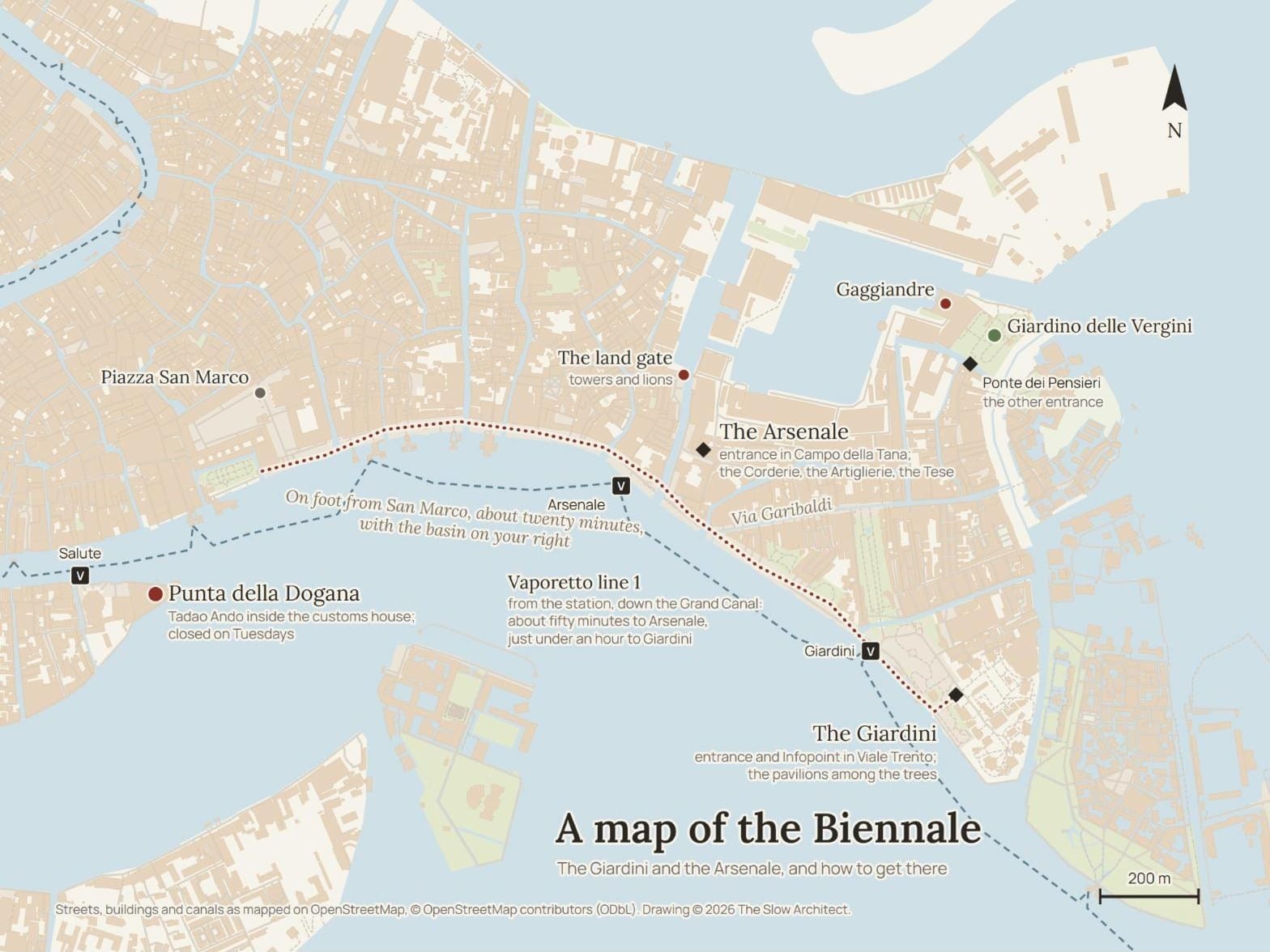
From the station. Vaporetto line 1 goes all the way down the Grand Canal and reaches the Arsenale in about fifty minutes and the Giardini in just under an hour, every twelve minutes: it is slow, and it is the most beautiful trip you can take on a €9.50 ticket, which lasts 75 minutes. For the Arsenale there is also the 4.1; for the Giardini the 2, the 4.1 and the 5.1, and from Piazzale Roma the 6. If you take more than two vaporetti a day, the pass pays for itself: in 2026, €25 for 24 hours, €35 for 48, €45 for 72 and €65 for the week.
On foot. From San Marco to the Giardini you walk along the waterfront, eastwards, twenty minutes or so with the water of the basin always on your right: it is the most beautiful way to get there. Between the Giardini and the Arsenale it's ten minutes on foot.
From Rome. The high-speed train gets you there in under four hours, with about thirty trains a day. You can do it in a day, but it is the mistake I made: the Biennale in half a day, between two trains.
The access fee. In 2026 anyone entering the old city for the day, without staying the night, paid on 60 days between April and July, weekends, public holidays and long weekends, from 8:30 to 16:30: €5 if booked at least four days ahead, €10 after that, on cda.veneziaunica.it, with a QR code to show at the checks. Exempt, among others, are under-14s, residents of the Veneto and anyone staying overnight in the municipality, who must still register. The 2027 calendar isn't out yet: the Biennale opens on 8 May, and in 2026 the paying days covered the weekends from May to July.
The Giardini, in order
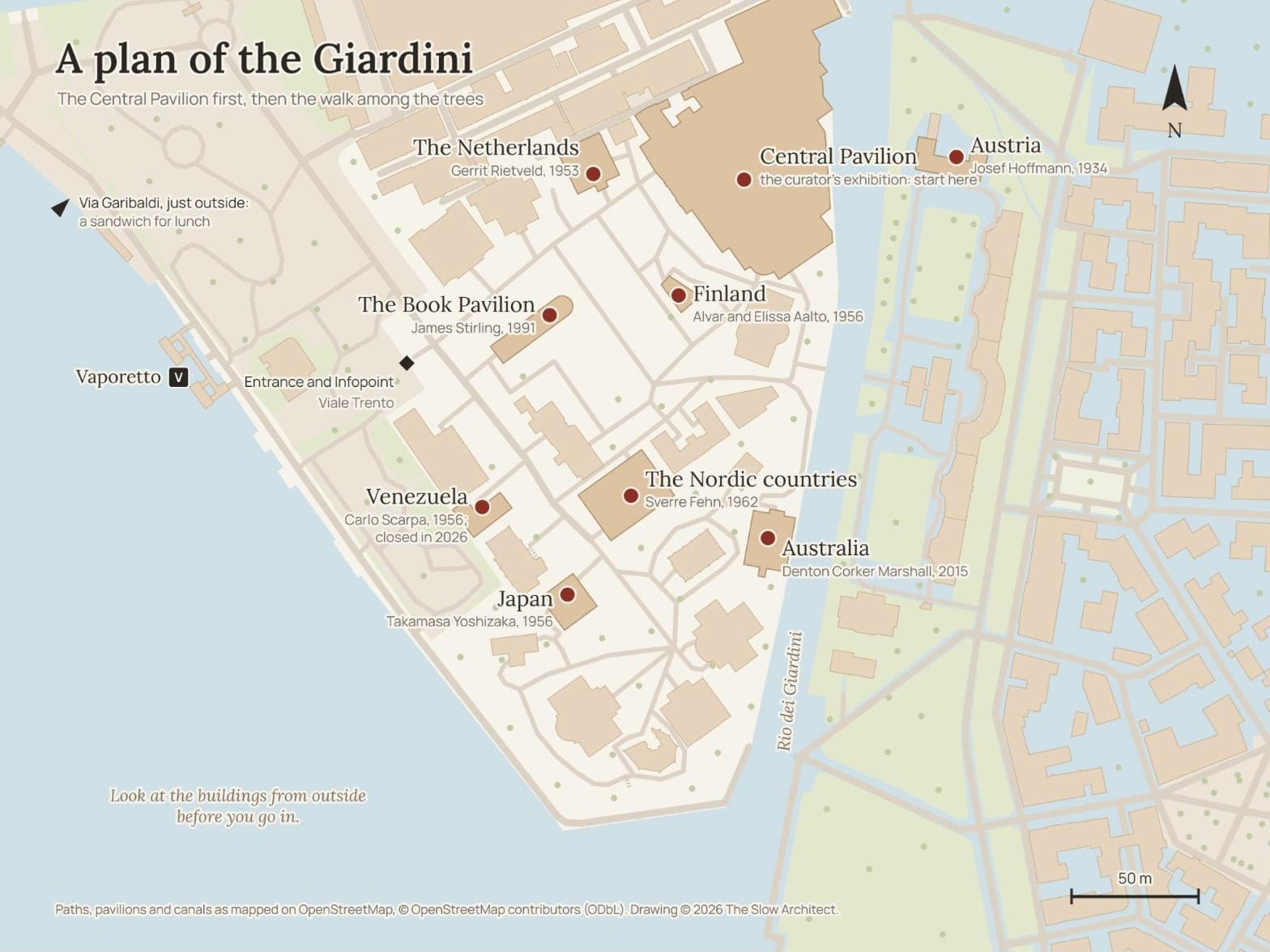
You go in from Viale Trento, where the Infopoint is. The first thing is the Central Pavilion, with the curator's exhibition: it was renovated from top to bottom and reopened in 2026, after sixteen months of work. With the renovation, Tobias Rehberger's café disappeared too, the one all black-and-white stripes and coloured chairs where we had an ice cream in 2023: it was a work of art, a Golden Lion in 2009, and today there is a new bar in its place.
Then the walk, without hurrying, among the trees. The pavilions to look at for what they are, not for what they contain:
Austria, Josef Hoffmann, 1934, finished in 1954: symmetrical, almost without ornament, and from the entrance you see through the hall to the garden terrace.
The Netherlands, Gerrit Rietveld, 1953: a square sixteen metres by sixteen, lower in the middle, with the windows high up and wooden shutters that soften the light.
Finland, Alvar and Elissa Aalto, 1956: timber, prefabricated in Finland for a single Biennale, to be taken down and put up again elsewhere. It could never be taken down, and it is still there.
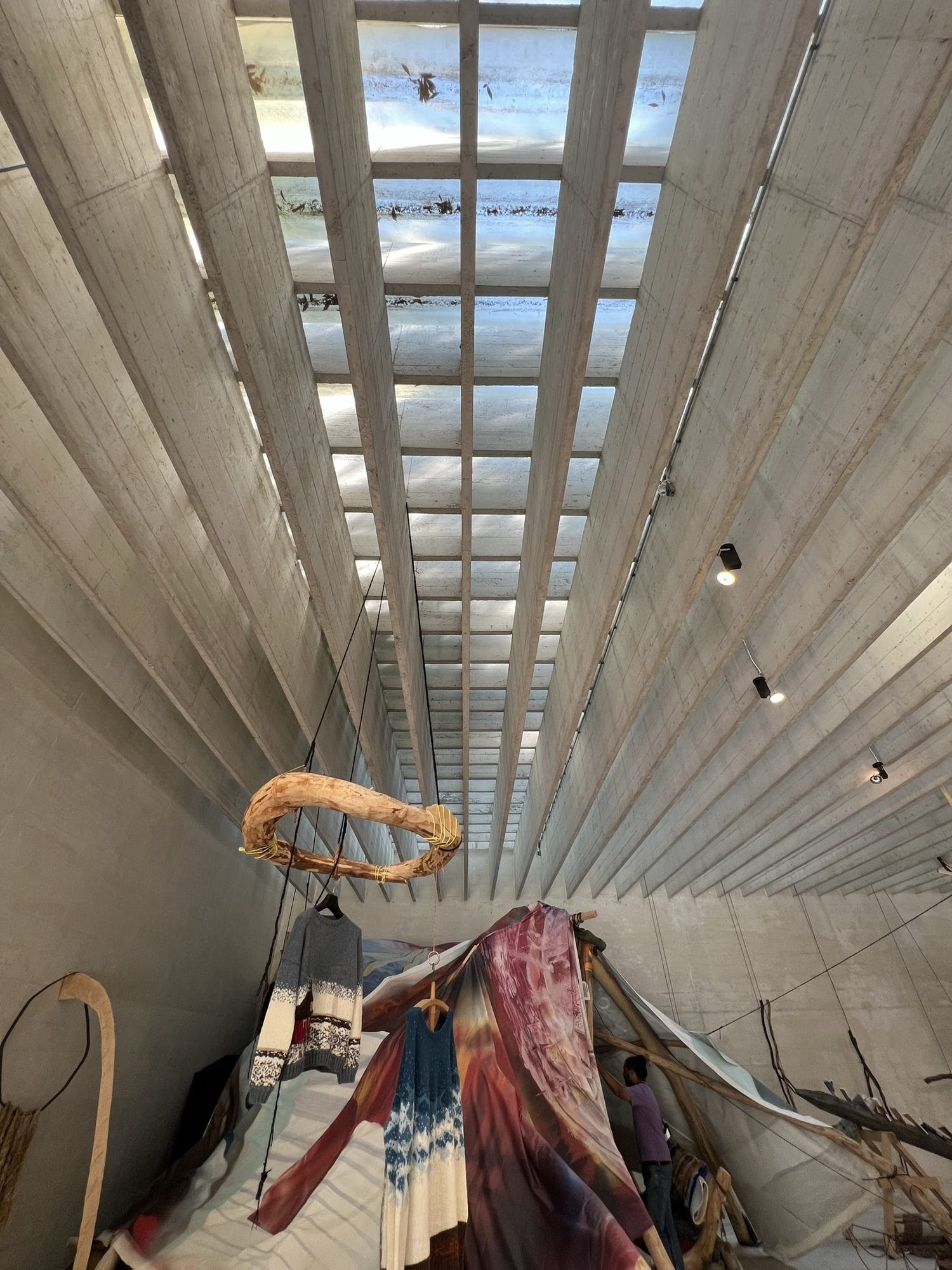
The Nordic countries, Sverre Fehn, 1962: the roof is made of two layers of concrete ribs, a metre deep and six centimetres thick, and the trees grow through it. The light inside is the most beautiful in the Giardini.
Japan, Takamasa Yoshizaka, 1956: the architect had spent two years in Le Corbusier's studio, and it shows.
Venezuela, Carlo Scarpa, 1956: the most refined, and the most neglected. In 2026 it was closed, with a sign in three languages saying it would soon be reborn: if it is open in 2027, go in.
The Book Pavilion, James Stirling, 1991, by the entrance.
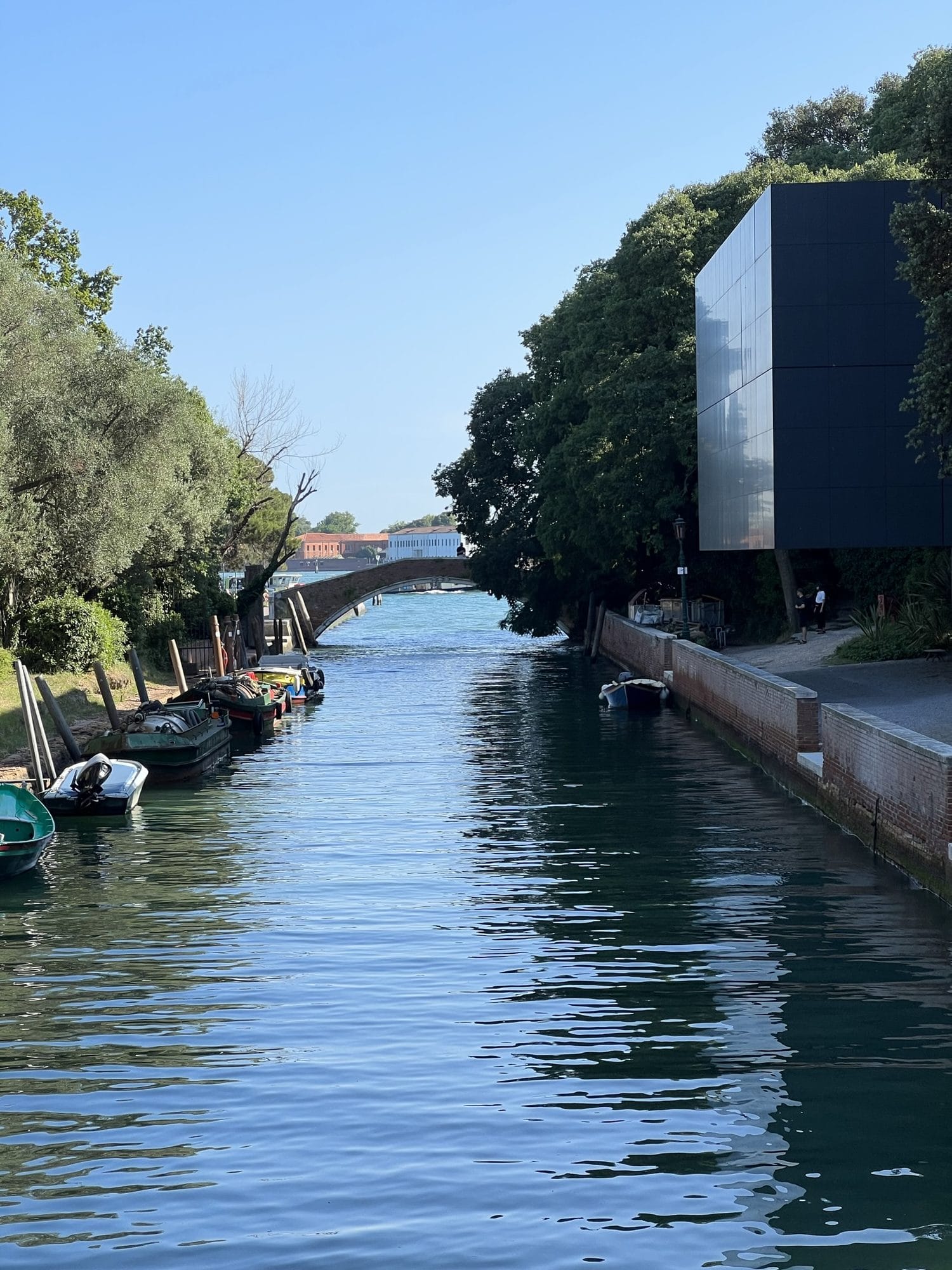
Australia, Denton Corker Marshall, 2015: a box of black granite on the Rio dei Giardini, white inside, the first building of this century in the park.
The pavilions' exhibitions change every time, and you'll like some and not others. The buildings don't: look at them from outside before you go in.
The Arsenale, if you have another half-day
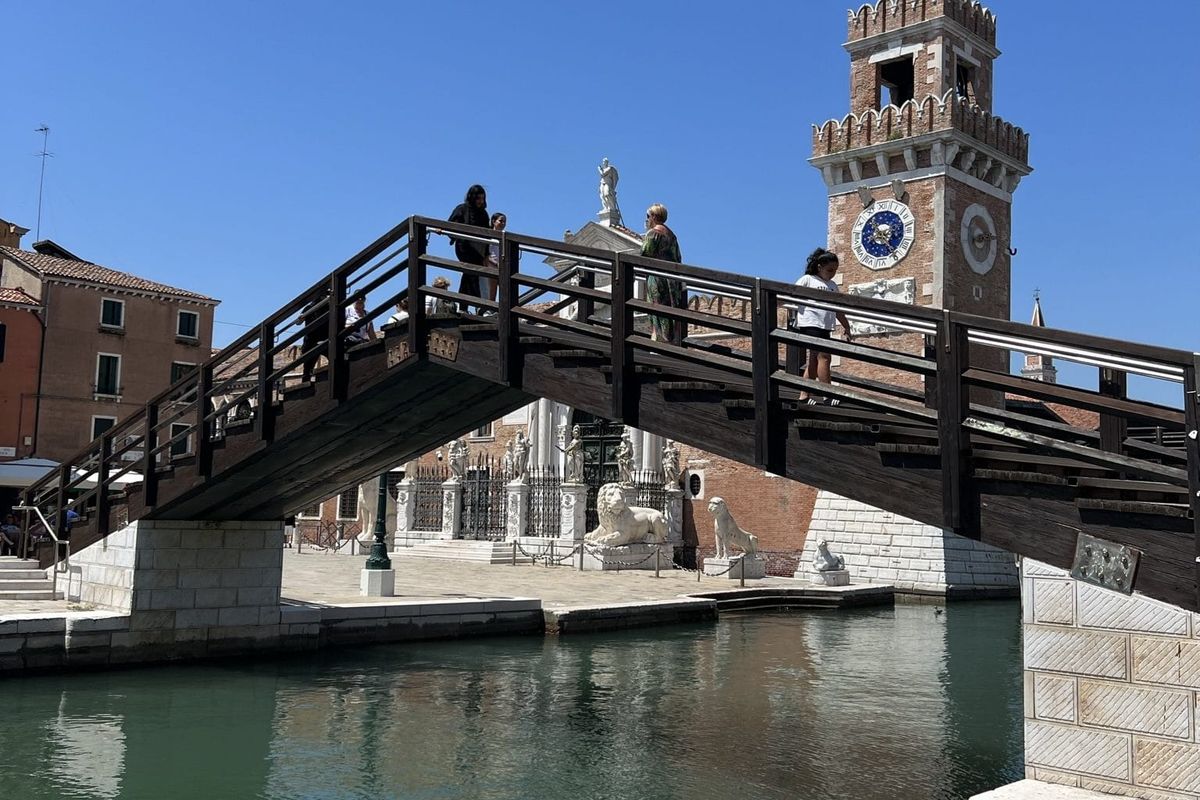
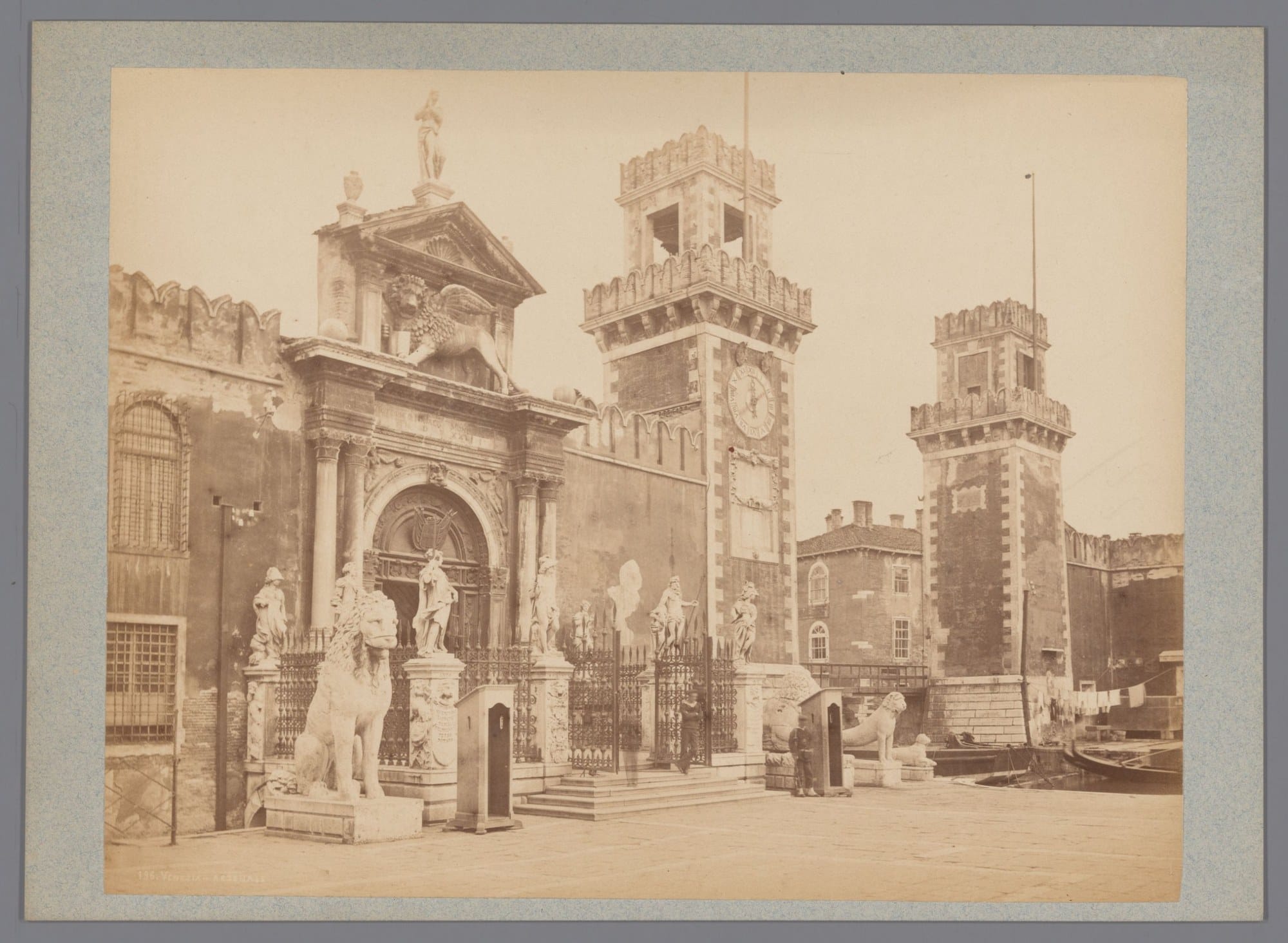
You go in from Campo della Tana, or from the Ponte dei Pensieri. The route starts in the Corderie, built in 1303 and rebuilt between 1579 and 1585 by Antonio Da Ponte, the man who built the Rialto Bridge: 317 metres of hall, with the curator's exhibition inside. Then the Artiglierie, the Tese, the national pavilions that have no house at the Giardini, the Italian Pavilion in the Tese delle Vergini, and the Gaggiandre, the two covered shipyards on the water built between 1568 and 1573 to designs attributed to Jacopo Sansovino. Off the route, but five minutes away, is the land gate of the Arsenale, in Campo dell'Arsenale, with the towers and the lions of the cover photo.
In summer the Arsenale is the venue to do in the cool. In 2026, on Fridays and Saturdays until September, it stayed open until 20:00: if they do the same in 2027, that is the right time to go in July.
Punta della Dogana, the exhibition that isn't the Biennale
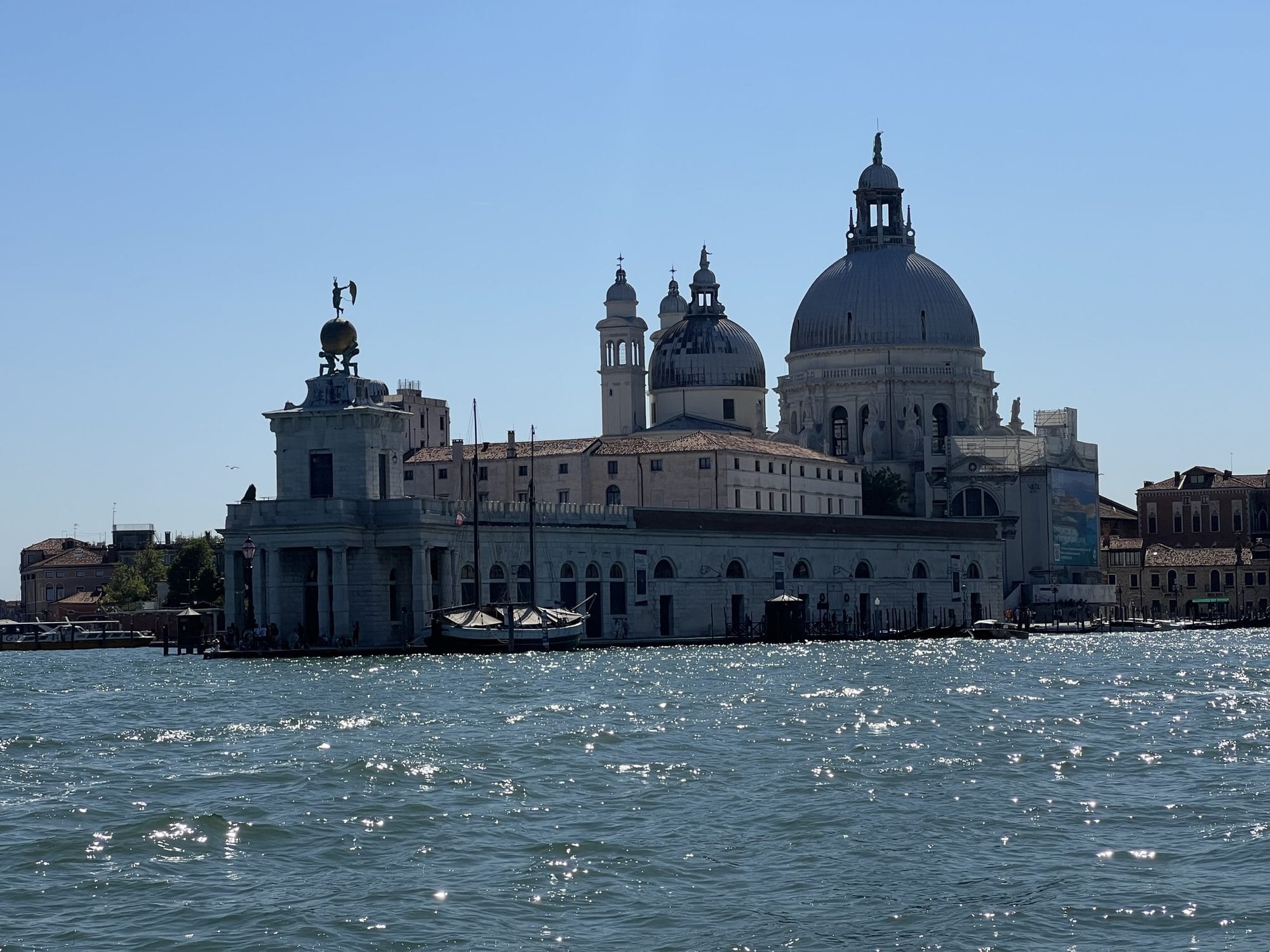
After the Arsenale I went to Punta della Dogana, to see what Tadao Ando did there: it is magnificent, and little known. It is the triangular building on the tip of Dorsoduro, the customs house for goods arriving by sea, finished in its present form in 1682 by Giuseppe Benoni. In 2009 Ando restored it for François Pinault's collection: the brick walls and the timber trusses brought back to light, a few walls of exposed concrete, a reinforced-concrete cube in the middle, and in the openings steel grilles that quote the door of Carlo Scarpa's Olivetti shop, in Piazza San Marco. Through the grilles you see San Giorgio Maggiore.
It is open during exhibitions, from 10:00 to 18:00, with the last entry at 17:00, and closed on Tuesdays. The ticket, €20, €7 from 20 to 26, free under 20, gets you in once to Punta della Dogana and once to Palazzo Grassi. You get there on line 1, Salute stop. And then you walk back, through the calli of Dorsoduro, which are less touristy and more real.
Eating
On Biennale day my usual rule applies: something light at lunch, to stay awake, and the best of the day in the evening. There are restaurants and cafés at both venues; just outside the Giardini there is Via Garibaldi, the wide street Napoleon had made by filling in a canal, where a sandwich is easy to find.
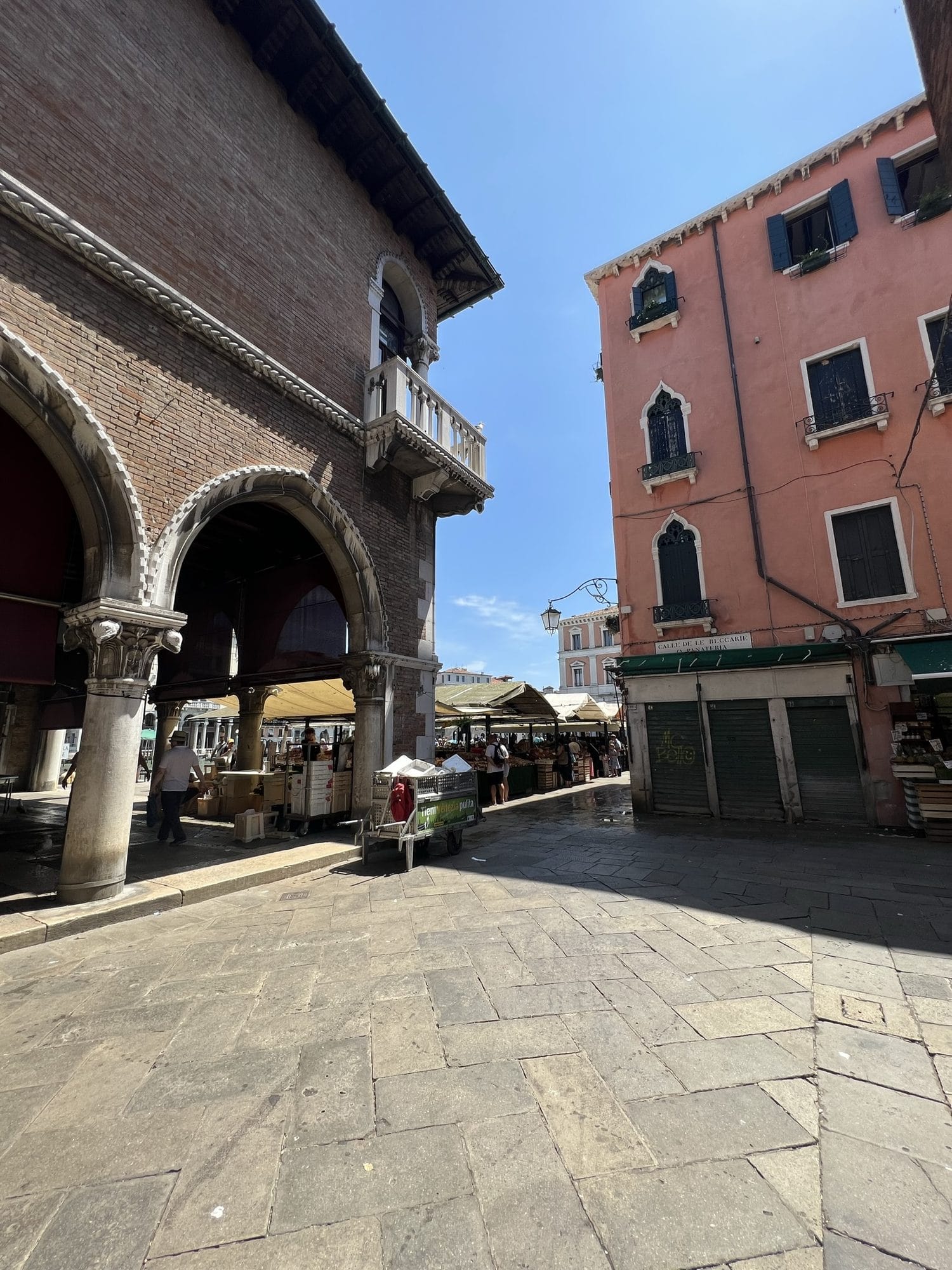
The bacari, Venice's old wine bars, are another day, and in Venice I broke that rule on purpose. We did the bacaro tour on a Saturday, the day in between the Giardini and the Arsenale: we started drinking mid-morning, we had lunch, and we carried on into the early afternoon. When you do something, you do it properly. The tour starts from Ca' Foscari, a few steps from where we were staying, heads for San Tomà, crosses San Polo to the Rialto market, goes over the bridge and heads up towards Santi Giovanni e Paolo. The stops: Cantina Do Mori, in Calle dei Do Mori, in San Polo, said to have been founded in 1462, where I had the Venetian spritz, the one made with Select, the aperitif born in Venice in 1920; Cantina Do Spade, close by, already mentioned in 1488; then, over the bridge, Bar Ai Santi, a few steps from Campo Santi Apostoli, and Un Mondo DiVino, in Cannaregio. You eat standing up, one cicchetto and one ombra at a time: the small bite and the small glass of wine. The bacari's hours change, and some close on Sundays: check before you go.
Sleeping
Stay in Venice, if you can. To do the Biennale over two days, to take the city slowly, and because anyone staying the night in the city doesn't pay the access fee. In 2023 we stayed at the Albergo Casa Peron, in Salizada San Pantalon, in Santa Croce: a small hotel, one star, among the calli, a few steps from Ca' Foscari and from Dorsoduro, and it was from near there, from Ca' Foscari, that the bacaro tour set off. For the evenings, Dorsoduro, which is less touristy and more real; for the Biennale, Castello, a few steps from the Giardini.
The traps
Mondays. The Giardini and the Arsenale are closed, except for a few Mondays announced in the calendar.
The single ticket. One entry per venue: if you leave, you don't get back in.
Suitcases. They aren't allowed in and can't be left: drop them first, at the hotel or at a left-luggage office.
The access fee. On the paying days, day-trippers pay €5 or €10, and anyone staying in Venice still has to register.
The heat. In July, at midday, there is no escape between one pavilion and the next: go early in the morning or in the evening.
Line 1. From the station to the Giardini takes almost an hour: don't cut it fine.
The hours. For 2027 the Biennale has announced 10:00 to 18:00; in 2026 the summer hours were 11:00 to 19:00, and 10:00 to 18:00 from 29 September. Check again in spring.
Punta della Dogana. Closed on Tuesdays, and open only while an exhibition is on.
The Venezuela pavilion. In 2026 it was closed.
Half a day. Both venues in one afternoon, between two trains, is the surest way to see nothing.
One day, two or three
One day. The Giardini at opening time, a light lunch in Via Garibaldi, the Arsenale in the afternoon. It can be done, but it is the tiring version, and there is no time left for the bacari.
Two days. On the first, the Giardini in the afternoon, calmly, and in the evening a bacaro, while they are still open. On the second, the Arsenale in the morning, then Punta della Dogana and the walk back through Dorsoduro.
Three days, as we did in 2023. On the Friday, arriving at lunchtime, the Giardini in the afternoon. On the Saturday the city and the bacaro tour, from mid-morning to early afternoon. On the Sunday the Arsenale, Punta della Dogana and Dorsoduro. It is the right rhythm: one venue a day, and a day in between for Venice.
Further reading
Alberto Toso Fei, Venetian Legends and Ghost Stories: A Guide to Places of Mystery in Venice (Elzeviro, 2002): the city's legends and mysteries, told place by place, by the author of Forse non tutti sanno che a Venezia..., the Italian book of Venetian curiosities. Fun to read, before you go or once you are there.