The question of the bridge
I went back to Civita with my daughter. She ran across the bridge; I walked behind, asking why we keep building bridges toward a city that is disappearing.
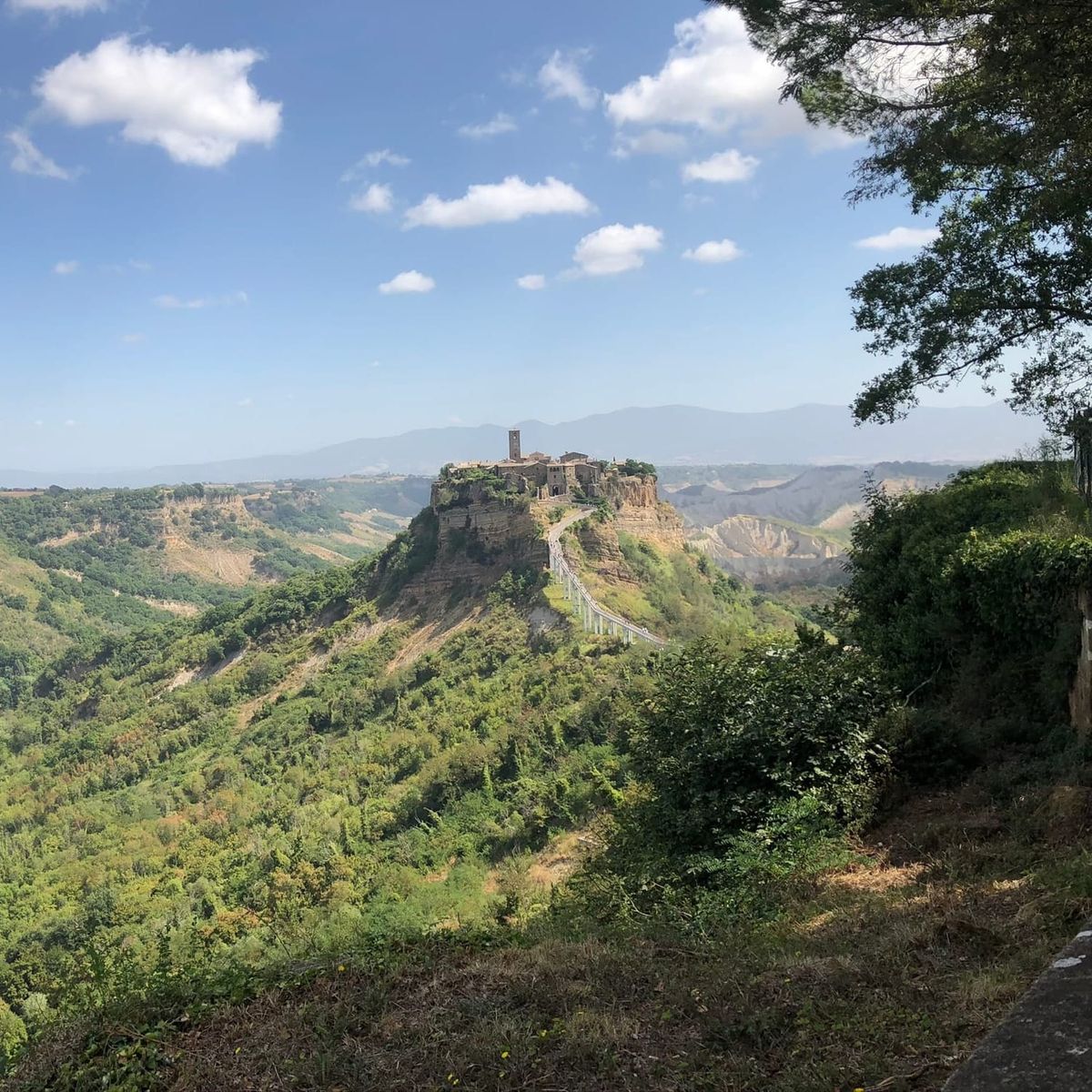
A few weeks ago I went back to Civita di Bagnoregio with my daughter Lea.
She is nearly three. For her the bridge was an adventure — three hundred metres of concrete suspended in the void, the wind coming up from the valley, the calanchi below that looked like they'd been drawn by someone with too much time on their hands. She ran for most of the crossing, stopped three times to look down through the railings, and said "daddy look" in the same voice she uses for cats and buses.
I walked behind her, thinking about a question I ask myself every time I come here.
Why do we keep building bridges toward a city that is disappearing?
This is not a rhetorical question. The tufa block on which Civita stands crumbles through catastrophic collapses — years of silence and then ten metres of cliff face falling into the valley in a few seconds. The average is seven centimetres per year, but that average conceals brutal discontinuities. Engineers work on the cliff with micropiles and steel tendons, and they work on the opposite bank at Lubriano too, because the two sides of the canyon condition each other. It is a continuous battle against a geology that has already decided the outcome.
And yet the bridge is there. And every morning thousands of people cross it.
I thought about this while Lea ran ahead — because in Civita children can run freely, there are no cars, no mopeds, the medieval streets are as safe as a park. She knew nothing about the geology, the collapses, the battle against the clay. She only saw a beautiful village where she could explore without anyone worrying.
Perhaps that is the answer. We don't build bridges toward Civita because we think we can save it permanently — geology will have its victory, sooner or later. We build bridges because as long as the place exists, it's worth reaching. Because beauty that is disappearing is still beauty. Because my daughter running through a medieval alley while I study a fourteenth-century wall is a thing worth doing, even knowing that alley won't be there in a few centuries.
Bonaventura Tecchi, the writer who gave Civita the name "the dying city," was from Bagnoregio. He lived his whole life with this place in front of his eyes. He chose to call it dying rather than dead — present tense, not past. It is still happening. It is still there.
We cross the bridge while it's there.
Giulio Romano — The Slow Architect
P.S. On the blog I've written Civita in two parts. The first covers the geology, the history, the 1695 earthquake that split the city in two, the cinema — Fellini, Totò, Miyazaki, Rohrwacher. The second covers Astra Zarina, Cesare Brandi's theory of restoration, and why the steel tendons in medieval rock must be visible.