One step to the side
Four visits to Orvieto, and I'd never seen it. Then I took one step to the side — and the whole building changed. On why this blog begins from the wrong angle.
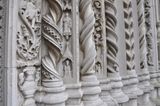
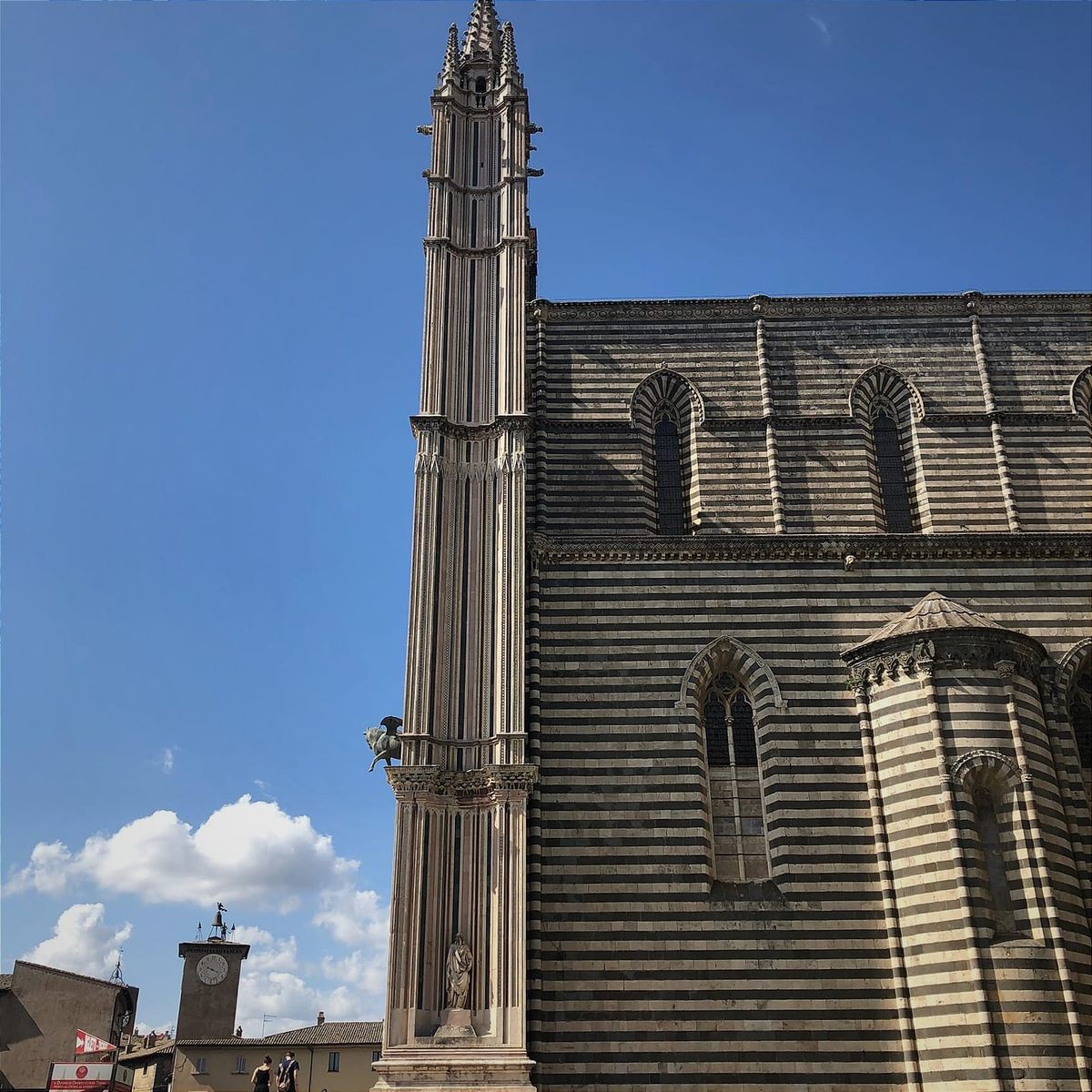
The facciata a paravento logic: a side profile revealing how the independent screen facade functions as an autonomous wall, ascending significantly higher than the actual roofline of the nave behind it.
There is a precise moment when I understood why I wanted to write this blog.
I was in Orvieto, in Piazza del Duomo, with the facade in front of me. It was afternoon, and the gold of the mosaics was beginning to do what it does in the late afternoon — reflect light instead of absorbing it, turning the piazza into something vaguely unreal. I had seen the Duomo of Orvieto three or four times in my life. I thought I knew what it was.
Then I took one step to the side.
For no precise reason — by chance, or perhaps because someone was walking past me. I moved three or four metres toward the edge of the piazza and looked at the Duomo's profile from the flank instead of from the front. And I saw something I had never noticed: in four previous visits, in years of architecture studies, in all the literature on Italian Gothic I had read.
The spires of the facade are taller than the roof of the church.
Not slightly. Significantly. The facade is not the front of the building — it is an autonomous screen, a wall that lives independently of the Romanesque body behind it. What you see from the piazza is not the end of the church. It is a manifesto leaning against the church.
I spent the next twenty minutes standing there, looking at the profile. The tourist beside me probably thought I was waiting for someone. I was actually trying to understand why, in four visits, I had never taken that step to the side.
The answer, I think, is that Gothic cathedrals are meant to be looked at head-on. That is how they are designed to be seen — the central axis, the symmetry, the verticality that draws the eye upward. Taking a step to the side goes against the grammar of the building. And that is precisely why it reveals something the grammar conceals.
This blog begins from that step to the side. Not from the facade — from the flank. Not from the optimal angle — from the wrong one. From the idea that the places we think we know always have a profile we haven't looked at yet.
Giulio Romano — The Slow Architect
P.S. On the blog I've written the full story of the Orvieto facade — why Maitani used the bas-reliefs as structural ballast, why the gold mosaics are an optical system and not decoration, and why Sangallo solved the problem of darkness in the Pozzo di San Patrizio with the same logic Maitani used to solve the problem of distance. If you haven't read it yet, it's here