HOW WAS ROMAN CONCRETE MADE?
Burn the limestone, slake it or don't, add volcanic ash and pack it in with rubble. How Roman concrete was made, from Vitruvius to the walls still standing.
How, exactly? · Lime, volcanic ash, rubble and not much water: the proportions Vitruvius wrote down, the ones in the walls still standing, and what is quick about quicklime.
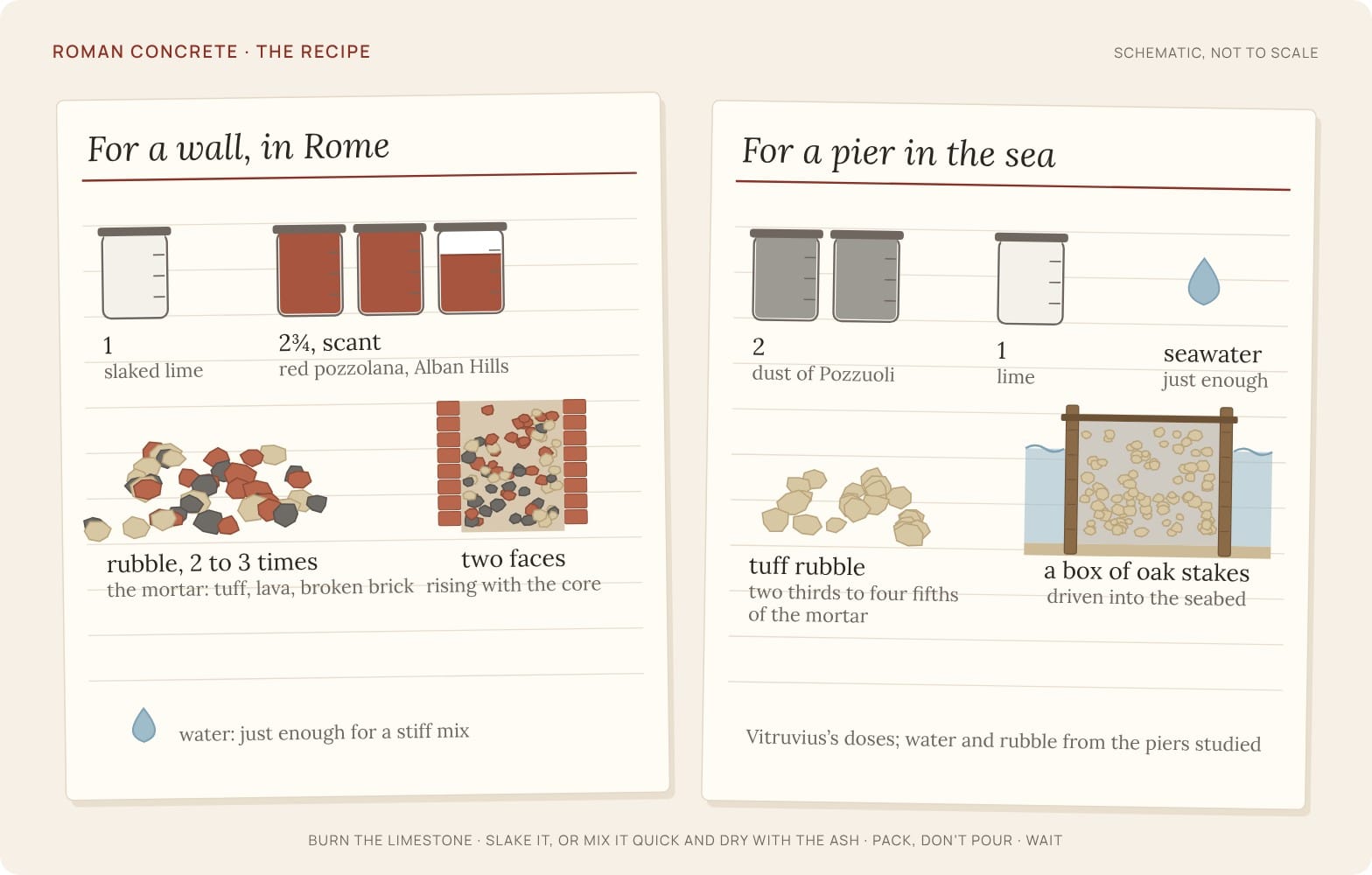
The short answer. Vitruvius wrote down the recipe for Roman concrete, and it can be made again. You need lime, volcanic ash, rubble and a little water. For harbours, two parts of ash to one of lime, mixed with seawater; in the concrete that has survived there is a little more ash, about two and three quarters. The lime was burnt in a kiln and used slaked, or else as quicklime, mixed dry with the ash. Nobody poured it. It went in stiff, packed between the two faces of a wall or into a timber box driven into the seabed, and the rubble was pressed into it. Time did the rest.
That is the short answer. The one you usually read fits on a single line.
The textbook answer
Lime, volcanic ash and seawater, plus a few lumps of volcanic rock: that is the recipe you usually find, for instance in the press release the University of Utah put out in 2017 for a study of Roman piers. For harbours it is right. Everywhere else it leaves things out: on land seawater has nothing to do with it, the proportions matter, the lime could go in quick or slaked, and the rubble was not always volcanic. And Vitruvius, who actually wrote the recipe down, says nothing about water.
The recipe
Vitruvius puts it down in black and white, the way a recipe is written at home: so many parts of this, so many of that, and the water left to whoever does the mixing. Here it is, with his proportions and, where he gives none, the ones scholars have found by measuring the walls and piers that are still standing.
As with any family recipe, the written version and the one actually made don't match. Vitruvius writes two of pozzolana to one of lime; in the Roman concrete studied today there are about 2.7 parts of pozzolana for every part of lime. In 2004 the ROMACONS team remade Vitruvius's recipe in the harbour at Brindisi, in the form of a pila, as the Romans called it: a block about two metres a side, small by the standards of a Roman harbour. They lowered the mortar into the box in wicker baskets, in layers of about twenty centimetres tamped down with rakes, and threw the tuff in on top, piece by piece; by the next day it had set enough to walk on. In the upper part, though, they had corrected Vitruvius the way the Romans did, with 2.7 parts of pozzolana, and it was the upper part that came closest to the ancient samples. Perhaps, they wrote, Vitruvius was following an ideal rule, the kind that belongs in a treatise, rather than what was done on site: lime was the most expensive ingredient, and builders in the first century may have skimped on it a little and found that the concrete came out better. It did not always end so well. The main reason buildings collapse in Rome, Pliny writes, is the purloining of lime.
The ingredients, one by one
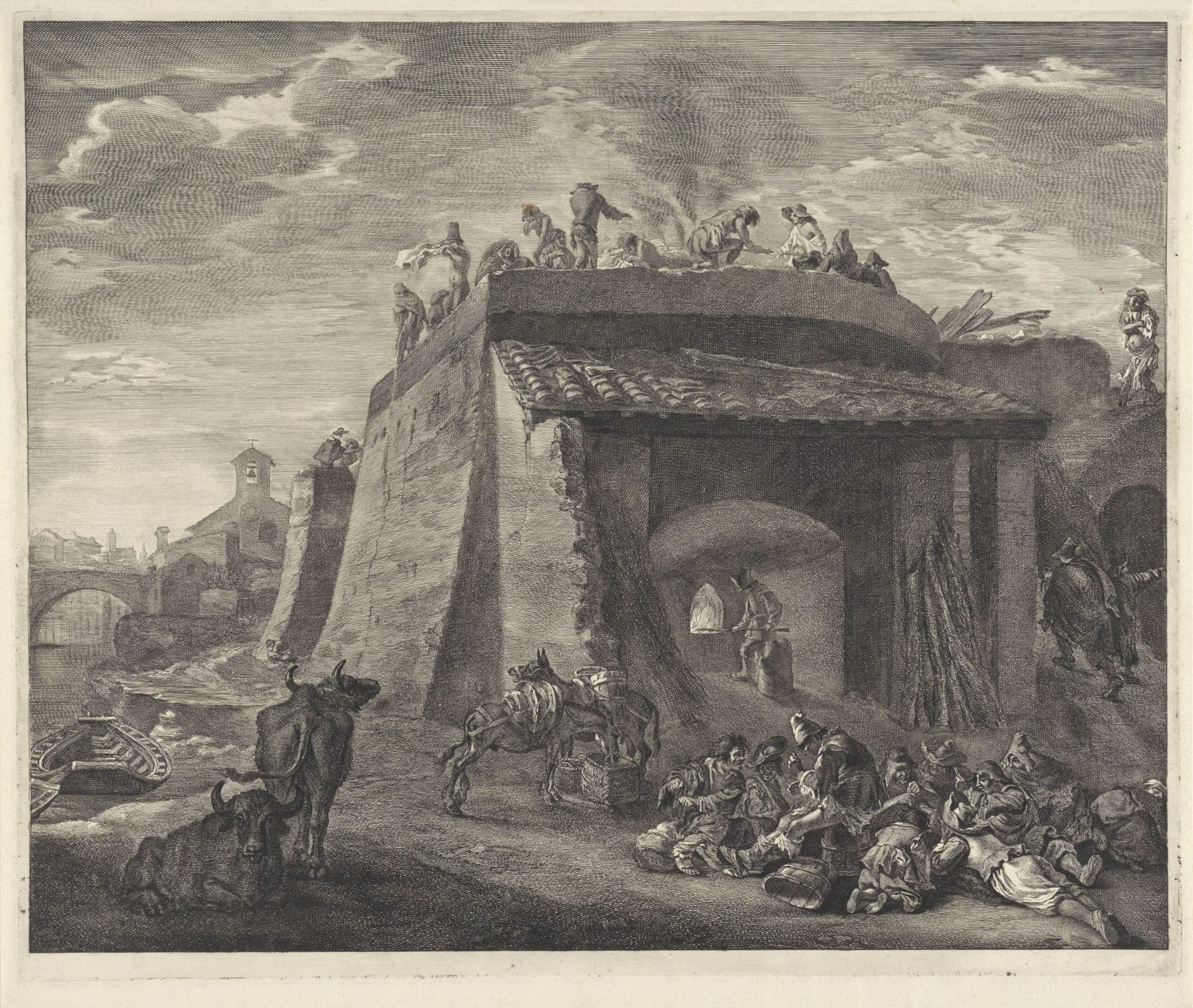
Lime. It is cooked stone. The heat of the kiln drives the carbon dioxide out of limestone and gives the stone back the same size, only lighter: it loses weight in the cooking, like a roast. Weighed, Vitruvius writes, it has lost about a third, and he thought the fire had boiled the water out of it. What comes out is quicklime, living lime. Why it should be living is not known for certain: perhaps because, like a fire, it has not yet been quenched, or because of the force with which it reacts. Wet it and it wakes up: it gets hot, very hot. To Pliny this was a remarkable quality: once burnt, it grows hotter still with water. When it has drunk and gone quiet again, it is called slaked. The words are Roman, calx viva and calx exstincta, living lime and quenched lime, and they are already in Vitruvius; quicklime says the same in English, from the days when quick meant alive. In the wall, the lime that has not reacted with the ash comes full circle: it takes back from the air the carbon dioxide the fire drove out, and slowly turns into calcium carbonate again. The stone that went into the kiln becomes stone again in the wall.
Pozzolana. It is volcanic ash, and it is the ingredient that makes the difference. In Rome it is the red pozzolana of the Alban Hills, erupted almost half a million years ago by the same volcano the Appian Way runs over, and it is the main ash in the mortars of the city's monuments. For harbours the ash came from the Bay of Naples instead, and it travelled, some of it a very long way. The Romans called it pulvis puteolanus, dust from Pozzuoli, and the word pozzolana still carries the town's name. Vitruvius knew it from around Baiae and the towns round Vesuvius, a powder that "from natural causes produces astonishing results": with lime and rubble it sets hard under water, hard enough to build piers in the sea. Vitruvius thought a fire hidden under that land made it work. The real reason is that the ash contains volcanic glass, molten rock quenched in an instant, and the glass reacts with lime and water to make new minerals that bind everything together, at sea as well.
Rubble. The Romans called it caementa, chips of split stone. Vitruvius calls this kind of building caementiciae structurae; opus caementicium, the name in the textbooks, turns up only once in ancient sources, in an inscription from a second-century sanctuary in what is now north-eastern Greece. It was split stone or fired clay: tuff, travertine, lava, broken brick. On land there was a lot of it, about three quarters of the volume; in the piers, a little under half.
Water. Not much, because the mix had to stay stiff. And at sea, seawater: that is what the Romans mixed the ash and the lime with.
A detail nobody notices
The recipe is written into the words, too. Cement comes from caementa, and caementa from caedere, to cut: at first it was the name of the stones, not of the glue. Mortar comes from mortarium, the trough it was mixed in, the same word as the mortar in a kitchen: the name passed from the bowl to what was made in it. The Latin for lime was calx, which the Romans had taken from the Greek chálix, a pebble. Calx also gave calculus, the little pebble used for counting, and so our calculations.
Where to see it
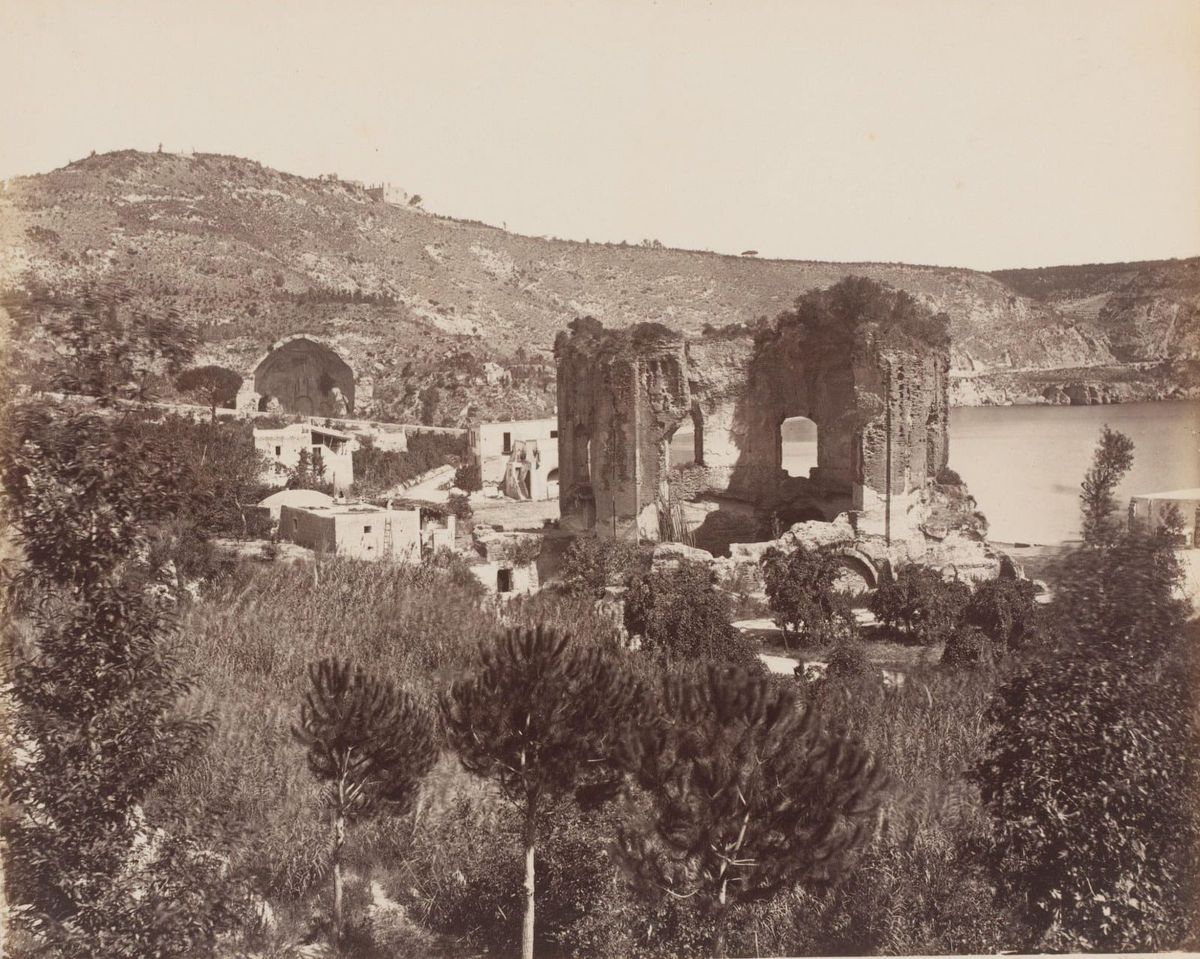
Under water, at Baiae. The underwater archaeological park, between Bacoli and Pozzuoli, can be seen from a glass-bottomed boat, usually from April to November, or with a mask or with scuba tanks, through the authorised diving centres. A few metres down, carried down by bradyseism, the slow rise and fall of the ground in the Campi Flegrei, lie the Roman villas and Portus Iulius, the harbour Agrippa built in a hurry around 37 BC, with its piers and its concrete pilae: it is one of the harbours where the ROMACONS team took its cores in 2006.
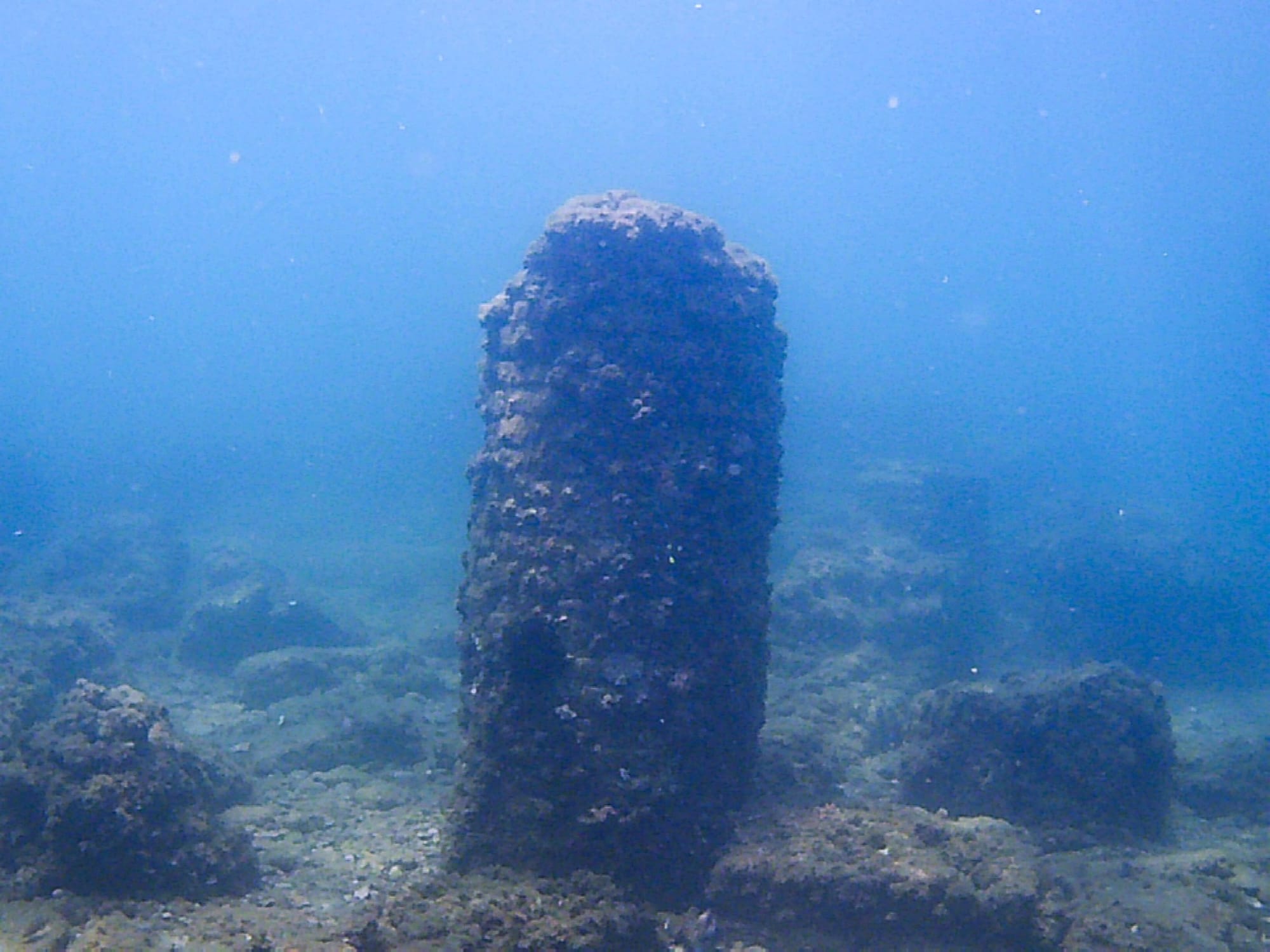
On land, in Rome, the same recipe with red pozzolana is in the walls of Trajan's Markets. Why it is still there after two thousand years is another question, with an answer of its own. [[ LINK: Why Does Roman Concrete Last? → /why-does-roman-concrete-last/, on "another question" ]]
…, Exactly? answers one question about a building, properly. If there is one you have always wondered about, reply to any Slow Letter and ask.
Sources: Vitruvius, De architectura II.4–6, V.12 and VIII, in Morgan's translation; Pliny the Elder, Natural History XXXVI.174–177, in Eichholz's translation; J. P. Oleson et al., the ROMACONS pila at Brindisi (2004); E. Gotti et al., "A Comparison of the Chemical and Engineering Characteristics of Ancient Roman Hydraulic Concrete with a Modern Reproduction of Vitruvian Hydraulic Concrete", Archaeometry 50 (2008); C. J. Brandon, R. L. Hohlfelder, J. P. Oleson, "The Concrete Construction of the Roman Harbours of Baiae and Portus Iulius, Italy: The ROMACONS 2006 field season", The International Journal of Nautical Archaeology 37 (2008); M. D. Jackson et al., "Mechanical resilience and cementitious processes in Imperial Roman architectural mortar", PNAS 111 (2014); L. M. Seymour et al., "Hot mixing: Mechanistic insights into the durability of ancient Roman concrete", Science Advances 9 (2023); Vaserman et al., Nature Communications 16 (2025); M. D. Jackson, M. J. Heap, V. L. Pavlovics, A. G. Sinner, "Caementiciae Structurae: Ancient Roman Concrete Structures Fabricated with Reactive Volcanic Rock", Annual Review of Earth and Planetary Sciences 54 (2026); Parco Archeologico dei Campi Flegrei; Lewis and Short, A Latin Dictionary; Online Etymology Dictionary.