WHAT HAPPENED TO THE COLOSSEUM?
It isn't half missing, it wasn't one earthquake, and the popes came last. Soft ground under the south side, lime kilns, a licensed quarry, and the Colosseum that Gladiator built in Malta.
Why, exactly? · Why half of it is missing. It isn't half, it wasn't a single earthquake, and the popes came last.
The Colosseum in Gladiator
The complete Colosseum most of us carry in our heads isn't in Rome. It's in Malta, at Fort Ricasoli, an old fort by the sea, and even there it is only partly complete. For Gladiator, which came out in 2000, the production built about a third of the first tier, sixteen metres high; the rest of the arches, the upper storeys and thirty-three thousand of the thirty-five thousand spectators were added by computer. For the sequel, which came out in 2024, Ridley Scott went back to the same fort and built it again.
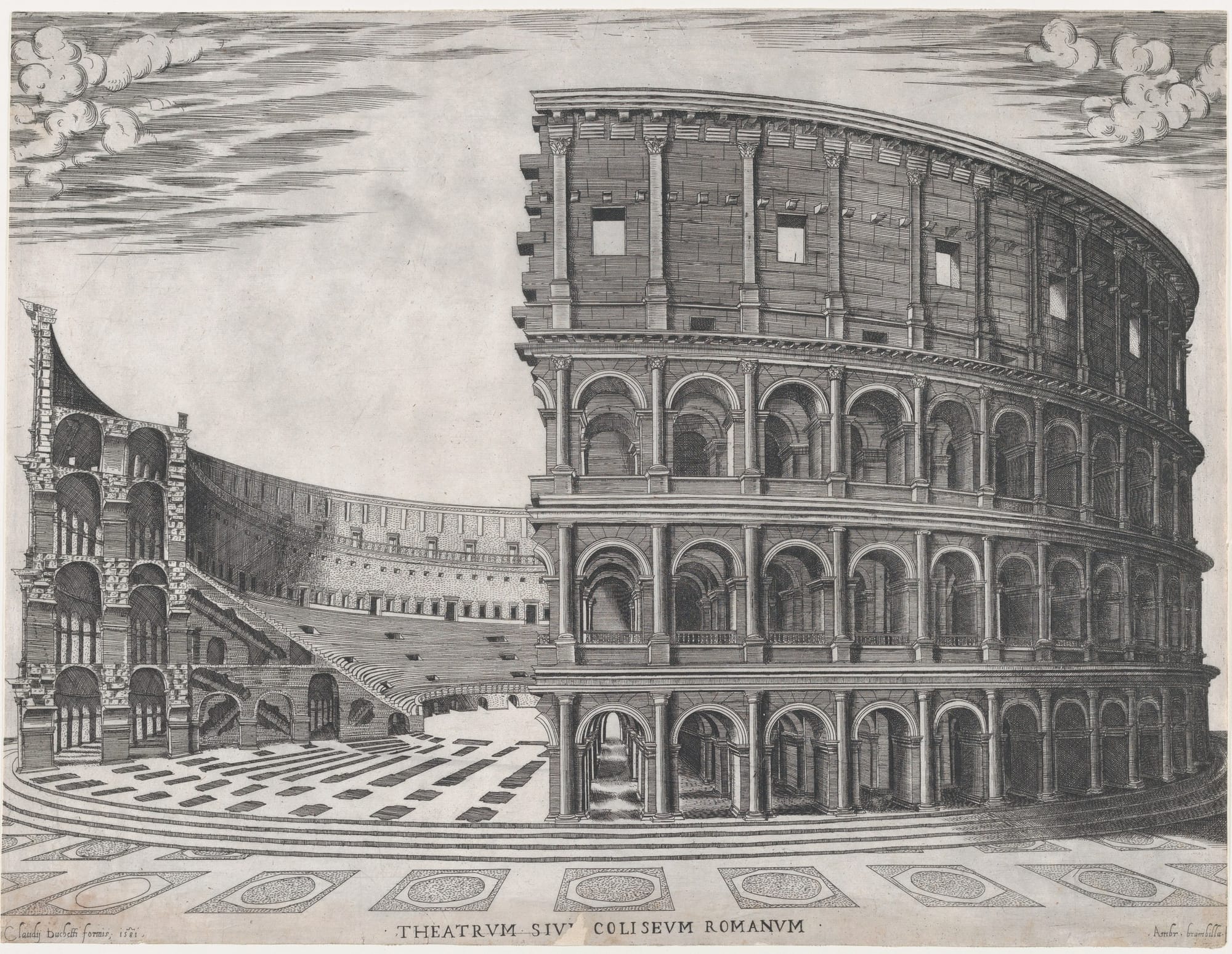
Nor was the chariot race in Ben-Hur run at the Colosseum. In the 1959 film it takes place in Judaea, in front of Pontius Pilate, on a track built at Cinecittà. The Romans raced chariots in circuses, long and narrow like the Circus Maximus, not in an arena less than ninety metres long.
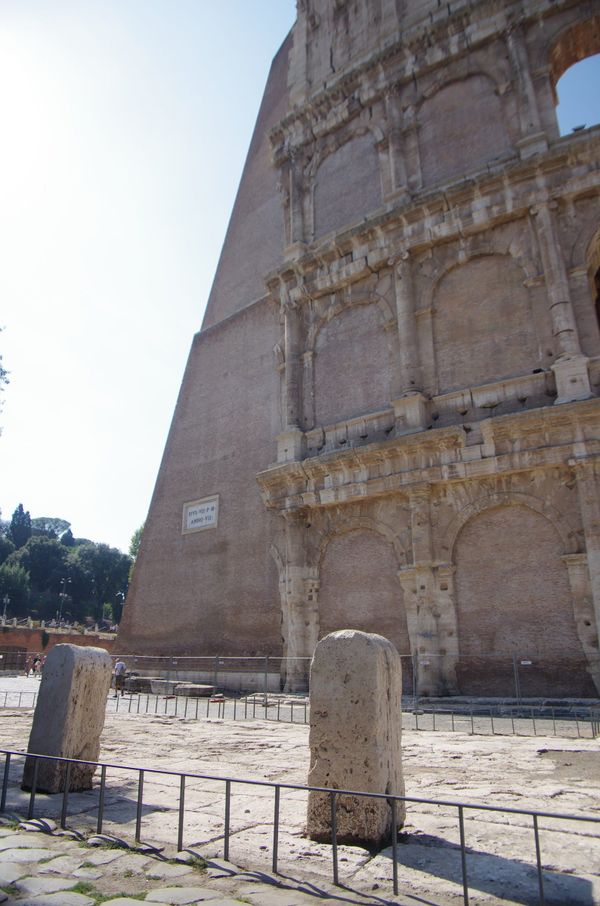
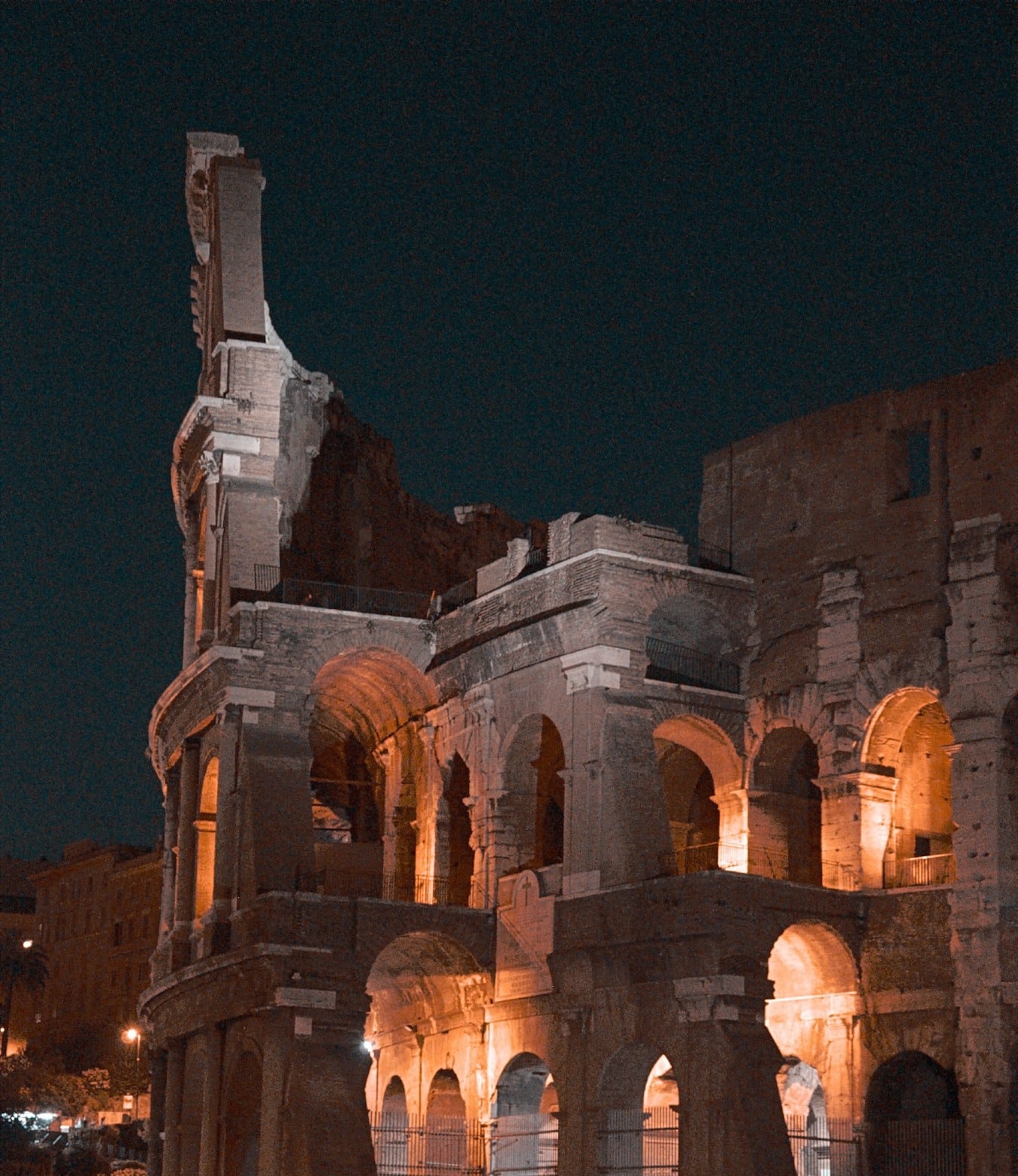
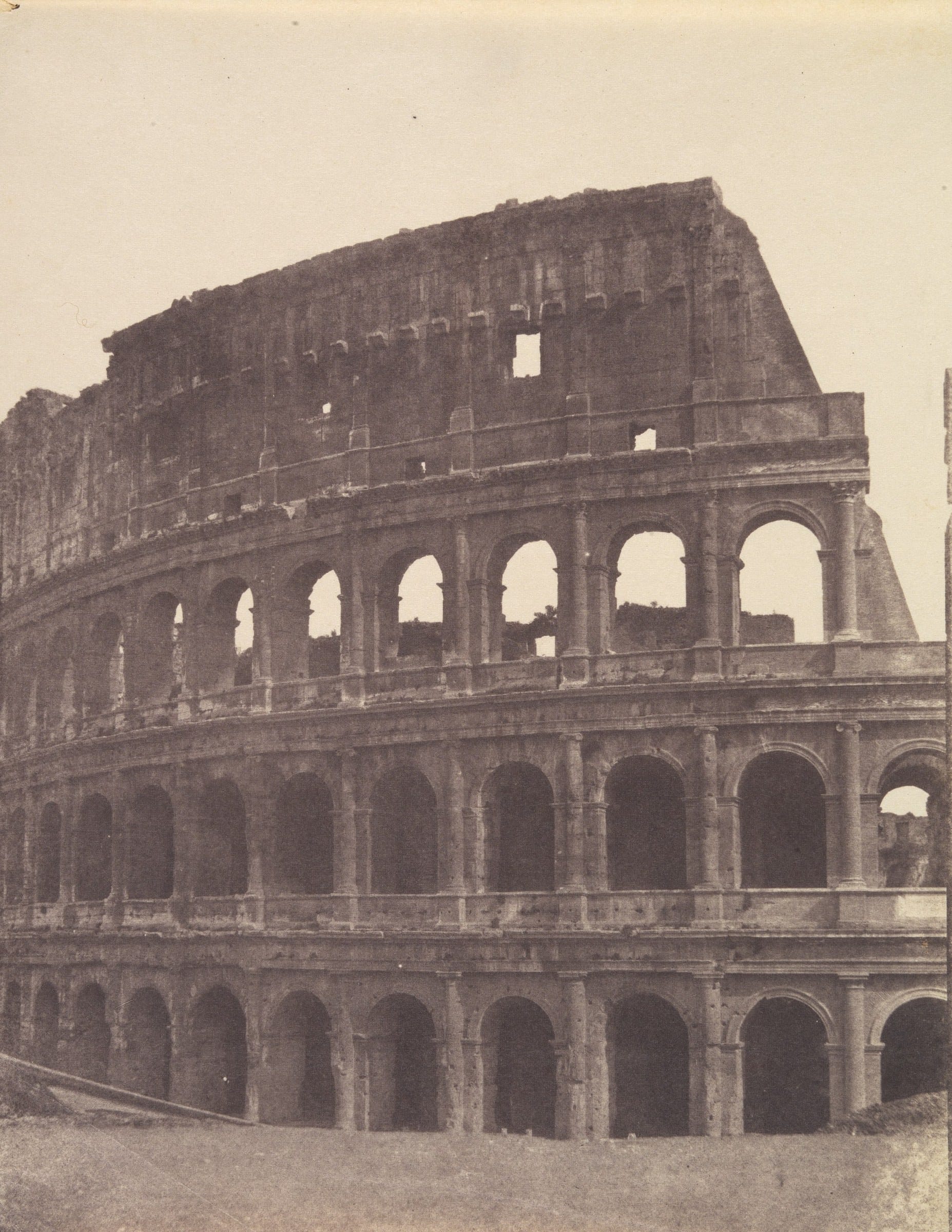
The real one, a few kilometres from Cinecittà, is a broken ring. On one side, three tiers of arches and the attic, close to fifty metres of travertine; on the other, the inner rings, exposed, like the walls of a house with its front taken off.
Why is the Colosseum broken?
The answer that goes round most online fits in three words: earthquakes, then popes. It's half right.
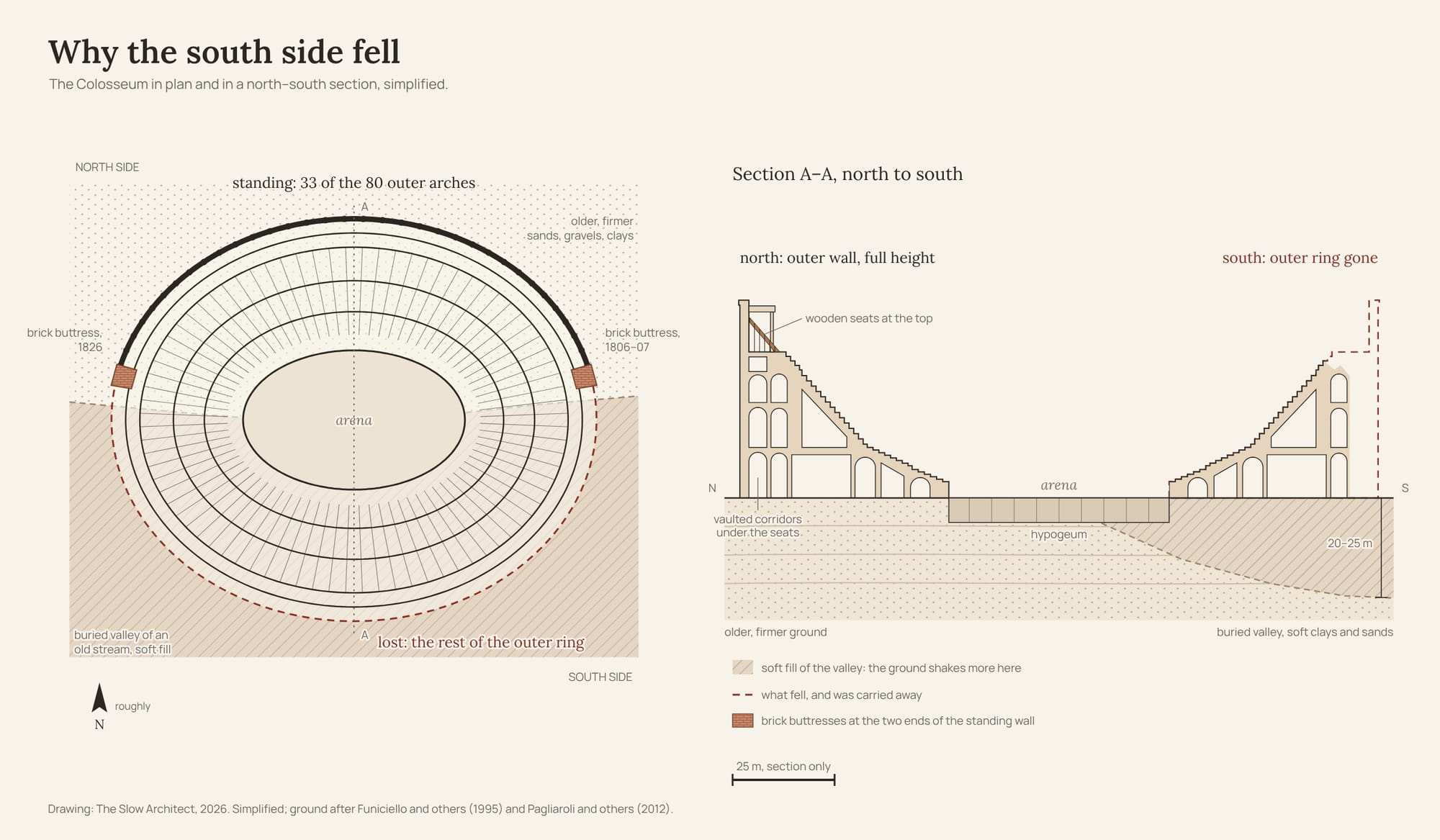
Half of the Colosseum is not missing. What is missing is more than half of its outer ring, the travertine wall on the postcards: of its eighty arches, thirty-three still stand, all on the north side. Behind it, the inner rings still run almost all the way round. And that wall did not come down in a day, or in a single earthquake. The southern half of the amphitheatre stands over a buried valley filled with twenty to twenty-five metres of clay and sand. The earthquakes found the weak spot, and the Romans did the rest, for more than a thousand years: burning marble and travertine for lime, digging the iron out of the joints, carting off the stones that had fallen and then the ones still standing. The popes came last. First they licensed the sale of the stone, then they stopped it.
The dates you usually read are three: the earthquake of 1349, the fifteenth-century popes using the ruins as a quarry, and Benedict XIV consecrating the Colosseum to the martyrs in 1749 and saving what was left. All three need correcting.
Rome shakes from far away
Rome is not an earthquake city. The strong shocks start far off, in the Apennines, and arrive weakened. But they arrive on ground that is not the same everywhere, and under the Colosseum it changes halfway across.
The Colosseum was begun around AD 70 where the lake of Nero's Golden House had been, at the bottom of a small valley. Vespasian drained it and built an amphitheatre for everyone: Martial wrote that Rome had been given back to itself. The building was the same all the way round, same piers, same arches, same weight, and it stood on two different kinds of ground. The southern half sits on the bed of an ancient stream, the Fosso Labicano, filled with twenty to twenty-five metres of clay and sand. The northern half sits on older, more compact sands, gravels and clays. It isn't rock, as you often read. It is good ground next to bad. In the 1990s a group of geologists pointed out that the damage to the monument over the centuries follows the outline of the buried valley, and a microzonation study in 2012 calculated that in the southern part the ground can amplify the shaking by up to 1.6–1.8 times.
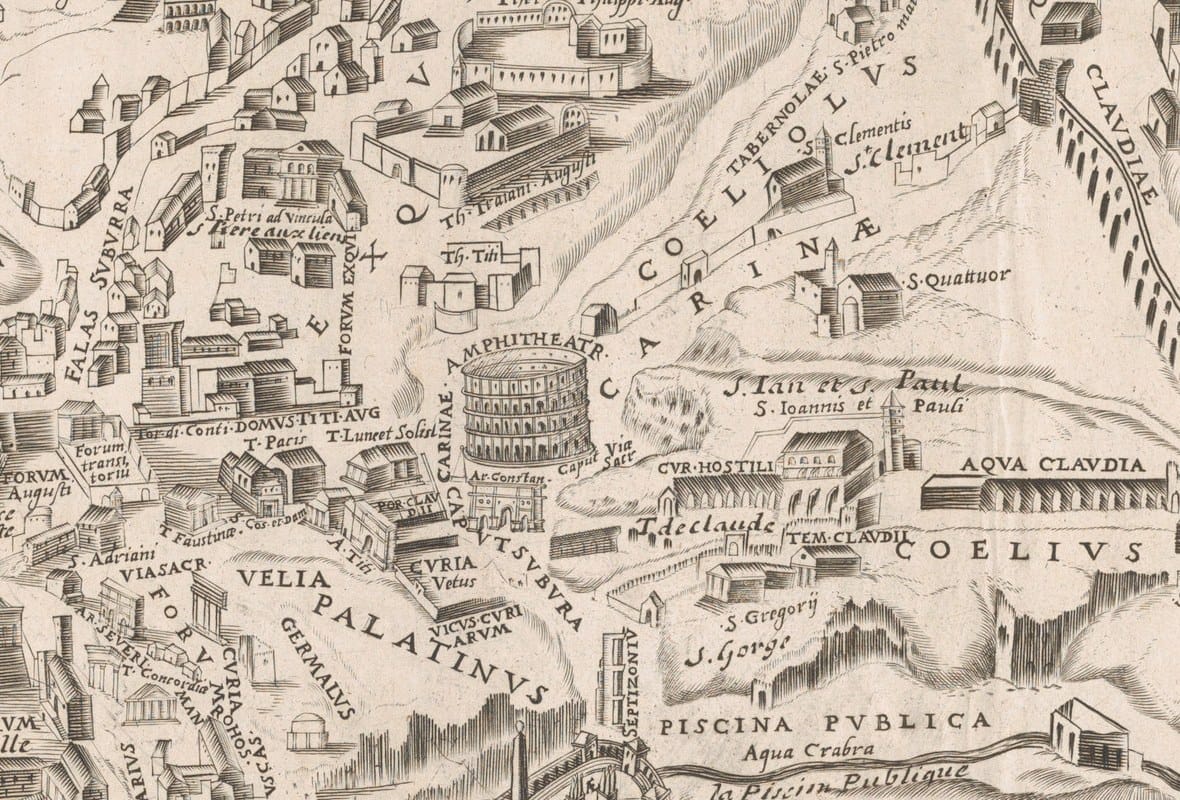
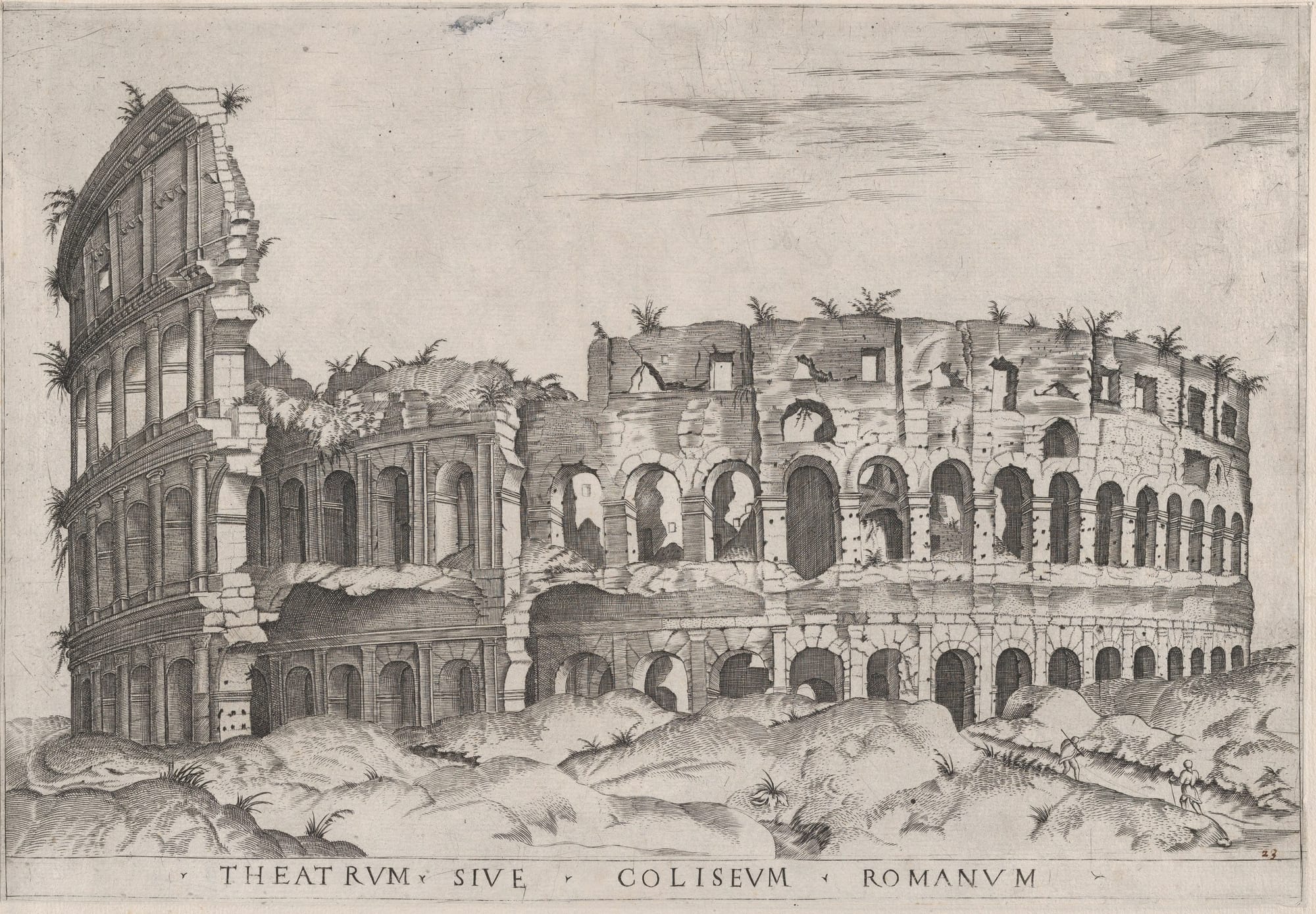
The first earthquakes are recorded in the inscriptions of two prefects of the city. After a quake in 443, Rufius Caecina Felix Lampadius had the arena, the podium and the seating rebuilt. His slab is the same one on which Vespasian had set, in bronze letters, the dedication of the amphitheatre built from the spoils of the Jewish War: in 1995 the epigraphist Géza Alföldy reconstructed it from the dowel holes alone. A few decades later, in 484 or 508, Decius Marius Venantius Basilius rebuilt the arena and the podium at his own expense, after "an abominable earthquake" had thrown them down. Both speak of the inside, not the façade. The last shows on record, animal hunts, date from 523.
The south façade fell later, and a piece at a time. In 847 an earthquake struck Rome, and for the Colosseum Archaeological Park that is when what was left of the south front, already badly ruined, came down for good, leaving on the ground a heap of travertine that the documents call the coxa. From then on, of the eighty outer arches, thirty-three remained.
The earthquake everyone cites, on 9 September 1349, found the Colosseum already like this. The witness usually called is Petrarch, who was not in Rome that day and wrote about it two years later. He doesn't name the Colosseum. He speaks of "a mass of ancient buildings, neglected by the citizens, a wonder to foreigners", which fell all at once, and of a single tower, "unique in the world", which lost its top. What fell at the Colosseum in 1349 was the fortress a Roman family, the Frangipane, had built inside it. The rest came later: to this day the English Wikipedia article on the earthquake gives an 1899 edition of Byron's works as its source for the collapse of the Colosseum's side.
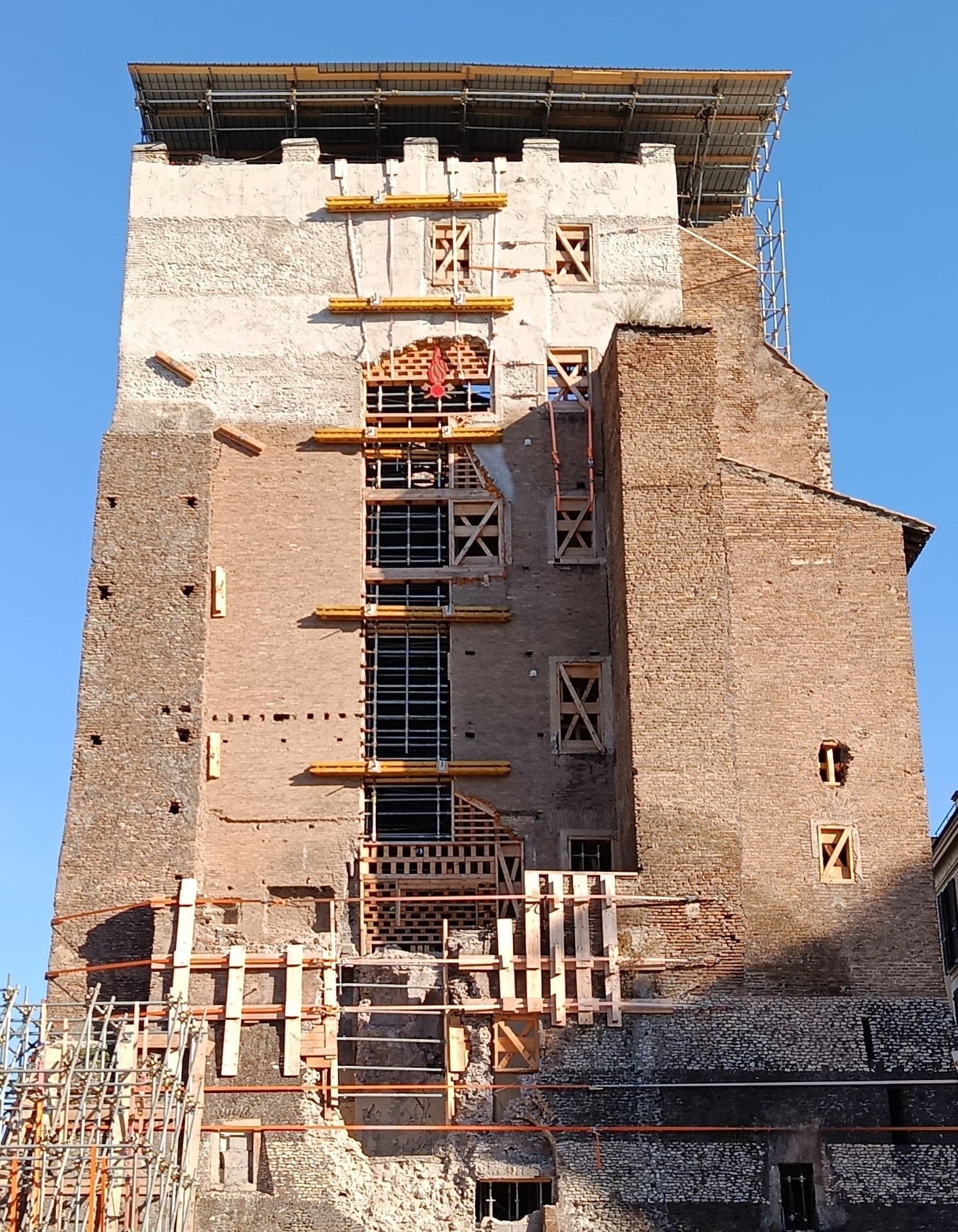
Petrarch's tower is the Torre dei Conti, and it is still there, on Largo Corrado Ricci, where Via Cavour comes out onto Via dei Fori Imperiali. The family of Innocent III enlarged it in the early thirteenth century around an older core, to fifty or sixty metres; today it measures twenty-nine. After 1349 it stayed uninhabitable for almost three centuries, more earthquakes struck it in 1630 and 1644, and at the end of the seventeenth century it was given two buttresses, which are still there. On 3 November 2025, during a restoration funded by Italy's post-pandemic recovery plan, part of it collapsed again, twice on the same day. A 66-year-old Romanian worker was trapped under the rubble for about eleven hours; he was brought out alive and died shortly afterwards in hospital. The Rome prosecutor's office opened an investigation into the causes. By April 2026 the tower had been made safe, and the restoration is due to resume.
The last time earthquake and man worked together on the Colosseum was 2 February 1703: two or three arches of the second ring fell on the south-west side, and Clement XI used their travertine for the river port of Ripetta, on the Tiber, which no longer exists. Since then the shocks have brought down only bits of cornice and the odd stone. But the Colosseum is still checked after every strong quake. In October 2016, when central Italy shook, it was inspected that same evening and again the next morning before reopening, and a few days later the superintendent at the time, Francesco Prosperetti, warned that the cracks were multiplying.
How the Colosseum was destroyed
The ground explains why the south side fell. The stones that are missing, though, were carried off by the Romans, for centuries and with nobody's permission.
Even before the tenth century, the Park writes, unauthorised salvage had begun inside the building. Marble and travertine were burned on the spot, in kilns, for lime. The travertine blocks were joined by iron clamps set in lead, an estimated three hundred tonnes of metal across the whole building, and to get them out people dug away the stone around them. If you have ever wondered why the Colosseum is covered in holes, that is why: they still pockmark the north façade. Every clamp removed weakened a pier, and every pier taken apart weakened the ring. A structural engineer, Mario Como, puts it bluntly: in his view earthquakes alone would not have brought the Colosseum down. Removing one pier is not enough, but "demolishing two can bring down the whole section of the outer ring above".
Meanwhile the Colosseum had become a neighbourhood. From the eleventh century the church of Santa Maria Nova let out its spaces as houses, stables, storerooms and workshops, and excavations in 2014 found a settlement lived in from the late ninth century to the fourteenth, with the arena used as a shared courtyard. By 1133 the Frangipane had made it their fortress, and that is what 1349 brought down.
After that, the stone had a price. In 1397 Boniface IX granted a confraternity that owned a third of the monument the right to sell the fallen stones. Not every pope agreed: Eugenius IV, pope until 1447, threatened severe penalties against anyone who took even the smallest stone from the Colosseum. In 1452, under his successor Nicholas V, a single contractor, Giovanni Foglia from Como, carted off 2,522 loads of travertine in nine months. Cardinal Pietro Barbo, later Pope Paul II, is said to have used travertine from the Colosseum and the Theatre of Marcellus for his Palazzo Venezia. For many of the other palaces that get named, from the Cancelleria to Palazzo Barberini, it is more tradition than record. And the saying "what the barbarians didn't do, the Barberini did" is about the bronzes of the Pantheon, not the Colosseum.
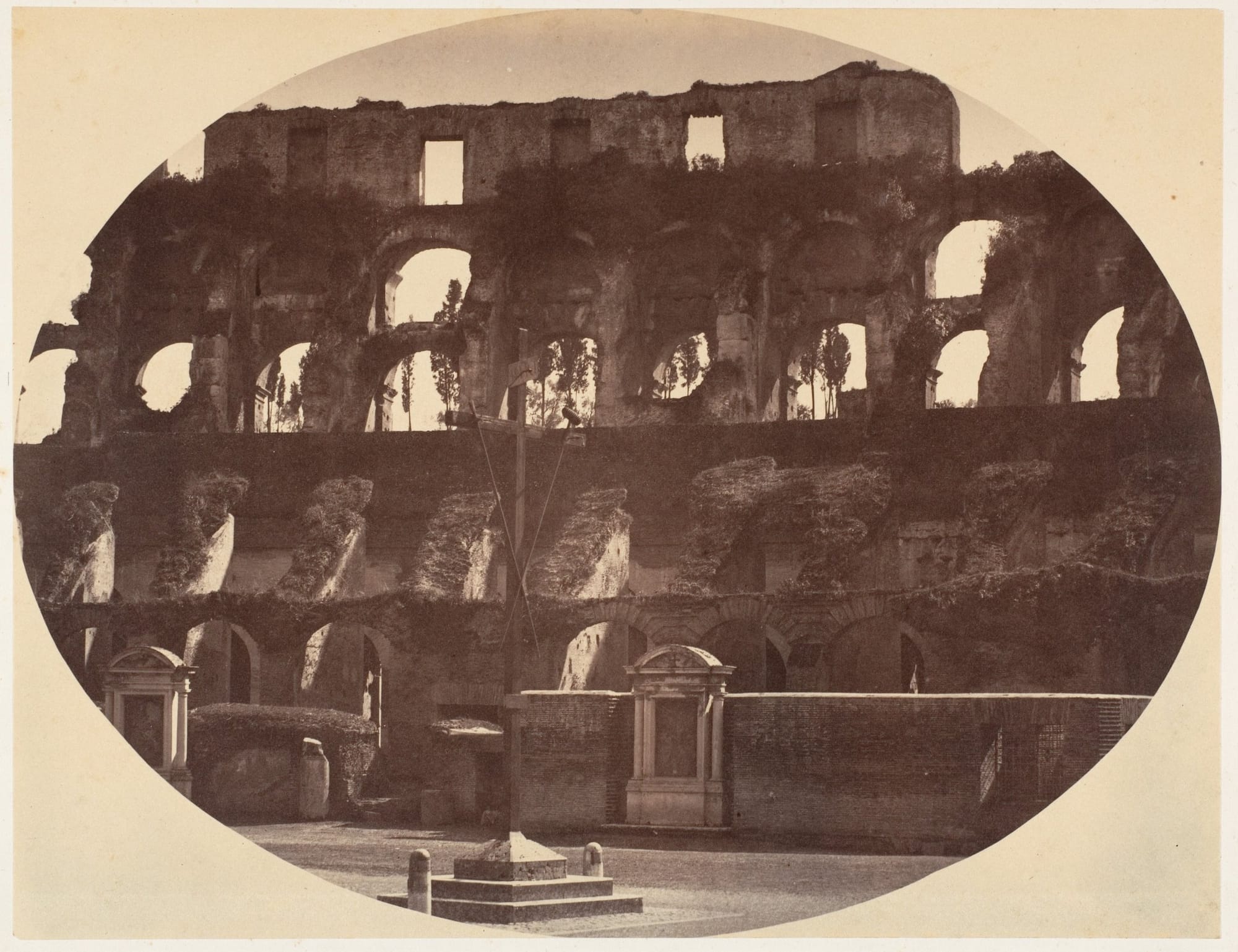
What stopped the quarry was a church, and not in 1749. The dedication to the martyrs is older: for the Jubilee of 1675 Clement X had a cross raised there. The stones kept leaving. In 1744 Benedict XIV forbade the desecration of the monument by edict, and between the end of 1749 and the beginning of 1750 he allowed a Franciscan friar, Leonard of Port Maurice, to set up the Stations of the Cross inside it for the Holy Year, fourteen shrines and a cross in the middle of the arena. The Colosseum became a public church, and you don't cart stones away from a church. Were Christians killed in the Colosseum? There is no record of it. The Jesuit Hippolyte Delehaye, whose job was the lives of the saints, said so more than a century ago. He didn't rule it out; he concluded that we know nothing about it.
When falls the Coliseum
The most quoted line about the Colosseum is about exactly this. Byron wrote it like this in 1818: "While stands the Coliseum, Rome shall stand; / When falls the Coliseum, Rome shall fall", and with Rome, the world. Tradition gives it to the Venerable Bede, an English monk who died in 735 and never went to Rome; Gibbon thought he had picked it up from pilgrims. And the Colyseus of that Latin was perhaps the colossal statue of Nero that stood nearby, from which, in the most common explanation, the amphitheatre takes its name.
The Colosseum has partly fallen, and Rome is still there. In fact, we recognise Rome by that broken outline. Paris has the Eiffel Tower, New York the Empire State Building, Moscow the Kremlin, and they are all whole. The Colosseum is a ruin, and it is the ruin a child draws, and the one the Italian Republic struck on the Italian side of the five-cent coin. Is it one of the seven wonders of the world? Of the new ones: in 2007 an online vote put it among the "New Seven Wonders of the World", a private competition UNESCO had kept its distance from. And since December 1999, at the initiative of the Community of Sant'Egidio, it has been lit up whenever a country abolishes the death penalty or a death sentence is suspended. The place of the gladiators and the wild beasts has become the sign that a life has been spared.
Where to see it
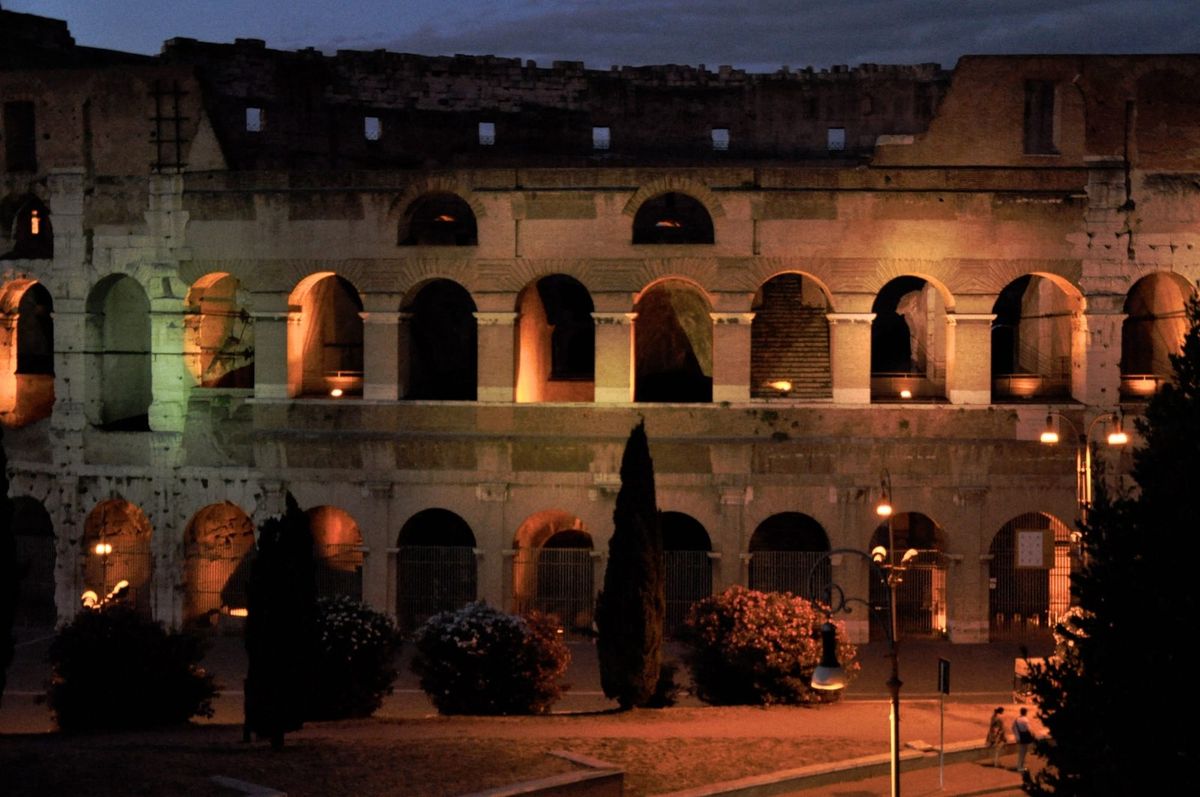
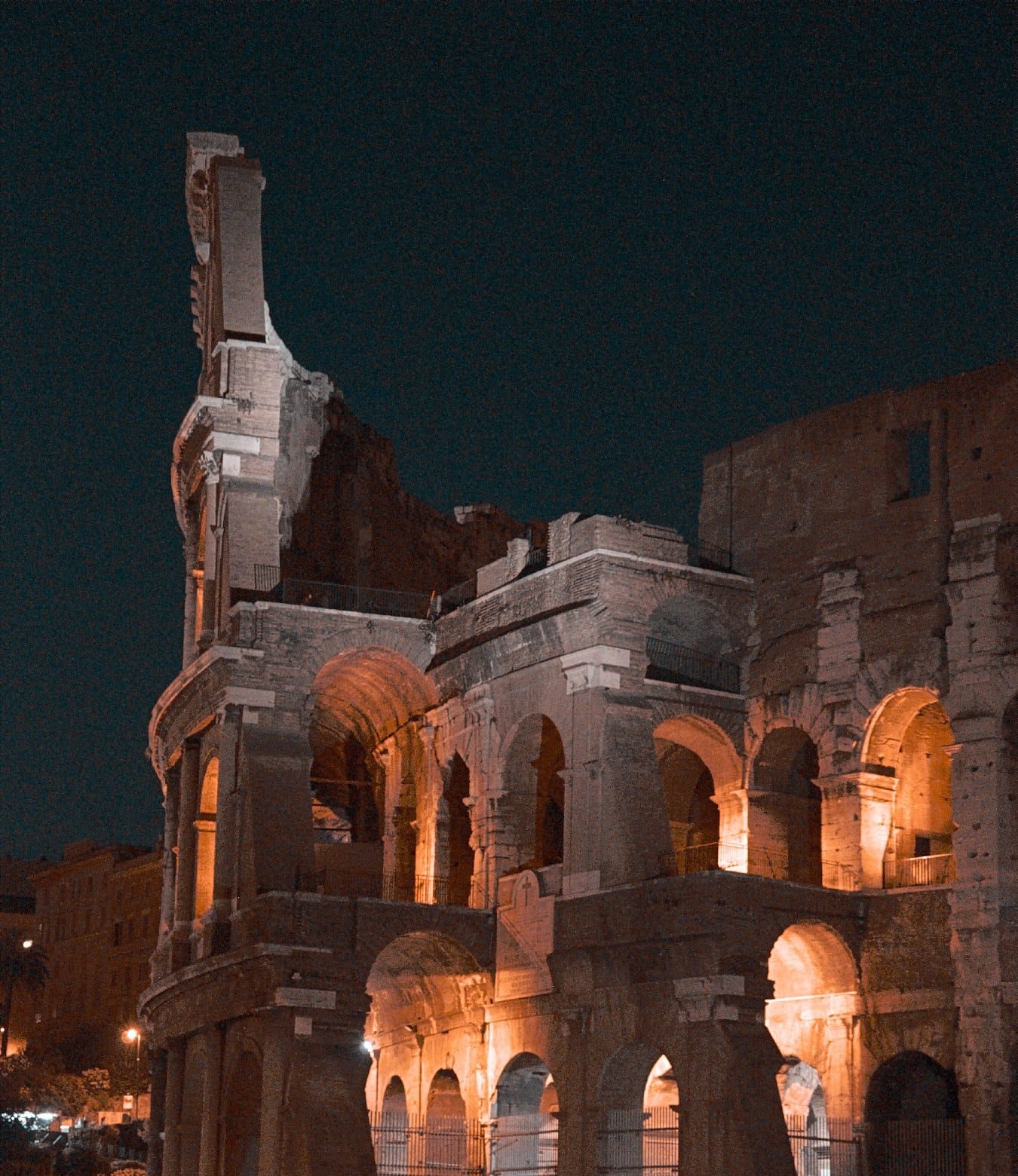
Walking around it, at sunset or in the evening, is the most romantic way to see the Colosseum and the Forums. The missing side is best seen from Via Celio Vibenna, on the edge of the Celio park: the photograph at the top of this page was taken from there, one evening in July 2010. Then go round to the north side, towards the Oppian Hill. Above the arches the Roman numerals are still there, from XXIII to LIV, and the clamp holes are at eye level. Halfway along is the north entrance, which never had a number: it was one of the four main entrances, on the axes of the oval. Then go to where the ring breaks off, and come back round to the south side, where the new paving marks the missing piers.
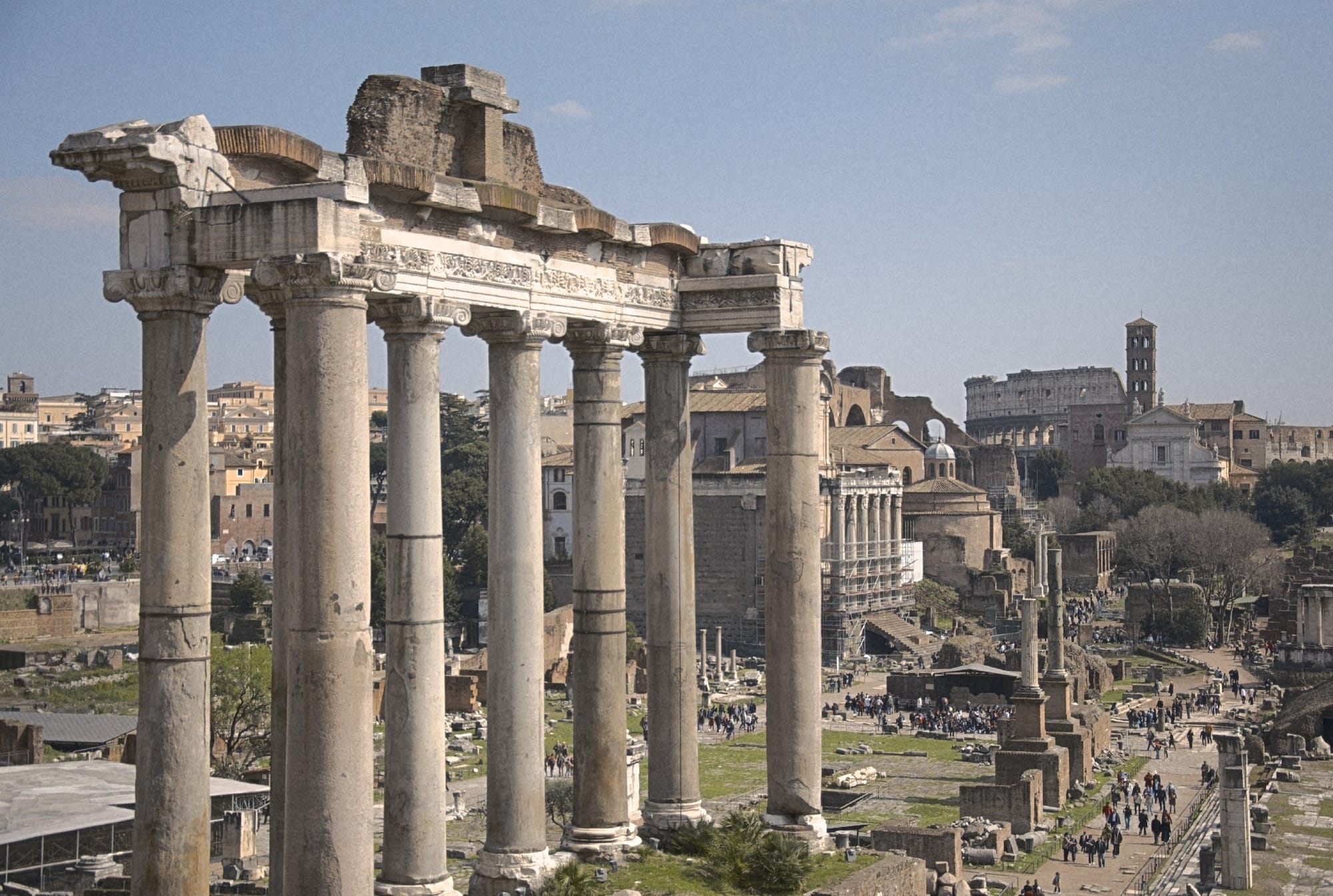
Inside, with a Park ticket, look up at the top of the inner ring on the first floor: the sockets for the beams of the Frangipane fortress are still there. Then walk up Via dei Fori Imperiali to Largo Corrado Ricci, and look at the tower Petrarch called unique in the world. Metro line B, Colosseo station.
…, Exactly? answers one question about a building, properly. If there is one you have always wondered about, reply to any Slow Letter and ask.
Sources: American Cinematographer (May 2000) and Archaeology on the set of Gladiator; TheWrap and Film New Europe on the sequel (2024); AFI Catalog on Ben-Hur (1959); R. Funiciello, L. Lombardi, F. Marra, M. Parotto, "Seismic damage and geological heterogeneity in Rome's Colosseum area: are they related?", Annali di Geofisica 38 (1995), as summarised in Y. Nakamura et al., 12th World Conference on Earthquake Engineering (2000); A. Pagliaroli et al., "Seismic microzonation of Palatine Hill, Roman Forum and Coliseum", 15th World Conference on Earthquake Engineering (2012); M. Como, "Il Colosseo: sulle ragioni del suo stato di danneggiamento" (2018; Gli Speciali de Il Giornale dell'Ingegnere 1/2021); H.-J. Beste, R. Rea, "Colosseo. Il podio e il palco dell'imperatore", Römische Mitteilungen 128 (2022); S. B. Platner, T. Ashby, A Topographical Dictionary of Ancient Rome (1929); Petrarch, Familiares, book XI; Colosseo. Un'icona, exhibition press kit and chronology (Electa, 2017); Colosseum Archaeological Park, pages on the Middle Ages, the Frangipane fortress, the consecration and the southern ambulatories, and press release of 17 March 2026; Italian Civil Protection Department, on the historical earthquakes of the Colosseum; Il Post, AGI, LaPresse and Artribune on the Torre dei Conti (November 2025, April 2026); ANSA and Apollo on the Colosseum after the earthquakes of October 2016; The Catholic Encyclopedia, "Coliseum" (1908); Lord Byron, Childe Harold's Pilgrimage, canto IV (1818), stanza 145; E. Gibbon, The History of the Decline and Fall of the Roman Empire, chapter LXXI; European Central Bank, Italian euro coins; Community of Sant'Egidio, "The Colosseum lights up for life" (1999); iTWire, 8 July 2007, and UNESCO on the "New Seven Wonders". Translations are my own.