THE LINE AND THE HILL
A prince unveils a mirrored city 170 kilometres long in the Saudi desert; a pope remakes his hilltop village in three years. The last chapter of Utopian Cities, and why some cities willed by one man live on while others stay in the renderings.

Utopian Cities, V · From a colonial village remade by a billionaire to a city 170 kilometres long in the desert. The last chapter, and the reason some cities willed by one man live on while others stay in the renderings.
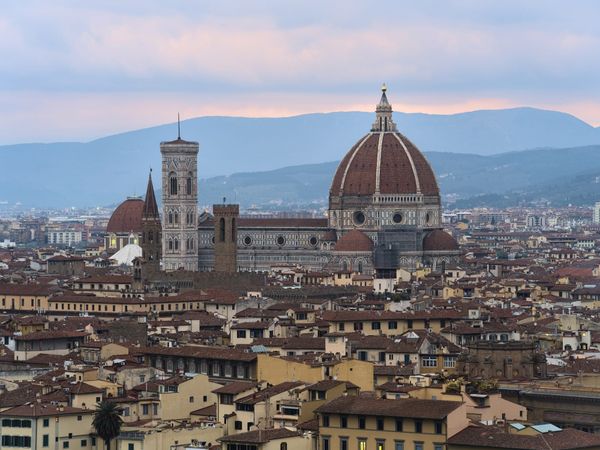
In the first chapter I left a pope at Pienza, looking out from a loggia. He had a village, an architect, a budget nobody kept to, and a view. In three years he turned the village into a city, and the city is still there.
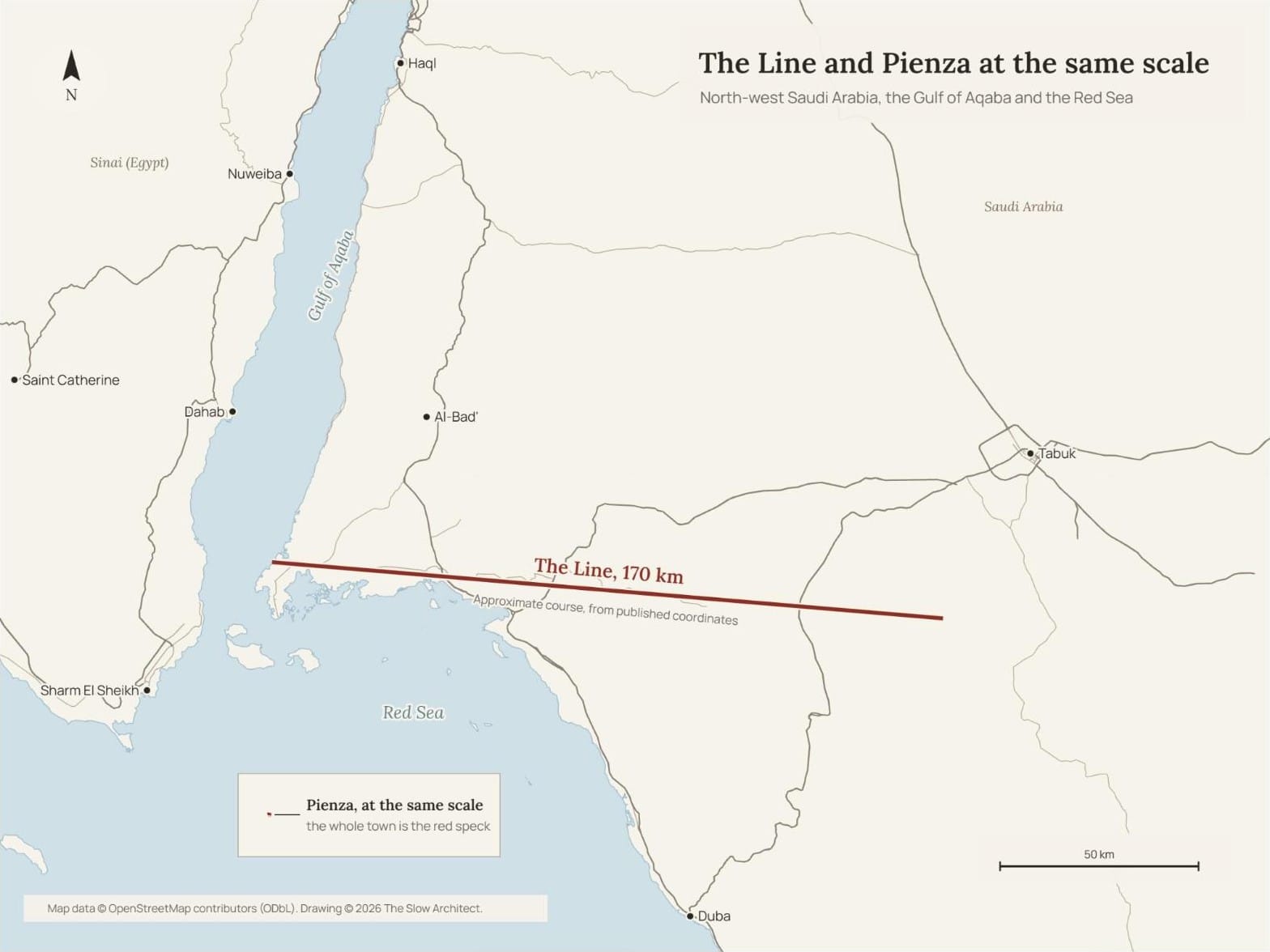
In January 2021 Saudi Arabia's crown prince, Mohammed bin Salman, unveiled another city. In July 2022 he gave the numbers: 170 kilometres long, 200 metres wide, 500 metres tall, nine million residents, all of it between two parallel mirrored walls running straight across the desert from the sea to the mountains. It is called The Line. In May 2026 Semafor reported that further work on The Line had been put off until after 2030 at the earliest, and that NEOM as a whole now expected up to 100,000 residents by then.
In between, in this series, came the kings with their avenues, the bosses with their factories, the states with their plans. This chapter starts where we had got to, in the century of the billionaires, and ends where we set out from, on the hill.
The billionaire's village
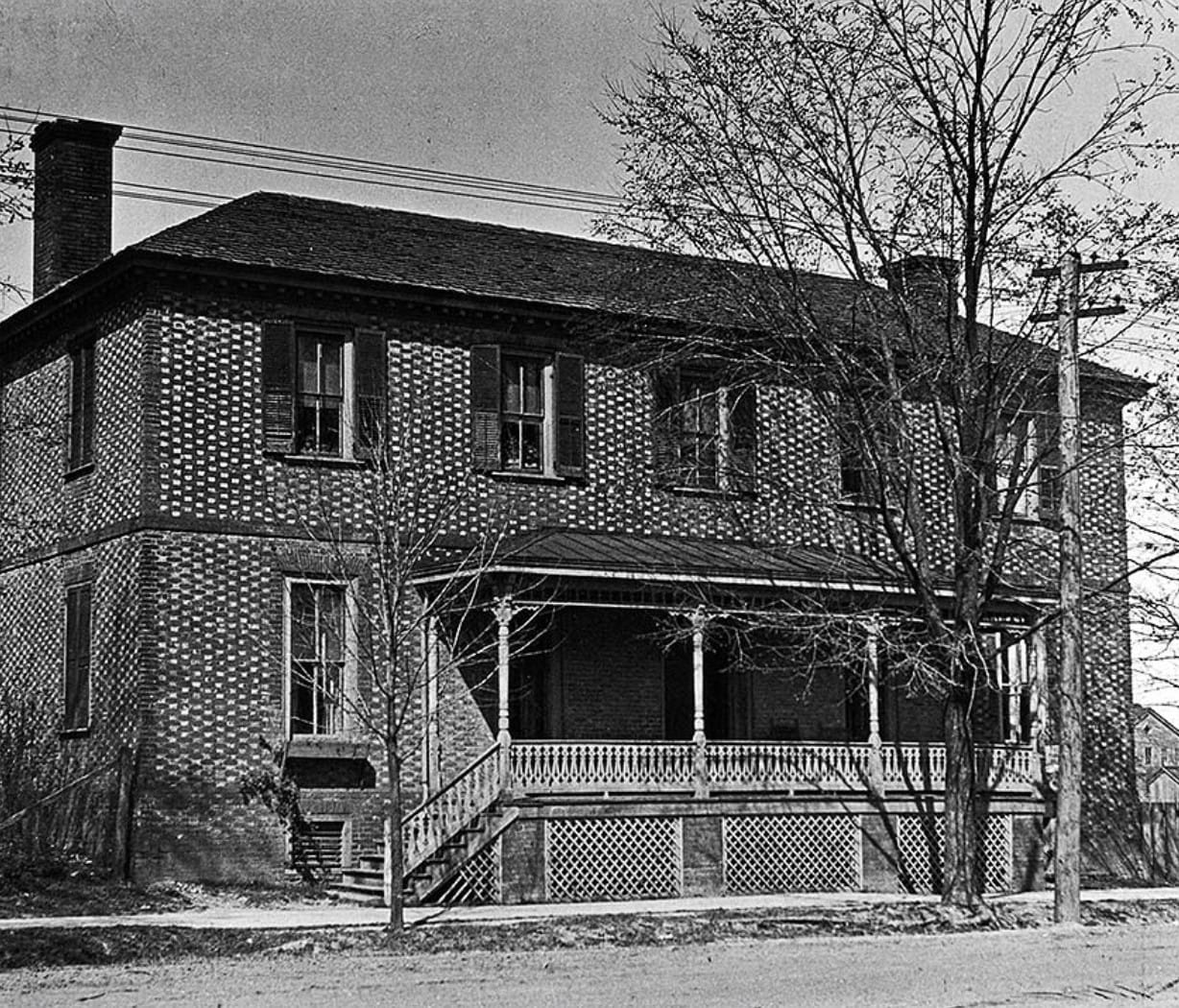
In 1926 John D. Rockefeller Jr. began secretly buying up Williamsburg, in Virginia, and signed the telegram that authorised the first purchase "David's Father". He took the town back to the way it had looked in the eighteenth century, and to do it he demolished more than 700 buildings: of the roughly 500 you see today, only 88 are original. It is a real town, with people living in it, and an open-air museum at the same time: one man deciding, with his own money, what a city should look like, and deciding it backwards.
The gesture has carried on ever since. In August 2025 an executive order from Donald Trump made classical architecture the preferred style for new federal buildings, and the default in Washington. The Freedom Cities he had promised during his campaign, up to ten new cities on federal land, appear to have stalled. This is not a judgement on either of them. It is the same gesture as Pius's, Louis's and Peter's, by other means.
The line
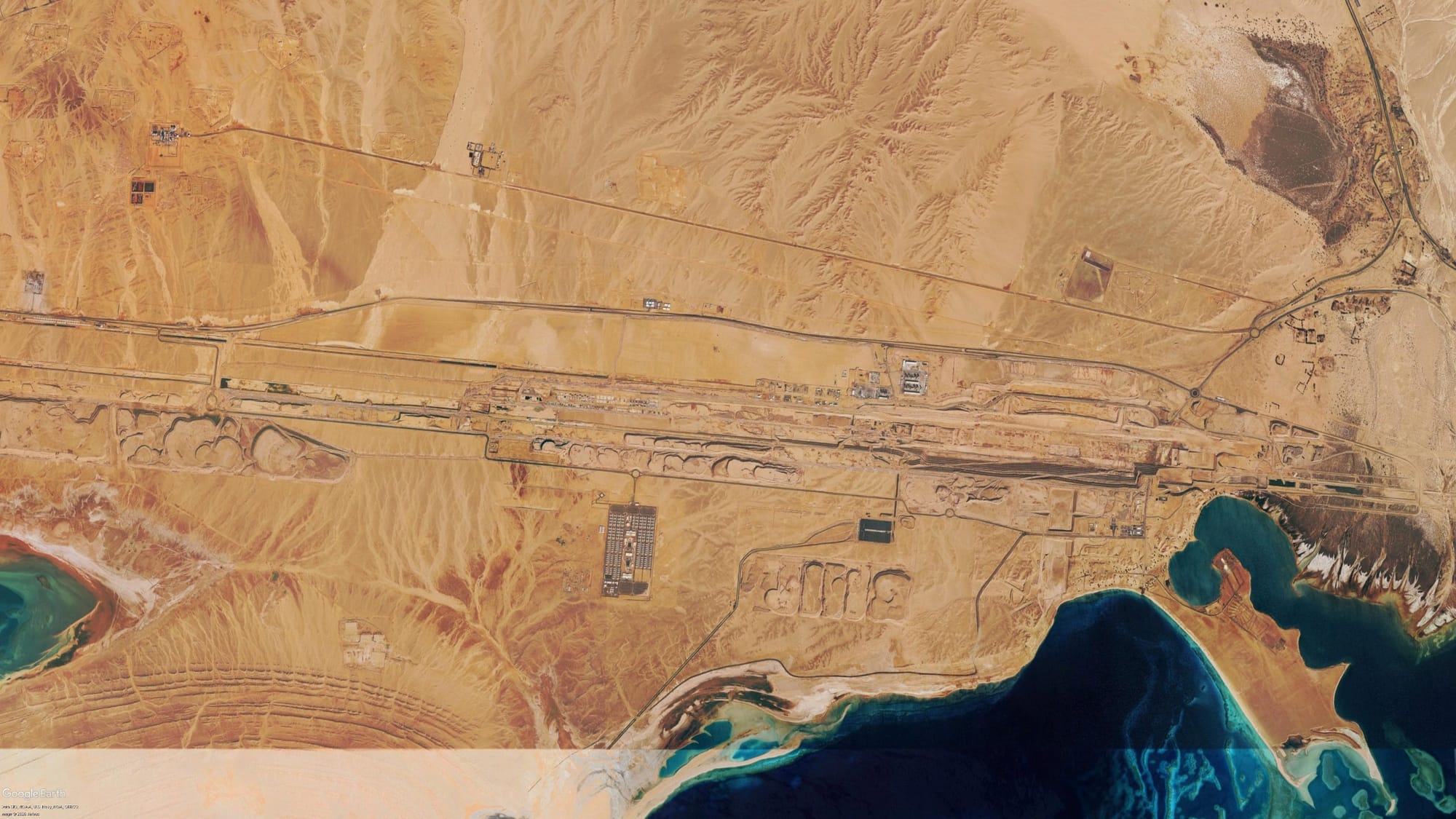
And then there is The Line. A city with no streets and no cars, everything five minutes away on foot, in a strip 200 metres wide and 170 kilometres long. In the renderings it is beautiful, and it has never existed.
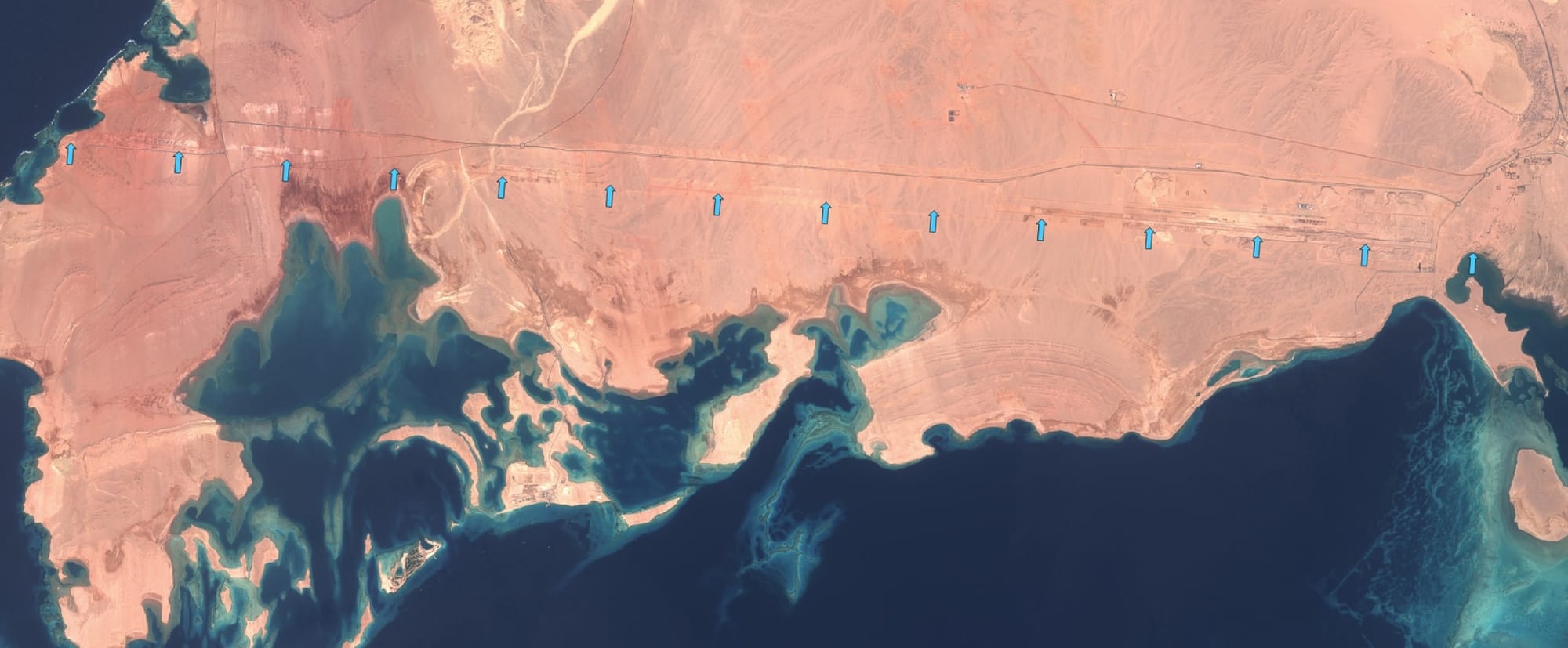
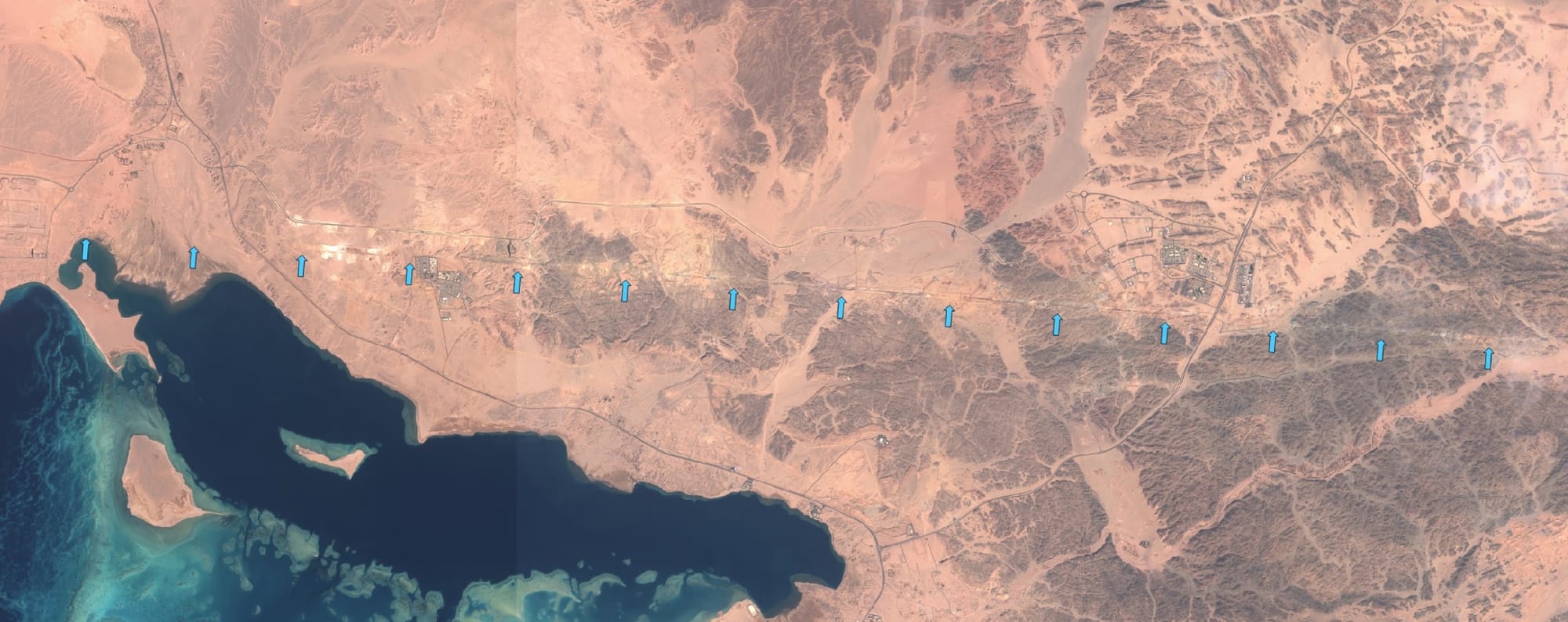
The Line from space in October 2022: from the coast, the straight cut of the excavations across the desert, marked with blue arrows by the maker of this mosaic of Sentinel-2 images. Contains Copernicus Sentinel data; image CC BY-SA 3.0, cropped, via Wikimedia Commons.
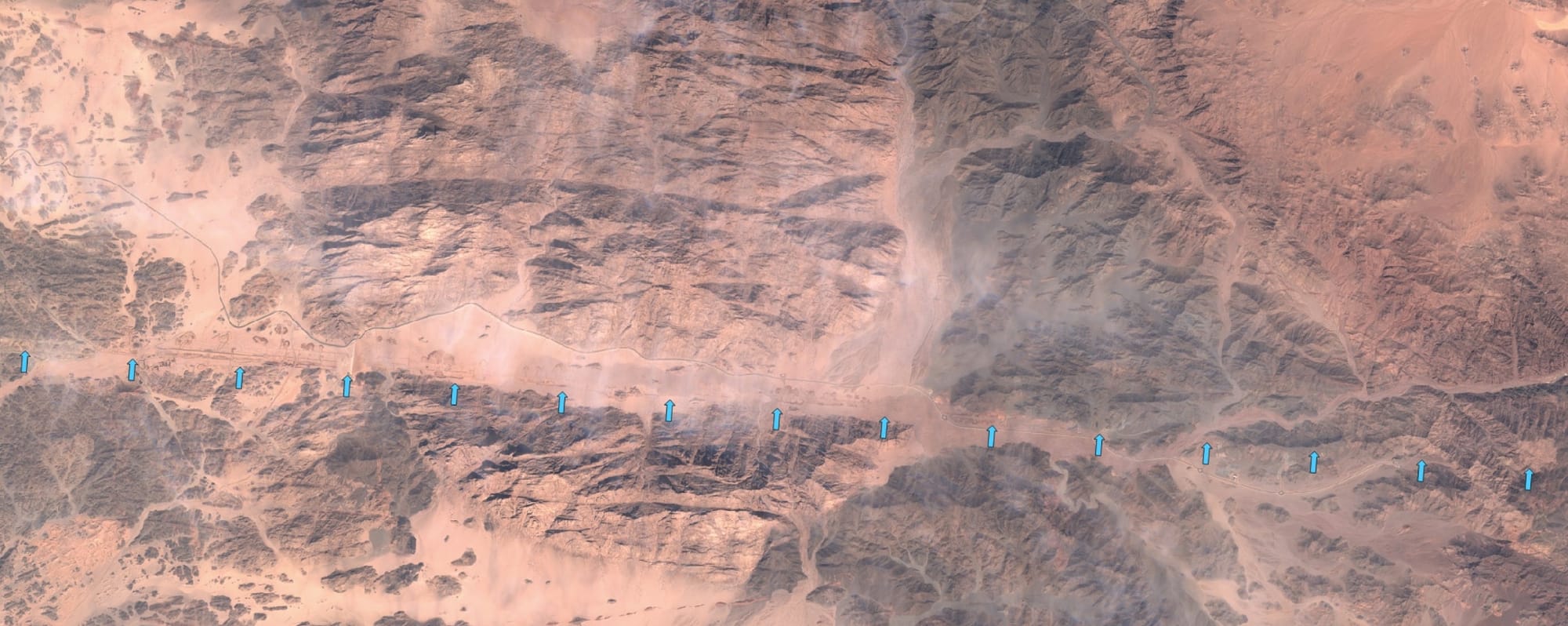
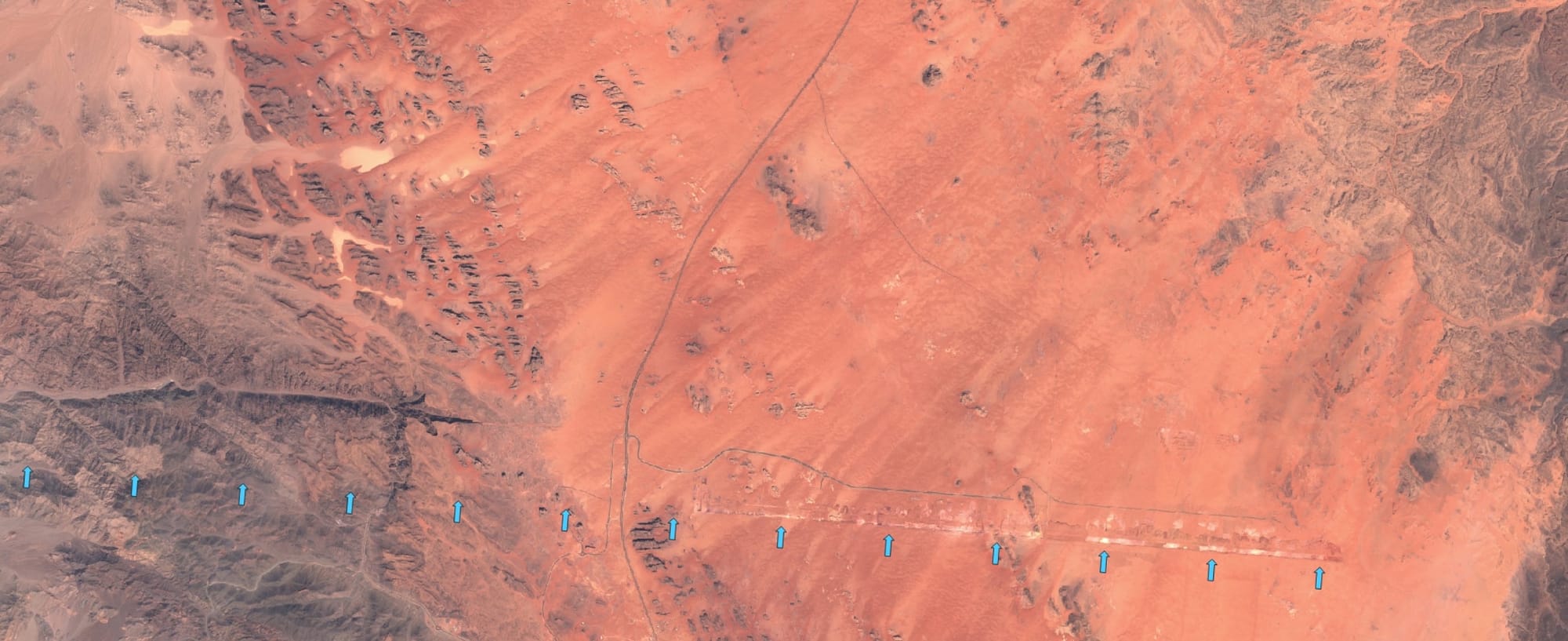
The Line from space in October 2022: from the coast, the straight cut of the excavations across the desert, marked with blue arrows by the maker of this mosaic of Sentinel-2 images. Contains Copernicus Sentinel data; image CC BY-SA 3.0, cropped, via Wikimedia Commons.
It is a city willed by one man, like Pienza. But Pienza was built on top of a village that was already there, for a man who had been born in it, around a view. The Line was a line drawn across a map.
What happened to The Line?
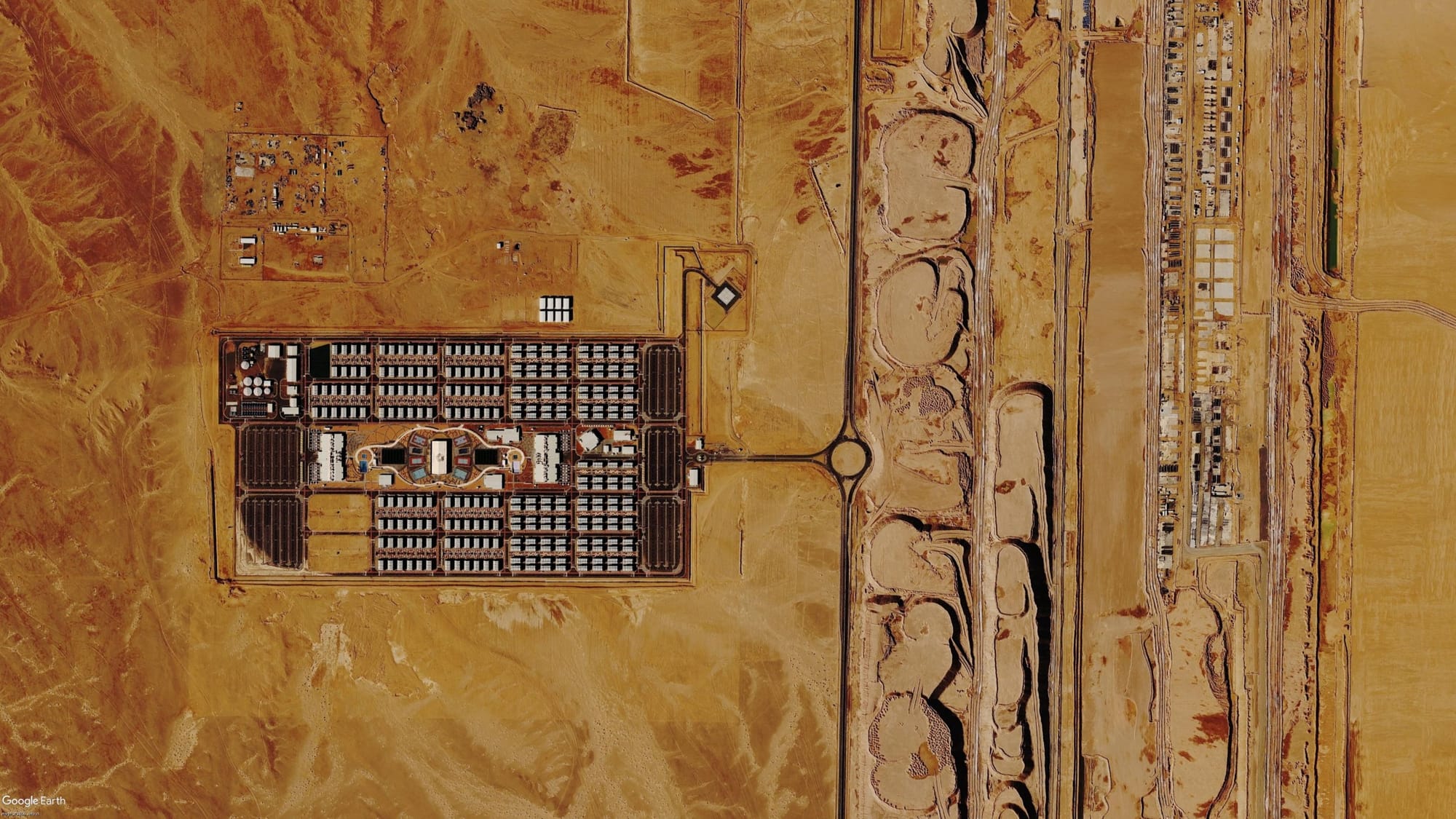
In 2024 The Wall Street Journal and Bloomberg reported that the first phase would be 2.4 kilometres long; the Saudi authorities denied it. In 2026 the plans were scaled back, work was suspended and the project's website was rewritten; NEOM says this is no change of vision. Cost estimates have ranged from 100 billion dollars to several trillion; the only official figure, given by the crown prince in 2022, was 1.2 trillion riyals, about 320 billion dollars, for the first phase alone.
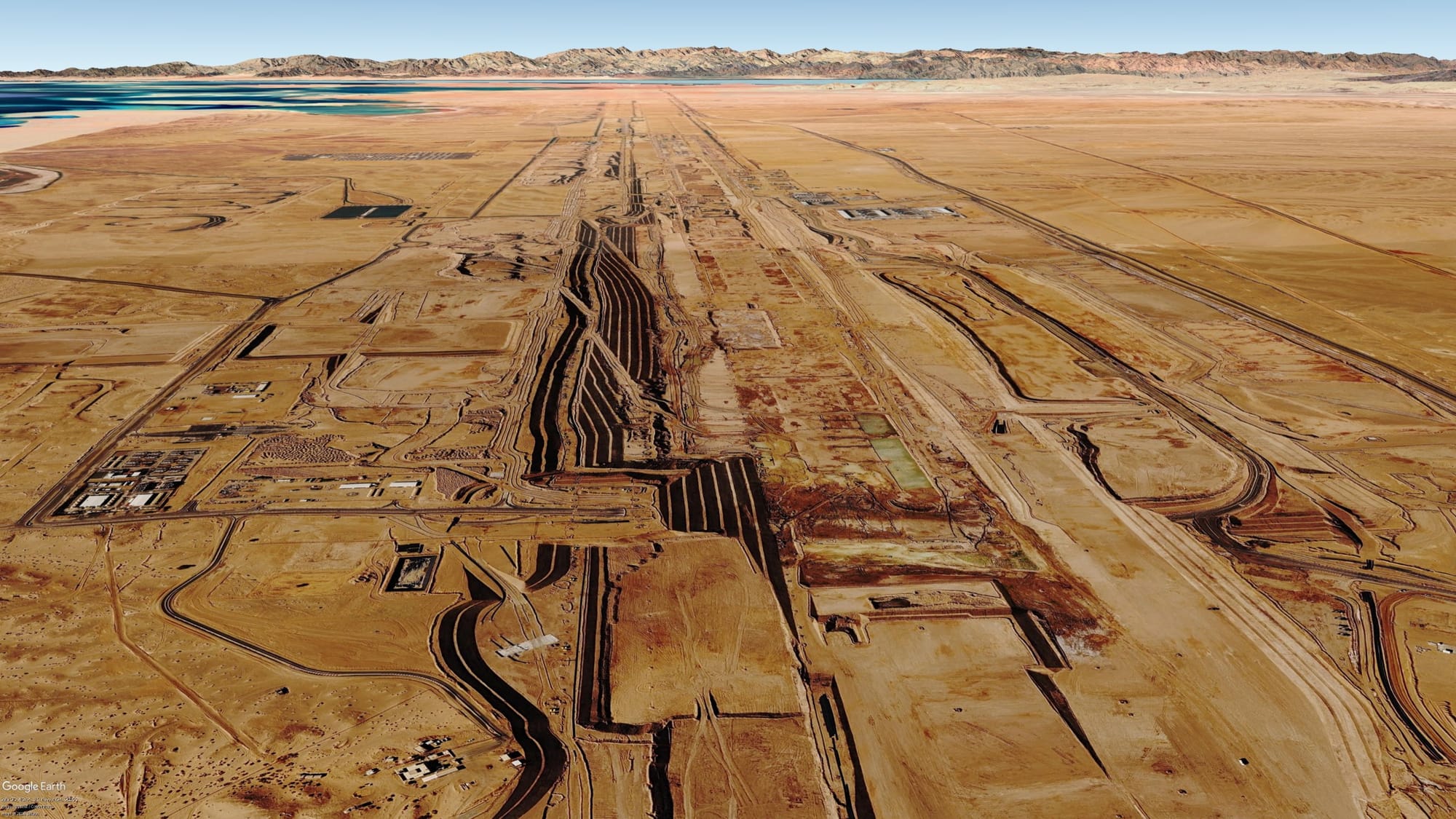
And there is the part the renderings don't show. To clear the land, according to the Saudi government, more than 6,000 people were moved, many of them from the Huwaitat tribe. In 2023 a group of United Nations experts wrote that those actions "would certainly amount to forced evictions, which are prohibited under international law". A man who opposed the relocation was killed by security forces in 2020, and three men from the tribe were sentenced to death in 2022. Asked by the BBC, which gathered witness accounts in 2024, the Saudi government and NEOM refused to comment.
The hill
The answer had been in my house for twenty years, in a book I studied badly at university: Jean Gottmann's La città invincibile, The Invincible City. Gottmann splits the life of a city between two forces. On one side there is circulation: the flows of goods, people, money and information that pass through and meet at crossroads. On the other there are iconographies: the symbols, memories and identities that bind a community to a place and resist change. A city lives if it holds the two together. Too much circulation without iconography, and you have a motorway junction. Too much iconography without circulation, and you have a museum.
From this comes the corollary that changed the way I look at cities. Urban design can welcome flows or get in their way, but it cannot create them. A city in the right place survives even a terrible plan; a city in the wrong place cannot be saved by the finest design of the century.
Line up the cities of this series again and it works almost every time. St Petersburg was built by force, but at the mouth of a river, on the Baltic, at the exact point where Russia wanted to trade with Europe: the crossroads was there, and the city stayed. Versailles lost its king, but it stayed tied to Paris. Pullman remained part of Chicago. Fordlândia had a boss and a plan, and no crossroads: the rubber would not grow, nobody passed through, and the town emptied. Brasília lives because the state brought its own flows there by decree: the ministries, the civil servants, the power. Around it, outside the drawing, the real city grew. Sabaudia had the regime for its iconography, and outlived the regime thanks to the sea and to Rome close by. Williamsburg kept the iconography and gave up on circulation. It became a museum, which is exactly what it wanted to be.
Pienza is the opposite of The Line. Pius did not create a crossroads. He had a village that was already there, a road, a valley, and to them he added a powerful iconography: the memory of a pope, and a view. It is small, it has stayed small, and it is alive. The Line had all the design in the world and no reason for anyone to be there, at that point in the desert, rather than anywhere else. A line, as the name says: a route, not a crossroads.
Others have put it in other ways. The political scientist James C. Scott, in Seeing Like a State, another book in my library that I have read in bits, writes that the great disasters of planning happen when a state that wants to see everything clearly, as on a map, a faith in technical progress and a power ready to use all of its force meet a civil society too weak to push back. He adds that the formal plan lives like a parasite on informal practices it could neither create nor keep going on its own. Jane Jacobs, long before him, said it more simply: you cannot impose a logic on a city, because its people make it, and plans have to be shaped around them, not around buildings. And Murray Bookchin, who walked us down the kings' avenues in chapter II, reminds us that a king's power was at least the power of a person: someone you could see, weigh up and, when it came to it, unseat.
The difference is not between beautiful and ugly, nor even between a good patron and a bad one. It is between a hill and a line, between a city that starts from a place and one that starts from a drawing. Sooner or later, people come to live in the first. The second stays in the renderings.
Further reading
Jean Gottmann, La città invincibile. Una confutazione dell'urbanistica negativa (Franco Angeli, 1983), with an introduction by Calogero Muscarà. It is in Italian; in English there are Megalopolis (1961) and Since Megalopolis (Johns Hopkins, 1990).
James C. Scott, Seeing Like a State: How Certain Schemes to Improve the Human Condition Have Failed (Yale University Press, 1998).
Jane Jacobs, The Death and Life of Great American Cities (1961).
Murray Bookchin, The Limits of the City (Harper & Row, 1974).