A Boy Called Michelangelo: the Medici Walk in Florence
A self-guided walk through Medici Florence, from the station to dinner at the Prato: the Medici Chapels, a conspiracy in the cathedral, a hanged man drawn by Leonardo, a friar burned in the square, and a boy called Michelangelo in the house of the lord of Florence. One full day;
Florence is a city to look at from outside, and this is one day of it, on foot, following the Medici and a boy called Michelangelo. Every story is told in the place where it happened: a conspiracy in the cathedral, a hanged man drawn by Leonardo, a friar burned in the square, a crucifix carved to thank a prior, a punch on the nose. The walk starts at the station and ends at dinner, across the Arno. It stands on its own; its companion, the Facades Walk, is another day.
The first time, and all the others
I have been to Florence a great many times, and I have kept going back with the people I love. The first time with Kat we were two kids, and I had a terrible allergy. We came back with her family and her grandmother, in a minibus. And I came back with my daughter, my sister and her grandfather, as if to go looking for old memories of my own grandparents, or to make new ones. Every time I go I walk through Piazza della Signoria, because I miss it. And every time I find a piece of the city I had not seen.
This walk puts some of those pieces in order, almost all of them outdoors. It is a family story, gossip included: the Medici, a conspiracy in the cathedral, a hanged man drawn by Leonardo, a friar burned in the square, a boy lodged in the house of the lord of Florence, and a punch on the nose. These stories were told by Vasari, Condivi and Cellini, and here they are told the way they told them. It is one of two walks I have written for Florence; the other, the Facades Walk, looks at the facades of the great churches and at the rusticated palaces, and neither needs the other.
Short answers
How long does it take? A full day, from the morning to dinner, and about eight kilometres on foot without the Boboli loop, plus the optional detour to Piazza San Marco.
Which day? Not a Monday, when the Medici Chapels are closed, nor a Tuesday, when the Brancacci Chapel is closed, nor a Wednesday, when the sacristy of Santo Spirito cannot be visited; and on Sundays Casa Ciabattini, where you have dinner, is closed. That leaves Thursday, Friday and Saturday. In winter, when you have to be inside Boboli by 3.30 pm, take the short loop.
What do you book? The Vasari Corridor, if you want to walk it, together with the Uffizi ticket. The Brancacci Chapel is worth booking. The rest you buy at the door.
Where is the real David? In the Accademia, since 1873. In Piazza della Signoria, where the original stood, there is a marble copy of 1910.
And the other walk? The Facades Walk is for a Saturday or a Sunday, so the two go together as Friday and Saturday, or Saturday and Sunday, the Medici first.
How to get to Florence
By train. From Roma Termini the fast trains, Frecciarossa and Italo, take about an hour and a half and arrive at Santa Maria Novella. It is the right way to arrive, and the walk starts there. The station was built in the 1930s by the Gruppo Toscano led by Giovanni Michelucci, who kept it low to leave the apse of the church that gives it its name in view. Walk out, look up, and there it is.
By car. The centre is a limited traffic zone, with electronic gates, and without a permit you cannot drive in. The zone is active all year from Monday to Friday from 7.30 am to 8 pm and on Saturdays from 7.30 am to 4 pm; from April to early October at night as well, from Thursday to Saturday, from 11 pm to 3 am. My advice, if you come by car, is to park at Piazzale Michelangelo: there are only a few blue-lined pay-and-display spaces, and the view is already there. From the Piazzale to the station, where the walk begins, there is a bus; in the evening the T1 tram from the Prato brings you back to the station.
The map of the Medici Walk
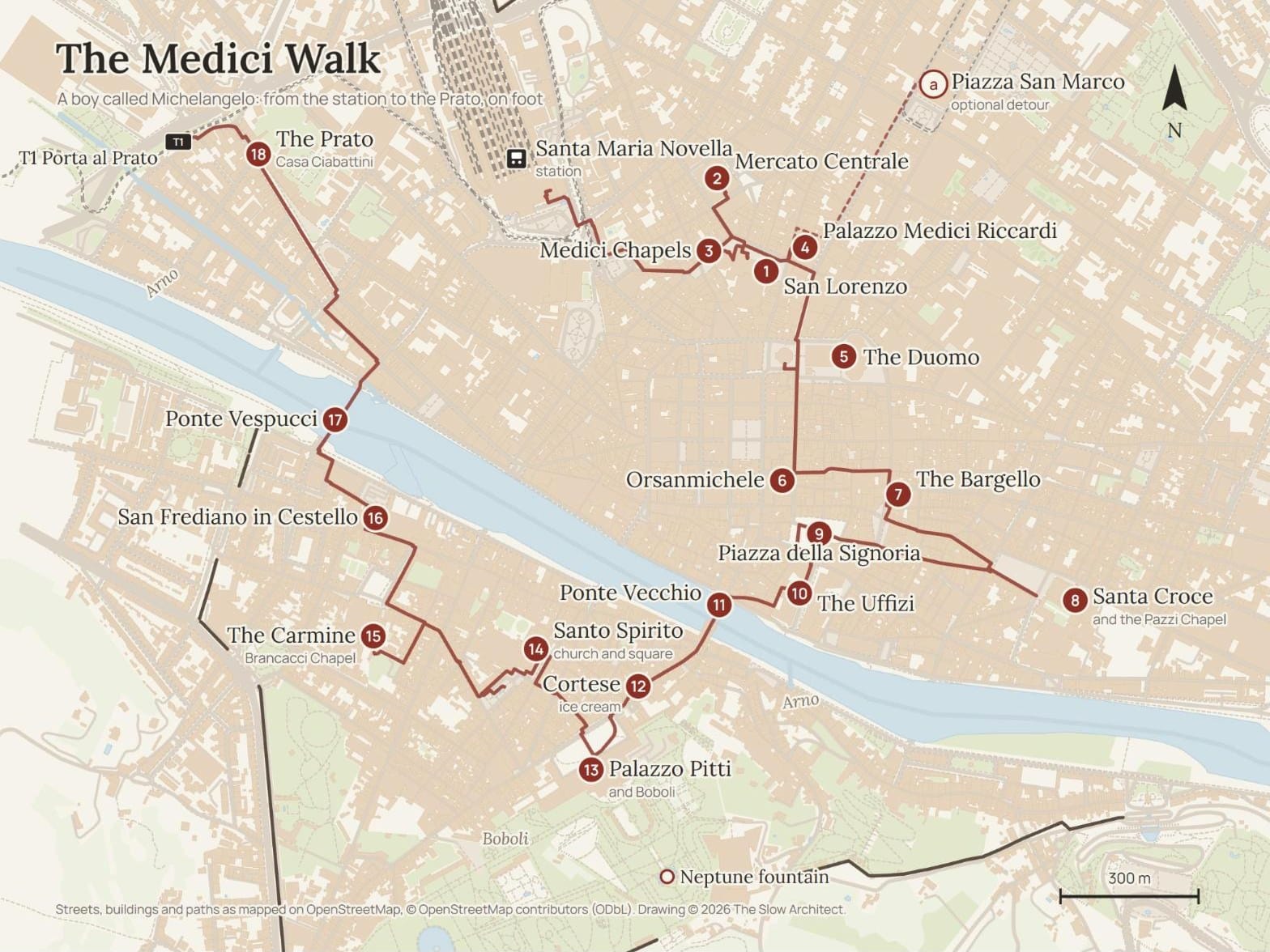
The Medici Walk, stop by stop
You start at the station, cross the Arno on the Ponte Vecchio and cross it back on the Ponte Vespucci, and finish at the Prato, at dinner. In between is almost a century of Florence: from the morning two Medici brothers were attacked in the cathedral to the one when Michelangelo's body came back to the city, packed up like merchandise. The stops follow the streets, and the story jumps back and forth.
San Lorenzo, the market and the Medici Chapels
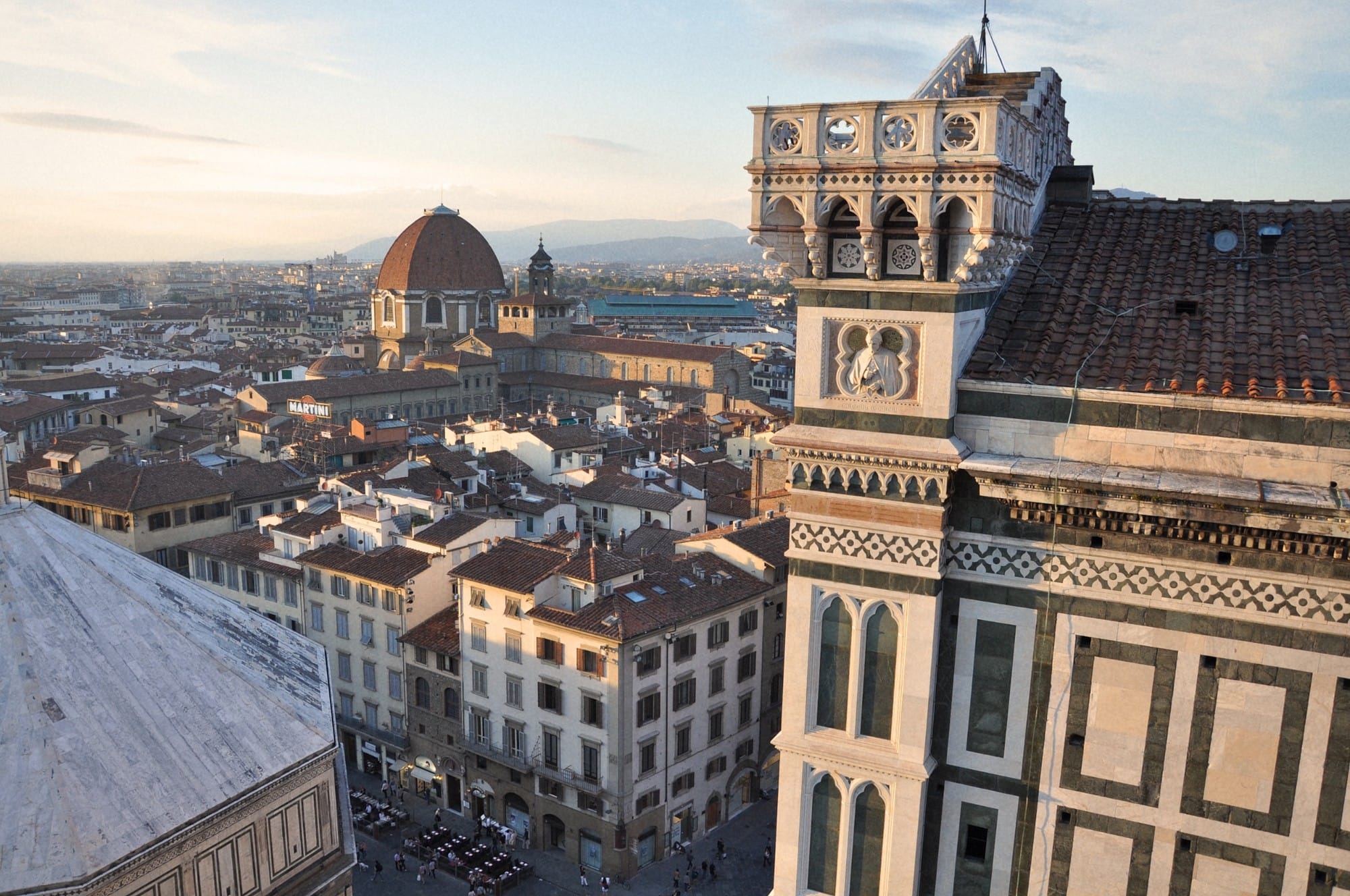
From the station to San Lorenzo is a few minutes. It is the Medici church: behind it, attached to the apse, are the Medici Chapels, the family mausoleum. It never got its facade, and what you see is a wall of rough brick and stone; the story of that wall belongs to the other walk.
All around is the market. The leather stalls in the street are one thing, the Mercato Centrale is another: a great shed of iron and glass by Giuseppe Mengoni, the architect of the Galleria in Milan, opened in 1874. On the ground floor is the food market, Monday to Saturday until the afternoon; on the first floor are the counters where you eat, open every day until midnight. That is how I remember the San Lorenzo market, full of colours and smells.
The Medici Chapels are a minute from the market, with the entrance in Piazza Madonna degli Aldobrandini. They are stupendous, and unfinished. The New Sacristy was commissioned from Michelangelo by two Medici, Pope Leo X and his cousin Cardinal Giulio, for the family tombs. He worked on it in fits and starts from about 1520 to 1534; then he left for Rome, and never set foot in Florence again. Only two of the tombs were finished, and some of the statues were left half done. More than twenty years later Vasari arranged the rest, and in this room he also placed the tomb of Lorenzo the Magnificent and his brother Giuliano.
The Medici Chapels are a state museum: open Tuesday to Sunday from 8.15 am to 6.50 pm, last entry forty minutes before closing, closed on Mondays. A full ticket costs €11.
The Medici house, and the garden of statues
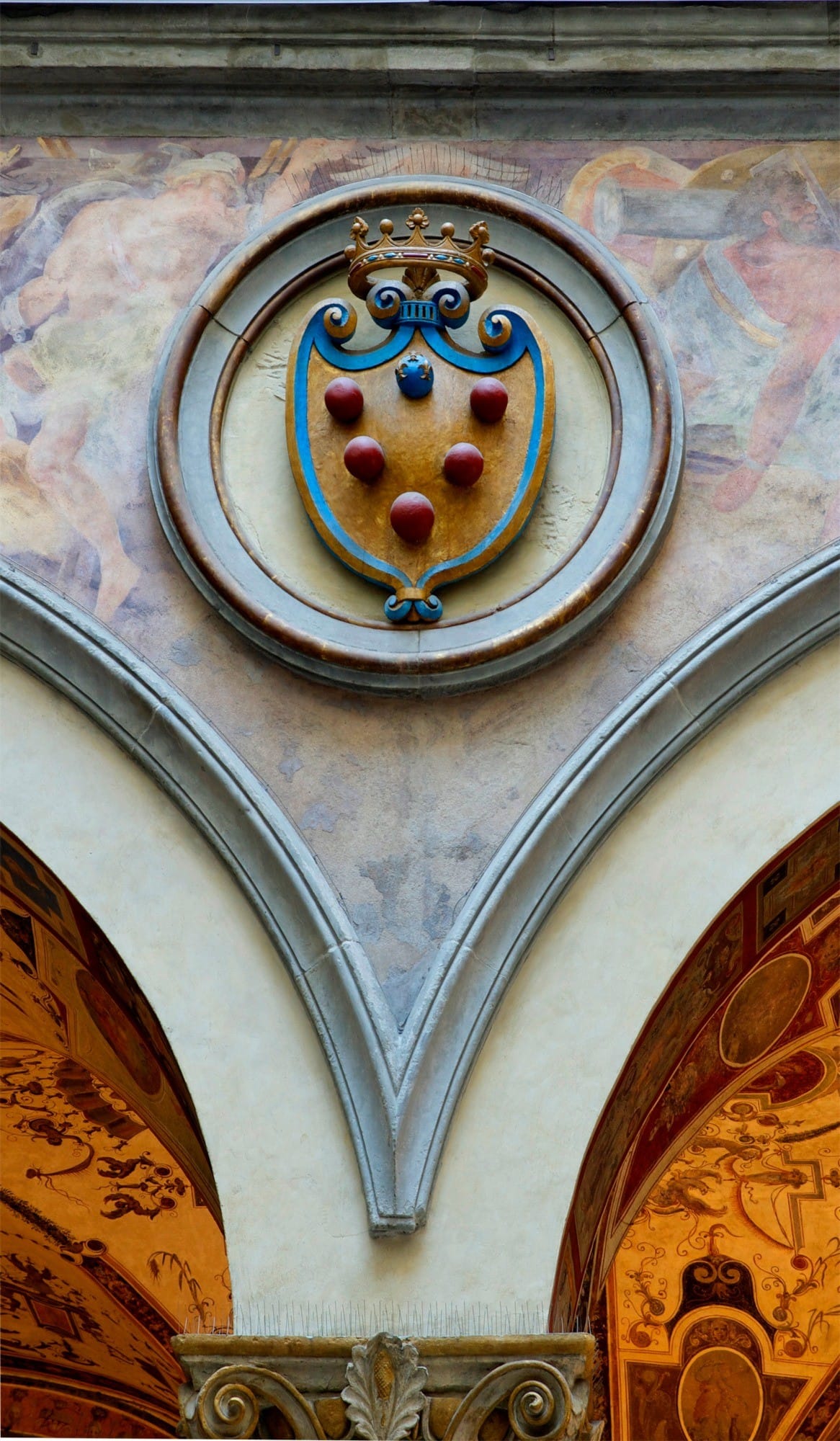
Two streets further on, in Via Cavour, is the house. Palazzo Medici Riccardi was designed by Michelozzo for Cosimo the Elder from 1444, and it is the model for the Florentine palaces that followed: rough stone on the ground floor, smoother and smoother as you go up. The Riccardi bought it in 1659, which is where the double name comes from.
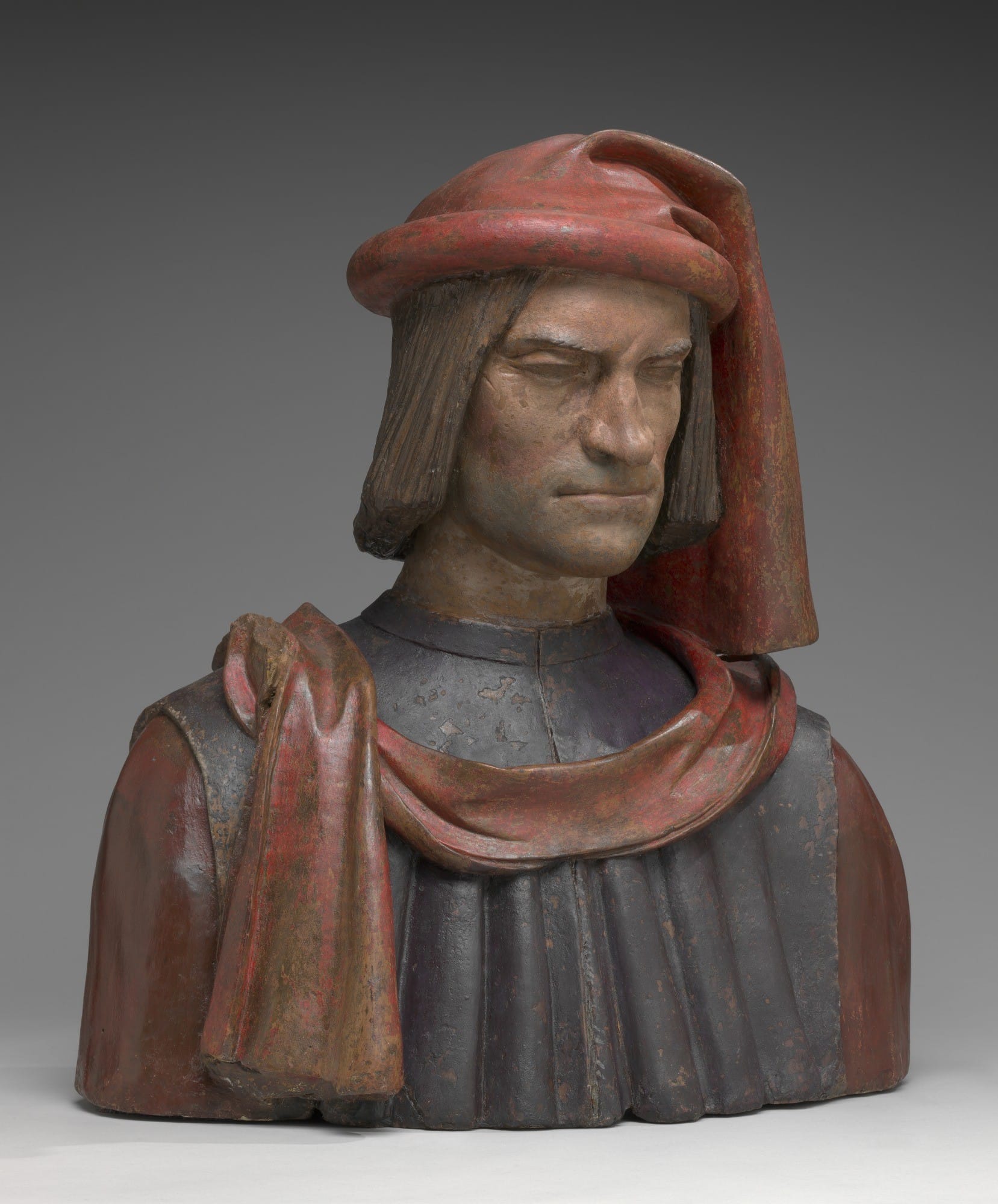
This is where the story of Michelangelo as a boy begins. A little further north, towards San Marco, Lorenzo the Magnificent had a garden full of antique statues, where talented young men learned by copying them under the sculptor Bertoldo di Giovanni, who had been a pupil of Donatello. Michelangelo got there at fourteen or fifteen. His first biographers, Condivi and Vasari, tell that he carved the head of an old faun, and that Lorenzo, passing by, teased him: old men never have all their teeth. The boy, there and then, recut the mouth with one tooth fewer. Lorenzo asked the boy's father whether he might keep him in the house, and Michelangelo lived in this palace, in the street then called Via Larga, until Lorenzo died, on 8 April 1492.
If you have a quarter of an hour, walk up Via Cavour to Piazza San Marco. Nothing is left to see of the garden of statues, but it was somewhere round here, and on the square is the convent of San Marco, which comes into this story twice. It was Lorenzo who brought back to Florence a Dominican friar from Ferrara who preached well, Girolamo Savonarola; on 16 May 1491 the friars elected him prior, and from this convent, after Lorenzo's death, he held the city in his grip. This is where they came for him on the evening of 8 April 1498. Then back down Via Cavour.
The Duomo, 26 April 1478: the Pazzi conspiracy
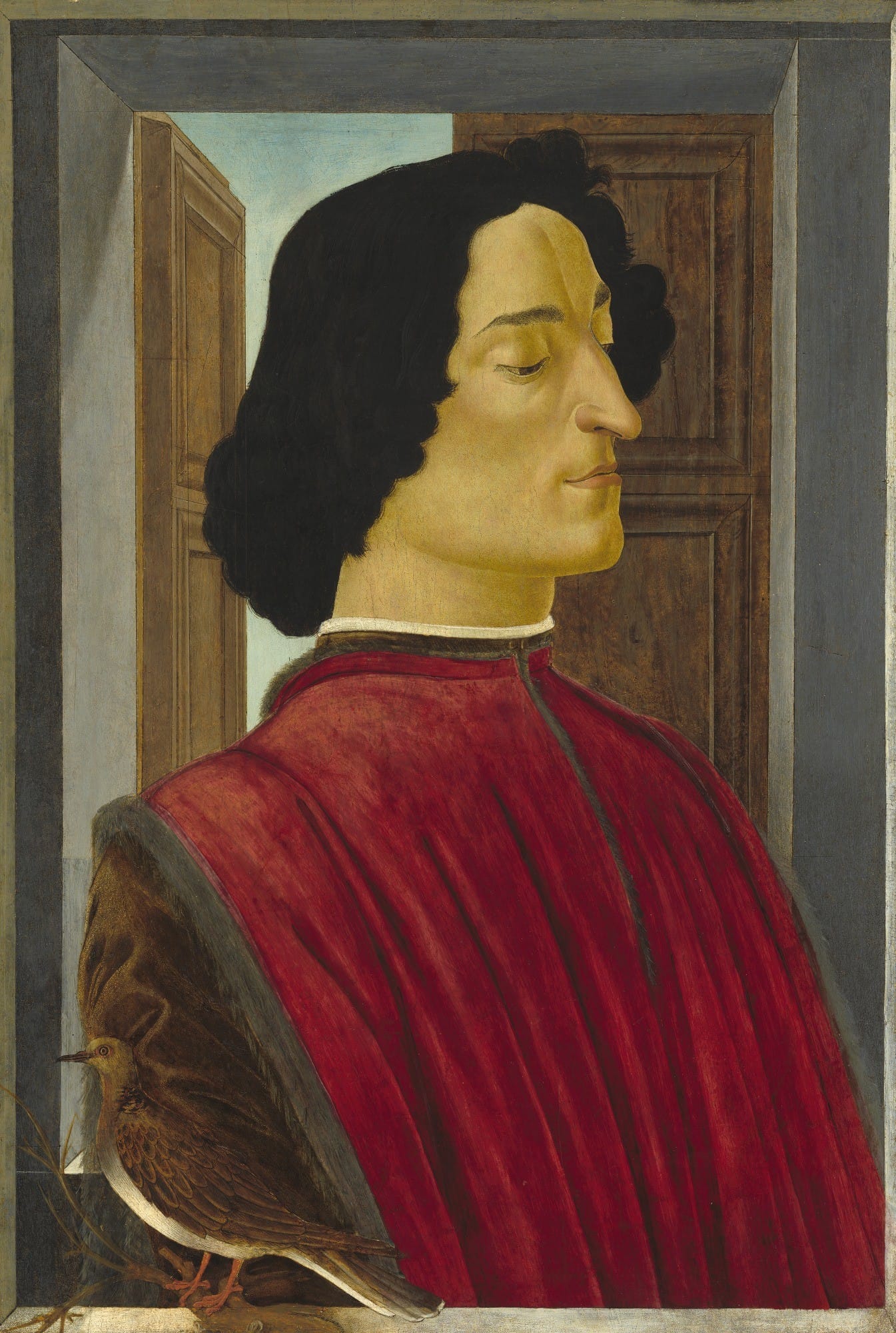
From the Medici palace to the cathedral is a few steps, down Via de' Martelli. On 26 April 1478, during High Mass, Bernardo Bandini Baroncelli and Francesco de' Pazzi stabbed Giuliano de' Medici, Lorenzo's younger brother, and killed him. Lorenzo was wounded and saved himself by taking refuge in the sacristy. Behind the conspiracy were the Pazzi, one of the most influential banking families in Florence.
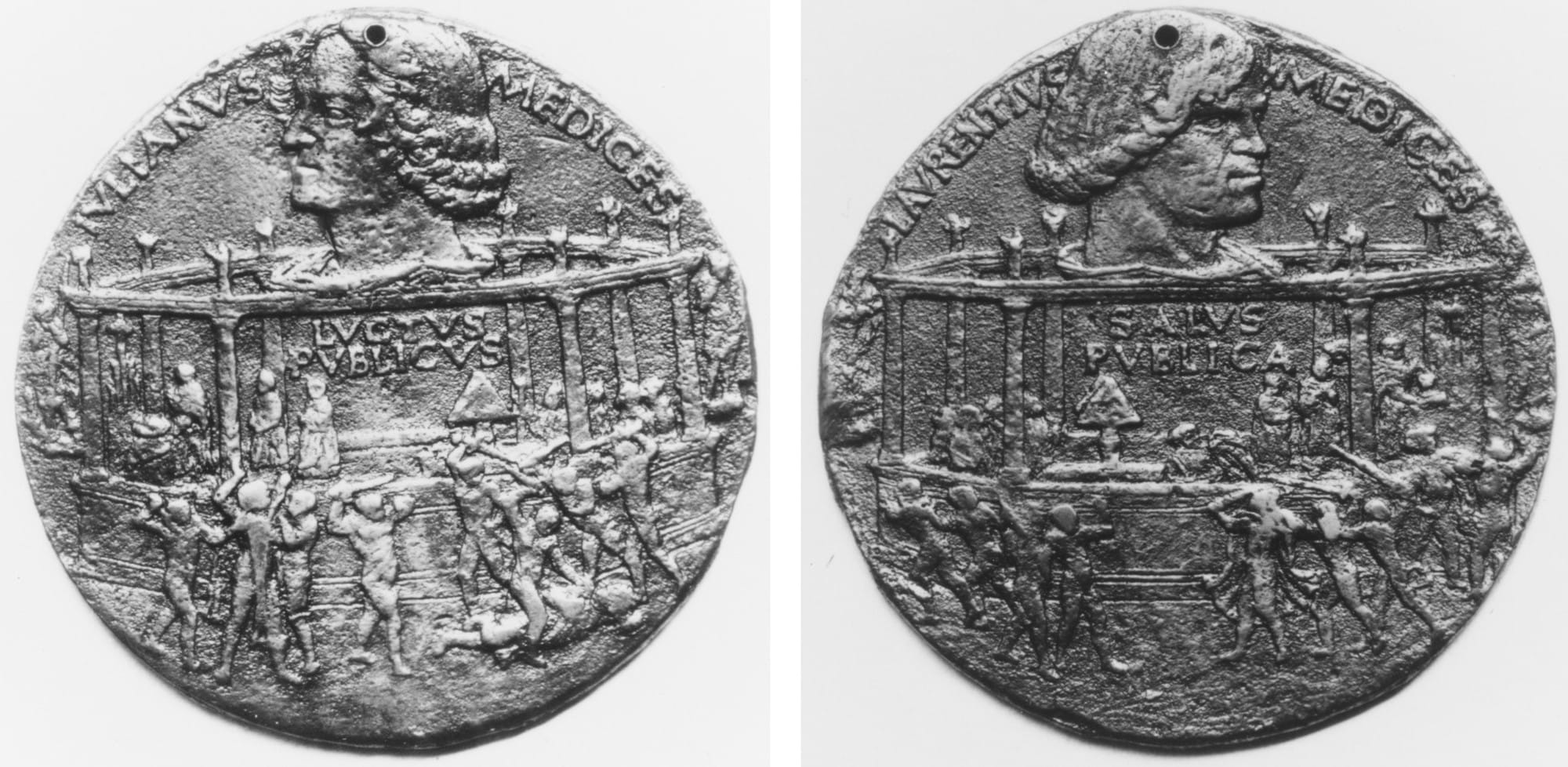
The conspiracy failed. Florence did not rise against the Medici, as the conspirators had hoped, and Lorenzo's revenge was quick. Lorenzo did something else as well: he asked Bertoldo, the sculptor of the garden, for a medal. On one side is Lorenzo, above the words SALVS PVBLICA, public safety; on the other Giuliano, above LVCTVS PVBLICVS, public mourning. Beneath the two heads is the choir of the cathedral, with the Mass and the daggers. It is the account of that morning as told by the side that won.
Orsanmichele, the statues of the guilds
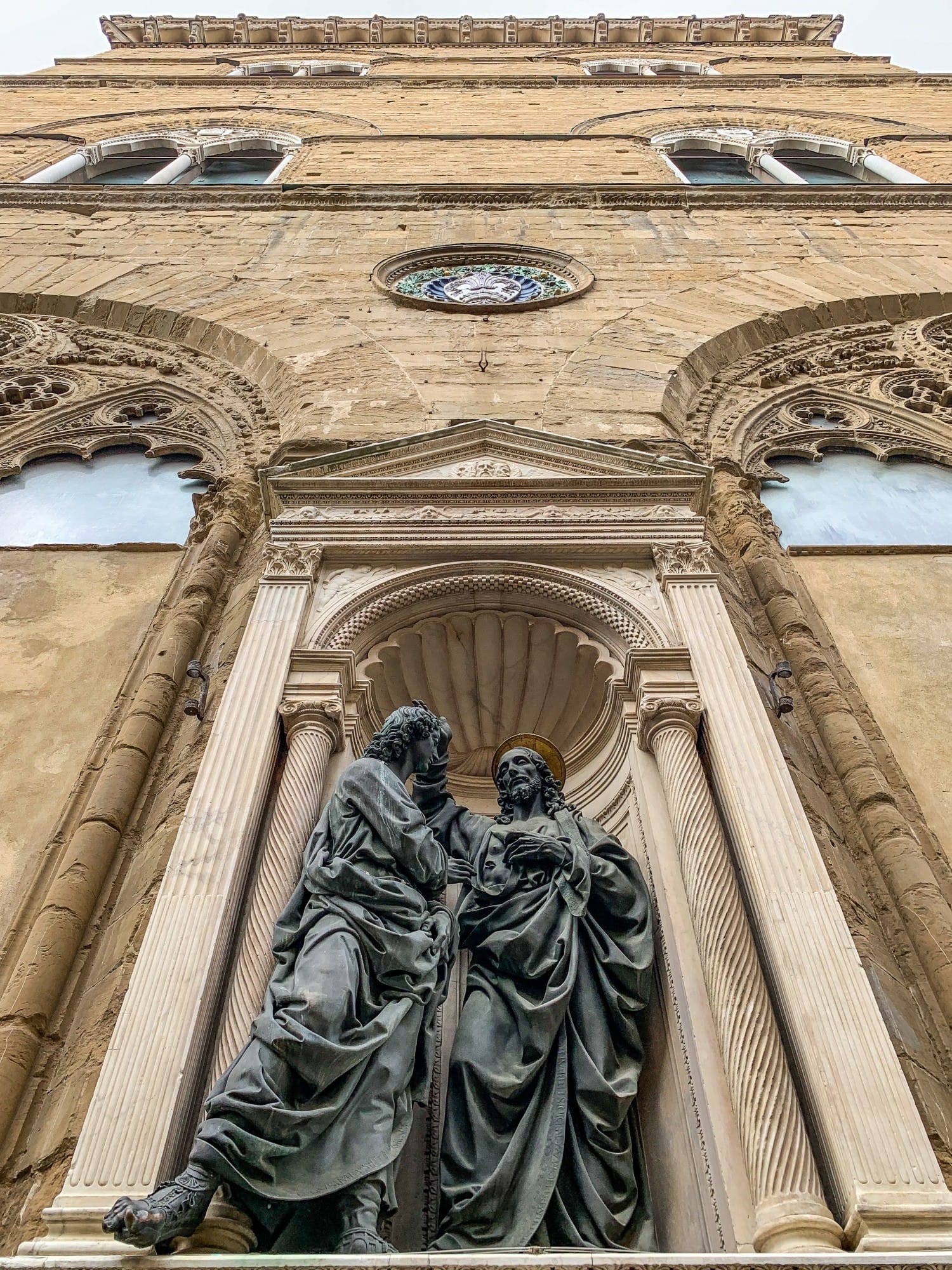
From the cathedral take Via de' Calzaiuoli, the street that runs straight to Piazza della Signoria, and halfway down, on the right, is a tall square building with its Gothic windows walled up: Orsanmichele. It was the Comune's grain market, with the storerooms on the upper floors, and in the fourteenth century it became a church without ceasing to be a granary. From the fifteenth century the Arti, the guilds, each put their patron saint in one of the fourteen niches outside, and competed with each other by hiring sculptors: Ghiberti, Nanni di Banco, Donatello, Verrocchio. Walk round it, it is free: the statues outside are copies, the originals are in the museum on the first floor and Donatello's Saint George has been in the Bargello since the end of the nineteenth century, but the niches read from below as they did then. Look at Verrocchio's Doubting Thomas, with Thomas reaching his hand towards the wound, and at Ghiberti's Saint John the Baptist, two and a half metres tall, which the Ministry's catalogue entry calls the first large statue cast in bronze in Florence. Church and museum are open Tuesday to Sunday from 8.30 am to 6.30 pm, last entry fifty minutes before; closed on Mondays; the ticket costs €10.
The Bargello, and Leonardo's hanged man
From Orsanmichele to the Bargello is a few minutes, along Via dei Tavolini and Via Dante Alighieri. In Via del Proconsolo stands the Bargello. It is the oldest public palace in Florence, begun in 1255 for the Captain of the People. Its name comes from the bargello, the chief of police, who was based there from 1574. Today it is the Museo Nazionale, and my advice is to see it at least from outside.
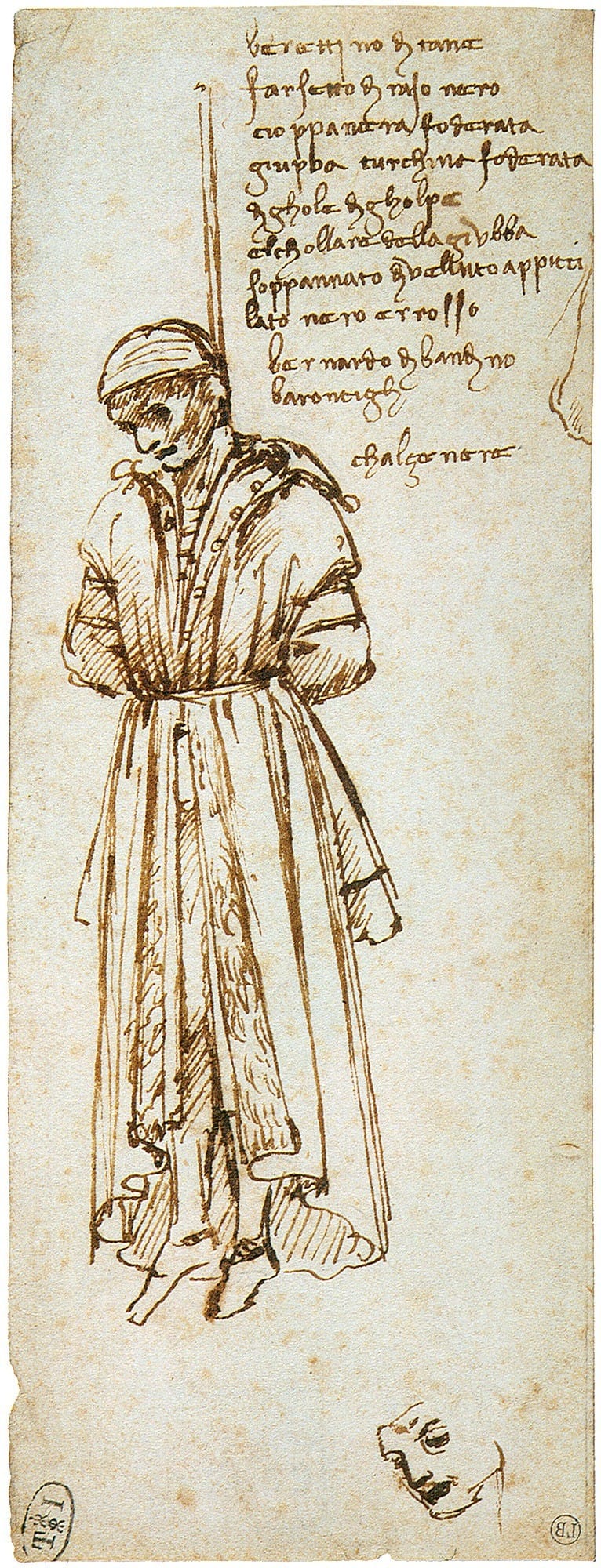
Bernardo Bandini, one of the two who had struck Giuliano, fled as far as Constantinople. Sultan Mehmed II had him seized and sent back to Florence, and on 29 December 1479 he was hanged from a window of this palace. Leonardo da Vinci, who was twenty-seven, drew him hanging there, hands tied, and beside the drawing noted what he was wearing, colour by colour. The sheet is now in the Musée Bonnat-Helleu in Bayonne, in France.
Santa Croce, where Michelangelo came back
Santa Croce, inside, is magnificent. It holds the tombs and monuments of many famous Italians, and the one we are after today belongs to a man who came back to Florence dead.
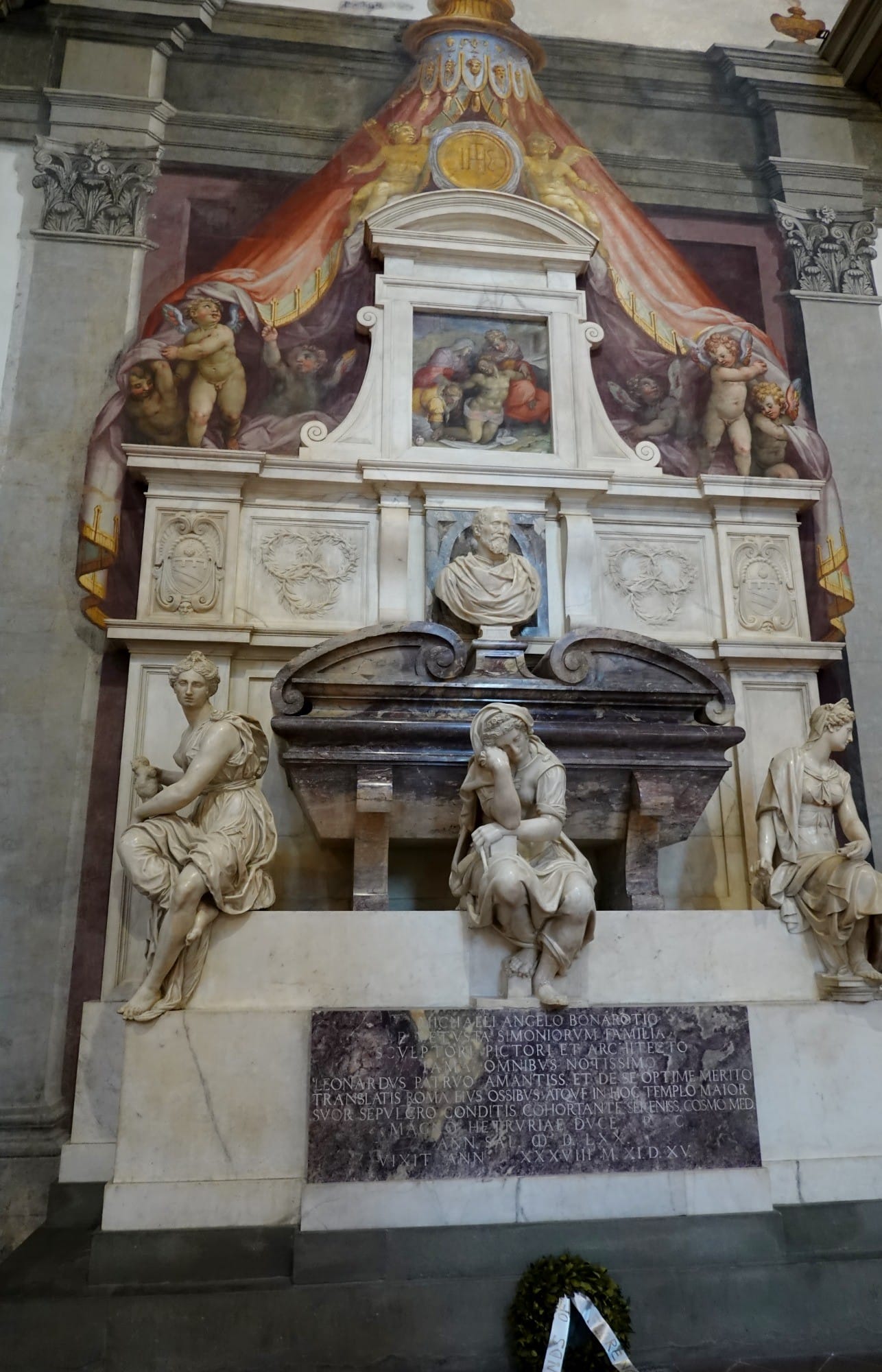
Michelangelo died in Rome on 18 February 1564, at eighty-eight, and by his own wish he was buried in Florence. Vasari tells that his nephew, Lionardo, had the body smuggled out of Rome packed up like ordinary merchandise. It reached Florence in March and was buried here, beneath the tomb Vasari designed; in July, in San Lorenzo, the city gave him a solemn funeral.
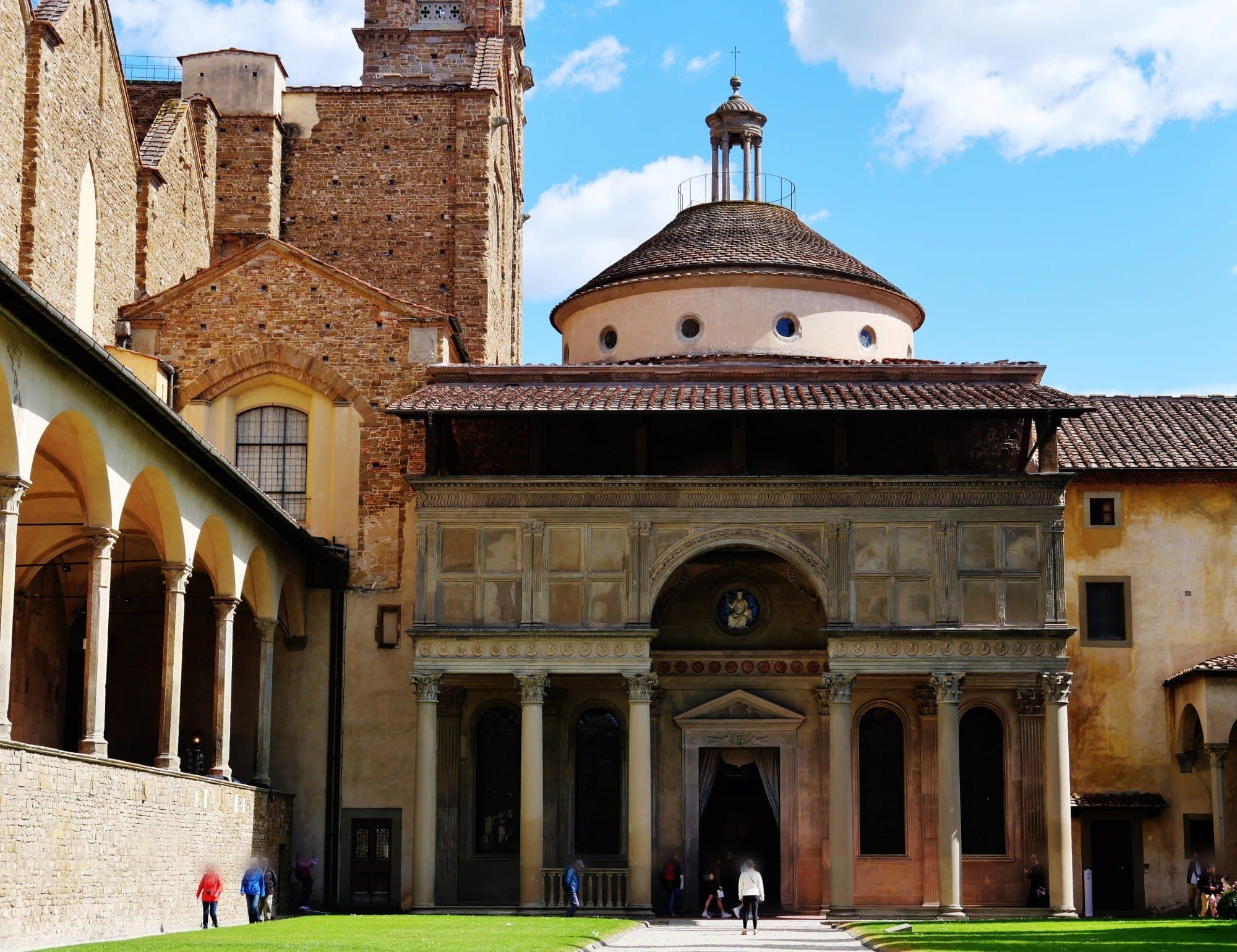
Before you leave, in the first cloister, is the Pazzi Chapel. Andrea de' Pazzi commissioned it, undertaking from 1429 to build it as a chapter house for the friars and a family chapel; the real work began in the 1440s, and it has come down to us almost as it was. Tradition gives it to Brunelleschi, but the first written attribution is from the end of the fifteenth century, and the historian Marvin Trachtenberg, who has doubted it for decades, gave it to Michelozzo in a book in 2024. Whatever you think, the family that tried to get rid of the Medici in 1478 had its chapel here.
The basilica is open Monday to Saturday from 9.30 am to 5.30 pm and on Sundays from 2 pm to 5.30 pm, last entry at 5 pm; a full ticket costs €10.
Piazza della Signoria: the David copy, and Savonarola's bonfire
In front of Palazzo Vecchio stands the David, but it isn't him. Michelangelo finished it in 1504, and on 8 September that year it was unveiled here, in front of the seat of government. It stayed until 1873, when it was moved to the Galleria dell'Accademia to protect it from the weather. The one in the square is the marble copy Luigi Arrighetti made in 1910.
The real David is in the Accademia, and what stuck in my head about it is a building-services story: the idea of a flow of air washing the statue all the time, so that it would not fill up with dirt over the years. Under the floor of the Tribuna there really is a ventilation system, from the 1980s; the air curtain, as far as I know, never got past the study stage.
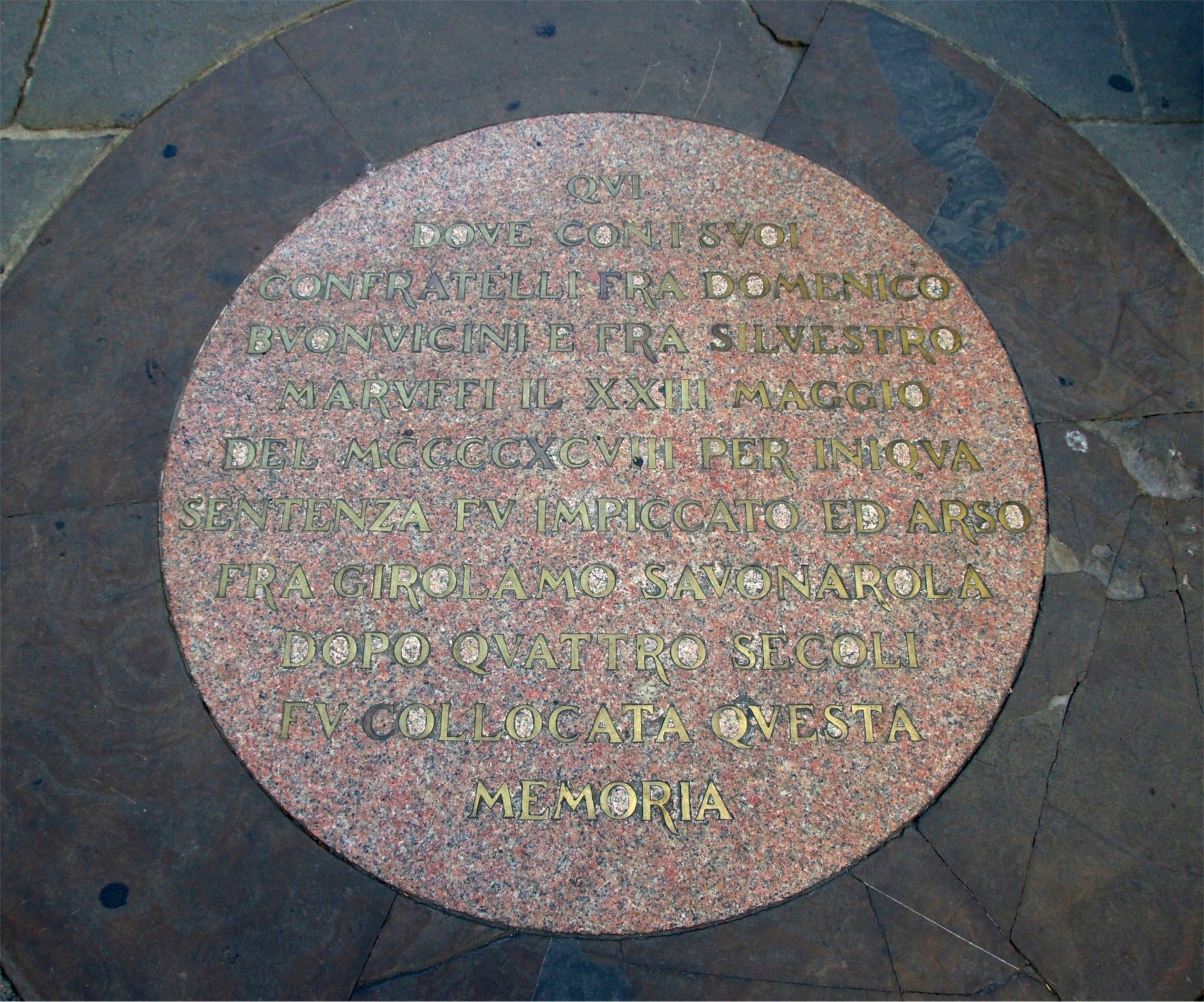
In front of the Neptune fountain, look at the ground. There is a round slab. It marks the spot where, on 23 May 1498, Friar Girolamo Savonarola was hanged and then burned, with two of his brethren. He was the Dominican who, after the Medici were driven out in 1494, had held Florence under his sermons, and who in the carnival of 1497 had had mirrors, clothes, paintings and books piled up and burned in this very square: the bonfires of the vanities. Then the city turned against him and the Church condemned him for heresy. His ashes were thrown into the Arno, so that nothing would be left to venerate. The slab was laid in 1898, four centuries later, and every 23 May the city leaves flowers on it.
The Uffizi, the Vasari Corridor and the Ponte Vecchio
From here my advice is a stroll: the Loggia dei Lanzi, the courtyard of the Uffizi, and down, straight into the Ponte Vecchio.
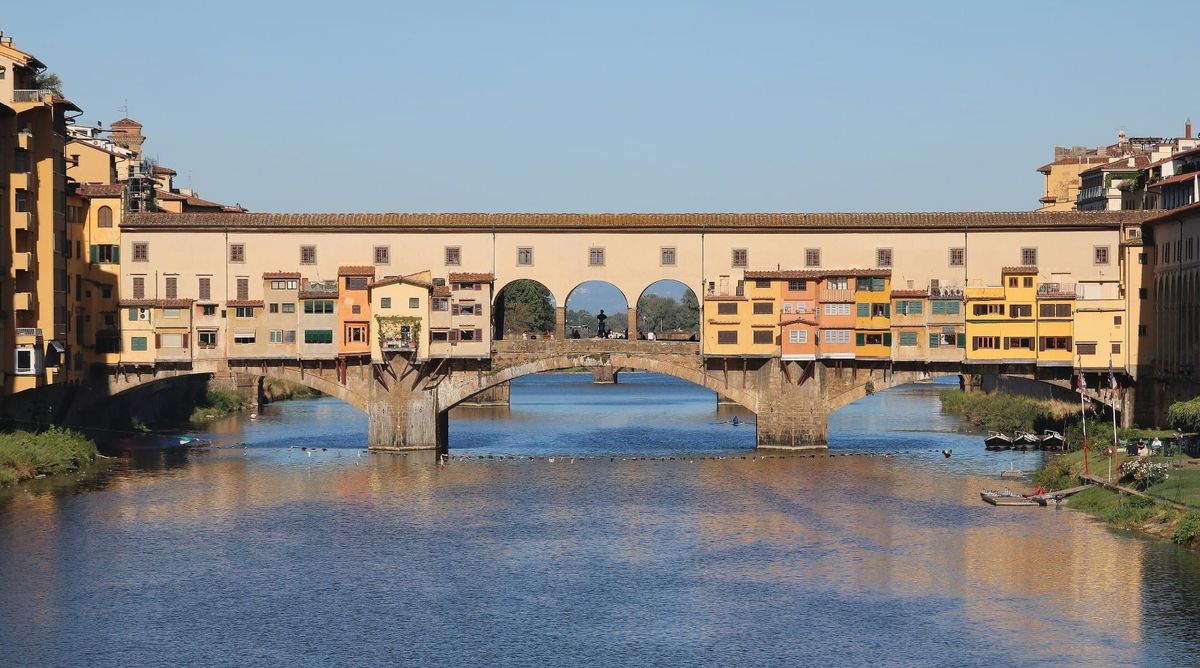
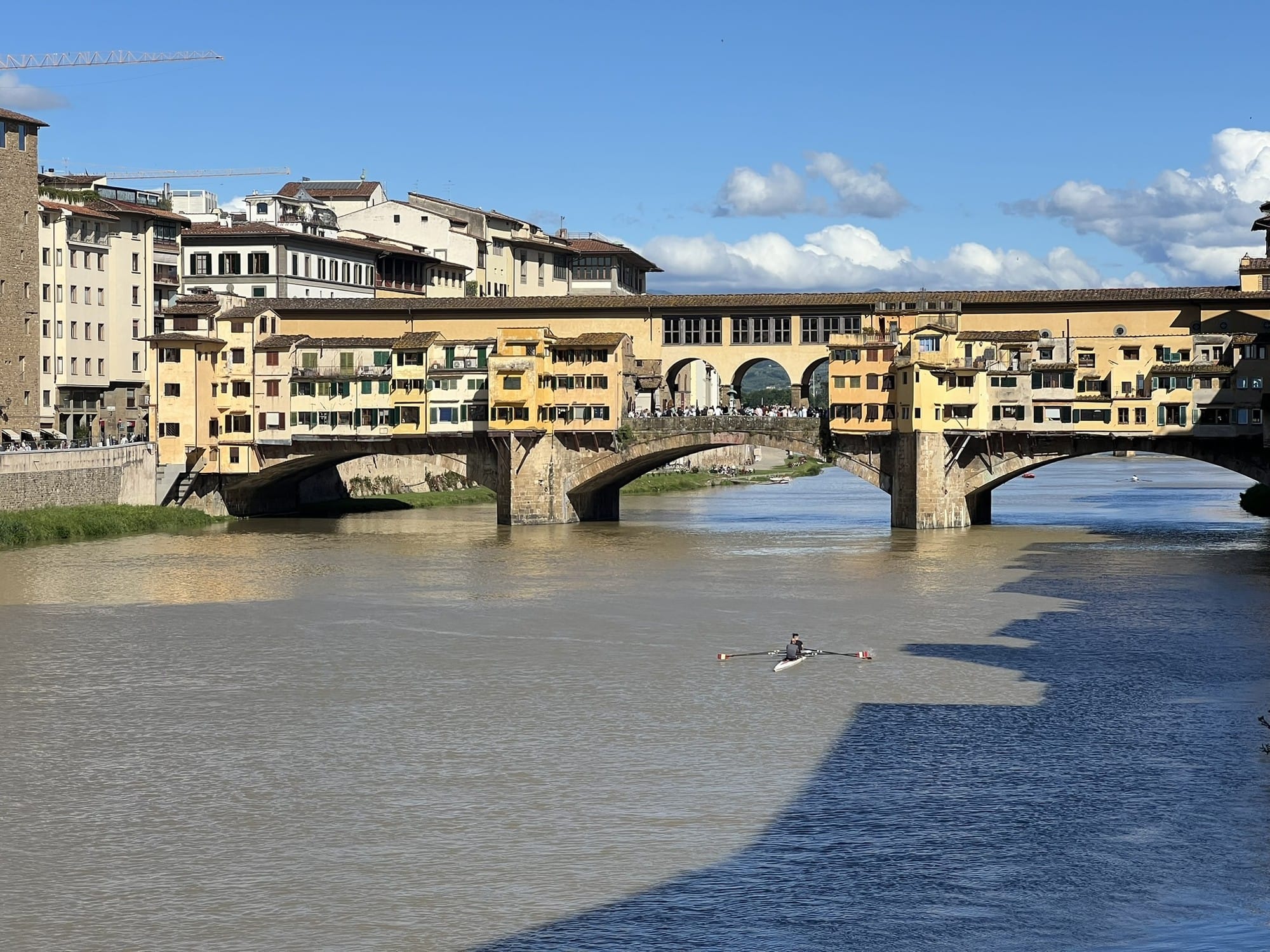
On the bridge, look up. Above the shops runs a row of small windows: it is the Vasari Corridor, which Vasari built in 1565 for Cosimo I, for the wedding of his son Francesco to Joanna of Austria. It is a covered passage that runs from the seat of government, through the Uffizi and over the Arno, to Palazzo Pitti, without touching the street. Since 21 December 2024 it can be walked again, by booking and with the Uffizi ticket.
Today's bridge dates from 1345. Until 1593 the shops belonged to butchers; then Ferdinand I sent them away and put in the goldsmiths, who are still there. In August 1944 it was the only bridge in Florence the retreating Germans did not blow up. The next one along, Santa Trinita, was rebuilt after the war as it had been, and it is one of the stops on the other walk.
An ice cream in Via de' Guicciardini
Across the Arno you go up Via de' Guicciardini towards Pitti. Before Boboli, an ice cream at Cortese, at number 124 red. To me it was “the Raw”: it is a raw, vegan, gluten-free gelateria, and anyone after egg custard should know that first.
Boboli, and the duchess who bought Pitti
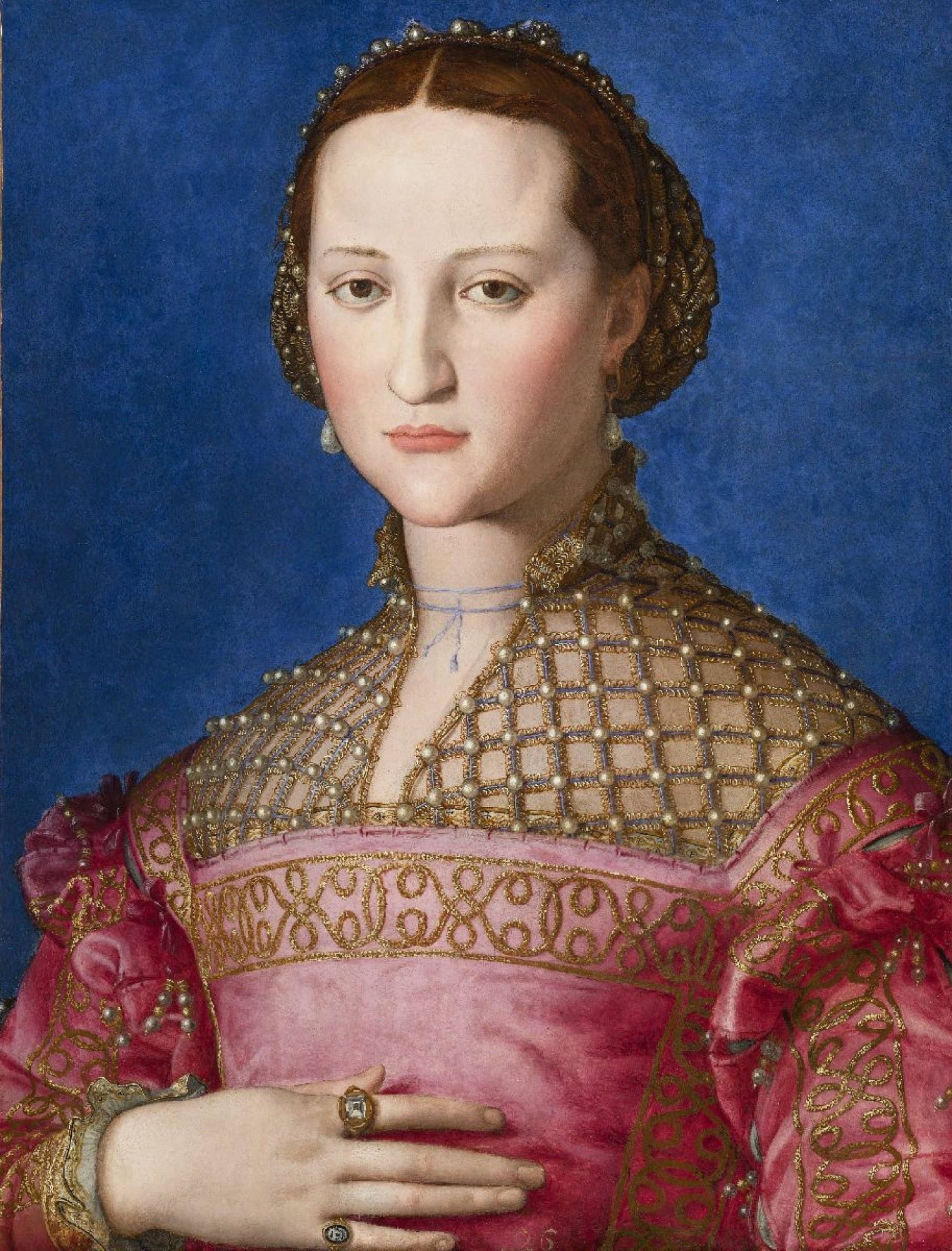
In the middle of the sixteenth century Palazzo Pitti was bought by Eleonora di Toledo, the wife of Cosimo I, who did not like living in Palazzo Vecchio. Behind the palace, on the hill, the Medici made their garden. The Vasari Corridor, the one you saw from the Ponte Vecchio, ends in here.
You have to go to Boboli. You can do it quickly: from the courtyard of Pitti you climb through the Amphitheatre to the Neptune fountain, which the Florentines call the Forcone, the pitchfork, for its trident, carved by Stoldo Lorenzi in the 1560s. Or you walk the whole of it, and that is hard work, because the slope is real. Be ready to sweat. In winter, with last entry at 3.30 pm, take the short loop.
From November to February Boboli opens at 8.15 am and closes at 4.30 pm, last entry an hour before; it is closed on the first and last Monday of the month and on 25 December. The ticket costs €10 at the door and €13 in advance; with Palazzo Pitti, €22 or €25.
Santo Spirito and the Oltrarno: the boy's crucifix
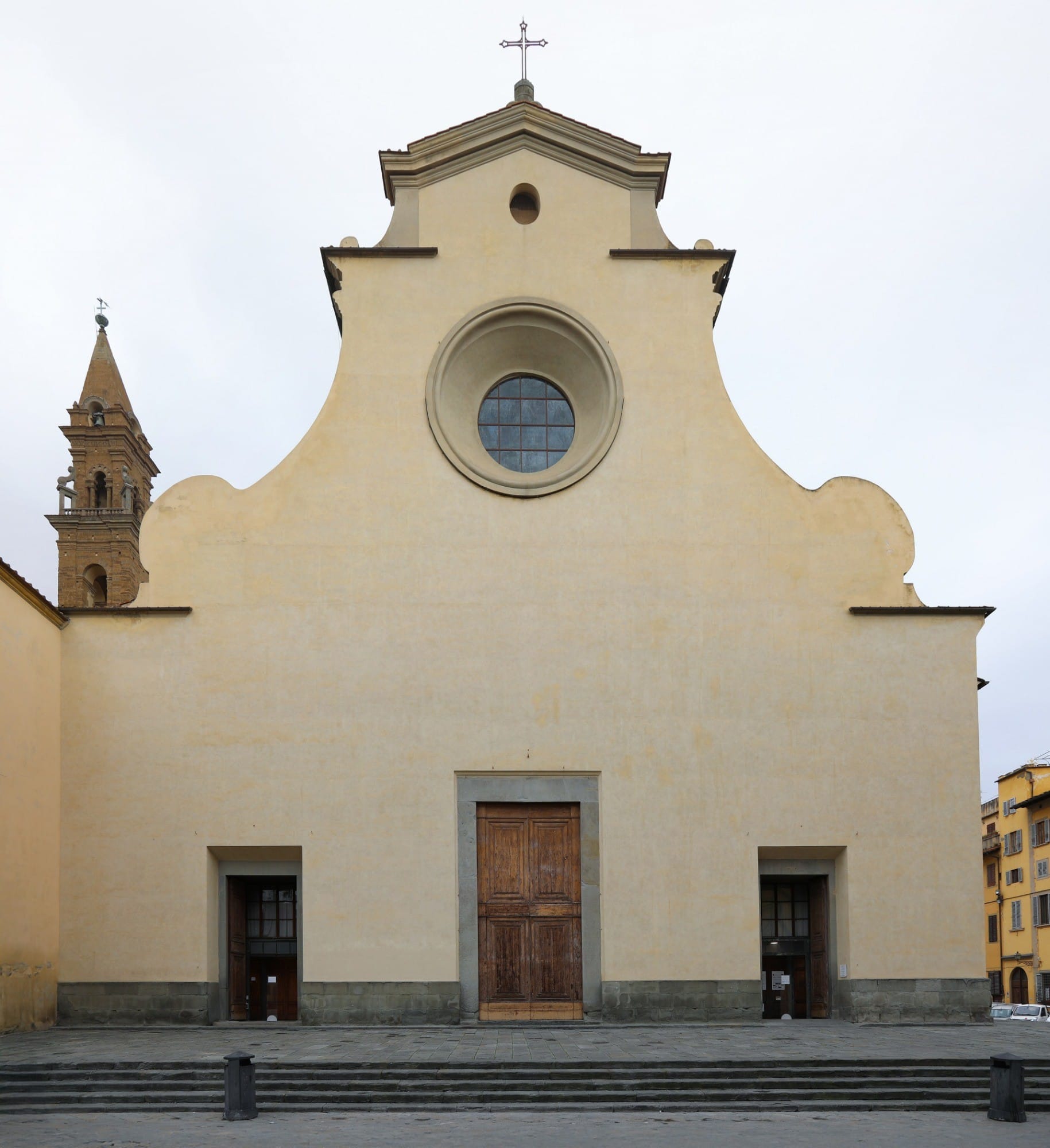
Coming out of Boboli you drop straight into the Santo Spirito quarter: the square, the church. The square is beautiful, and in the evening it is the place for aperitivi and music. The church is by Brunelleschi, who designed it and died two years after work began, in 1446. The facade is smooth plaster: the stone never arrived.
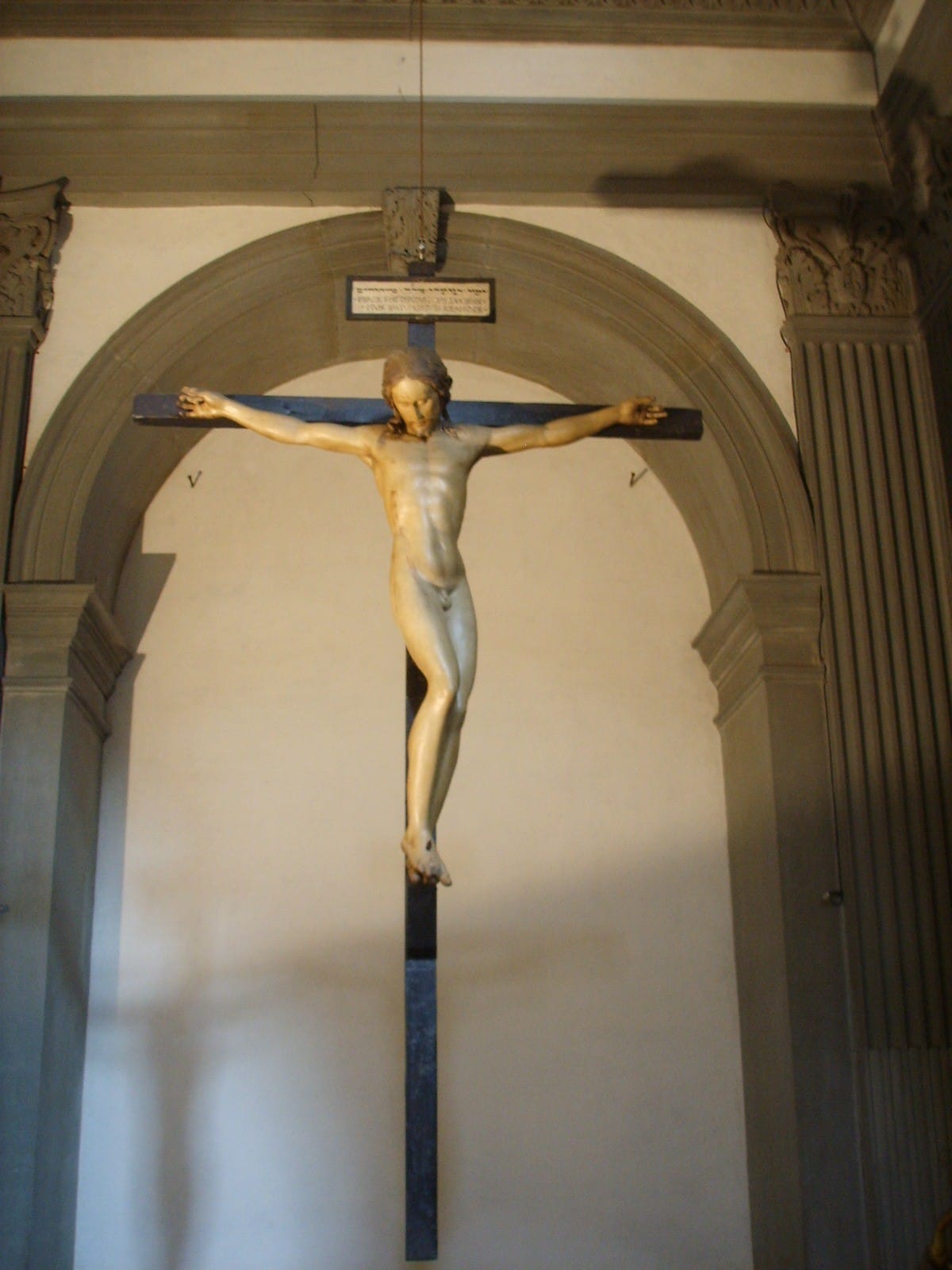
When Lorenzo died, in 1492, Michelangelo went back to his father's house. The prior of Santo Spirito, Niccolò Bichiellini, opened the convent hospital to him, where he could study anatomy on the bodies of the dead. To thank him, the boy carved him a wooden crucifix, between 1492 and 1494: a slender, naked Christ, the body twisting just slightly. Since 2000 it has been in the sacristy, and today it hangs in the middle of the octagonal room, so that you can walk round it.
The sacristy is one of those rooms people study, like Michelangelo's at San Lorenzo. The church is free; the sacristy, cloister and refectory are visited for a contribution of €2, from 10 am to 1 pm and from 3 pm to 6 pm (on Sundays the morning starts at 11.30), and are closed on Wednesdays.
The Carmine, and the punch
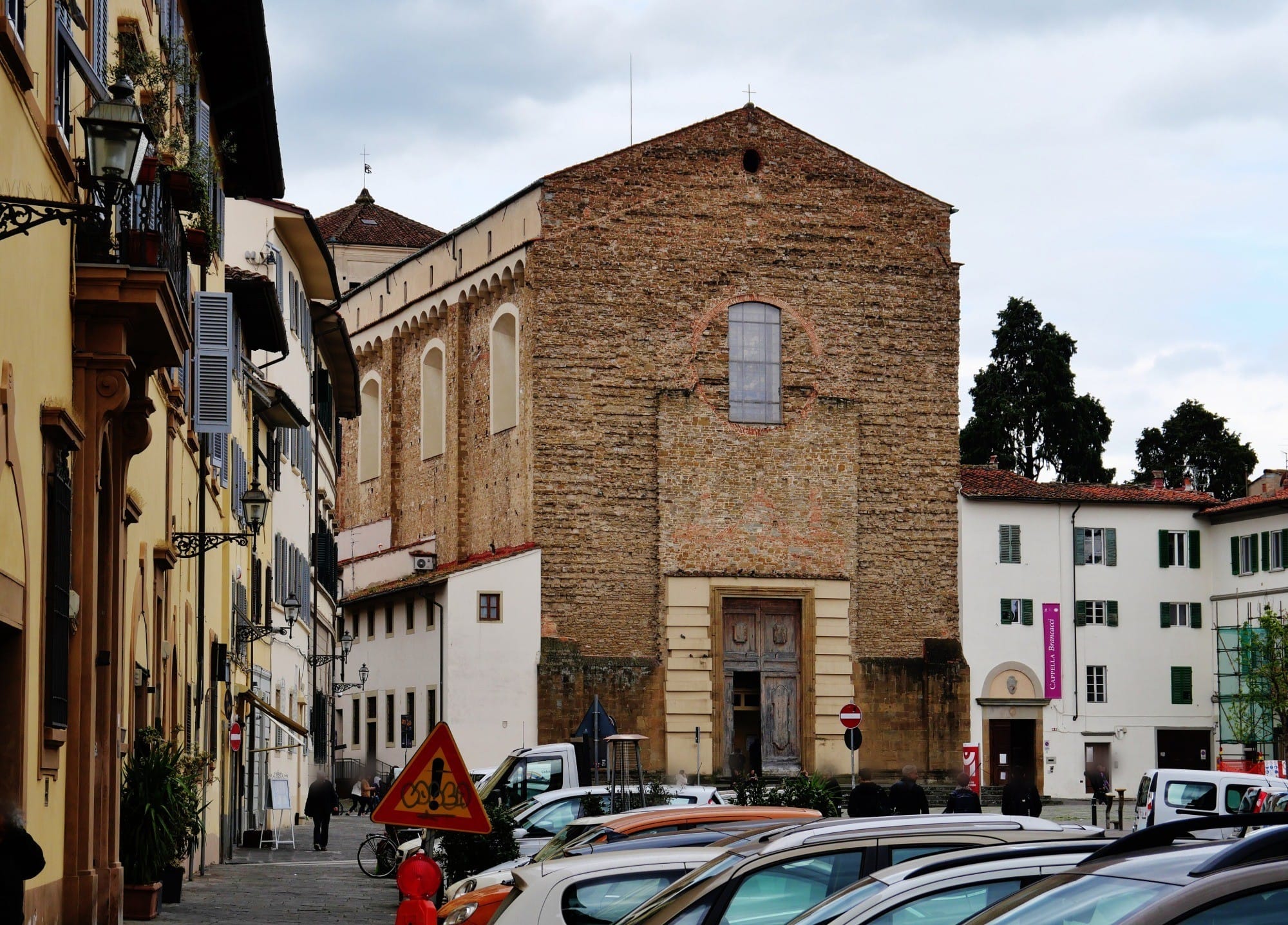
From Santo Spirito it is a few minutes to Piazza del Carmine. Another unfinished facade, rough stone and brick. The church was founded by the Carmelites in 1268; in 1771 a fire destroyed almost all the interior, rebuilt by 1782. The sacristy, the Corsini Chapel and the Brancacci Chapel survived, with the frescoes by Masaccio and Masolino, finished by Filippino Lippi.
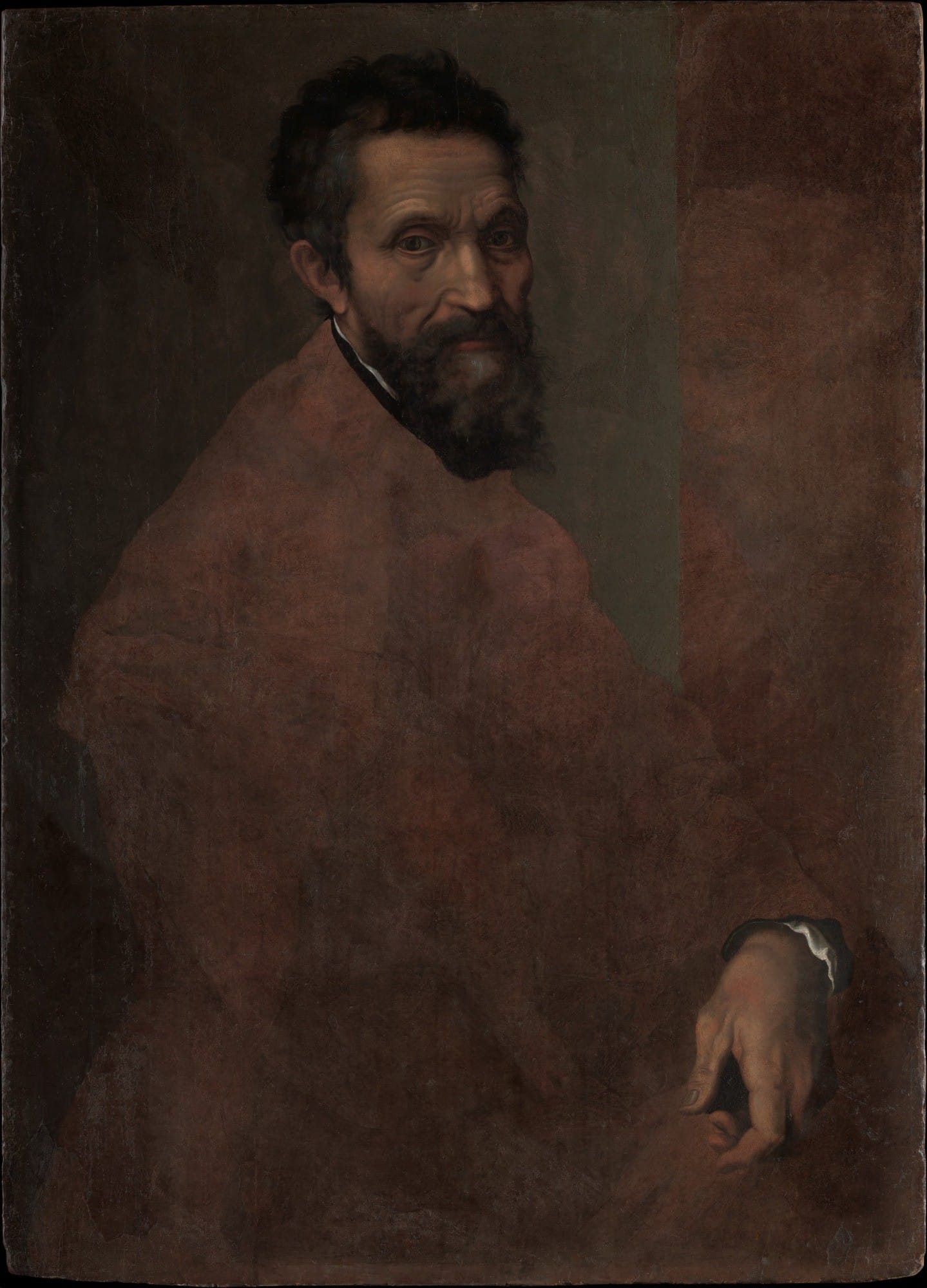
For the story of this chapel you have to go back to when Michelangelo was in the garden at San Marco. Among the boys was Pietro Torrigiano, a couple of years older, and together they came here to draw, copying Masaccio. Many years later Torrigiano told the story to Benvenuto Cellini, who wrote it in his Life: Michelangelo had a habit of mocking the others, and one day Torrigiano, angrier than usual, punched him on the nose and felt the bone and cartilage give way under his knuckles. Vasari tells it a little differently: for him it was envy, and Torrigiano had to leave Florence. Michelangelo kept that crooked nose all his life, and you can see it plainly in the portrait attributed to Daniele da Volterra, painted when he was old.
The Brancacci Chapel belongs to the Musei Civici: booking is advisable, it is closed on Tuesdays, open from 10 am to 5 pm and on Sundays from 1 pm to 5 pm, and the ticket costs €15.
The evening, and dinner at the Prato
You have already had your ice cream in Via de' Guicciardini. For the aperitivo, go back a few minutes to Piazza Santo Spirito, which fills with people and music in the evening: take a table, and stay there.
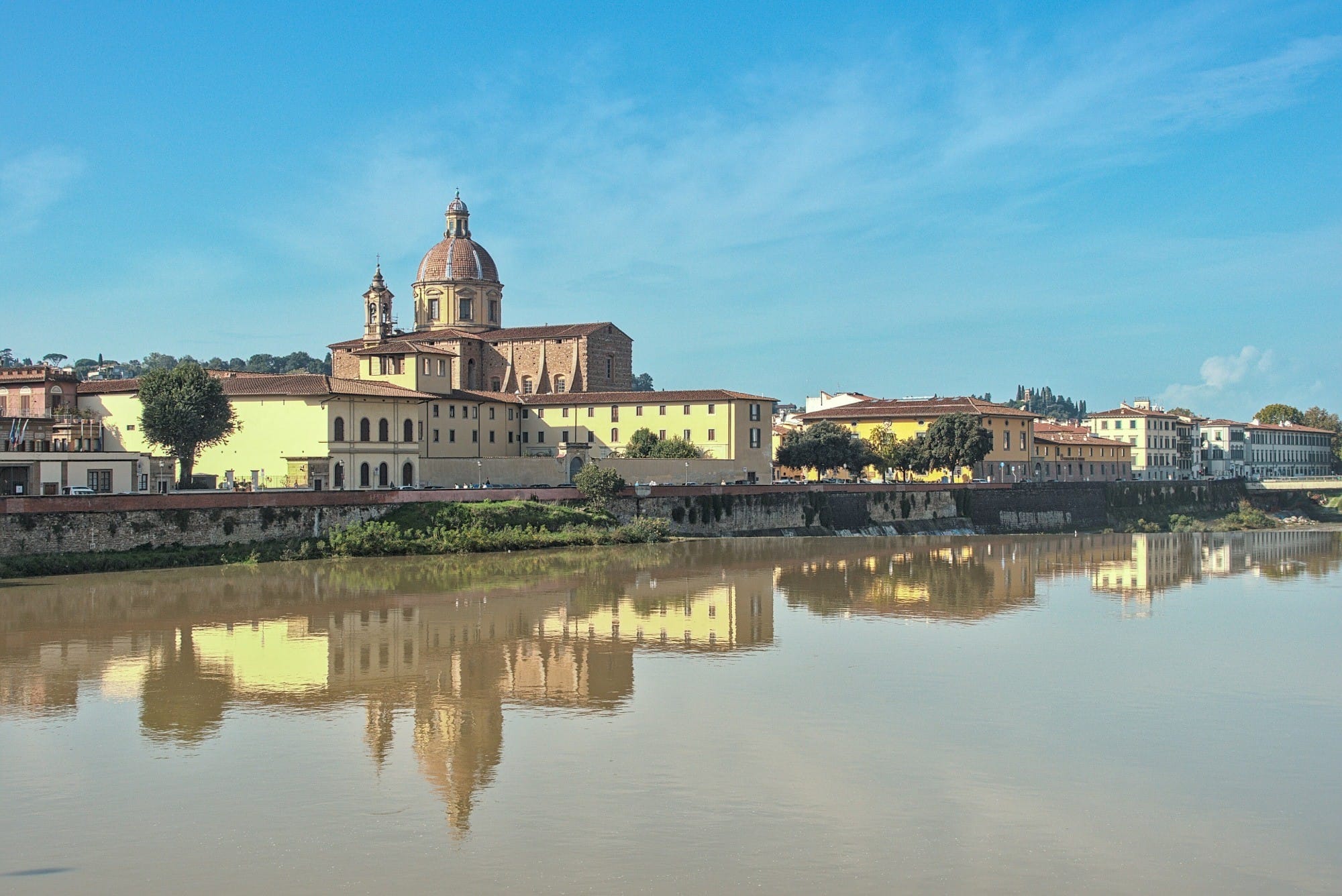
For dinner you go to the Prato, across the Arno, and the way there is the last stop. From Piazza Santo Spirito go back past the Carmine and take Borgo San Frediano, the quarter's main street, and turn into Via di Cestello, which brings you into the square on the river. The church is San Frediano in Cestello, rebuilt between 1680 and 1689 to a design by Gherardo Silvani, with the tall dome on its drum that Antonio Maria Ferri finished in 1689: you can pick it out from every lungarno. The facade, here too, was never built, and has stayed rough stone with a door in the middle.
Cross the Arno on the Ponte Vespucci, which is right there, and in a quarter of an hour you are at the Prato, the area around the gardens of Palazzo Corsini, which is fairly lively in the evening. The garden is private and can be visited only by booking, but in the evening you come for the streets around it, not for the garden. For dinner I recommend Casa Ciabattini, at Via Il Prato 68 red: I have been, and I have fond memories of it. It is open for lunch Monday to Saturday and for dinner Tuesday to Saturday, from 7 pm to 10 pm; closed on Sundays. Round the corner is the Porta al Prato stop of the T1 tram, which takes you back to the station.
In summer, a concert
In summer the big night out in Florence can be a concert. Firenze Rocks is held in June at the Visarno Arena, the racecourse in the Cascine park, and you get there on the T1 tram, Cascine stop, the same line as the Prato. I saw the Smashing Pumpkins there. The line-up changes every year: look it up on the festival's website.
Where to stay in Florence
I don't name hotels; I tell you the area. Near Santa Maria Novella if you arrive by train and leave by train, because the walk starts there and the tram brings you back there in the evening. In the Oltrarno, around Santo Spirito, if you want your evening in the square, which is where this walk goes for the aperitivo. With a car, ask the hotel first how to get into the traffic zone and where to leave the car.