The name I didn't steal
I always thought signing this blog "Giulio Romano" was a small imposture — and that sooner or later I'd have to go to Palazzo Te and settle up with the rightful owner of the name. Then I found out there wasn't one.
We stopped in Mantua on purpose.
We were driving home from a sea whose name I have lost — it happens, with the seas of August — and it was the last night before home. Kat and I have a game: you pick somewhere neither of you has ever seen, you go there even when it isn't on the way, and you plant the flag. It serves no purpose whatsoever. That is precisely why it works.
We arrived in the late afternoon of 14 August 2011 — the eve of Ferragosto, though I had to ask my camera for the date. Ferragosto does not empty a Po valley city all at once; it empties it in shifts. That evening the side streets had their shutters down and every single person left in town was sitting at a table in Piazza delle Erbe, eating. The heat was that still, humid heat the plain produces as a local speciality. And the mosquitoes were flying like helicopters — the toll Mantua has been paying for eight hundred years for having built itself a moat the size of a city.
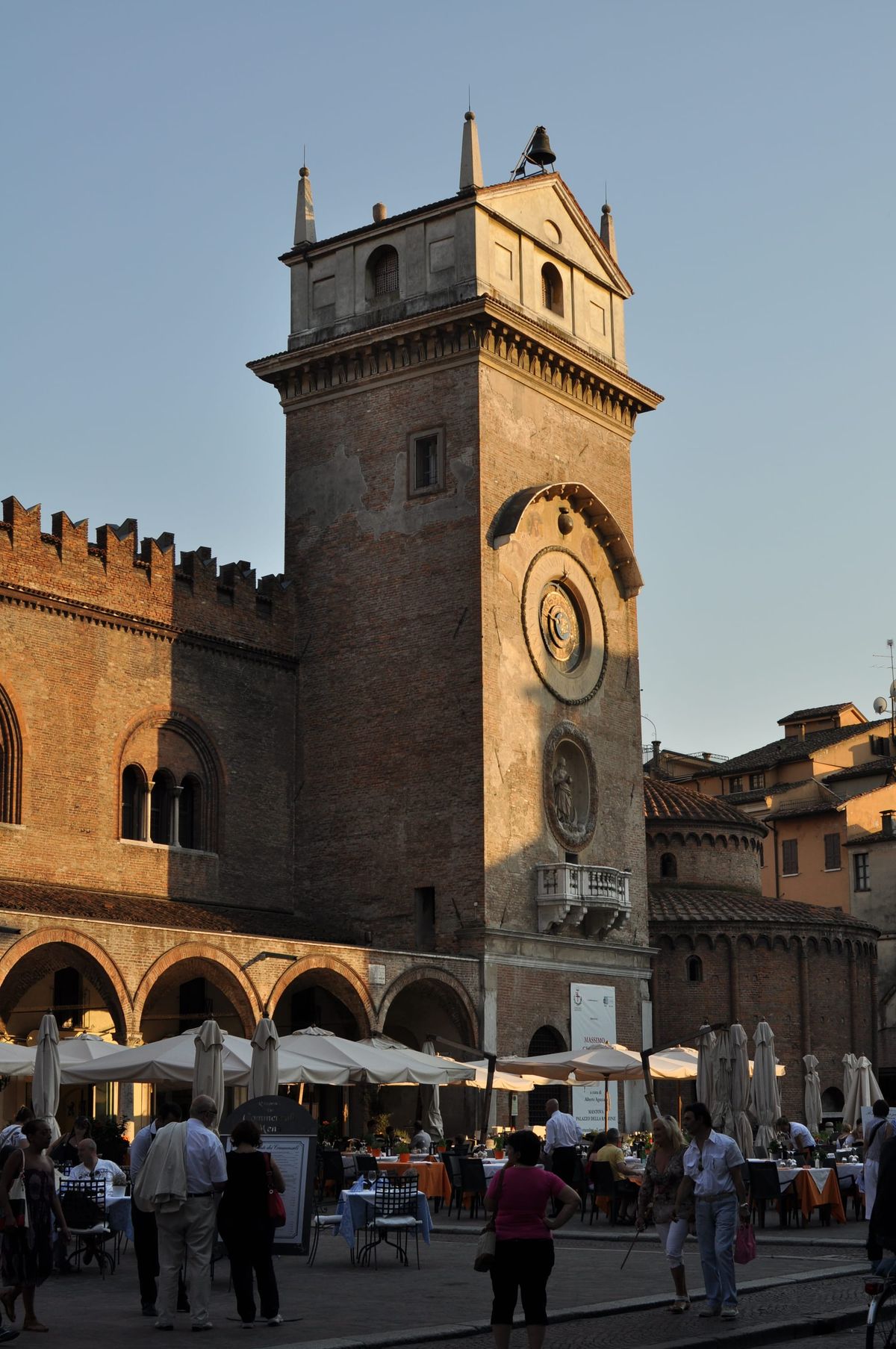
We had dinner in Piazza delle Erbe, under a tower.
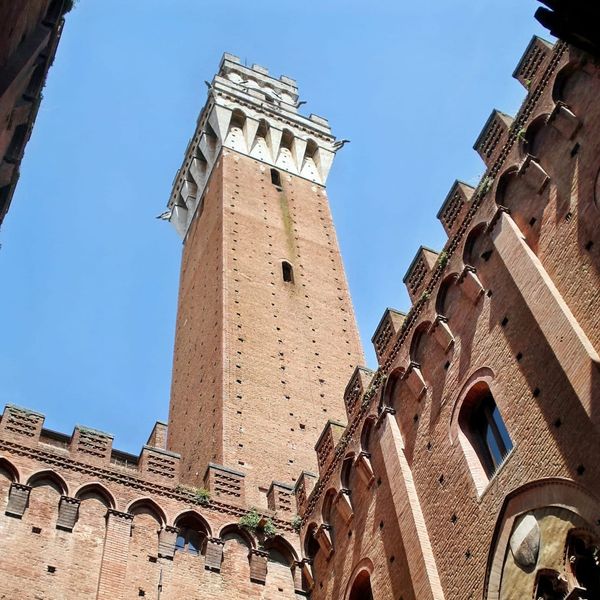
It took me years to work out what that tower was. It is the Torre dell'Orologio, and the clock is from 1473: a mechanism that gives you not only the hour but the phases of the moon, the signs of the zodiac, the rising and setting of the sun, the influence of the stars at any moment of the day. A machine built on the conviction that the order of the world exists, entire, and can be read off a dial. We sat underneath it eating and swatting mosquitoes, with no idea. I could not have told you what year it was without asking a camera. The tower above our heads had been keeping the date since 1473, along with the moon, the zodiac, and the position of every star over the Po valley.Piazza delle Erbe, 19:22. Above, the astronomical clock of 1473: the hours, the phases of the moon, the signs of the zodiac, the influence of the stars at any moment of the day. Below, everyone left in town.
We slept beautifully, in a bed and breakfast whose name I have long since forgotten. The next morning was Ferragosto proper, and the second shift had gone: no tables, no crowd, nobody. We walked through a city that had been handed back to its buildings, and then we went to Palazzo Te.
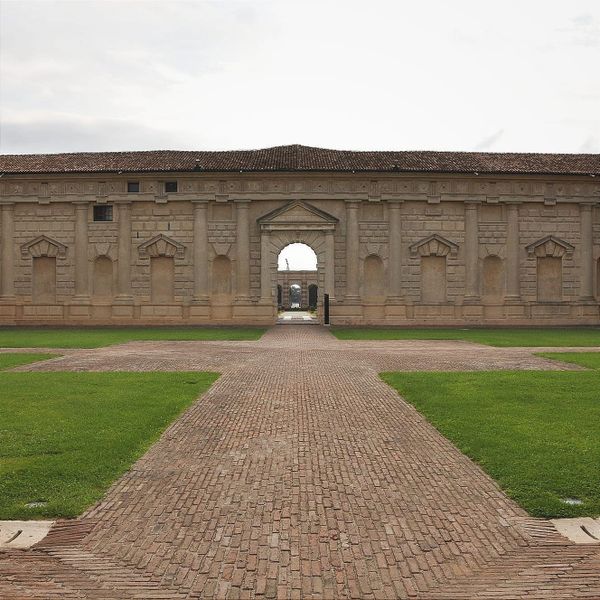
And in the Courtyard of Honour, above my head, a triglyph sliding out of the frieze like a voussoir working loose from an arch. The entablature is failing. It has been failing for five hundred years.
Fifty years separate those two things, and two kilometres of city. On one side, a machine that measures the order of the heavens with a precision that is almost frightening. On the other, a man who takes that same order and lets it fall — deliberately, and with a grace that makes you want to applaud. And what I carried out of that courtyard is that the second cannot exist without the first. Giulio could afford the lie only because he knew the truth better than anyone else in that city. It holds for architecture, and it holds for anything you might try to write.
There is something I have never said, and I will say it here.
I always thought that signing this blog "Giulio Romano" was a small imposture — that sooner or later I would have to go to Palazzo Te and settle up with the rightful owner of the name. Then I found out there was no rightful owner. His name was Pippi. Romano was stuck on him by the Mantuans, to mean the one from outside, from Rome. It was not a surname. It was a nickname given by provincials to a man who had arrived from the capital. He became himself only when somebody else named him from the outside.
So no, I am not borrowing anything from him. The name was no more his than it is mine. We both just found it on us.
That Ferragosto, we planted the flag. And it is the only reason I ever saw that triglyph.
Until soon,
Giulio Romano — The Slow Architect
P.S. This week's piece is Palazzo Te itself: the lie of the false-stone facade, the calculated collapse of the courtyard, and the story of a man who left Rome three years before Rome ended. You'll find it here.