Bomarzo Monster Park with Kids: A Day Trip from Rome, and the Afternoon in Viterbo
A wood full of stone giants, a crooked house you walk into, an hour and a half with no route to follow. Tickets, the family timetable, the pushchair question, and Viterbo in the afternoon.
Is the Monster Park worth visiting? The short answers
Is it worth it? Yes, and with children twice over: it is the place where they understand before you do.
How long? An hour and a half in the wood, two with children doubling back. Half a day with a picnic; a full day with Viterbo or Villa Lante.
Train or car? Car. The nearest station, Attigliano-Bomarzo, is five kilometres from the park, and the buses are few.
How much? €15 for adults, €9 for children from 4 to 13, nothing under 4; parking free. A family of four, €48.
What to combine it with? Viterbo, half an hour away, which is magnificent. Or Villa Lante at Bagnaia, the garden that is the exact opposite of this wood.
Don't miss: everything. It is not a town, it is a garden: you see the whole of it.
Skip: nothing, not even the route: at Bomarzo you get lost on purpose.
Avoid: midday in summer, and spring weekends in the middle of the day, when the queue in front of the Orcus flattens everything.
This is the practical guide. Who Vicino Orsini was, why the wood has no axis, and what is really written in the mouth of the Orcus, is in the essay: Bomarzo, the garden that doesn't explain itself. The leaning house, seen with a spirit level in hand, is in a letter.
The park's own name is Sacro Bosco, the Sacred Wood; everyone calls it the Parco dei Mostri, the Monster Park. Same gate.
What it is, in three lines
A sixteenth-century prince, Vicino Orsini, from 1547 had dozens of giant figures carved in the wood below his village, straight into the peperino boulders that lay there, where they lay: an ogre, an elephant, a dragon, a tortoise, a house built crooked. Then the wood was left abandoned for three centuries, until a family, the Bettini, bought it and put it in order in the middle of the twentieth century. Today it is private, you pay, and it is the only Renaissance garden where children run ahead.
Getting there
From Rome it is an hour and a half on the A1 motorway, exit at Orte, or at Attigliano, then a quarter of an hour of road following the signs for Bomarzo: the park is below the village, at Località Giardino, with a large free car park in front of the entrance. Anyone coming up the Via Cassia passes through Viterbo and arrives from the west, and that is the road to take if Viterbo is in the plan.
Without a car it is a day on a leash. The nearest station is Attigliano-Bomarzo, on the regional line to Florence, an hour from Rome: from there to the park it is five kilometres, too many on foot with children, so a taxi booked in advance. The other way is the train to Orte or Viterbo and the Cotral bus to Bomarzo, with few runs, to be checked the day before.
Tickets are sold at the gate or online, on the park's website, and on spring weekends buying ahead saves you the queue. The park opens every day except Christmas, at 8:30: it closes at 19:00 from April to August, and at sunset from September to March, so in winter at around five, or earlier. Anyone arriving on a winter afternoon has little time: the wood is for the morning.
The day, with a family
9:00 At opening, or just after. This is when the wood is yours: cool, empty, with the smell of the undergrowth, which is the first thing I remember. The children have fresh legs and the Orcus has no queue.
11:00 Out. Picnic in the shade in the area with the tables, or a sandwich at the bar, or the restaurant in the garden if you want to sit down.
12:30 In the car towards Viterbo, half an hour.
13:00 Park at Valle Faul and take the free lift up to the cathedral hill. The hill, then San Pellegrino on foot, an ice cream.
16:30 Leave, before the Sunday motorway fills up.
I did it the other way round, by motorbike and as a couple: Viterbo at ten, a sandwich on the go, and at two at the gate of Bomarzo, where in an hour and a half I saw everything, and then the bends of the Cimini hills again to go home. It was the long weekend at the end of April, with the heat of another month, and at that hour the wood was full. With children do it in the order above: the wood early, the town after.
The wood, freely
At the entrance they give you a map with a numbered route. Take it, and then don't follow it. At Bomarzo there is no right or wrong itinerary, and that is not a flaw: it is the design. Orsini neither levelled the ground nor laid out an axis, he left the boulders where nature had put them and carved into them. Whoever follows the numbers visits; whoever lets go finds, behind every bend, something that shouldn't be there, and comes closer to the man who thought this wood up.
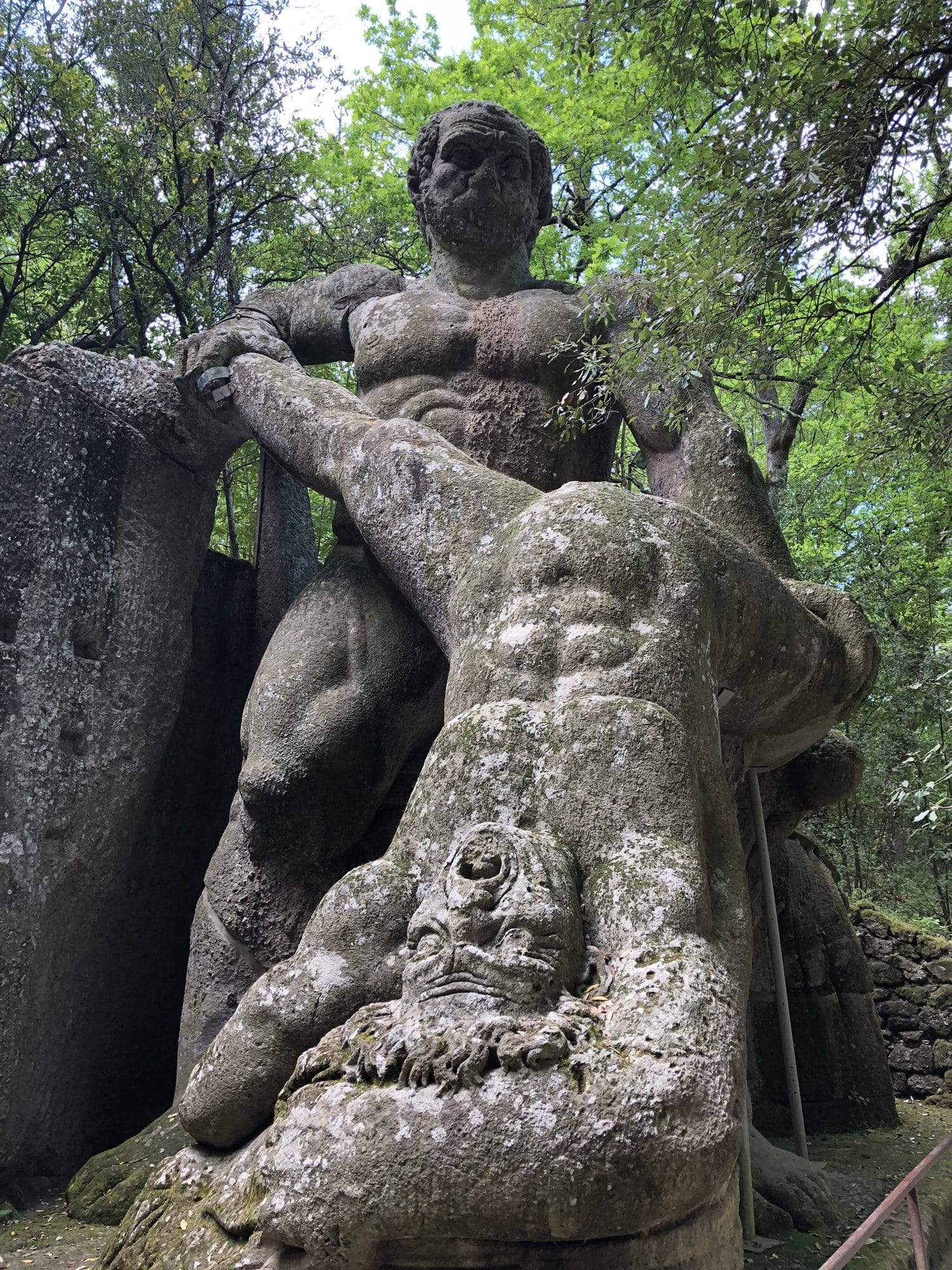
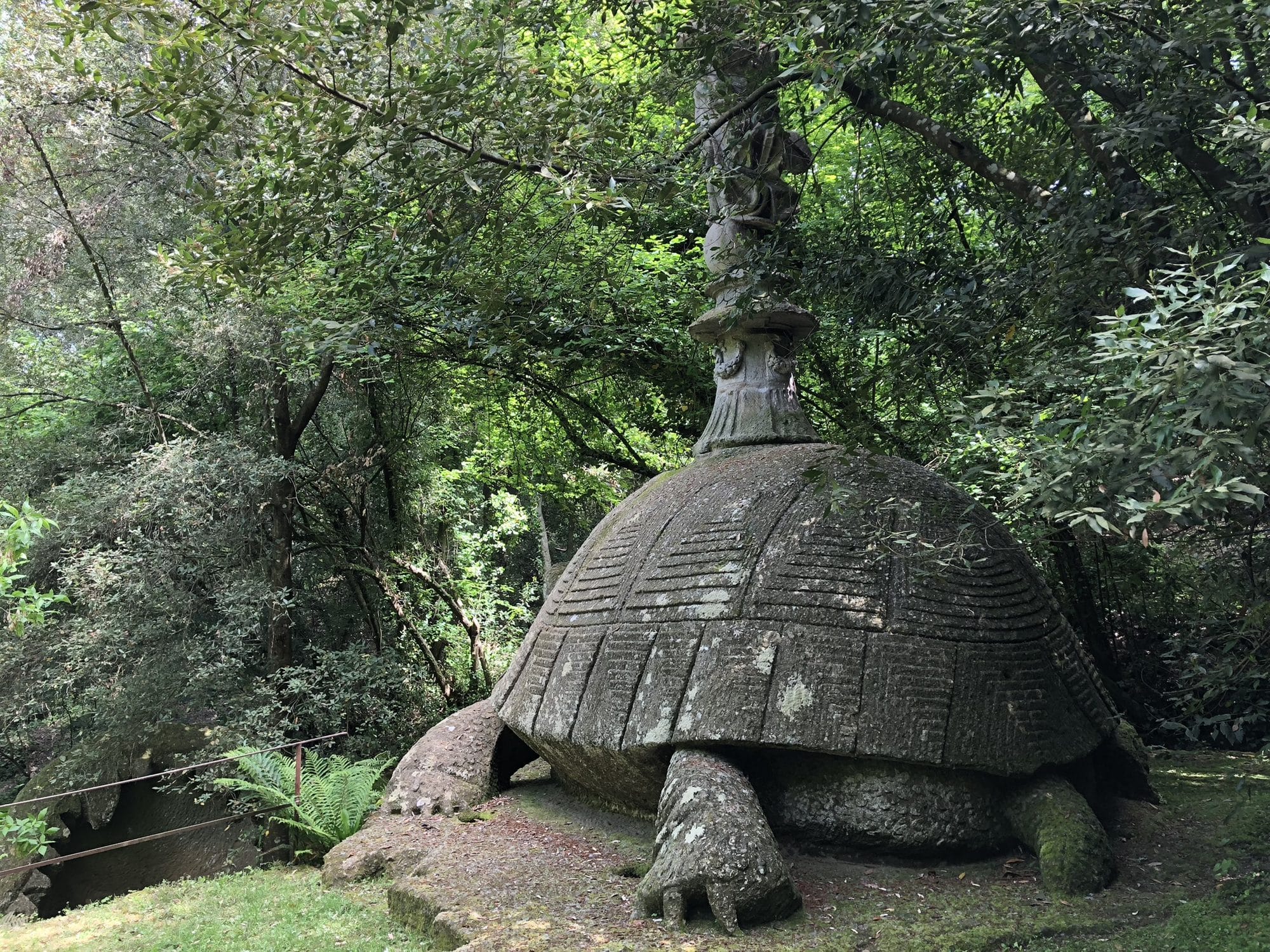
Hercules and Cacus, the largest group in the wood, and the tortoise with the winged figure on its shell: the boulders were already there, Orsini carved into them.
The figures, one by one
There are about twenty, scattered over a wooded slope. You won't find them in this order, and that is fine: this is so that you know what is in front of you when you get there.
The two sphinxes at the entrance, with inscriptions that warn you: whoever enters without wonder will understand nothing. It is the pact of the wood.
Proteus, or Glaucus, a head with an open mouth and on top a globe with the Orsini castle: the first giant, and the first the children point at.
Hercules and Cacus, the two colossi locked together, the largest group in the wood: one tears the other apart, and nobody explains who is in the right.
The tortoise, as big as a car, with a winged figure balanced on its shell, and next to it the whale with its jaws open.
Pegasus, the winged horse on a fountain.
The sleeping nymph, stretched out on a boulder, and the theatre, the only thing in the wood made for looking at something instead of being looked at.
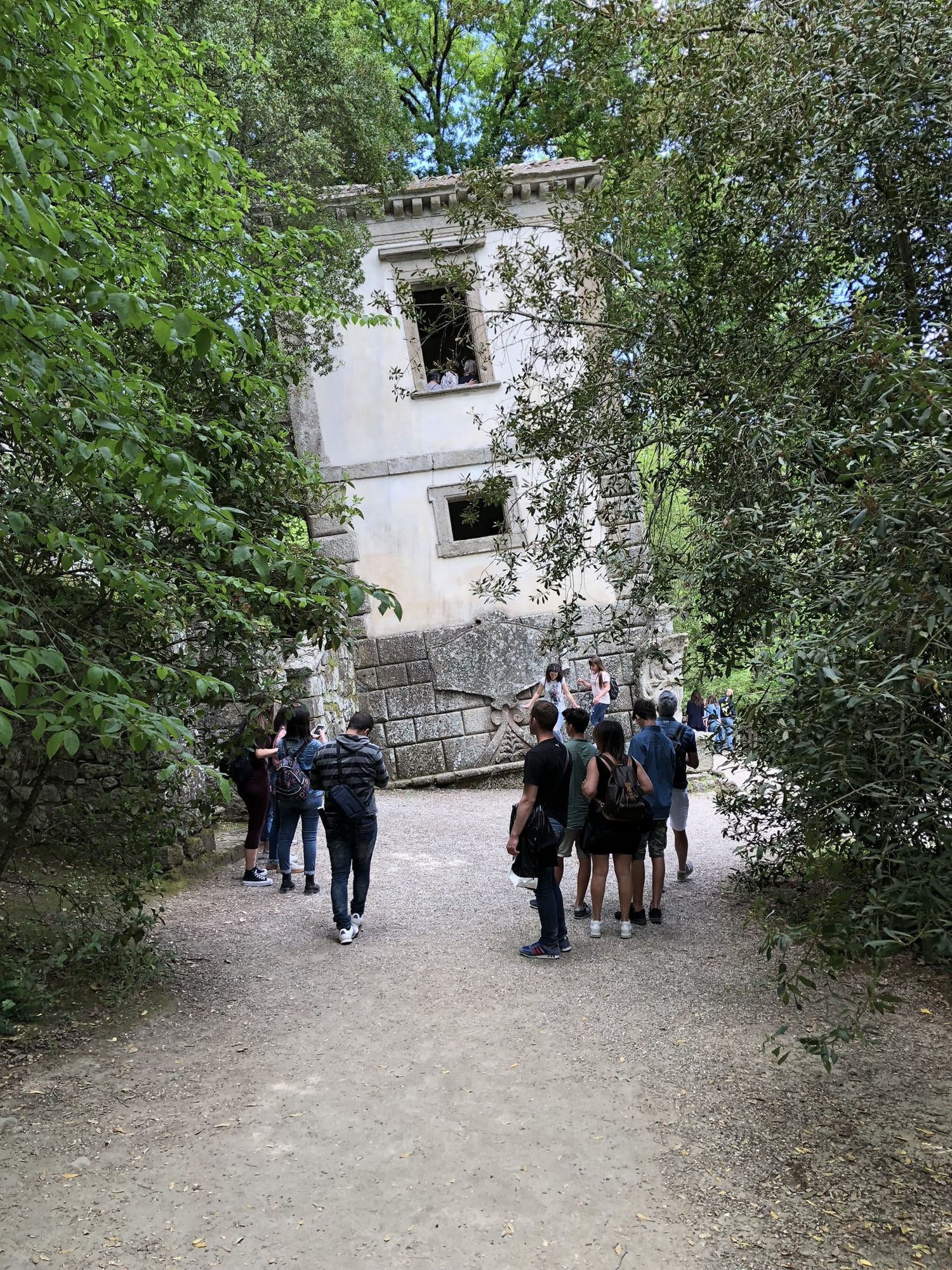
The leaning house, built crooked on a tilted rock and dedicated to Cardinal Madruzzo: tiny, and you see at once that it is not a house but a game, and yet inside the body protests before the head does, the floor pulls one way and the eyes the other. Go in with the children.
Neptune, reclining, and Ceres seated with a pot of plants on her head, the two placid figures of the wood.
The elephant with a tower on its back, gripping a Roman soldier in its trunk: Hannibal's elephant.
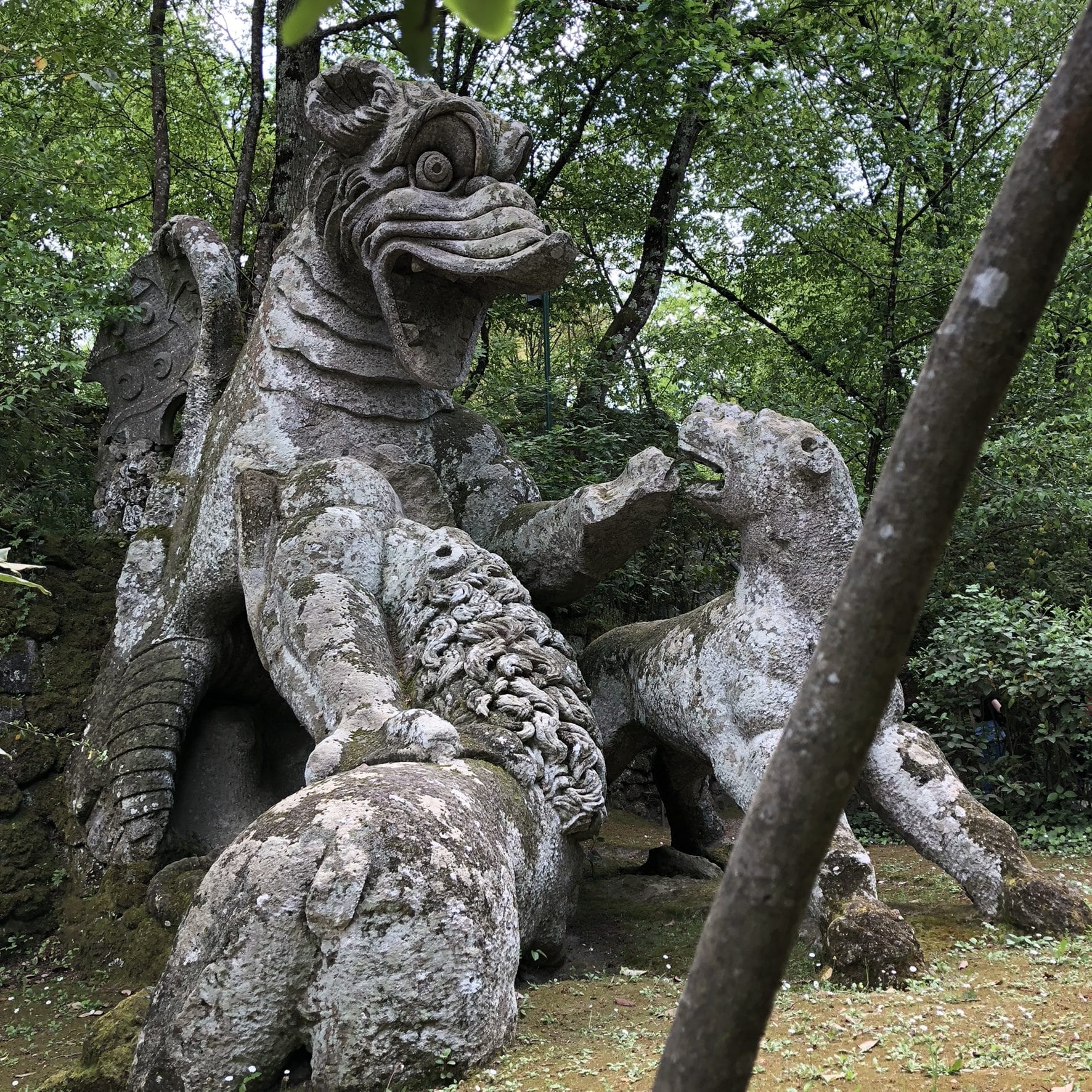
The dragon attacked by lions, covered in moss, in the greenest spot.
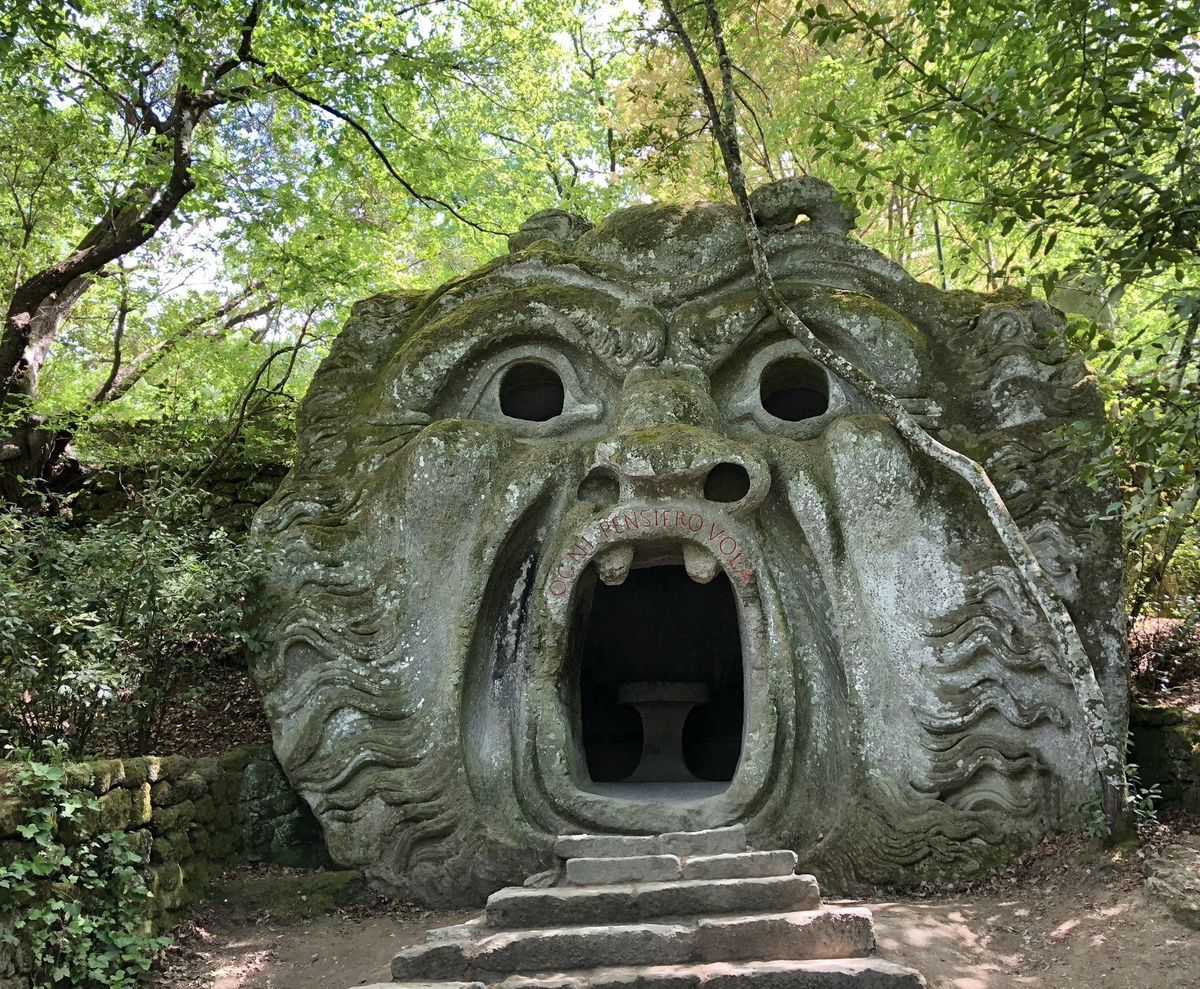
The Orcus, the giant head with the open mouth. On the lip is carved "Ogni pensiero vola", every thought flies away; inside there is a stone table, and the mouth is made so that whoever speaks softly inside is heard outside: the children discover it on their own.
The small temple, at the top, the only straight thing in the wood: Orsini wanted it in memory of his wife, Giulia Farnese, and today it holds the tombs of the Bettini, who saved the wood.
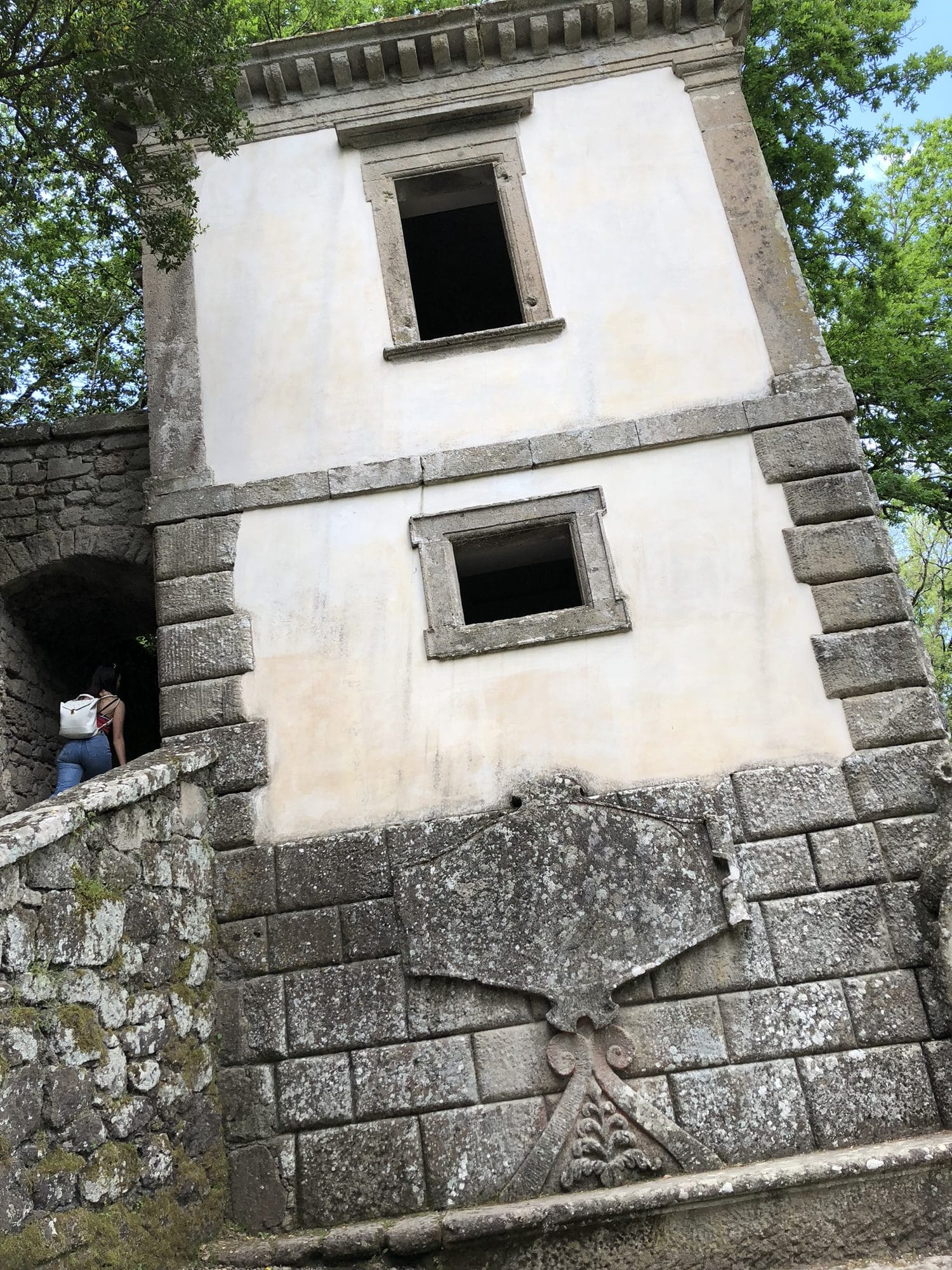
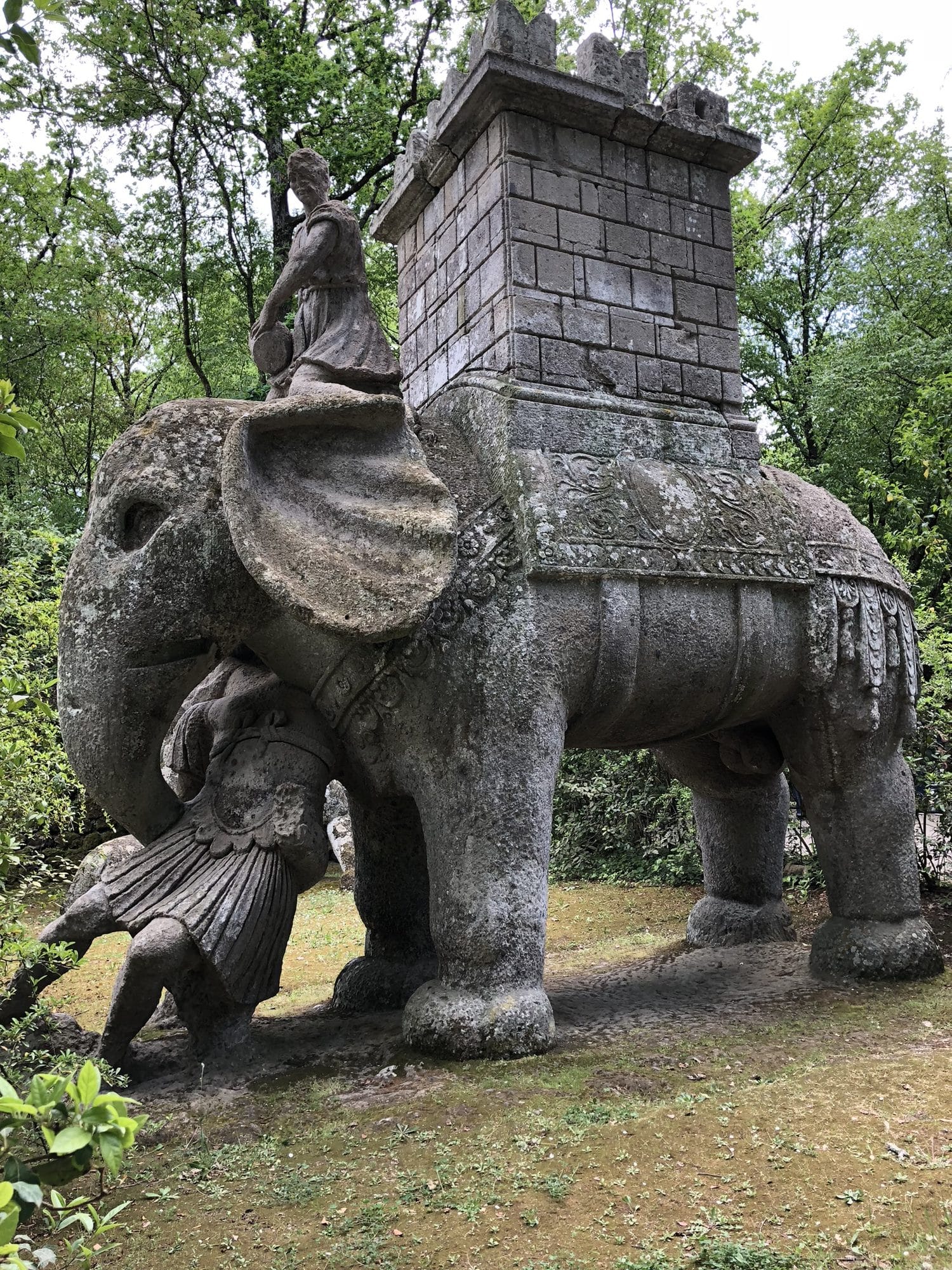
The house built crooked, which you walk into, and the elephant with the soldier in its trunk.
With children
Children are not frightened. The monsters of Bomarzo don't frighten the way horror does, they are strange, and children like strange: they go into the mouth of the Orcus before you do. I say this as an adult who went as a couple, and I write it for those who go as a family of four.
The ground is beaten earth, roots, slopes and stone steps: with a pushchair it is really difficult, not impossible, but I wouldn't bring one. A carrier or a backpack for the little ones, closed shoes for everyone, and let them run ahead: nothing breaks here. The statues are not for climbing, and that does matter. Photos are fine, without flash.
Inside the park there is a playground, a bar with sandwiches, a restaurant in the garden, the Locanda del Mostro, where at lunchtime you get in with the park ticket, and a picnic area in the shade with tables and benches, open to everyone: with children it is the honest solution, and it leaves the afternoon free. Dogs don't go in; at the entrance there are free kennels. The wood stays pleasantly cool even when it is hot outside: bring mosquito repellent to be safe, though I don't remember any.
When
Spring and autumn, for the wood. Summer works, but at midday the crowd flattens everything; winter has a rarefied air of its own, with the park closing at dusk. The hour matters more than the month: if you manage to get in when there are few people, at opening or on a weekday, you find yourself alone in front of a giant, and at that point you are inside it.
The traps
Midday at the weekend. A queue at the gate, a queue in front of the Orcus, and the wood becomes a line. At nine, or on a weekday.
The pushchair. See above.
Following the numbers. The map is for not losing the children, not for visiting.
Winter hours. From September to March the park closes at sunset, in winter at around five: with Viterbo in the plan, the wood first.
The Sunday drive home. Anyone going back by car takes the motorway, and on Sunday afternoons the A1 towards Rome fills up; the Braccianense is no better. Leave Viterbo by half past four, or give in and have dinner there.
The afternoon: Viterbo
Viterbo is half an hour away, and it is magnificent, and almost nobody puts it among the day trips from Rome: the city of the thirteenth-century popes, with one of the largest intact medieval quarters in Europe, and the cathedral hill on top. I saw it in passing, in one morning, and it was enough to make me want to go back.
Parking. At Valle Faul, below the hill, with the free lifts that take you up, a few steps from Piazza San Lorenzo: that is the solution with children. Or at the Sacrario, in Piazza Martiri d'Ungheria, large and always open, five minutes on foot from the centre. I was on a motorbike, and on a motorbike parking is never a problem: this advice I had to look up.
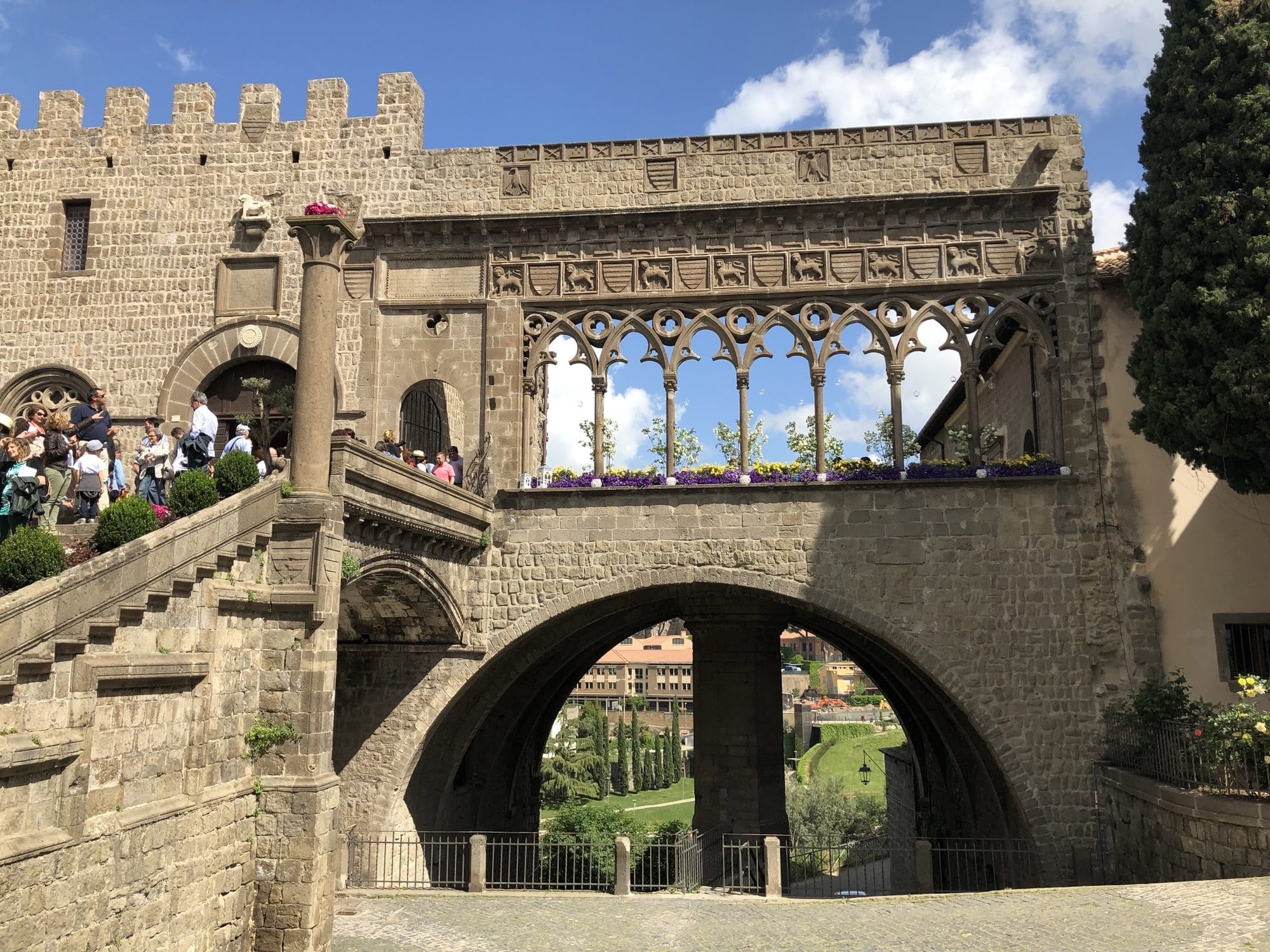
The hill. Two things, facing each other. The Palazzo dei Papi, finished around 1266, with the staircase of 1267 and the loggia of interlaced arches open onto the void: here the longest conclave in history was held, from 1268 to 1271, until the people of Viterbo locked the cardinals in and took the roof off; Gregory X came out of it. The loggia is seen from the staircase, free. Opposite, the cathedral of San Lorenzo: Romanesque inside, with the columns, the Cosmatesque floor and the trussed roof, and outside a sixteenth-century façade that carries at the top the name of the man who paid for it, Cardinal Gambara. The same man who at Bagnaia, five kilometres away, was having the garden of Villa Lante designed. If you go at the end of April, as I did, you find San Pellegrino in Fiore: the squares and the loggia covered in flowers, and the city full. It is the reason to choose that week, and also to arrive early.
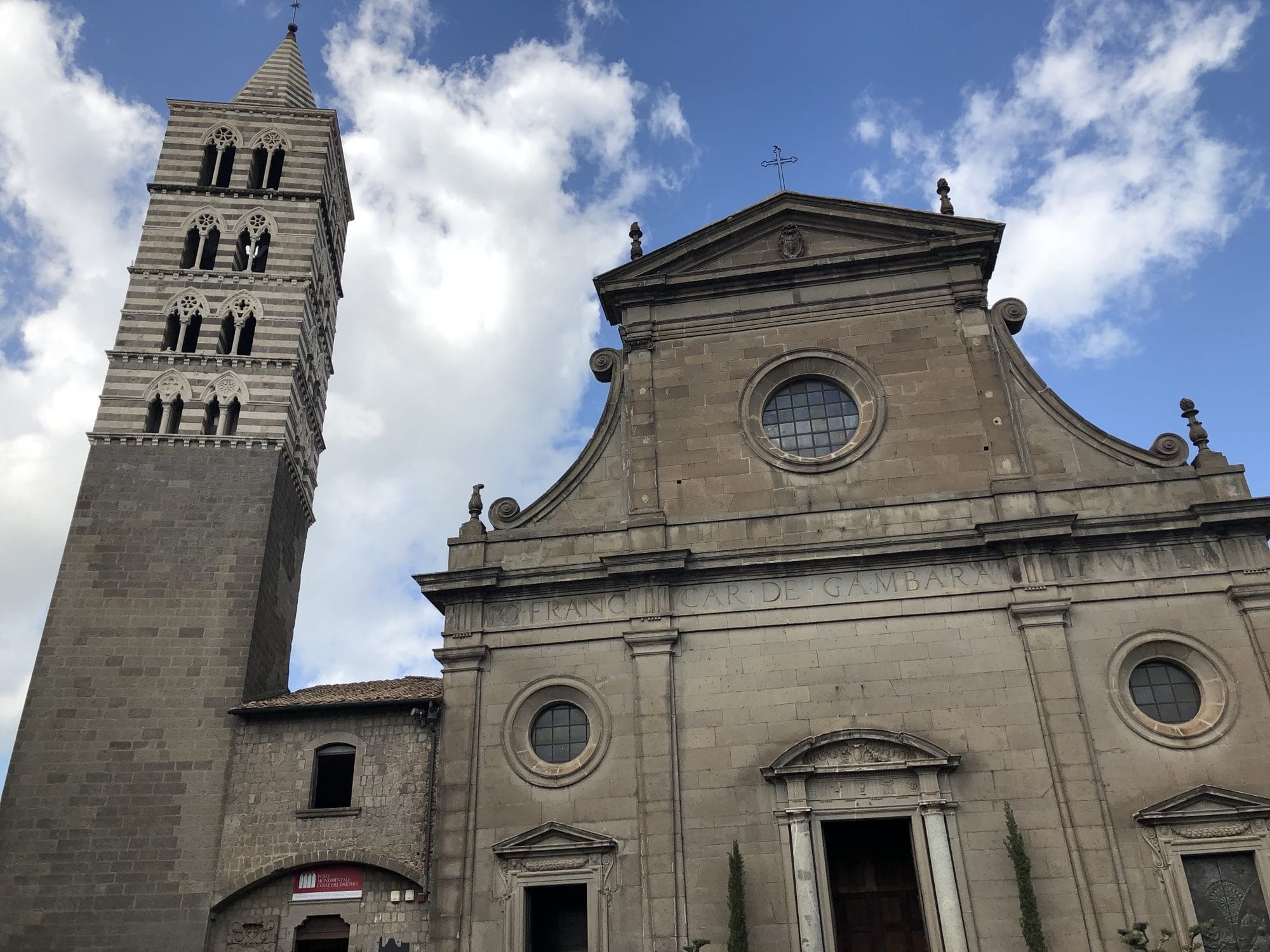
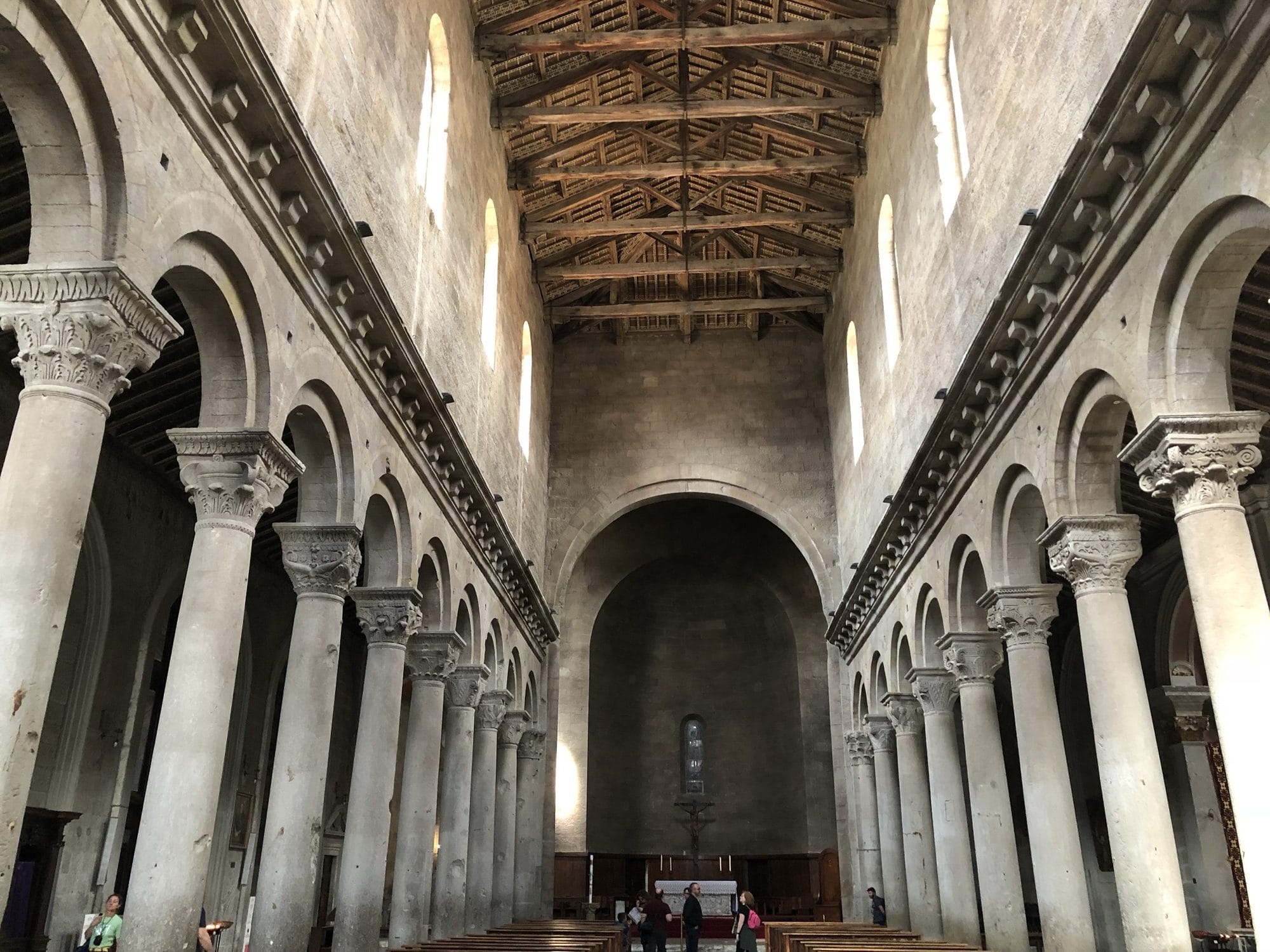
The cathedral of San Lorenzo, outside and in: the sixteenth-century façade with the striped bell tower, and the Romanesque nave with its roof of beams.
San Pellegrino. From the hill you go down into the medieval quarter: tower houses, outside staircases, the profferli, arches passing over the street, and no cars. Half an hour of walking without a goal, which is the right way, and then the Fontana Grande, the oldest of the city's fountains, towards Porta Romana. Viterbo deserves a guide of its own, and it will come; for this afternoon the hill, San Pellegrino and an ice cream in the square are enough. One day to avoid, or to choose on purpose: 3 September, when a hundred men carry the Macchina di Santa Rosa through the streets on their shoulders, an illuminated tower thirty metres high, and the city is impassable.
By car, the other roads
If you don't want the city, around Bomarzo there is a piece of the Tuscia I know by halves, and I say so: many beautiful things, not all of which I have seen.
Villa Lante, at Bagnaia, half an hour from Bomarzo and ten minutes from Viterbo. The Italian garden attributed to Vignola, begun in the late 1560s for Cardinal Gambara: the square of box hedges, the water chain, the two twin pavilions, the stone table with the channel for keeping the wine cool. It is the exact opposite of Bomarzo, order against disorder, the same century and the same province, and with the two in one day you understand the sixteenth century better than from a book. Open Tuesday to Sunday, €8, hours that change with the seasons. It is the best pairing there is, and I haven't done it yet.
Vitorchiano, ten kilometres from Viterbo: the village suspended on its peperino cliff, with thirteenth-century walls and, on a belvedere, a moai six metres high carved in 1990 by eleven craftsmen from Easter Island. Very beautiful, and for the children a second giant.
Orte, twenty minutes away, on its cliff above the Tiber: worth it, even if I have no photos.
Sant'Angelo di Roccalvecce, twenty minutes away: the "village of fairy tales", with the tales painted on the walls since the end of 2016. I haven't been, and it intrigues me: with children, after the monsters, it has a logic.
Castello Ruspoli, at Vignanello, half an hour away: the box garden of eight green rooms, laid out at the beginning of the seventeenth century by Ottavia Orsini, who was Vicino's daughter. The father made the wood without an axis, the daughter the most orderly garden in the Tuscia. Visited with guides, at weekends, by booking.
With two days. My long weekend, the one at the end of April, was this: the first day Lake Bracciano with Anguillara, then Nepi and Caprarola; the night at San Martino al Cimino, which is tiny but pretty, a square with the church; the second day Viterbo and Bomarzo, and home. I did it by motorbike, with the bends of the Cimini in between, and by motorbike it is another thing: you arrive early, you park anywhere, you are inside the road. With a family you do it by car, in the same order, with the wood on the morning of the second day: the night in between is there precisely so that you don't rush. The Caprarola guide is here: Villa Farnese at Caprarola, a day trip from Rome that starts at the bottom of the hill.